


 SIGN UP
You've found a Honda CR-V advertised at an attractive price, the photographs look clean, and the seller says it's foreign-used with low mileage. Then the important questions start. Is it eligible for importation? Do the chassis number and paperwork match? Will the transmission behave in Nairobi traffic, and what will the car cost after taxes, inspection, registration and its first proper service?
A used Honda CR-V for sale in Kenya can be a sensible family SUV, but the badge and asking price aren't enough. The right purchase depends on age eligibility, import history, mechanical condition, engine choice and the cost of keeping it on Kenyan roads.
Why the Honda CR-V Still Leads the Used SUV Market in Kenya
A lot of Nairobi buyers start with the asking price, then realise later that a used SUV has to work in traffic, on rougher roads, with family, luggage and the odd upcountry trip. That is where the CR-V keeps winning. It gives you the higher seating position many buyers want, proper cabin space, and everyday usability without stepping into a bulkier SUV that costs more to buy and keep.
It also sits in the part of the market that matters in Kenya. The Kenya Revenue Authority's vehicle import information says approximately 70,000 to 80,000 motor vehicles enter the country annually, including new and used units, and about 80% are used vehicles. So if you are shopping for an imported CR-V, you are looking at the same supply channel that serves a large share of Kenyan buyers.
Body style matters too. Analysts in the Kenya used-car market analysis identify SUVs and MPVs as the fastest-growing used-car body-type segment in Kenya, with projected compound annual growth of 4.44% through 2031. The same analysis says hatchbacks still held 42.36% of the market in 2025, which tells you something practical. Buyers are not abandoning smaller cars. They are choosing SUVs like the CR-V when they want more space, better clearance and a more relaxed driving position, and they accept the higher running costs that come with that choice.
The age bracket that matters
The import rule cuts through a lot of listing noise.
Vehicles aged five to eight years accounted for 50.73% of Kenya's used-car market in 2025, according to Kenya used-car market analysis. That helps explain why so many buyers end up looking at CR-Vs in that band. You get newer safety and comfort features than you would in older stock, but you stay away from nearly-new pricing.
The catch is simple. Many buyers focus on model year and forget import eligibility. A foreign-used CR-V generally needs to fall within Kenya's eight-year import rule, counted from the manufacture year or first registration date. KRA guidance makes that age limit a first filter. Check it before you commit money, not after the seller starts talking about shipping and clearance.
That is one reason the CR-V stays strong in this market. It fits how Kenyans buy used SUVs, but only when the age, paperwork and total ownership picture make sense.
Honda CR-V Engine Options and Real-World Kenyan Running Costs
A CR-V can look affordable on the listing, then punish you after purchase if you choose the wrong engine for how you drive in Kenya. For most buyers here, the decision is not just power. It is fuel use in Nairobi traffic, service history, and whether the car you are considering has been maintained well enough to keep future bills under control.
The two engine families most relevant to Kenyan buyers carry different trade-offs. The 1.5-litre turbo usually gives better fuel economy in both town and highway use, while the 2.4-litre naturally aspirated petrol engine appeals to buyers who prefer a simpler, more familiar petrol setup.
Kenyan review figures place the 1.5-litre turbo at about 10 to 12 km/L in city driving and 14 to 16 km/L on highways, while the 2.4-litre version is estimated at 9 to 11 km/L in the city and 13 to 15 km/L on highways, according to this Honda CR-V Kenya review. Actual consumption still depends on traffic, tyre condition, load, air-conditioning use, throttle habits and the state of tune.
| Engine type | City fuel economy | Highway fuel economy | Best suited for |
|---|---|---|---|
| 1.5-litre turbo petrol | 10 to 12 km/L | 14 to 16 km/L | Nairobi commuters and drivers covering regular long-distance routes |
| 2.4-litre naturally aspirated petrol | 9 to 11 km/L | 13 to 15 km/L | Buyers prioritising a larger non-turbo engine and straightforward response |
The turbo saves fuel. The condition decides the bill
For a buyer who spends weekdays in stop-start traffic, the turbo often makes more sense on paper. It gives back some savings at the pump without forcing you out of the CR-V class. On long runs, it can also be the better companion if the cooling system, transmission and service record are in order.
That last part matters more than the brochure.
A turbo CR-V with poor maintenance history can wipe out its fuel advantage very quickly. Delayed oil changes, weak cooling-system care, cheap replacement parts and missed gearbox servicing are the problems that turn a smart buy into a workshop car. I would rather back a clean, well-kept 2.4 than a cheaper turbo with gaps in its history.
The 2.4-litre uses more fuel, but it is not automatically the wrong choice. If you find one with a clear service trail, stable idle, smooth gearbox behaviour and no suspension knocks, it can be the easier car to own over time. Buyers who do mixed town driving, upcountry trips and rougher road use often end up caring more about known condition than the extra litre per hundred kilometres.
Budget for the first service before you negotiate
Kenyan maintenance estimates commonly place a basic oil-and-filter service at roughly KSh8,000 to KSh28,000, transmission-fluid service at KSh12,000 to KSh45,000, and suspension work at KSh25,000 to KSh180,000, depending on parts quality, workshop choice and the car's starting condition.
Set aside money for a proper baseline service the moment you buy. Check transmission-fluid history, turbo response where fitted, coolant condition, suspension noise and scan results before you let a lower asking price sway you.
If you are comparing petrol SUVs against electrified alternatives, this guide to hybrid cars for sale in Kenya gives useful local context. For a conventional CR-V, the practical question remains the same. Does the car's documented condition justify its fuel use and likely repair profile?
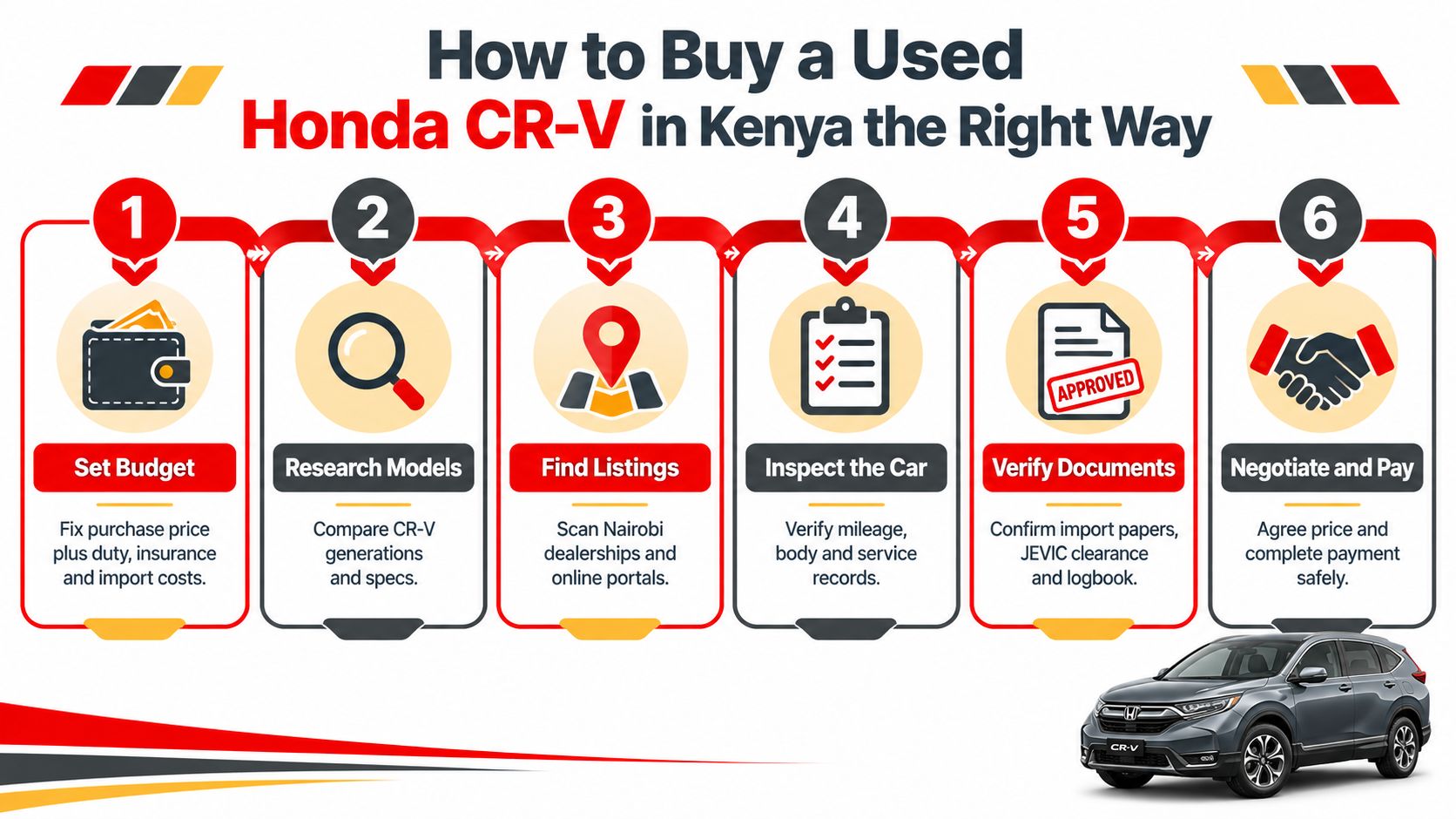
How to Buy a Used Honda CR-V in Kenya the Right Way
Start with a budget that includes more than the seller's figure. Allow for insurance, inspection, transfer or registration requirements, an initial service and repairs revealed during the viewing. If the car is still being imported, add customs and clearance costs rather than treating the advertised vehicle price as the final amount.
Follow the paperwork before the test drive
First establish whether the CR-V is locally used or foreign-used. A locally registered vehicle should have a consistent Kenyan ownership and service trail. An imported vehicle should have supporting import documentation, inspection evidence and a clear explanation of its first registration and arrival history.
Kenya's import rules are strict enough to reject casual assumptions. KEBS requirements for imported used road vehicles state that imported used vehicles must be right-hand drive, meet Euro IV emissions requirements, and generally have less than a one-year difference between manufacture and registration dates. Converted steering-side vehicles aren't permitted for importation.
Ask to see the foreign logbook, export or deregistration documentation, pre-shipment inspection evidence and local registration records where applicable. Check that the vehicle identification number or chassis number is consistent across the car and documents. Don't rely on a dashboard odometer or a verbal explanation when the paperwork tells a different story.
Use the eight-year rule as an early filter
KRA applies an eight-year age limit to imported used vehicles. A CR-V advertised as a Japanese import should therefore be screened using its manufacture year and first-registration date, not just the year displayed in a sales advert.
That matters particularly from 1 January 2026, when imported used vehicles are expected to meet the eight-year requirement, generally making 2019-or-newer vehicles the relevant import-age benchmark at that point. Confirm the current position with KRA and KEBS before committing funds, especially where manufacture and registration dates are close together.
View the car with a process, not excitement
Before travelling to see the vehicle, request clear photographs of the chassis or vehicle identification number, engine bay, tyres, interior and any repair areas. At the viewing, inspect the body in daylight, start the engine from cold if possible, check the air-conditioning and electronics, and drive on both smooth and uneven roads.
A rushed viewing creates room for expensive surprises. A properly organised viewing gives you evidence you can compare against the documents and the seller's description.
Used Honda CR-V Price Bands and Total Landed Cost Reality in Kenya
A CR-V can look affordable on a listing, then turn expensive the moment you ask who is paying duty, clearing, inspection, registration and insurance. In Kenya, the asking price only tells you part of the story.
The first distinction is simple. Some units are already locally registered, so many import-related costs have already been absorbed into the sale price. Others are still in the import pipeline or advertised before full landing, which is where buyers get caught by a low headline figure that does not reflect the amount needed to put the car on the road. That gap matters even more with the eight-year import rule, because the pool of CR-Vs that can legally come in is narrower than many adverts suggest.
General price guidance
Use price bands as a rough filter, not as proof of value. Year, engine, mileage, trim, accident history, service records and overall condition can shift a CR-V far above or below the bracket it appears to fit.
| General guide | Typical model profile | Indicative price range |
|---|---|---|
| Budget | Older examples with higher mileage and greater condition risk | KSh800,000 to KSh1,200,000 |
| Mid-range | Mid-generation vehicles with a more balanced condition and specification | KSh1,300,000 to KSh1,900,000 |
| Premium | More recent examples with lower mileage and stronger service records | KSh2,000,000 to KSh2,800,000 |
A cheap CR-V is not automatically a good buy. I have seen buyers save money on the sticker price, then spend the difference on gearbox work, cooling-system repairs, tyres, or documentation gaps they should have spotted earlier. A better-kept unit in the next band can be the cheaper car to own. For a market snapshot, check current Honda pricing guidance in Kenya, then compare that with the exact vehicle in front of you.
Understand the tax layers
If you are importing or buying a unit that has not been fully landed, build the budget from the tax structure upward. According to KEBS inspection code and related import guidance, import duty is 25% of customs value. Excise duty is 20% of customs value plus import duty for vehicles of 1,500cc and below, and 25% for vehicles above 1,500cc. VAT is 16% of customs value plus import duty and excise duty. The same guidance also lists the Import Declaration Fee at 3.5% of CIF value and the Railway Development Levy at 2% of CIF value.
Engine choice changes the math here. Many CR-V variants commonly seen in Kenya sit above 1,500cc, so a buyer who budgets using the lower excise band can be wrong before the car even leaves the port. Customs valuation also affects the final figure, and so do inspection charges, clearing fees, port costs, registration and insurance.
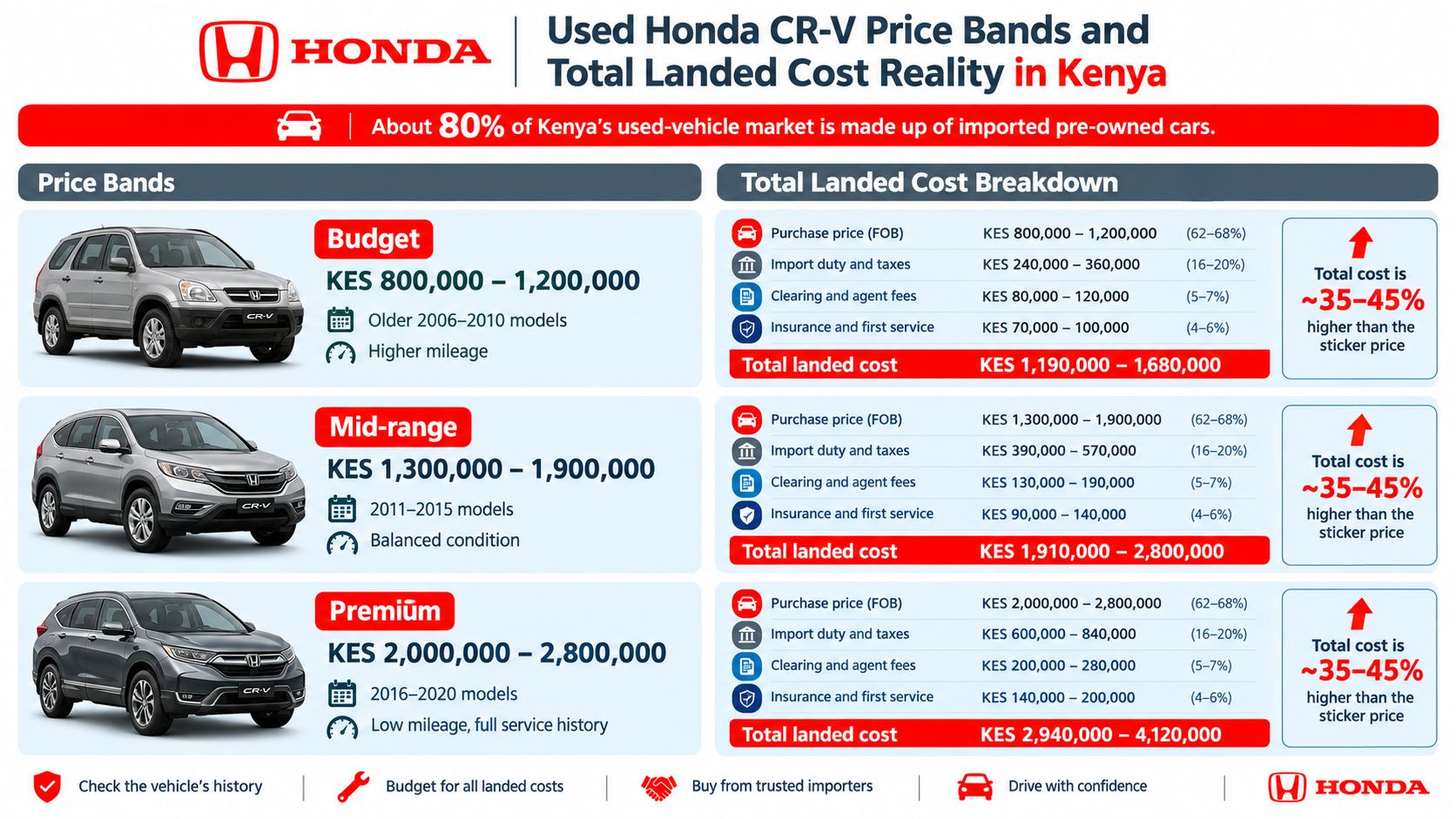
Locally registered units are usually easier to price because most of those layers have already been paid and folded into the deal. Imported units need a written landed-cost breakdown before you treat the asking price as meaningful. If a seller cannot show that breakdown clearly, assume the car will cost more than the advert suggests.
Used Honda CR-V Buyer Checklist and Where to View Stock in Nairobi
You are standing beside a clean-looking CR-V in Nairobi, the paint shines, the cabin smells fine, and the seller wants a quick commitment. That is the point where buyers get trapped. A proper viewing needs proof on the car, proof in the paperwork, and enough time to see where the asking price stops and the true cost starts.
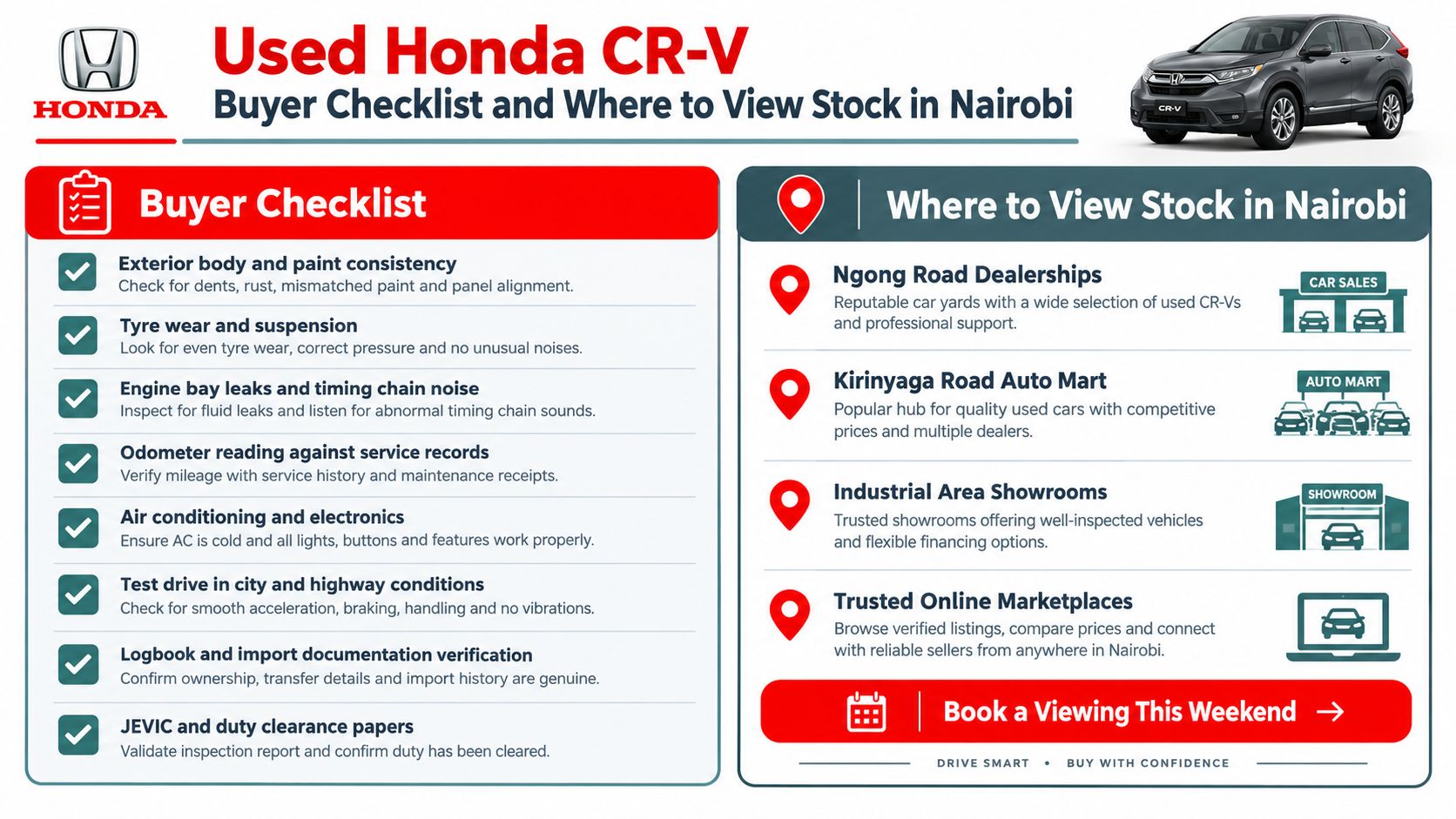
Inspect the CR-V in one complete pass
Walk around the car once, then inspect it again with the documents open. Buyers who separate the physical check from the paperwork miss too much.
Use this checklist during the viewing:
- Body and paint: Check for colour mismatch, uneven panel gaps, overspray, ripples and signs of previous repair. A neat exterior can still hide a hard knock underneath.
- Odometer and records: Match the mileage against service invoices, inspection papers, interior wear and any import history. A low reading alone proves nothing.
- Engine and turbo: Start it cold if you can. Listen for abnormal noise, check for leaks and smoke, and watch for warning lights. On 1.5-litre units, confirm the turbo responds cleanly.
- Cooling system: Check coolant condition and level, inspect hoses and the radiator area, and watch the temperature gauge during the drive. Nairobi traffic quickly exposes weak cooling systems.
- Transmission: Drive the car long enough for the CVT or automatic to warm up. Watch for shuddering, delayed engagement, flaring revs, hesitation and unusual noise.
- Suspension and steering: Use rough sections of road and speed bumps. Listen for knocks, check steering response, and look at tyre wear for signs of alignment or suspension trouble.
- Underbody and corrosion: Get underneath if possible. Look for rust, impact marks, fresh undercoat hiding repairs, and fluid leaks.
- Flood and accident history: Check for damp smells, rusty electrical points, replaced carpets, inconsistent welds and warning lights that stay on. A diagnostic scan helps confirm what the dashboard does not show.
- Cabin systems: Test the air-conditioning, windows, locks, infotainment, lights, camera and every warning indicator.
- Test drive: Use slow traffic and an open stretch if possible. Check braking, straight-line stability, acceleration, gearbox behaviour and engine temperature.
- Documents and identification: Match the chassis or vehicle identification number to the foreign logbook, export or deregistration papers, inspection records and Kenyan registration documents.
- Roadworthiness evidence: Imported units must clear inspection before registration. KEBS roadworthiness and import-document guidance sets out the inspection requirement and the role of validated import documents where a certificate of roadworthiness is not available.
Decide what the price is really buying
A CR-V asking price only tells part of the story. Year, engine, mileage, drivetrain, service history and condition all matter, but the key question is what you must spend after purchase to make the car dependable. Budget for overdue service, tyres, suspension work, transmission fluid, cooling-system attention and any paperwork problem that could delay transfer or registration.
That trade-off matters more in Kenya because many listings show the sticker price and leave out the hidden layers. Some cars are cheap because the next owner will pay for neglected maintenance. Others look expensive until you realise the seller already sorted the expensive jobs.
If the car is already registered locally, confirm logbook details and ownership before you negotiate. If it is foreign-used, confirm it is legally eligible to import under the current age rule and make sure the import records line up before you hand over a deposit.
Browse current used Honda stock at Brill Motors, then arrange showroom viewing at Garden City Mall Rooftop Car Yard, Thika Road, Nairobi. Use the visit to inspect the vehicle properly, review its paperwork, and discuss financing, valuation, trade-ins or selling your current car if those details apply to your deal.