


 SIGN UP
The most popular advice about hybrid cars for sale in Kenya is also the least useful: buy a hybrid and your fuel costs will automatically fall. In Nairobi, the result depends on your mileage, traffic pattern, purchase premium, import taxes, battery condition and how long you'll keep the car. A hybrid can be an excellent commuter, but it can also be an expensive purchase for a driver who covers few kilometres or buys a tired battery without proper checks.
Kenya's policy framework treats hybrids as part of the move towards cleaner transport. The national energy-efficiency strategy set a target for electric and hybrid vehicles to represent 5% of annual vehicle imports by 2025, but that figure isn't a measured share of all vehicles on Kenyan roads or a guarantee of availability for a particular model. The policy reference is useful context, but your decision still needs to rest on the specific car in front of you.
The Reality of Hybrid Fuel Savings in Nairobi
A hybrid can save fuel in Nairobi, but the badge alone does not make it a cheaper car to own. The result depends on traffic, annual mileage, purchase premium, import costs, battery condition and resale prospects. Stop-start driving allows the electric motor to assist at low speed and recover energy during braking, yet the same car can consume noticeably more when the petrol engine carries the load for long periods.
Traffic, air-conditioning, road surface, tyre pressure, passenger load and battery condition all affect consumption. A rating from a controlled overseas test is only a reference point. On Thika Road, a long queue with the air-conditioning running can produce a very different fill-to-fill result from the advertised figure. Rough roads that demand repeated acceleration and fast highway driving can also reduce the benefit.
The driver matters more than the badge
Begin with annual distance and driving pattern. A low-mileage driver may recover the hybrid's higher purchase price slowly, especially after import taxes and any battery-related repair. A commuter who spends many hours in congested Nairobi traffic has a stronger case because the system gets frequent opportunities to assist at low speed and during braking.
Calculate the full ownership cost:
- Purchase premium: Compare the hybrid with a similar petrol model, including its landed and registered cost.
- Fuel use: Measure realistic consumption on your routes, with traffic and air-conditioning included.
- Maintenance: Allow for tyres, fluids, suspension work and hybrid-system diagnostics.
- Battery contingency: Keep funds available for a fault even if an initial scan appears healthy.
- Resale exposure: Unclear battery history, inconsistent mileage or weak documentation can reduce buyer confidence later.
A hybrid is a financial decision, not a fuel-saving slogan. Work out the expected cost over the period you plan to keep the car, then test whether the fuel saving covers the purchase premium and battery risk.
Kenya's used-car market relies heavily on imports. A mobility assessment reports that imported vehicles are generally used light-duty vehicles, often averaging about seven years old, while Kenya applies an eight-year maximum age restriction to imported used vehicles. The mobility assessment explains this import context For a hybrid buyer, age, source market, inspection status and battery history can matter as much as the model name. A clean battery-health report and consistent import records also support resale when you eventually sell.
Popular Hybrid Models and Market Price Ranges
Kenyan buyers usually choose between compact hatchbacks, saloons, wagons and compact SUVs. Body style affects ownership cost as much as fuel economy. A hatchback is easier to park and can suit daily Nairobi commuting, while a wagon provides more luggage space without the size and running costs of a larger SUV.
The table provides general guide ranges, not live quotations. Fuel economy is an indicative planning range. Nairobi traffic, road conditions, air-conditioning, driving habits and battery condition can reduce consumption from the quoted figures. A cheaper model can also become more expensive to own if its battery history is unclear or its resale records are incomplete.
Common Hybrid Models in Kenya
| Model | Engine Size | Estimated Fuel Economy | General Price Range (KSh) |
|---|---|---|---|
| Toyota Aqua | 1,500 cc | About 20 to 25 km/l in suitable mixed use | KSh 1.2 million to KSh 1.8 million |
| Toyota Prius | 1,800 cc | About 18 to 24 km/l in suitable mixed use | KSh 1.5 million to KSh 2.5 million |
| Toyota Axio Hybrid | 1,500 cc | About 18 to 24 km/l in suitable mixed use | KSh 1.4 million to KSh 2 million |
| Toyota Fielder Hybrid | 1,500 cc | About 18 to 24 km/l in suitable mixed use | KSh 1.5 million to KSh 2 million |
| Honda Vezel Hybrid | 1,500 cc | About 16 to 21 km/l in suitable mixed use | KSh 1.8 million to KSh 2.5 million |
| Toyota Corolla Cross Hybrid | 1,800 cc | About 17 to 23 km/l in suitable mixed use | KSh 3 million to KSh 4.5 million |
Year, trim, mileage, import history, condition and tax treatment can materially change the final price. Treat these figures as a starting point, then confirm current stock and pricing through the Brill Motors current vehicle catalogue. Ask for a battery-health report before comparing two vehicles with similar advertised prices. The car with the stronger report and clearer history may carry lower resale risk.
Match the body style to your routes
The Toyota Aqua is a compact city hatchback suited to easy parking and modest running costs. Its cabin and luggage area may be limiting for a large family. The Toyota Prius offers a roomier hybrid layout, but its battery condition and underbody history deserve close inspection before purchase.
The Toyota Axio Hybrid fits buyers who prefer a saloon. The Toyota Fielder Hybrid adds a practical wagon body and can carry more luggage without requiring an SUV. Similar-looking petrol versions are also available, so confirm the propulsion system using the logbook, engine bay, chassis details and a diagnostic scan. Brill Motors discusses the wagon layout in its guide to the Toyota Fielder Hybrid.
A Honda Vezel Hybrid provides SUV styling and a raised driving position. Check its transmission history and confirm that the hybrid system operates correctly. The Toyota Corolla Cross Hybrid offers newer SUV packaging, but its higher entry price requires sufficient use or a longer ownership period to justify the premium.
Choose the model that fits your routes, load requirements and battery-risk tolerance, not the one with the most attractive fuel-economy figure.
Calculating Total Ownership and Import Costs
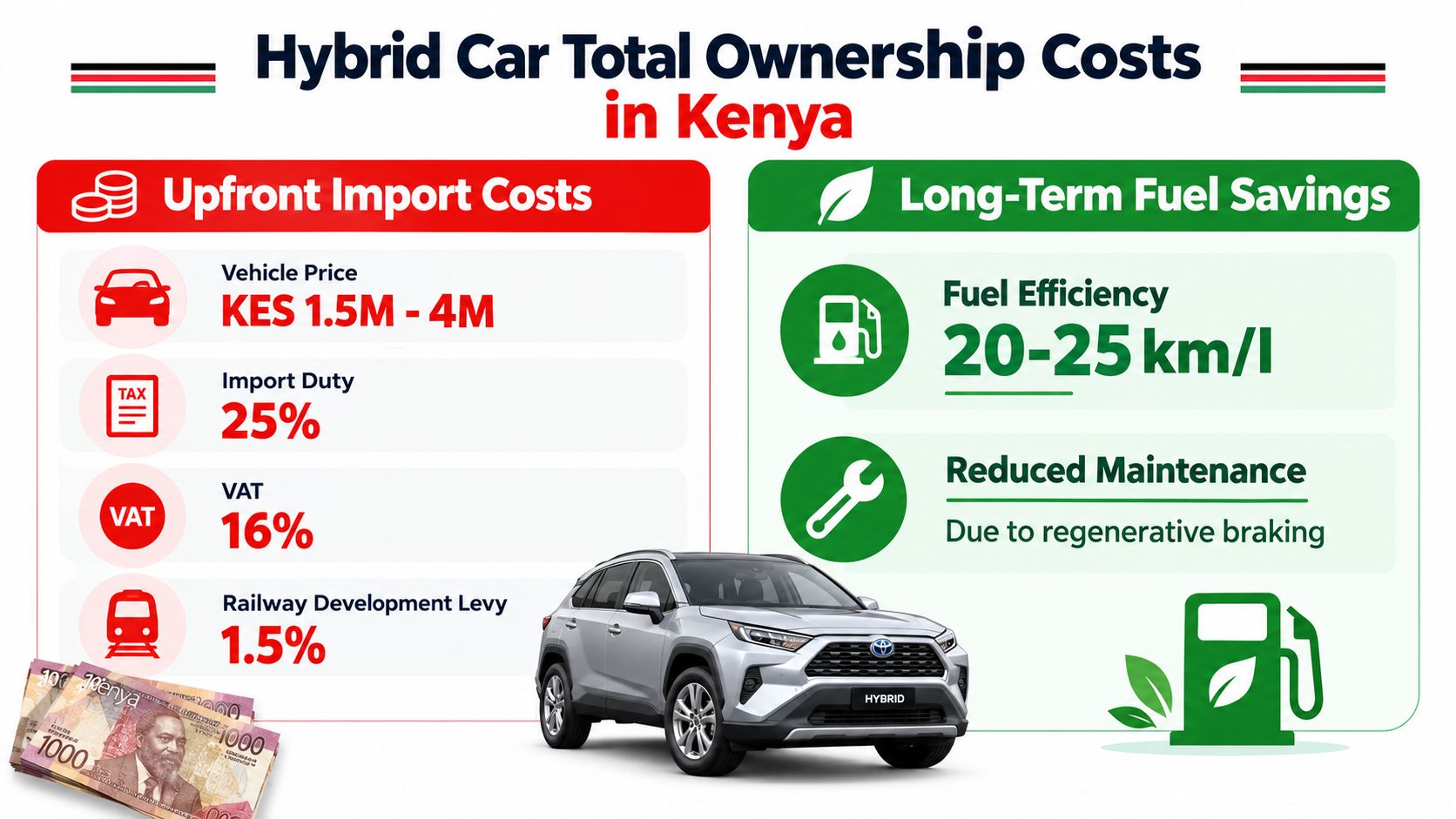
The advertised overseas price is only one part of a hybrid's cost. A buyer must account for the customs value, applicable import duty, excise duty, VAT, import declaration charges, Railway Development Levy, registration, clearance and any preparation needed before use. Current taxes should be confirmed with the Kenya Revenue Authority or a licensed clearing agent because classifications and rates can change.
For hybrids classified as having both a spark-ignition internal-combustion engine and an electric motor for propulsion, Kenya applies a 25% import-duty rate. The Kenya Revenue Authority motor-vehicle guidance distinguishes plug-in and non-plug-in configurations and lists this duty rate for both categories. The electric motor doesn't automatically make the car duty-free.
Build your own break-even calculation
Use your actual figures rather than a generic fuel-saving claim. First, estimate your annual kilometres. Then divide that distance by the realistic kilometres per litre for the hybrid and multiply the result by the current petrol price. Repeat the calculation for the petrol car you're considering.
Next, subtract the hybrid's annual fuel cost from the petrol car's annual fuel cost. Divide the hybrid's extra purchase and import cost by that annual difference. The result is an estimated break-even period, before financing, repairs, depreciation and unexpected battery work.
This calculation changes sharply between drivers:
- Low-mileage owner: The hybrid premium may take a long time to recover, particularly if most journeys are short but infrequent.
- Daily Nairobi commuter: Frequent congestion and regenerative braking can improve the hybrid's case.
- Highway-focused driver: The fuel advantage may be narrower because the petrol engine operates more consistently at cruising speeds.
- Family SUV buyer: A hybrid may reduce fuel use compared with a similar petrol SUV, but the larger purchase price still needs justification.
The Toyota price guide can help you structure a model comparison, but don't use any guide as a substitute for a current tax calculation. A lower-priced petrol car can still be the better financial choice if your annual mileage is modest.
Battery Health and Import Document Verification
The battery is not a reason to reject every used hybrid. It is a reason to demand evidence. A seller saying that the battery is “good” hasn't provided a measurable diagnosis, and a dashboard with no warning light doesn't prove that every battery module is performing evenly.
Kenya's electrified-vehicle support ecosystem is growing. Registered electric vehicles rose from 4,047 in 2023 to 9,144 in 2024, a 126% increase, according to the Electric Mobility Association of Kenya white paper. That growth indicates stronger interest, but buyers should still confirm that suitable diagnostic expertise, replacement modules and repair support are available for the exact system they're considering.
Battery checks that deserve written evidence
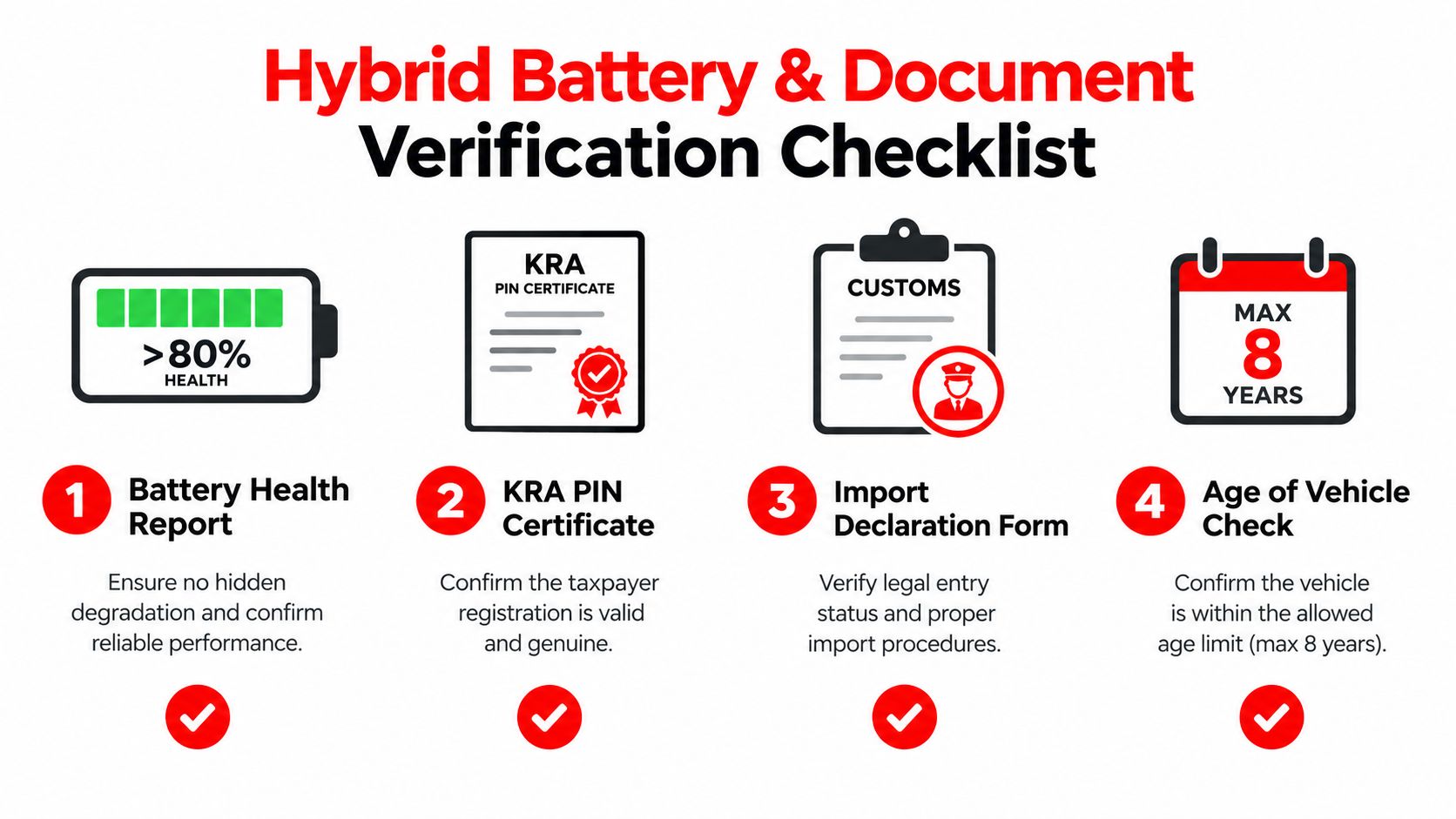
Request a diagnostic scan and a battery state-of-health report. The inspection should also consider the cooling fan, inverter, regenerative braking, stored fault codes and the condition of the high-voltage cabling. A technician should test the vehicle when cold and during a proper drive, because some faults appear only under load.
Look for accident, flood or heat damage around the battery compartment and electrical components. Check whether the service history identifies battery-related work, cooling-system cleaning or previous warning lights. Battery age alone isn't enough to reject a car, but an uncertain history should affect the price and your contingency budget.
Import records are part of the car
KEBS requires imported used vehicles without an accompanying Certificate of Roadworthiness to have their import documents validated before destination inspection. The KEBS public notice explains the document-validation requirement.
Use this checklist once, before paying a deposit:
- Confirm identity: Match the chassis or vehicle-identification number across the car, logbook, export certificate and deregistration record.
- Verify age: Check the documented year of first registration, not only the model year in an advert. KEBS requirements generally restrict imported passenger vehicles older than eight years from first registration, and the manufacturing and first-registration years should not differ by more than one year. The KEBS inspection code sets out these requirements.
- Check entry paperwork: Review the logbook, deregistration certificate or export certificate where applicable.
- Separate documents by purpose: A Certificate of Roadworthiness supports the formal inspection process, while service records show maintenance history. One doesn't replace the other.
- Record the tax trail: Ask for customs valuation and tax-calculation documents for an imported unit.
Inspecting the Vehicle at the Dealership
A hybrid viewing should include the same body, interior and chassis inspection you'd perform on a petrol car, followed by a more deliberate test drive. Don't start with the fuel-economy display. Start with the vehicle's condition and the evidence supporting its history.
Observe the hybrid system under real load
Begin with a cold start if possible. Listen for unusual engine vibration, warning chimes or delayed engagement. During gentle acceleration, note the transition from electric assistance to petrol power. It should feel controlled rather than accompanied by harsh jolts, slipping or unexplained hesitation.
Test regenerative braking at different speeds. The pedal should feel predictable, even if its initial response differs from a conventional braking system. Ask the seller or technician to demonstrate the inverter and hybrid-system readings under load, then compare those results with the written diagnostic report.
A proper road test should include:
- Low-speed traffic: Check whether electric assistance engages smoothly.
- Moderate acceleration: Watch for hesitation, warning lights or abnormal transmission noise.
- Braking: Feel for consistent pedal response and unusual vibration.
- Inclines: Listen for excessive engine revving or reduced power.
- Air-conditioning use: Observe whether the system remains stable with the cabin cooling.
- Steering and suspension: Check for pulling, knocks and uneven tyre wear.
Inspect the shell as carefully as the electronics
Look for mismatched paint, uneven panel gaps, corrosion, water marks, damp smells and mud or silt in hidden areas. Flood damage can affect connectors and battery-related wiring long after the car appears clean. Uneven tyre wear may point to alignment, suspension or accident damage rather than a simple tyre issue.
Review the spare wheel well, door seals, carpets, underbody and suspension mounts. Confirm that the charging equipment and cables match the vehicle if you're viewing a plug-in hybrid. For a broader example of how running costs and vehicle condition affect a different SUV purchase, see this Forester price guide.
Don't rush because the dashboard looks modern. A clean interior and quiet drive are positive signs, but they don't replace a battery report, document check or independent technical opinion.
Viewing Current Stock and Arranging a Visit
Once you have a shortlist, arrange a viewing around the numbers you will use. Bring a printed break-even sheet showing your annual kilometres, expected km/l and a KSh 150,000 battery contingency. Compare the asking price with your estimated ownership cost, including import duties built into the vehicle's price, Nairobi traffic consumption and likely resale risk.
Brill Motors handles online enquiries and showroom viewings at Garden City Mall Rooftop Car Yard on Thika Road, Nairobi, as well as financing, valuations and trade-ins. A valuation compares keeping your current car with changing to a hybrid. Ask whether the displayed price includes charges, and request the terms in writing.
At the appointment, bring your licence and questions from your battery assessment. Confirm that the vehicle is the exact unit advertised, then record its mileage, battery test result, propulsion type and import history. Check registration details and service evidence against the documents, not memory or assurances.
View current hybrid stock at Brill Motors, then compare each vehicle's condition, paperwork and calculated ownership cost before paying a deposit. Visit the Garden City Mall Rooftop Car Yard on Thika Road, Nairobi, to inspect the car, discuss financing or trade in your vehicle.