


 SIGN UP
A used Toyota Fielder Hybrid in Kenya typically costs about KSh 1,590,000 to KSh 2,200,000, with many better-specified units around KSh 1.9 million to KSh 2.2 million. The final price is shaped by import taxes, customs valuation, mileage, battery condition, registration status and dealer preparation, not just the overseas vehicle price.
You may have seen one Fielder Hybrid advertised below KSh 1.6 million and another that looks almost identical above KSh 2 million. That difference isn't automatically a rip-off. A lower-priced car may have higher mileage, an unresolved import bill, weaker hybrid components or incomplete registration records. A higher-priced unit may have better history, newer import details and a tested battery, but you still need proof before paying the premium.
For a Nairobi buyer, the sensible approach is simple: start with the delivered price, then inspect the hybrid system and documents before judging whether the sticker price is fair.
Understanding Current Toyota Fielder Hybrid Prices in Kenya
A buyer scrolling through vehicle adverts can quickly lose a clear sense of value. One Toyota Fielder Hybrid may be listed at KSh 1,590,000, while another is advertised above KSh 2,200,000, even when both appear to have the same 1.5-litre engine and automatic transmission.
Current Kenya market-listing data places the median asking price at about KSh 2,075,000, with advertised examples starting at KSh 1,590,000. The same dataset places the conventional 1.5-litre Fielder at a median asking price of KSh 1,300,000, meaning the hybrid median is KSh 775,000 higher, or approximately 59.6% above the conventional model's median asking price. These figures are asking prices, not guaranteed completed sale values. Review the current Toyota Fielder stock at Brill Motors before treating any figure as a final deal.
A practical budget for buyers
Use these bands as a starting point:
- Around KSh 1.6 million: Expect a lower-priced example. Check mileage, battery condition, accident history, duty status and registration carefully.
- KSh 1.9 million to KSh 2.2 million: This is a realistic working budget for many better-specified or newer units, subject to inspection and paperwork.
- Above KSh 2.2 million: Demand a clear reason for the premium, such as condition, specification, verified history or a particularly clean import record.
The conventional Fielder's lower median price doesn't make it a poor choice. It means the hybrid drivetrain, newer import cohorts and expected fuel savings command more money in Kenya.
Why two similar cars cost differently
The most important price factors are customs valuation, mileage, year of first registration, service history, hybrid battery health, accident records and whether registration is complete. A car that looks cheap before clearance can become expensive once taxes, port charges, transport, registration and preparation are added.
Ask for a written price breakdown. Don't compare an overseas purchase price with a fully registered Nairobi vehicle. Those are different products with different costs attached.
How Kenyan Import Taxes Affect Your Final Cost
Kenyan import taxes can turn an apparently affordable Fielder Hybrid into a much larger purchase. The Kenya Revenue Authority states that imported motor vehicles attract 25% import duty calculated on customs value, which includes the vehicle cost, insurance and freight to Kenya. For vehicles with an engine capacity of 1,500cc or below, KRA's stated baseline includes 20% excise duty on customs value plus import duty, 16% VAT on customs value, import duty and excise duty, an Import Declaration Fee of 3.5% of CIF value, and a Railway Development Levy of 2% of CIF value. See the KRA motor vehicle importation guidance for the stated calculation approach.
A typical Fielder Hybrid has a 1.5-litre engine, so this framework is useful for illustrating the scale of the charges. It isn't a substitute for a current written assessment from KRA or a licensed clearing professional.
Kenya import tax breakdown for Fielder Hybrid
| Tax component | Rate | Basis of calculation |
|---|---|---|
| Import duty | 25% | Customs value, including cost, insurance and freight |
| Excise duty | 20% | Customs value plus import duty for vehicles of 1,500cc or below |
| VAT | 16% | Customs value plus import duty and excise duty |
| Import Declaration Fee | 3.5% | CIF value |
| Railway Development Levy | 2% | CIF value |
A simple landed-cost example
Take a hypothetical CIF value of KSh 1,000,000. The 25% import duty would be KSh 250,000. The 20% excise calculation would also produce KSh 250,000 under the stated baseline, while VAT would be approximately KSh 240,000. IDF would be KSh 35,000, and RDL would be KSh 20,000.
That gives estimated taxes and levies of about KSh 795,000, before port charges, clearing, registration and dealer costs. The resulting pre-registration landed cost would be roughly KSh 1.795 million. The Toyota price guide for Kenya is useful for broader budgeting, but your actual Fielder Hybrid calculation must use the vehicle's customs valuation and current tax treatment.
Practical rule: Never approve a car using the auction or overseas price alone. Ask for the CIF value, every tax line, clearance costs, registration charges and the final amount payable in Kenya.
The tax position can vary with vehicle classification and the applicable current rules. KRA's motor vehicle procedure lists hybrid vehicles using both a spark-ignition engine and an electric motor under a 25% import-duty category, and lists VAT at 16%. Check KRA's motor vehicle importation procedure before relying on an online estimate.
Hybrid vs Petrol Fielder, Comparing Value and Running Costs
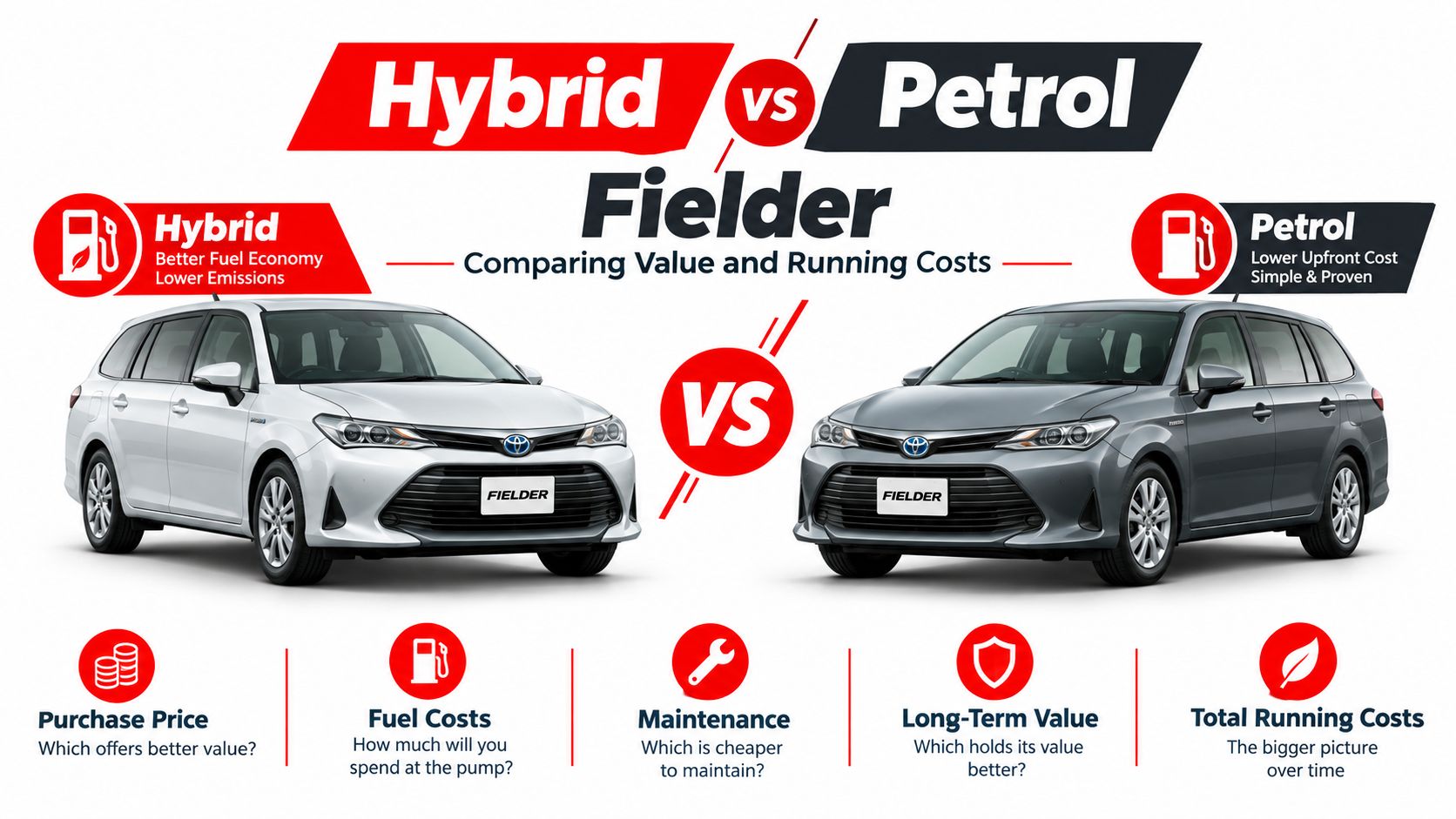
A driver leaving Nairobi during rush hour can spend far more time crawling than cruising. In that situation, the hybrid's electric motor can reduce fuel use during repeated stops, starts and slow traffic. The conventional 1.5-litre Fielder remains easier to understand mechanically and usually costs less to buy. The right choice depends on mileage, traffic conditions and the condition of the hybrid system.
With the hybrid purchase premium established above, the question is whether fuel savings can recover it over your ownership period. Use the detailed Toyota Fielder Hybrid buying guide to compare individual vehicles, because asking prices alone do not show battery condition, service history, import costs or repair exposure.
Where the hybrid earns its premium
The common Fielder Hybrid uses the 1NZ-FXE 1.5-litre petrol-electric system, an electrically controlled continuously variable transmission and generally front-wheel drive, with some 4WD availability. Toyota's official specification for the NKE165G records a 1,496cc engine, 74 PS, a 36-litre fuel tank and a JC08 test figure of 33.0 km/L. Treat that laboratory result as a reference, not a promise for Nairobi traffic. Check Toyota's official Fielder specification.
Kenya-oriented guidance puts mixed real-world hybrid economy at approximately 22 to 28 km/L, with Nairobi traffic around 22 to 26 km/L. At 20,000 km per year and KSh 200 per litre, that range implies roughly KSh 154,000 to KSh 182,000 in annual fuel cost, before traffic variation, maintenance and fuel-price changes. Review the Kenya-focused Fielder Hybrid operating guidance.
Fuel economy is only one part of the landed-cost decision. Import duty and other taxes have already raised the amount paid before the car reaches your driveway, so a fuel saving must be measured against the complete Kenyan purchase cost, not the overseas auction figure.
The petrol version suits a lower-mileage driver, a tighter upfront budget or a buyer who wants a simpler repair profile. Choose the hybrid for frequent urban driving, provided the battery, inverter, cooling system and service records pass inspection.
The ownership trade-off
A weak traction battery can reduce efficiency and trigger warning lights. Inverter or cooling-system faults can turn projected fuel savings into a large repair bill. A petrol Fielder avoids traction-battery risk, but it will not provide the same stop-start efficiency in heavy traffic.
My recommendation is direct: choose the hybrid for high urban mileage, and choose the petrol model when purchase budget and mechanical simplicity matter more. In both cases, inspect the actual car, verify its documents and calculate the full Kenyan landed cost before paying.
Essential Hybrid System Inspection Checklist
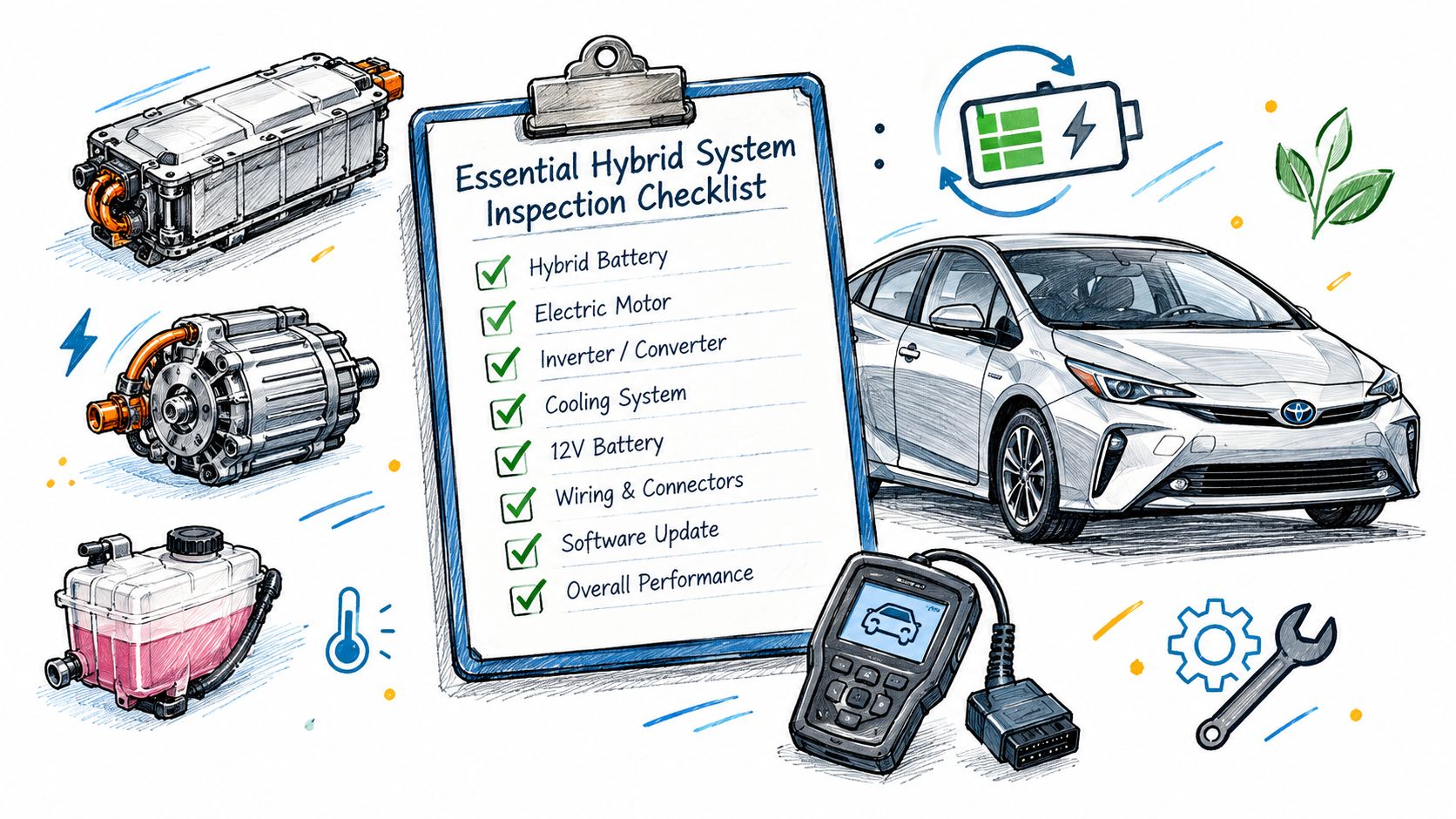
A hybrid viewing should never end with a short test drive and a clean-looking interior. The car may start, move and appear normal while storing a fault that only shows under load, during regenerative braking or after the battery reaches operating temperature.
Inspect the warning lights first
Switch the ignition on before starting the vehicle. Confirm that the hybrid, engine and other warning lights illuminate during the self-check, then confirm that they disappear after the engine starts. A light that stays on, flashes or has been removed from the instrument cluster needs a proper diagnostic explanation.
Look for signs of a weak 12-volt battery, such as slow system activation, unusual dashboard behaviour or repeated warning messages. This small battery helps the vehicle's control systems wake up, so a fault there can imitate a larger hybrid problem.
Test the battery and inverter behaviour
Ask for a hybrid diagnostic report showing the traction battery's state of health. Don't accept the words “battery is fine” without a test result or a technician's inspection. The report should be connected to the specific chassis number and should identify abnormal cell imbalance or other recorded faults.
Listen for unusual cooling-fan noise and inspect the inverter cooling system for warning signs, leaks or poor maintenance. The inverter controls electrical energy between the battery, motor and petrol engine. A cooling problem can become serious if ignored.
Drive it properly
During the road test, notice how the car moves between electric assistance and petrol power. The transition should feel controlled rather than jerky. Lift off the accelerator and apply the brakes gently. Regenerative braking should feel consistent, without strange vibration, sudden grabbing or a warning message.
Also check the transmission response, steering, suspension, air-conditioning and tyre condition. These aren't hybrid-specific, but they affect the car's total value and can hide a poor purchase behind a clean dashboard.
Walk away from unexplained warning lights. A low price doesn't compensate for a hybrid fault that the seller can't document.
Navigating Kenya's Vehicle Age Limit Regulations
Kenya's used-vehicle import rule makes the year of first registration more important than the model year printed in an advert. The Kenya Bureau of Standards PVOC manual states that used vehicles are inspected under KS 1515:2019 and must not be more than eight years old from the year of first registration. See the published vehicle age and inspection guidance.
That distinction matters because a vehicle can be marketed using one model year while its first registration falls in another period. If you check only the model year, you may misjudge whether the vehicle was eligible for import or whether the paperwork matches the car.
Check the dates before negotiating
Ask to see the first-registration details, export documents and inspection records. Match the dates against the chassis number, not merely against a printed advert or verbal description. The age rule affects which import cohorts can legally enter Kenya, so it also affects supply, choice and pricing.
The same guidance says that used vehicles imported into Kenya must not exceed the eight-year limit from first registration. It also identifies odometer-integrity verification as part of the inspection process. A clean-looking interior isn't enough evidence of genuine mileage.
What the buyer should verify
Use this sequence:
- Confirm first registration: Compare the date on the original documentation with the vehicle records.
- Match the chassis number: Check the number on the car against the export and inspection documents.
- Review the odometer evidence: Look for consistent mileage across the available records.
- Check inspection validity: Make sure the relevant inspection certificate and import documents are present.
- Ask about registration status: Establish whether the car is already registered locally or still requires completion of the process.
A seller who can't explain the date history creates unnecessary risk. A compliant car with coherent records is easier to value and easier to transfer.
Calculating Total Five-Year Ownership Costs
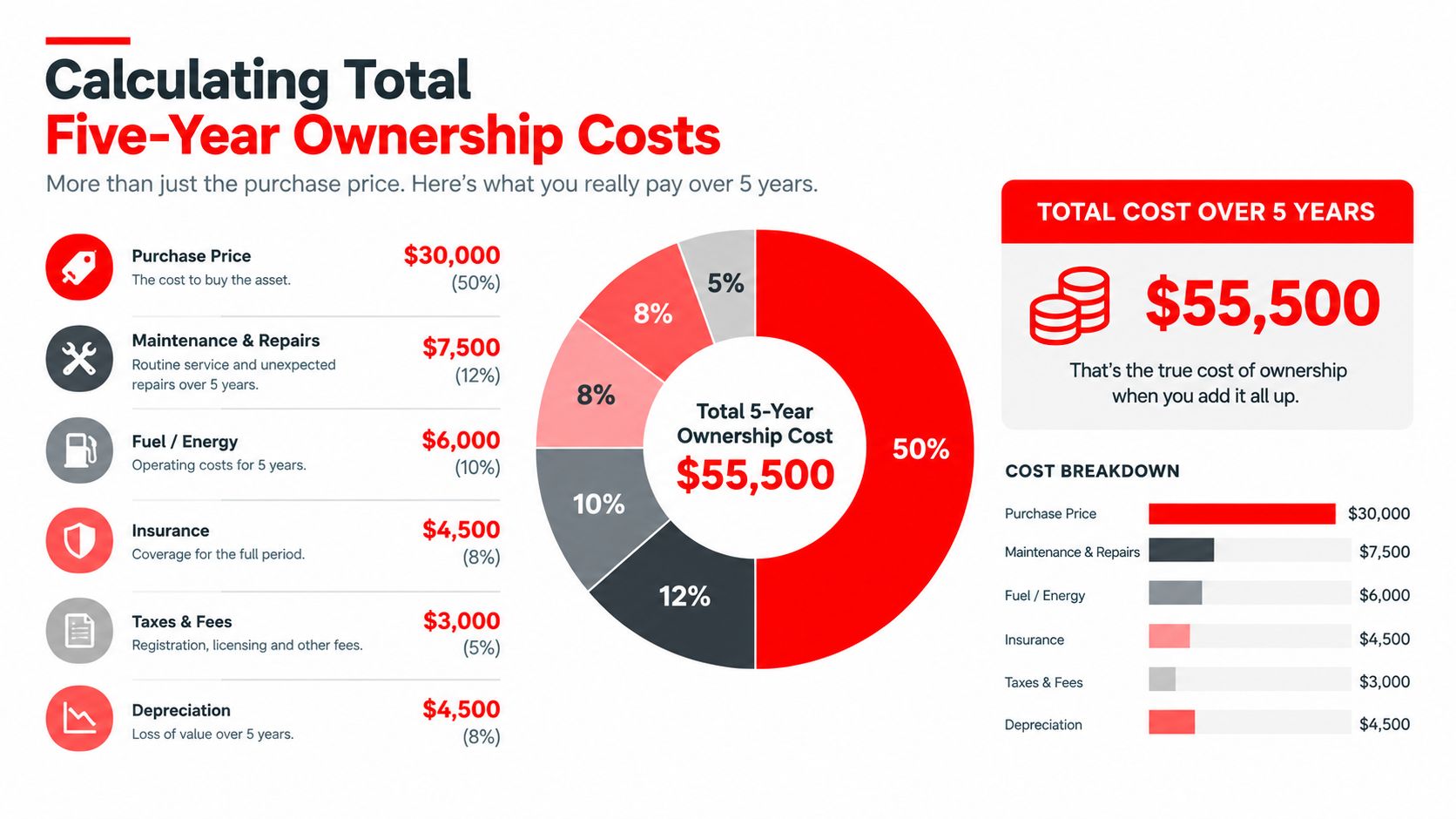
A Toyota Fielder Hybrid can look affordable in an advert and become expensive after clearance. Build your budget from the landed cost, including the agreed vehicle price, applicable taxes and levies, transport, registration, insurance, servicing and a reserve for hybrid-system repairs. Confirm each tax assumption before committing, because a foreign purchase price does not automatically include Kenyan clearance charges.
For a Fielder Hybrid driven 20,000 km annually, the Kenya-oriented economy range of 22 to 26 km/L gives estimated fuel spending of KSh 154,000 to KSh 182,000 a year at KSh 200 per litre. Over five years, that equals approximately KSh 770,000 to KSh 910,000, before maintenance and fuel-price changes. Use the Kenya Hybrid operating assumptions as a starting point.
Build a five-year cost ledger
Separate one-off landed costs from expenses that recur. Record the vehicle price, import taxes, levies, transport, dealer preparation and registration in the first-year column. Keep insurance, fuel and routine maintenance in yearly columns, then show the five-year total. This layout exposes double-counting and shows whether an advertised price excludes charges you still have to pay.
| Cost category | Year 1 | Years 2 to 5 | Five-year treatment |
|---|---|---|---|
| Landed purchase and statutory charges | Record confirmed amounts | None unless outstanding | Add once |
| Fuel | Use actual distance and economy | Update with actual use | Add yearly totals |
| Insurance | Obtain a quotation | Renew using the current valuation | Add each policy period |
| Routine maintenance | Inspect and service condition items | Track servicing, fluids, brakes, tyres and suspension | Add invoices and allowances |
| Hybrid reserve | Set aside an amount | Keep it available for battery, inverter or electrical work | Do not treat it as spent unless needed |
A reserve is part of responsible budgeting, even if the vehicle does not require a major hybrid repair. Include periodic checks of battery behaviour, inverter cooling and warning systems, especially when the inspection history is incomplete.
Compare the right vehicles
Compare the hybrid with a petrol Fielder of similar condition, history and equipment. A lower-priced petrol car may require suspension, tyres, body repairs or transmission work. A higher-priced hybrid may justify its premium when its battery health, service records and mechanical condition are verified.
Fuel savings favour the hybrid for regular traffic driving. The purchase premium becomes harder to recover when annual driving is limited or the car has unresolved warning signs. Use the inspection report and confirmed landed cost, not a fuel-economy promise, to make the final decision.
Verifying Documentation and Completing Registration
A Fielder Hybrid's documents should tell the same story as the car. The chassis number, first-registration date, mileage, inspection record, import paperwork and local registration details need to align. If one record conflicts with another, stop the purchase until the discrepancy is explained in writing.
Documents to request
Ask for:
- Chassis-number evidence: Match the number stamped on the vehicle with every relevant document.
- Odometer records: Check that the displayed mileage is consistent with the inspection and export history.
- Inspection certificate: Confirm that the required inspection documentation is present and valid.
- Import records: Review the customs and clearance documents, including the basis used for valuation.
- Registration records: Confirm the vehicle's local registration status and the identity of the registered owner.
- Service history: Check whether maintenance entries identify the same vehicle and mileage progression.
Don't rely on a photocopy that cannot be matched to the vehicle. A genuine document for a different chassis number is still the wrong document.
Completing the ownership process
Use the official National Transport and Safety Authority process for registration and transfer, and make sure the seller's details match the records before money changes hands. The buyer should confirm what remains outstanding, who will complete each step and whether any statutory or preparation charges sit outside the advertised price.
A vehicle with incomplete paperwork can delay ownership transfer, financing and resale. It can also make it difficult to prove lawful importation later.
Good paperwork is part of the vehicle's value. Don't pay a premium for a clean hybrid and then accept vague answers about its import file.
Before signing, write the chassis number, agreed price, included charges, outstanding documents and handover responsibilities into the sale paperwork. Keep copies of the inspection report and every document supplied with the vehicle.
Next Steps for Buying Your Toyota Fielder Hybrid
Start by deciding whether your driving pattern justifies the hybrid premium. Nairobi commuters who spend much of the week in slow traffic are more likely to benefit from the system's fuel efficiency. Drivers with low mileage or a strict purchase budget may prefer the simpler petrol Fielder.
Then shortlist the actual vehicle, not just the model. Check the price against its mileage, condition, first-registration date, import status, battery report, service history and registration records. A clean inspection is more valuable than a vague promise of low fuel consumption.
You can view current stock online, enquire about a specific vehicle and arrange a showroom viewing at Garden City Mall Rooftop Car Yard on Thika Road, Nairobi. Available support includes vehicle financing, trade-ins and vehicle valuation for owners who want to sell their current car.
Bring your questions to the viewing. Ask for the hybrid diagnostic results, import and registration documents, a written price breakdown and a road test. If the figures and records make sense, you can make a confident decision without being distracted by an unrealistic headline price.
Visit Brill Motors to view current Toyota Fielder Hybrid stock and enquire about a vehicle that matches your budget. You can also visit the Garden City Mall Rooftop Car Yard on Thika Road for an in-person viewing, financing discussion, trade-in or vehicle valuation.