

 SIGN UP
You've found a Toyota that looks affordable, only to discover that the asking price doesn't tell the whole story. The car may have a clean exterior but high mileage, a fresh import may carry different landing costs from locally used stock, and two vehicles wearing the same badge can sit in completely different price brackets.
That's why a Toyota cars price list should be used as a starting point, not as a promise of what you'll pay. In Nairobi, the sensible buyer compares the model, year, engine, fuel type, transmission, condition, import status and paperwork before committing money. The figures below are practical market guides, while exact live prices depend on the specific vehicle available for viewing.
Understanding Toyota Pricing in Kenya
Toyota prices in Kenya cover an unusually wide ladder. A Kenya-focused market guide records Toyota vehicles ranging from KSh 3,000 to about KSh 13 million, with the average used Toyota at roughly KSh 1.7 million, the average new Toyota at about KSh 3.2 million, and Toyota SUVs and four-wheel-drive vehicles averaging around KSh 3.8 million. Those figures illustrate why a single Toyota price list can be confusing. The badge covers small commuter cars, family saloons, commercial wagons, luxury vehicles and serious off-road machines.
A buyer working with less than KSh 1 million may be looking at an older compact car or saloon, while another buyer comparing Toyota vehicles in the same market may be considering a multi-million-shilling SUV. Neither is necessarily paying an unfair price. The vehicles have different body types, drivetrain systems, import histories, equipment levels and expected running costs.
Why static prices mislead buyers
Kenya's used-car market has moved upwards, and old price lists can leave buyers with unrealistic expectations. Local market coverage citing vehicle listing data places average vehicle asking prices at about KSh 797,000 in 2024 and KSh 1.37 million in 2026, while the median locally used vehicle price moved above KSh 1 million for the first time. You can review the underlying market discussion in this Kenya vehicle market update, although the exact price of an individual Toyota still depends on its condition and specification.
That shift matters when you search for an Axio, Corolla, Fielder, Noah or RAV4. A low figure may relate to older Nairobi stock with substantial mileage, while a higher figure may reflect a newer import, a cleaner interior, a better trim or a more desirable drivetrain. The asking price also may not include every cost associated with getting the car ready for ownership.
Nairobi buying rule: Don't ask only, “What's the Toyota price?” Ask, “What will this specific Toyota cost me after inspection, transfer, preparation and any required repairs?”
Treat the price list as a ladder
Toyota pricing makes more sense when you arrange it by buyer budget. The model name gives you the starting point, but year and condition decide where that model sits on the ladder. An Aqua, for example, occupies a different part of the market from a Harrier, while two Axio saloons can differ substantially because of age, mileage and import status.
Use the following figures to narrow your search, then confirm the actual specification and condition during a physical viewing.
Toyota Price Ranges by Budget Category
A useful Toyota budget guide should answer one practical question: what can I realistically inspect within my budget? The ranges below are broad market guides, not fixed quotations. Toyota price pages show the Aqua at about KSh 1.29 million to KSh 1.85 million, the Axio at roughly KSh 850,000 to KSh 2.05 million, and the Crown Royal Saloon at about KSh 1.35 million to KSh 3.8 million.
| Budget Tier | Typical Models | General Price Range (KSh) |
|---|---|---|
| Under KSh 1 million | Older Vitz, Passo, Corolla and selected compact cars | Below KSh 1 million |
| KSh 1 million to KSh 2 million | Aqua, Axio, Premio, Fielder, Probox, Succeed and Hilux examples | KSh 1 million to KSh 2 million |
| Above KSh 2 million | Harrier, RAV4, Prado, Land Cruiser, newer Crown and larger SUVs | Above KSh 2 million |
A few real examples show how sharply the market can vary. Recent Kenyan Toyota listings include a 2009 Premio at KSh 1,150,000, a 2009 Hilux at KSh 1,750,000, a 2013 Vitz at KSh 880,000, a 2016 Succeed at KSh 1,090,000, and a 2016 Probox at KSh 1,050,000. Auction-style stock has also included a 2008 Passo at KSh 276,000 and a 2019 Spade at KSh 980,000.
Those figures aren't interchangeable. A cheap Passo may need more careful inspection, while a commercial wagon may have worked hard even if its registration year looks attractive. If your budget is tight, leave room for ownership costs rather than spending every shilling on the purchase price.
Hatchbacks and Compact Cars
Small Toyota hatchbacks suit Nairobi traffic because they're easy to place on crowded roads, simple to park and generally less demanding than a large SUV. The main choices include the Vitz, Passo, Aqua and Spade, but they don't serve exactly the same buyer.
A Vitz is the straightforward petrol commuter. A Passo usually appeals to a buyer who wants a compact town car at a lower entry point. The Aqua adds hybrid efficiency, while the Spade offers a boxier cabin and easier access for some passengers. Recent Kenyan figures place the Vitz around the sub-KSh 1 million bracket in some examples, the Passo from a much lower auction-style price in an older example, and the Spade around KSh 980,000 in a 2019 example.
Which compact Toyota fits your routine
Choose based on how you drive, not on the badge alone.
- Vitz: A sensible option for a commuter who wants a compact petrol hatchback and easy urban handling.
- Passo: Useful for a buyer prioritising a lower purchase price, but older examples need especially careful checks.
- Aqua: A strong choice for frequent city driving where hybrid operation can reduce fuel use, provided the hybrid system has been properly assessed.
- Spade: Practical for buyers who value a taller cabin and flexible access in a small footprint.
The Aqua's price range of about KSh 1.29 million to KSh 1.85 million shows that hybrid technology doesn't automatically mean a cheap Toyota. Battery condition, import year, mileage and trim can move the final figure considerably.
Compact-car faults worth checking
Don't buy a small Toyota just because it starts and moves during a short test drive. Inspect the engine for oil leaks, listen for rattling on cold start and check whether the idle stays stable after the car warms up. On an Aqua, ask for evidence that the hybrid battery and warning systems have been checked. A hybrid fault can change the ownership calculation quickly.
Inside the cabin, compare steering-wheel, pedal and seat wear with the displayed mileage. Excessive wear can indicate hard use or an odometer concern. During the drive, test the air conditioning, electric windows, reverse camera, central locking and dashboard warning lights.
Practical check: A compact Toyota should feel smooth at low speed. Hesitation, harsh engagement, warning lights or unusual vibration deserve investigation before you discuss a deposit.
Saloons and Family Estates
The Axio, Premio, Corolla and Fielder remain popular because they offer a sensible balance between comfort, parts availability, fuel use and everyday practicality. The right choice depends on whether you need a conventional boot, extra luggage space or a more comfortable rear cabin.
The Axio is usually the rational family saloon. It's compact enough for Nairobi but offers more dignity and cabin space than a very small hatchback. Its broad price range, roughly KSh 850,000 to KSh 2.05 million, reflects the differences between model years, trims, mileage and import status.
The Premio sits further towards comfort and refinement. A 2009 example at KSh 1,150,000 demonstrates that an older saloon can still command a solid price when the badge, condition and specification are right. Don't assume registration year alone tells you whether it's good value.
Saloon or estate
The Corolla is the familiar all-rounder. It suits a buyer who wants a straightforward saloon for family use, commuting and occasional upcountry travel. The Fielder gives you a larger rear load area and a more useful opening for luggage, shopping, tools or children's equipment.
| Model | Best suited to | Main advantage | Main caution |
|---|---|---|---|
| Axio | Commuters and small families | Balanced size and running costs | Wide variation between years and trims |
| Premio | Buyers wanting extra comfort | Quieter, more refined saloon feel | Older examples need suspension and interior checks |
| Corolla | General family and personal use | Familiar mechanical layout | Condition varies greatly by previous use |
| Fielder | Families and practical users | Estate body gives better load flexibility | Inspect the rear suspension and cargo-area wear |
A saloon can be easier to live with in tight parking spaces, while an estate is more useful when the rear seats and boot carry real loads. For upcountry roads, ground clearance, tyre condition and suspension health matter more than the body style printed on the logbook.
What to inspect on family cars
Check the rear seat condition, boot floor and spare-wheel well for water entry or accident repairs. A Fielder used heavily for transport may show worn cargo trim, sagging suspension or uneven tyre wear. On an Axio or Premio, test the automatic transmission for smooth engagement and listen for suspension knocks over controlled bumps.
Engine capacity also affects how the vehicle feels under load and may influence insurance and import-related calculations. Don't choose a larger engine for status if most of your driving is in town. Pay for the performance you'll really use.
SUVs and Crossovers
Toyota's SUV range moves from comfortable urban crossovers to heavy-duty four-wheel-drive vehicles. The Harrier, RAV4, Prado and Land Cruiser families attract different buyers, and their price jumps are driven by more than appearance.
A Kenya pricing guide places the Toyota Harrier at about KSh 3.732 million to KSh 8.099 million landed in Nairobi for 2018 to 2026 models. That spread reflects import year, trim, engine, mileage and landing costs. It also explains why comparing a Harrier with an older RAV4 purely by badge is poor buying practice.
Comfort, clearance and drivetrain
The RAV4 is often the sensible crossover for a buyer who wants a higher driving position without committing to the size and running costs of a large four-wheel-drive vehicle. The Harrier leans towards road comfort and premium presentation. The Prado and Land Cruiser families make more sense when ground clearance, durability and demanding travel genuinely matter.
A four-wheel-drive system adds capability, but it also adds components that need inspection. Check the transfer case, propeller shafts, differentials and underbody for leaks, dents or neglected servicing. Engage the relevant drivetrain functions only in a safe, suitable environment and confirm that warning lights behave correctly.
Non-negotiable SUV checks
Inspect the chassis rails, suspension arms, steering components and shock absorbers. A vehicle that has spent time on rough roads may have hidden wear beneath an attractive body. Check that the tyres match in size and have even wear. Uneven wear can point to alignment, suspension or accident problems.
On a Harrier or other premium SUV, test every electrical feature. A luxury trim with a faulty screen, power seat, tailgate or climate-control system can become expensive to put right. On a Prado or Land Cruiser, look for evidence of towing, off-road use and heavy underbody impact.
Fuel use will generally be higher in larger, heavier vehicles, particularly where the engine and drivetrain are built for utility rather than economy. Don't buy a large SUV for Nairobi errands if you don't need its clearance or load-carrying ability. Buy it when the roads, passengers and work justify it.
Pickups and Commercial Vehicles
The Hilux, Probox and Succeed serve business buyers in different ways. The Hilux is the choice for buyers who need a pickup, ground clearance and a stronger platform for demanding work. The Probox and Succeed are more practical for light deliveries, stock movement and urban business use.
Recent Kenyan examples include a 2009 Hilux at KSh 1,750,000, a 2016 Probox at KSh 1,050,000 and a 2016 Succeed at KSh 1,090,000. Those figures show the usual pattern, but the condition of a commercial Toyota matters more than a small difference in asking price.
Match the body to the job
A Probox is easier to run for light delivery work where fuel and manoeuvrability matter. A Succeed offers similar commercial practicality with a different cabin and load-area arrangement. The Hilux is more suitable when the business needs a pickup bed, higher clearance or regular work on rougher routes.
Use the Toyota Hilux range to check the type of vehicle that fits your work, then inspect the actual unit carefully. Don't assume a diesel pickup is automatically the cheaper business decision. A neglected diesel engine, turbocharger, clutch or injector system can cost more than a well-maintained petrol vehicle.
Check what commercial use has done
Start underneath. Look for bent chassis sections, fresh paint on structural areas, cracked leaf springs, leaking shock absorbers and damaged mounting points. Check the load bed for dents and welds, then inspect the tailgate, hinges and latches.
Inside, compare seat and pedal wear with the recorded mileage. Test the clutch for slipping, the gearbox for difficult engagement and the brakes for pulling. During the drive, listen for differential whine, propeller-shaft vibration and suspension knocks.
A commercial Toyota should be judged by its remaining working life. A clean service history, straight chassis and healthy drivetrain are worth more than a low purchase figure attached to a vehicle that has been overloaded.
Understanding Import Duties and Landed Costs
The price printed beside an imported Toyota doesn't represent a simple overseas purchase price plus transport. Kenya Revenue Authority valuation and taxation affect the final landed cost, and the calculation can change according to engine capacity, customs value, age and the applicable valuation schedule.
KRA states that imported motor vehicles are assessed using Customs Value, or CIF. Its guidance describes Import Duty at 25%, Excise Duty at 20% of CIF plus Import Duty for vehicles of 1,500 cc and below, VAT at 16% of CIF plus Import Duty plus Excise Duty, IDF at 2% of CIF, and Railway Development Levy at 1.5% of CIF. KRA also states that CIF is derived from the vehicle's Current Retail Selling Price, or CRSP, as explained in its official motor vehicle taxation guidance.
Engine capacity changes the calculation
KRA's motor vehicle importation procedure lists different Import Duty bands by engine capacity. It lists 20% for spark-ignition vehicles over 1,000 cc up to 1,500 cc, 25% for vehicles over 1,500 cc up to 3,000 cc, and 35% for vehicles over 3,000 cc. You can confirm the applicable treatment in KRA's motor vehicle importation procedure.
That's one reason a compact Toyota and a larger SUV can have very different landed costs even when their purchase prices appear close at the source. Engine size, vehicle classification and the valuation basis all matter. A buyer should never estimate tax by applying one flat figure to every Toyota.
CRSP and depreciation
KRA announced that a new Current Retail Selling Price schedule for used motor vehicles became effective on 1 July 2025. That change affects customs valuation for used imports, so older price discussions may no longer describe the current assessment accurately. Check the KRA CRSP public notice before relying on an old import calculation.
KRA's valuation template also includes a 10% depreciation bracket for vehicles over 6 months old in the published valuation material. The used motor vehicle valuation template helps show how age adjustments can enter the assessment.
Money rule: Before importing or buying a fresh import, calculate the complete landed cost with KRA or a licensed clearing agent. Don't confuse the overseas purchase figure with the amount needed to place the vehicle legally on Kenyan roads.
Inspection Checklist for Used Toyota Vehicles
A clean Toyota can still hide accident repairs, neglected servicing or mechanical wear. Inspect the car in daylight, start it from cold where possible and take a proper drive. If the seller won't allow reasonable checks, walk away.
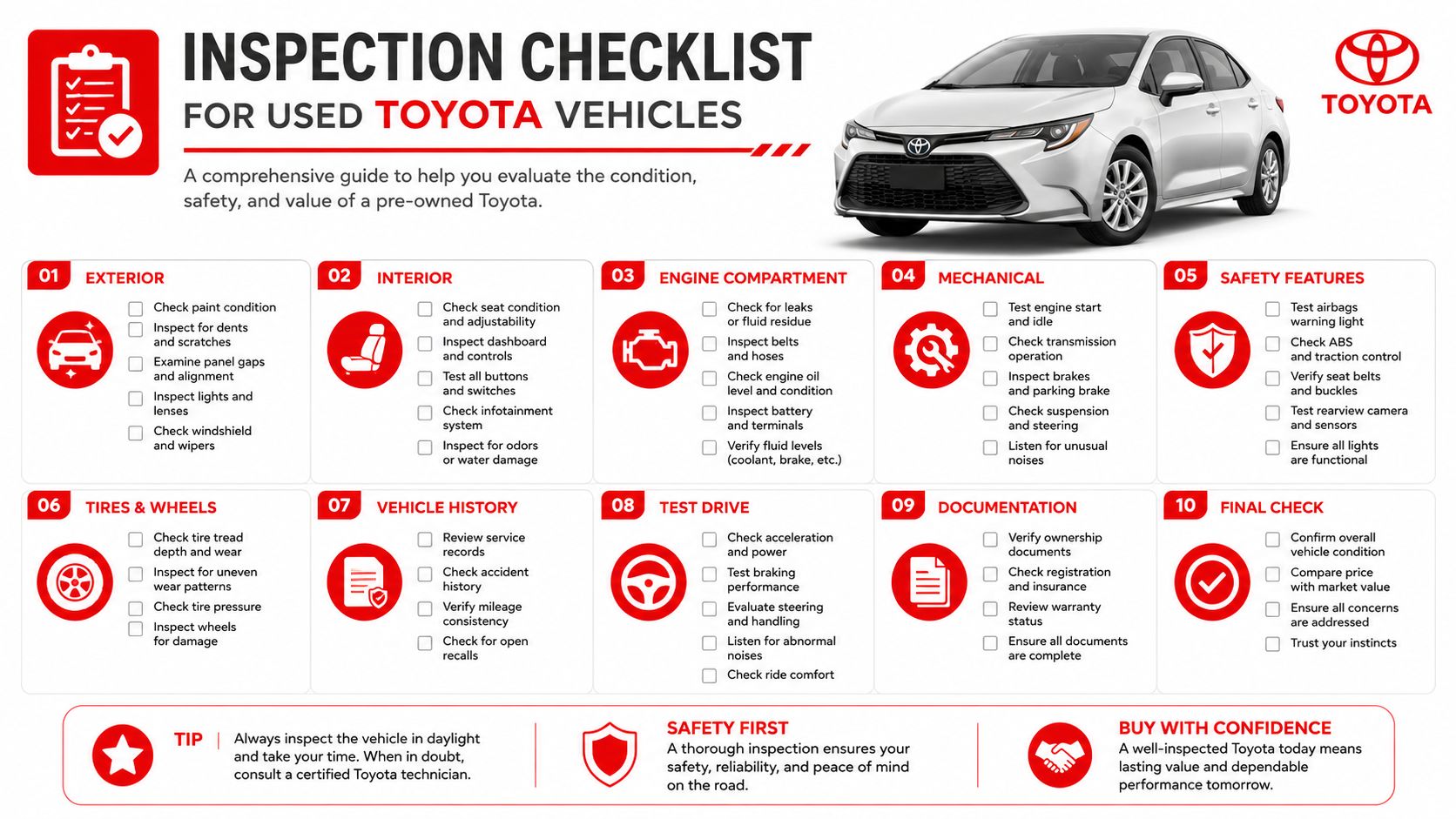
Use this sequence rather than jumping straight to the dashboard and asking about the final price.
- Confirm the identity: Match the chassis number, engine details, registration information and physical vehicle against the available documents. Check that the details are consistent before discussing payment.
- Walk around the body: Look for mismatched paint, uneven panel gaps, overspray, ripples and fresh underseal. Inspect the roof, pillars, boot floor and bonnet for signs of structural repair.
- Check the glass and lights: Confirm that the windows, mirrors, lamps, indicators and wipers work. Look for cracks, condensation and different glass dates that may indicate replacement.
- Inspect the cabin: Compare seat, steering-wheel, pedal and carpet wear with the stated mileage. Test air conditioning, audio, locks, windows, cameras, sensors and every warning-light function.
- Open the engine bay: Look for oil or coolant leaks, damaged wiring, corrosion, loose belts and signs of poor repairs. Check fluid levels and ask for the service history.
- Start the engine cold: Listen for knocking, rattling, excessive vibration or a smoky exhaust. The idle should settle rather than hunt or repeatedly threaten to stall.
- Test the transmission: Select reverse and drive smoothly, then accelerate gently and firmly. Hesitation, shuddering, slipping or harsh shifts require a qualified mechanical opinion.
- Drive over controlled bumps: Listen for suspension knocks and steering noise. The vehicle should track straight, brake without pulling and return smoothly after a turn.
- Inspect the underside: Check the chassis, sump, exhaust, driveshafts, differentials, suspension mounts and brake lines for impact damage or leaks. Commercial vehicles and SUVs deserve particular attention here.
- Review the paperwork: Confirm ownership, transfer requirements, import records where relevant, inspection documentation and any outstanding issue before making a financial commitment.
The used Toyota vehicle selection can help you identify vehicles to inspect, but don't let a familiar model name replace a physical assessment. A Toyota is only good value when the actual car is sound.
Selling or Trading In Your Toyota
Selling privately may appear to offer a higher figure, but it also leaves you handling enquiries, viewings, negotiation, paperwork and the risk of dealing with people who aren't ready to complete. A direct valuation gives you a clearer starting point and reduces the time your vehicle sits unused.
A professional valuation should consider the model, year, mileage, service history, body condition, tyres, mechanical health and current demand. Prepare the logbook and service records, remove personal items, wash the vehicle and disclose known faults. Honest information makes the valuation more useful.
Trading in can simplify the upgrade
A trade-in lets you apply the value of your current car towards another vehicle instead of completing two separate transactions. That can be practical when you're moving from a compact Toyota into a family saloon, or from a saloon into an SUV.
The important comparison is not just the trade-in figure. Compare the final amount you'll pay for the replacement after the value of your current vehicle has been deducted. Ask for the figures in writing, confirm the transfer process and understand whether any outstanding finance or documentation issue affects completion.
If you're selling rather than upgrading, direct vehicle valuation and selling your car through a dealership can reduce the administration involved in finding a private buyer. Keep your expectations realistic. A clean, documented Toyota usually gives the valuer a stronger basis than a vehicle with missing records or unresolved mechanical faults.
Viewing Current Stock and Showroom Visits
A Toyota price list becomes useful when you use it to create a shortlist, not when you treat it as a final invoice. Start with your budget, then decide whether you need a hatchback, saloon, estate, pickup or SUV. Filter further by fuel type, transmission, mileage and the kind of roads you use most.
If you're comparing an Axio with a Fielder, bring the people who'll regularly sit in the back and test the luggage space you need. If you're considering a Harrier, RAV4, Prado or Land Cruiser, inspect the ride height, entry height, boot access and parking footprint rather than choosing from photographs alone.
Live stock changes, and trim availability won't remain fixed. Use the Toyota vehicles catalogue to review current options, then arrange a hands-on viewing at the Garden City Mall Rooftop Car Yard on Thika Road, Nairobi. Viewing the car in person lets you compare paint, cabin condition, tyre wear, engine sound and paperwork before you make a decision.
Come with your licence, a written list of questions and a clear maximum budget. If you're trading in your current vehicle, bring its documents and service records so its valuation can be handled alongside the next purchase. Financing, vehicle valuation and trade-ins are available as part of the buying and selling process, subject to the relevant assessment and terms.
Visit Brill Motors to view current Toyota stock, compare vehicles by budget and arrange a showroom viewing at Garden City Mall Rooftop Car Yard. If you're selling or trading in your Toyota, request a vehicle valuation before choosing your next car.