

 SIGN UP
Brill Motors' indicative planning bands put the Wagon R price in Kenya between roughly KSh 350,000 for an older locally used car and about KSh 1,600,000 for a recent import. That spread is the point: the advertised figure is where the calculation starts, not where it ends.
What a particular Wagon R is worth depends on model year, mileage, powertrain and whether the paperwork holds up. A registered, prepared car in Nairobi sits on a different cost base from a vehicle whose quoted figure excludes taxes, clearance or registration. The all-in cost of a recent import can also sit well above its overseas auction figure, while a cheaper car can become the more expensive purchase once mechanical repairs and unresolved paperwork enter the calculation.
Wagon R Prices in Kenya by Model Year
Model year fixes the budget envelope before any other factor comes into play. The ranges below are a planning framework built around the condition groups shown in the middle column: they reflect where asking prices for locally used cars of each age typically fall, with the newest band extended to cover the delivered cost of import-eligible cars. Use them to set a starting budget; confirmed figures come from individual listings.
| Model years | Typical condition | Indicative planning band |
|---|---|---|
| 2008 to 2012 | Older locally used, mixed condition | KSh 350,000 to KSh 650,000 |
| 2013 to 2016 | Locally used, mid-range condition | KSh 550,000 to KSh 850,000 |
| 2017 to 2019 | Locally used or previously imported, hybrid or non-hybrid | KSh 800,000 to KSh 1,150,000 |
| 2020 to 2026 | Eligible import or retail-ready unit, subject to registration dates | KSh 1,000,000 to KSh 1,600,000 |
Each band is wide by design. The upper bound exists to absorb fuller specifications, hybrid versions and strong examples of that age group; a specific import can still cost more once taxes, clearance and registration enter the total. For a live asking figure on a particular car, check the current stock list.
Within the oldest band, condition outweighs the registration year. A car with clear maintenance records, sound bodywork and a healthy transmission deserves a different assessment from one needing immediate repairs, even when both advertisements display the same year. Two cars of the same age can differ widely in real value.
The middle locally used band needs similar care. A newer-looking interior or fresh paint does not establish value on its own. Ask what work has been completed, what remains outstanding and whether the seller can support those answers with receipts.
How to use the bands
For later cars, separate model year, first registration and import status. An older vehicle already registered in Kenya is a different proposition from an overseas car offered for fresh importation, and import eligibility has to be established separately.
Hybrid equipment, trim, mileage and condition can move a vehicle within its band. Resist placing every hybrid at the top automatically: the premium only makes sense when the extra equipment works and the powertrain passes inspection.
The 2019 Suzuki Wagon R listing at Brill Motors shows what an advertised specification looks like and lets you enquire about current availability. A market guide describes the field; a listing describes one actual car.
Budgeting rule: Compare cars at the same stage of readiness. A cleared, registered vehicle and an overseas purchase are different products until all outstanding costs are accounted for.
Read the bands as a filter, then a check. The age group narrows the search and sets the starting budget; the car's documented condition and the costs already inside the asking figure decide whether that figure is defensible.
How Mileage and Powertrain Move the Price
| Mileage | Indicative position within the model-year band |
|---|---|
| Under 60,000 km | Upper end, if mileage and condition are supported |
| 60,000 to 100,000 km | Middle, subject to maintenance and specification |
| 100,000 to 150,000 km | Lower half, with service history increasingly important |
| Over 150,000 km | Lower end, with mechanical condition taking priority |
Treat these mileage brackets as a comparison framework, not a depreciation formula. They don't establish a fixed discount, and an unsupported low reading shouldn't outweigh convincing maintenance records.
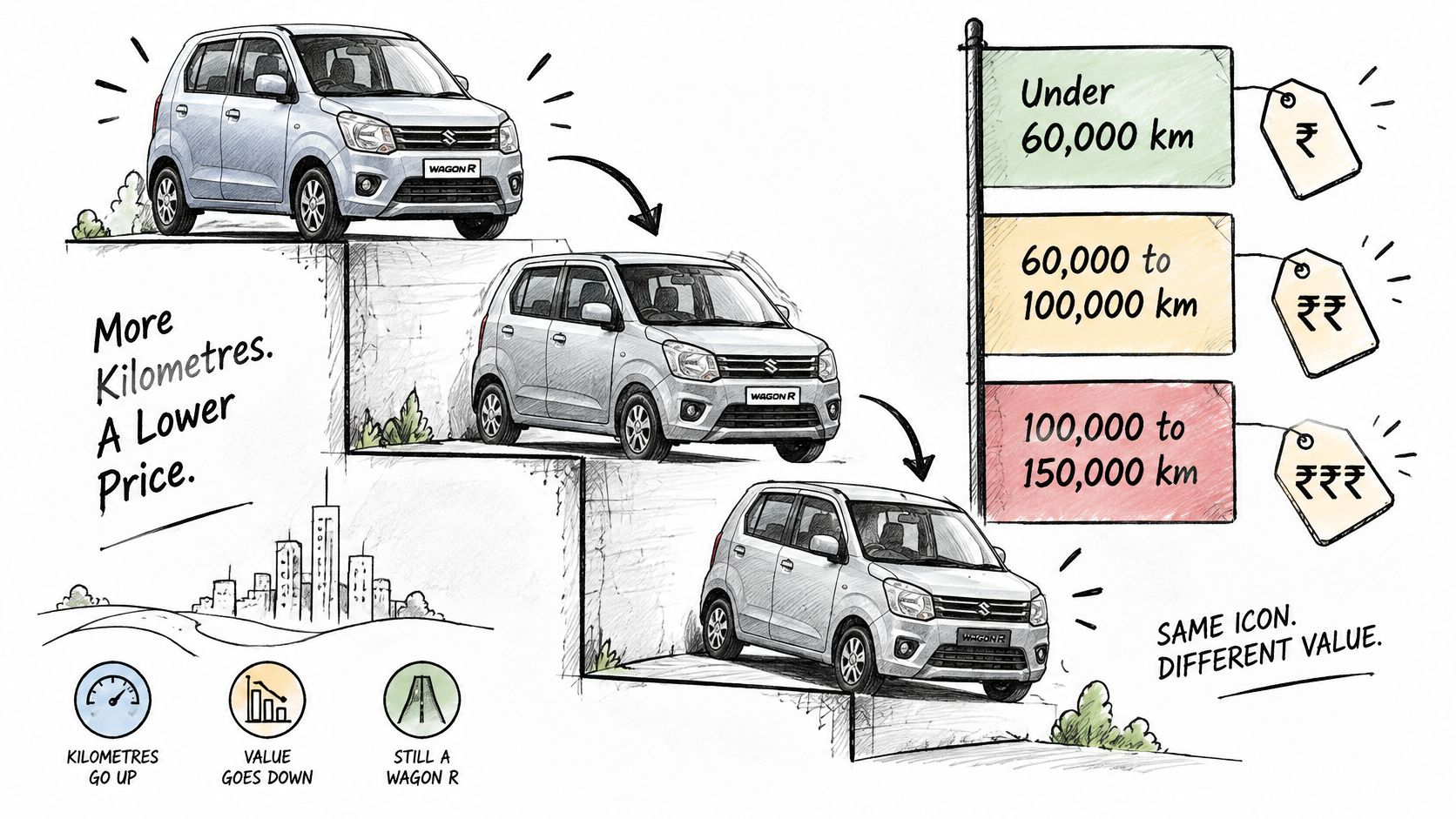
The odometer matters because it helps you ask better questions. Check whether the wear on the steering wheel, pedals and driver's seat is consistent with the claimed use. Then compare dated service entries rather than deciding from appearance alone.
A higher-mileage car with documented servicing may be the more sensible purchase than a lower-mileage example with gaps in its history. You're buying the remaining usefulness of the vehicle, not just the smallest number on the dashboard.
Price the exact powertrain
Confirm whether the car has the Japanese-market 660cc engine or a larger 1.0 litre or 1.2 litre powertrain from another market. Those descriptions shouldn't be treated as interchangeable specifications under the Wagon R name. Check the engine details against the vehicle's documents before comparing prices.
A hybrid may attract an asking-price premium, but the badge alone doesn't justify it. Establish what hybrid system is fitted, whether it operates correctly and whether a specialist can assess its battery condition.
Likewise, don't assume every automatic has the same gearbox. Confirm the transmission type, then judge its operation during a proper test drive. A convenient specification has little value if it brings an unresolved repair requirement.
Grade and trim need supporting evidence
An auction grade is useful only when the sheet belongs to the car and its annotations are understood. Ask for the original document, match the chassis details and have unfamiliar repair symbols explained.
Fuller trim can justify paying more when you'll use the equipment and it works properly. Check the fitted features rather than relying on a trim badge or a copied advertisement. Cars of the same apparent year can warrant materially different prices because their histories and equipment aren't equivalent.
Wagon R Generations and Chassis Codes Explained
The code on the vehicle is the stable identifier. Generation wording in an advertisement is a shortcut, useful for grouping cars but too loose to support a price on its own.
| Generation | Chassis code to verify | What to note |
|---|---|---|
| Fourth-generation description | MH22S, with the complete model designation checked against the vehicle record | Older locally used cars need careful identification because cosmetic changes can make one generation resemble another |
| Fifth-generation description | MH34S, with the complete model designation checked against the vehicle record | Establish engine, transmission and exact specification before comparing asking prices |
| Sixth-generation description | MH55S, with the complete model designation checked against the vehicle record | Establish hybrid status and market specification rather than relying on body shape or trim wording |
Read the chassis plate in order
Work through the identifiers as a set, because each one answers a different question:
- Full model designation: record every character, including prefixes and suffixes around the family code.
- Chassis or frame number: compare the stamped number with the identification plate and the registration document.
- Engine designation: check that the engine described in the paperwork matches the specification used to value the car.
- Manufacture date: separate the build date from the first-registration date shown later in Kenya or Japan.
- Equipment markers: use badges and visible features as supporting evidence only, alongside the documents.
A partial match leaves room for error. MH34S or MH55S identifies a chassis family, while the wider designation and supporting documents describe the car more precisely.
Separate generation from condition
Manufacture year and first-registration year can describe different events. An advertisement may use either date in its model-year field, so ask which one is being quoted before placing the car in a comparison group.
That distinction matters most on older locally used examples. Replacement lights, bumpers or interior trim can copy the appearance of a newer model while the underlying designation remains unchanged. Price the vehicle from its recorded identity, then assess wear, repairs and equipment within that group.
For recent imports, establish the specific powertrain instead of assuming that similar bodywork means hybrid equipment. For older cars, focus on whether the documents describe the same vehicle and whether the mechanical specification can be confirmed.
A generation label helps organise a shortlist. The physical chassis identification determines which car you are actually assessing.
What identification means for value
A correctly identified Wagon R is easier to assess for parts compatibility, equipment and likely maintenance needs. Conflicting descriptions can arise from a copied listing, a careless year entry or a repaired car described by its replacement panels. Ask the seller to resolve the difference in writing before discussing money.
A newer-sounding label deserves a higher price only when the vehicle record, chassis details and specification support it. Otherwise it belongs in the comparison group its documents identify, priced according to condition rather than wording.
Import Costs That Lift the Price Above the Auction Figure
A Kenyan selling price should be assessed against the complete delivered cost, not the overseas purchase alone. The tax valuation can differ from the auction invoice, so a low winning bid doesn't necessarily produce a proportionately low Kenyan tax bill.
The Kenya Revenue Authority's motor-vehicle FAQ describes the following charges and explains that customs valuation may use the Current Retail Selling Price, with depreciation according to vehicle age. The percentages below reproduce that published framework, not a guarantee of the rates applicable to a particular shipment.
| Charge | Rate stated in the KRA FAQ | Calculated on |
|---|---|---|
| Import duty | 25% | Customs value |
| Excise duty | 20% | Customs value plus import duty |
| VAT | 16% | Customs value plus import duty and excise duty |
| Import Declaration Fee | 2% | CIF value |
| Railway Development Levy | 1.5% | CIF value |
Confirm the current assessment before committing funds. Vehicle classification, valuation and changes to legislation can affect the amount payable.
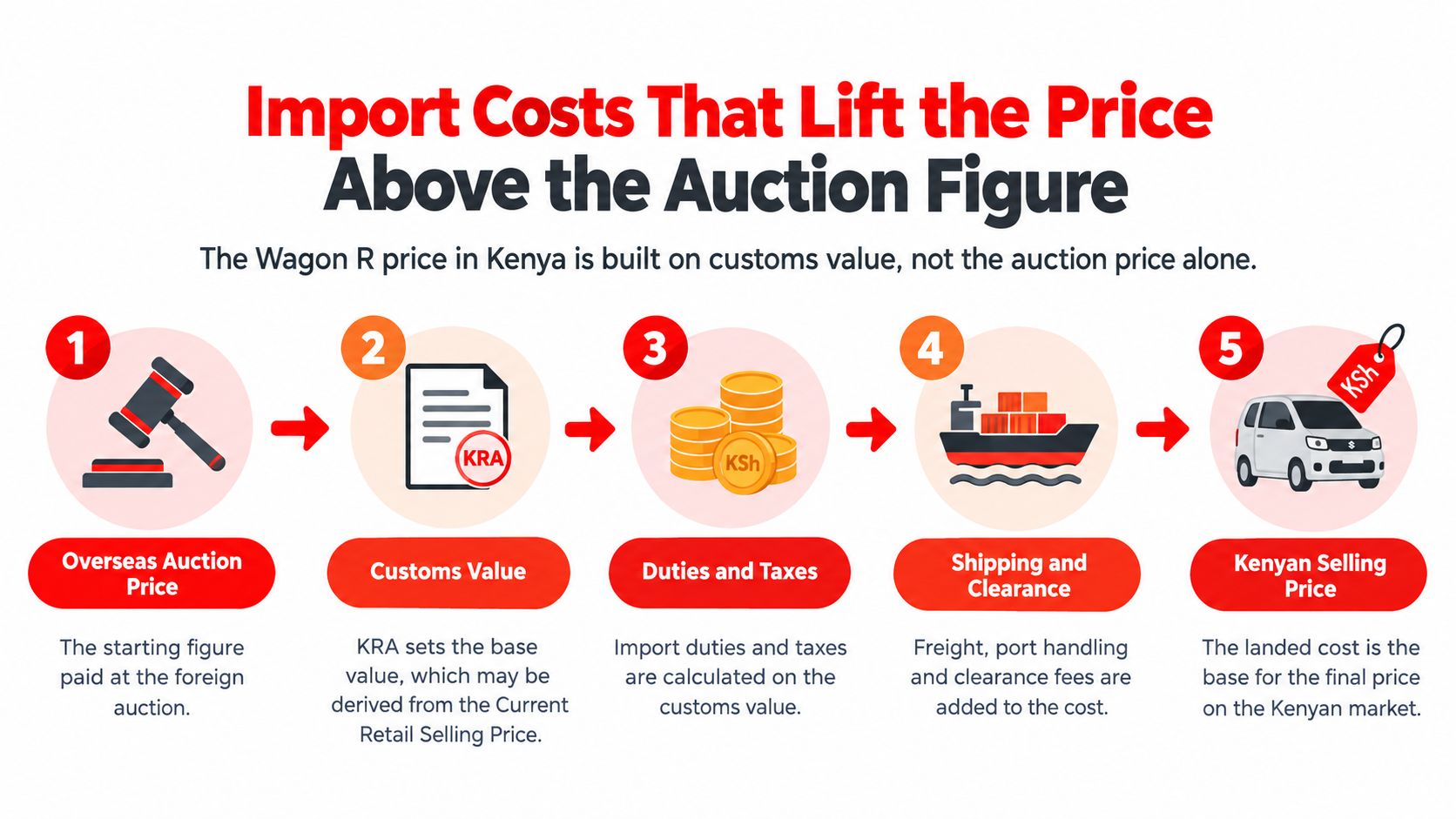
Follow the money through to Nairobi
Start with the overseas purchase figure, then establish CIF, meaning cost, insurance and freight. Keep that commercial amount separate from KRA's customs valuation where the assessment uses a different basis.
Next, obtain the duty and tax computation. The calculation bases matter because these charges aren't independent percentages applied to the original auction price.
After that, add port handling, clearance and any other documented release costs. Include inland transport to Nairobi, registration, applicable inspection and dealer preparation. Ask whether each item is already included in the seller's figure.
The sequence is useful for comparing offers, although individual charges may be invoiced at different stages. What matters is that nothing disappears between the overseas purchase and a vehicle ready for lawful use.
Request a written landed-cost worksheet
A useful worksheet identifies:
- Valuation basis: The vehicle specification and CRSP basis used for the assessment.
- Statutory charges: The tax computation and the party responsible for paying it.
- Logistics: Freight, port charges, clearing and inland delivery.
- Road readiness: Registration, applicable inspection and preparation.
- Outstanding exposure: Any provisional amount, exclusion or charge that remains payable.
A quotation described as landed should still be examined closely. Ask whether it means released at the port, delivered to Nairobi or fully registered and prepared.
That distinction explains why a seemingly expensive local car may compare more favourably once an import quotation is completed. It also prevents the opposite mistake: accepting an inflated retail figure just because importing involves taxes.
Before relying on any percentage or total, confirm current rates with KRA or a licensed clearing agent and obtain a vehicle-specific assessment.
Import Eligibility and Paperwork to Confirm
A low price isn't a good deal if the vehicle can't satisfy import or registration requirements. For an overseas car, eligibility is a condition of the purchase, not something to sort out after payment.
The KEBS public notice on used-vehicle document validation describes the general eight-year limit from first registration under KS 1515:2000 and states that manufacture and first registration must be no more than one year apart. Confirm both dates for the specific vehicle rather than calculating eligibility from an advertisement's model year alone.
The KRA motor-vehicle importation procedure also sets out the right-hand-drive requirement and roadworthiness conditions for imported used vehicles. Don't assume that a vehicle offered overseas is automatically suitable for Kenyan importation.
Documents that establish the car's status
Request the records appropriate to its import and registration history:
- Overseas identity documents: The foreign logbook, export certificate or deregistration certificate.
- Roadworthiness documentation: The applicable inspection certificate and any required validation records.
- Customs documentation: Evidence that the vehicle has been released and its statutory obligations addressed.
- Kenyan registration records: Documents showing the registered vehicle and owner.
Where a car arrived without a Certificate of Roadworthiness, document validation may be required before destination inspection. Ask what remains outstanding and who is responsible for completing it.
Registration and transfer are part of the purchase
The Kenya Traffic Act states that an imported vehicle for home use must not be used on a road before registration. Match the physical chassis details and registration number with the documents, then complete ownership transfer through the authorised government system.
Check the registered owner's identity and their authority to sell. If someone acts for the owner, establish that authority before paying.
Our guide to imported cars in Kenya provides further buying context. For the individual vehicle, unresolved dates, inconsistent chassis details or incomplete ownership records should pause the transaction, regardless of how attractive the asking price appears.
What to Check at a Wagon R Viewing
A viewing should establish what you're likely to pay after purchase, not just whether the car looks presentable. Use a qualified independent mechanic where you need help interpreting symptoms or estimating repairs.
The KEBS draft road-vehicle inspection code of practice provides an inspection framework, but a forecourt check isn't a substitute for a full mechanical assessment.
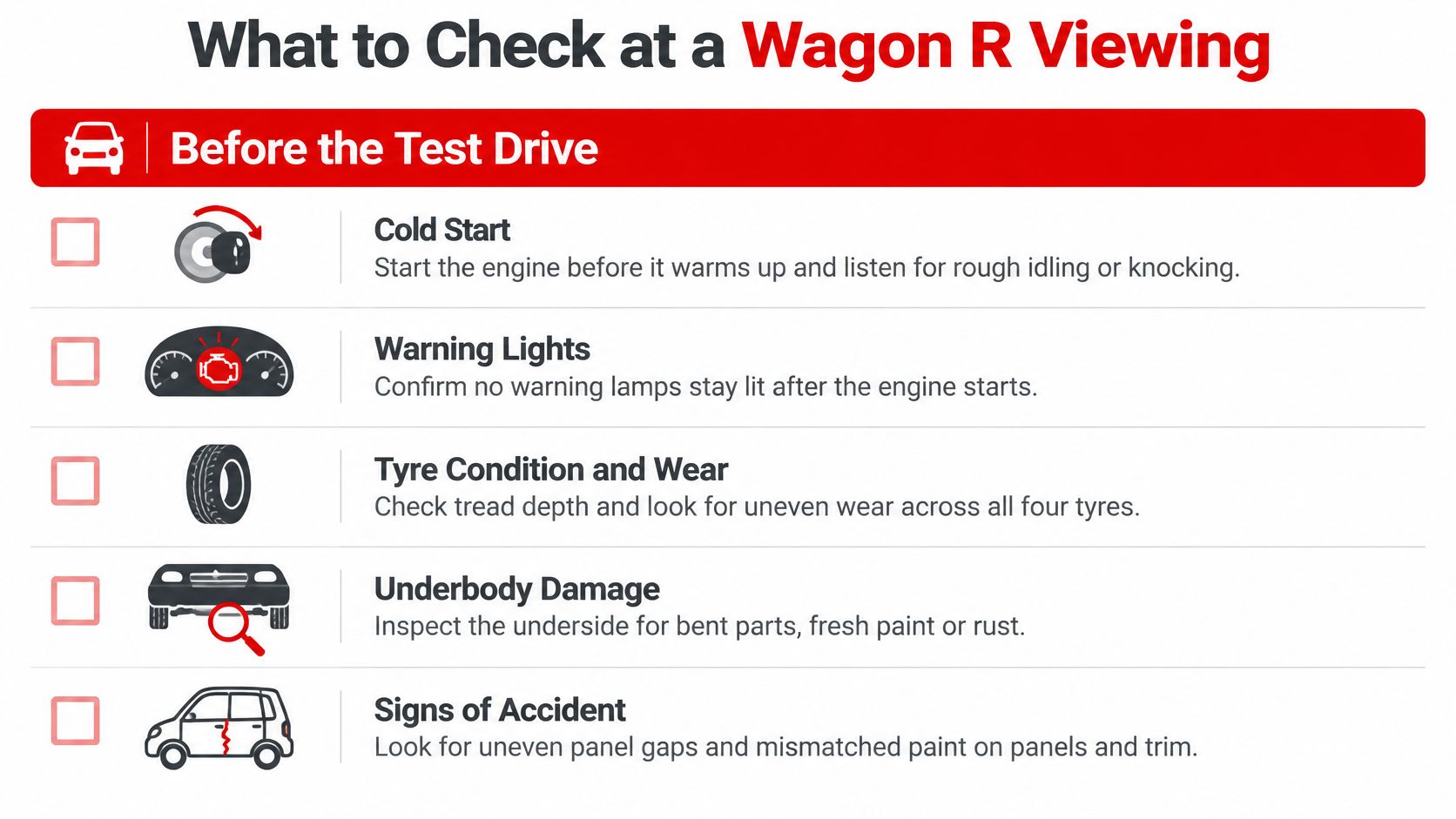
Before the test drive
- Cold start: Ask for the engine to remain cold before arrival and listen for rough idling or unusual knocking.
- Warning lights: Check that relevant lamps illuminate during the initial check and extinguish appropriately after starting.
- Tyres: Look for uneven wear, sidewall damage and inconsistent tyre condition.
- Underbody: Inspect for bent components, corrosion, impact damage and suspicious fresh coatings.
- Accident repairs: Examine panel gaps, paint matching, welds and disturbed fasteners.
Don't dismiss a warning lamp because the car still drives. Establish the cause with diagnostic testing rather than accepting an explanation that it only needs resetting.
During the test drive
- Brakes: Check for pulling, vibration, unusual pedal feel and grinding.
- Steering: Assess whether the vehicle tracks consistently without excessive play or vibration.
- Suspension: Listen for knocks and rattles over an appropriate road surface.
- Transmission: Check engagement and acceleration for delay, shudder, slipping or warning messages.
Test the car under conditions that resemble your intended use. A brief movement around a yard won't tell you enough about braking, steering or transmission behaviour.
Under the bonnet and against the records
- Leaks: Look around the engine and underneath for fresh fluid traces.
- Wiring: Identify loose connections, improvised repairs and unexplained aftermarket wiring.
- Mileage history: Compare the odometer with dated service records and maintenance receipts.
- Hybrid system: Arrange a separate assessment of battery condition and stored warnings where applicable.
Ask the mechanic to separate urgent safety work, necessary maintenance and optional improvements. Those categories affect your decision differently: a cosmetic issue can wait, while an unresolved braking fault changes whether the car should be driven.
The inspection doesn't establish a market price on its own. It helps you judge whether the asking figure remains reasonable after likely repair expenditure is included.
We offer in-person showroom viewing at Garden City Mall in Nairobi. Arrange a visit so you can examine the vehicle before committing to a price.
Running Costs, Parts and Resale Value
The purchase price is only part of ownership cost. A cheaper car can require more cash after purchase, while a more expensive specification won't necessarily recover its premium through lower fuel expenditure.
For fuel budgeting, ask for owner-recorded consumption, with the driving conditions explained. Receipts are most useful when they can be matched to distance travelled; a fuel receipt alone doesn't establish economy.
Match the engine to your actual journeys
Assess the smaller Japanese-market engine and larger-engine versions against your normal passenger load, gradients and cruising requirements. Don't assume that the smallest engine is automatically the least expensive choice for every journey.
During the test drive, check acceleration with the air conditioning operating and consider how the car responds when joining faster traffic. Cabin practicality and road clearance also deserve attention if your daily route includes rough access roads.
For a hybrid, evaluate the expected fuel benefit alongside battery condition and possible future repairs. Without a battery assessment and a credible replacement quotation, you can't confidently decide whether the purchase premium makes financial sense.
Ownership-cost test: Choose the car you can maintain properly, not merely the one whose purchase price uses up your available cash.
Servicing and parts determine the practical budget
Follow the maintenance schedule for the exact engine and transmission. Confirm the correct fluid specifications rather than assuming that a product suitable for another automatic gearbox is appropriate.
Keep receipts showing the date, work completed and parts fitted. Ask whether replacement components are genuine or aftermarket, and have the garage explain the quality and suitability of the proposed part.
Before buying an unfamiliar specification, ask a garage to identify routine service parts and any component already showing signs of wear. Establish availability, likely sourcing time and an actual quotation rather than accepting a general assurance that parts are easy to find.
Resale starts with the records you keep
Clear ownership and maintenance records help a future buyer understand what they're purchasing. They don't guarantee a selling price, but they reduce the uncertainty that otherwise gives buyers reasons to negotiate.
If you're also budgeting for another compact hatchback, our Vitz price guide offers a separate reference point. For the Wagon R itself, compare purchase cost, immediate repairs, routine servicing and your expected use before paying extra for equipment you may not need.
Check the Price Before You Commit
An advertised figure is the start of the calculation, not the answer. Before accepting it, put these questions to the seller:
- Which vehicle does it describe? Establish the year, complete chassis identity and exact powertrain. Two Wagon Rs with the same sticker price can differ on all three.
- Does the specification support the price? Check whether the mileage, trim and condition justify its position in the planning band.
- Can ownership be completed cleanly? Resolve missing or inconsistent documents before any money moves.
A seller who answers clearly gives you something to compare. A vague answer leaves you pricing an assumption rather than a car.
Compare the cash commitment
Ask for the agreed price, inclusions and exclusions in writing. Keep a separate allowance for work identified during inspection rather than treating every available shilling as purchase money. When two cars carry similar asking prices, the one with verified records and fewer immediate repairs is usually the cheaper buy, even before negotiation.
For owners considering a sale, Brill Motors offers vehicle valuation and trade-ins. A valuation prices your actual vehicle, which is more useful than assuming an advertised asking price equals what another buyer will pay. You can reach the team by phone or WhatsApp on +254 758 243 058 to discuss a viewing, valuation or trade-in.
Brill Motors provides showroom viewing, vehicle valuation and trade-ins for buyers and sellers in Kenya. View current stock at Brill Motors, or visit the showroom at Garden City Mall in Nairobi to examine a vehicle before agreeing a price.