

 SIGN UP
A buyer comparing two Sylphys of the same year may find one priced far above the other. The difference can reflect condition, mileage and import status, not just the badge or model year. For imported cars, engine size, transmission and tax also affect the amount due, so a headline Nissan Sylphy price in Kenya cannot tell the whole story.
Start by checking what each car's price includes. Mileage and service records help indicate how much wear to expect, while the body condition and paperwork can reveal further costs or risks. Engine size and transmission matter too, particularly when comparing an imported car's purchase price with its landed cost. A lower asking price may leave room for repairs or charges; a higher one needs support in the vehicle's condition and documents.
Compare like with like, then judge the specific car against its price band. The year gives you a starting point, but condition, import status and paperwork determine whether the figure makes sense.
Nissan Sylphy Price Ranges in Kenya by Year
A buyer comparing two Sylphys can use the bands below to shortlist a model year, then check whether the asking price fits the car's specification and records. These are indicative estimates for locally used cars, not valuations for individual vehicles.
Indicative Nissan Sylphy price ranges in Kenya by model year
| Model year | Indicative locally used range | What moves the price |
|---|---|---|
| 2010 to 2013 | KSh 590,000 to KSh 900,000 | Mileage, body condition and service records |
| 2014 to 2016 | KSh 860,000 to KSh 1,550,000 | Engine size, trim level and mileage |
| 2017 to 2019 | KSh 980,000 to KSh 1,950,000 | Mileage, accident history and import status |
| 2020 and newer | Request a current quote | Specification and available stock |
How to read the bands
Prices near the lower end often reflect higher mileage, worn paint, limited service records or maintenance due soon. At the upper end, buyers may find lower mileage, cleaner bodywork, more equipment and documents that are easier to check. A price above the band calls for a clear explanation supported by the car's specification and condition. A low asking price should also prompt questions about upcoming repairs.
Year is only one part of the comparison. For example, a well-kept 2014 with low mileage and full service records may attract more interest than a 2017 with heavy use and accident repairs. The model year helps set expectations, while the car's condition and history help explain its position in the range.
Foreign used examples may cost more than locally used cars of the same year because their asking prices can include freight, duties, clearing and registration. Check which of those costs are included before comparing the two categories. Similar differences apply when comparing saloons such as the Sylphy with other models. The guide to Toyota Allion prices in Kenya offers a reference point for another saloon across different years and conditions.
Practical rule: Choose a year range that fits your budget, then assess the car's mileage, service records and documents together before deciding whether its price is reasonable.
For 2020 and newer models, request a current quote because prices depend on the specification and stock available. Brill Motors sells locally used and foreign used cars from its Garden City Mall showroom in Nairobi.
What Changes the Price of the Same Model Year
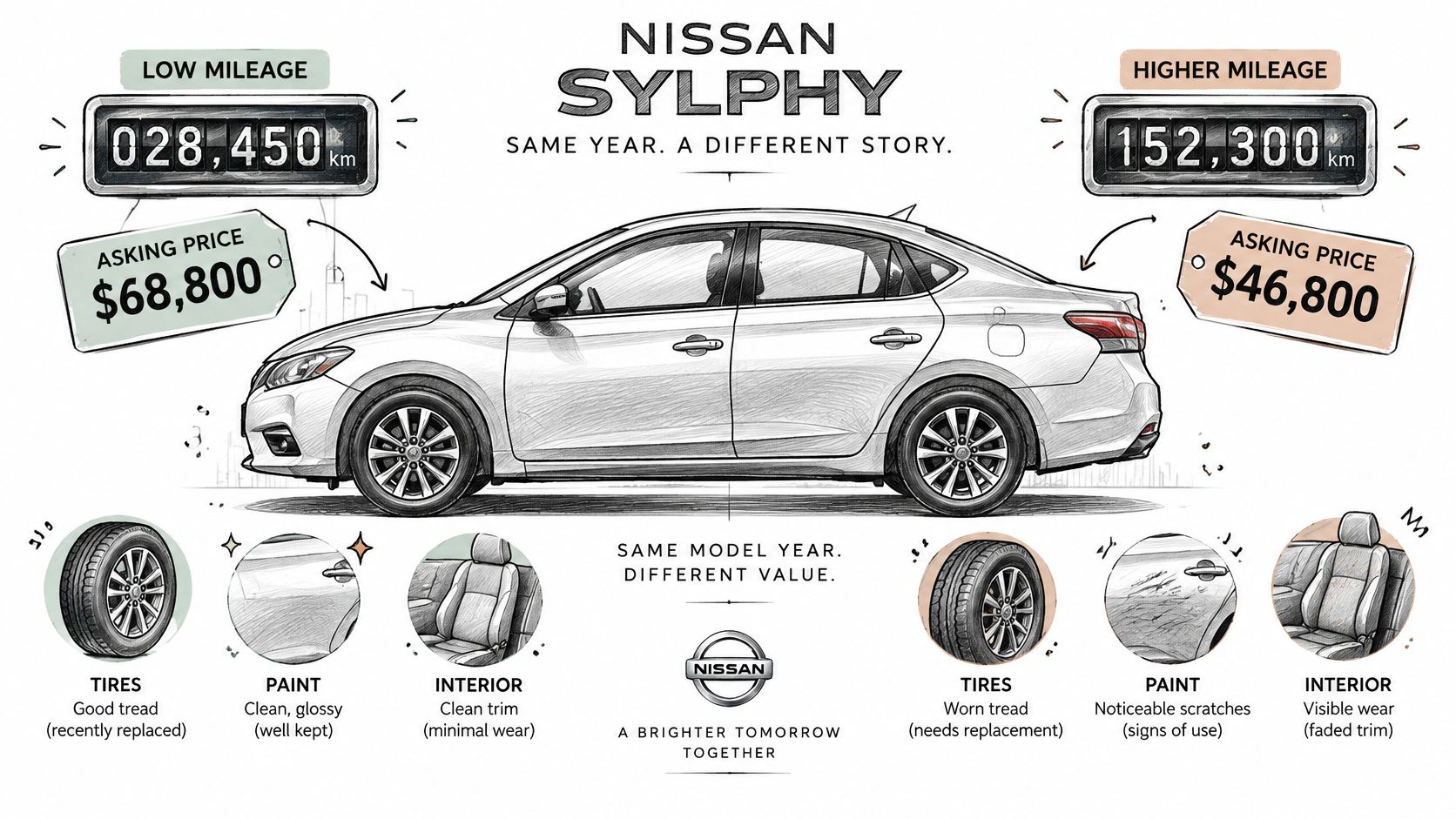
A lower-mileage Sylphy with clean paperwork may be priced well above a higher-mileage car of the same year. Compare the actual vehicles, not just the year in the advert. Mileage, condition, import status, trim and documentation each help explain the difference.
The five factors ranked
- Mileage: A 2019 car showing under 30,000 km has less recorded use than a 2019 car past 100,000 km. The higher-mileage vehicle may be closer to major engine, transmission or suspension repairs, so check its service records and condition before treating a lower price as a saving.
- Condition and accident history: Check for uneven panel gaps, paint that looks thicker on one panel, overspray on rubber trims, and colour differences between a door and a wing. These signs can point to repairs beneath a fresh finish. An honest scratch may matter less than poorly repaired accident damage.
- Import status: A foreign used car's price can include freight, duty, clearing and registration. A locally used car has Kenyan road use instead. Confirm which category the car belongs to and what costs are included before comparing asking prices.
- Trim and equipment: Higher grades may have different safety equipment, seats, wheels and infotainment. Since adverts may use trim names inconsistently, inspect the fitted equipment rather than relying on the headline.
- Documentation: Check that the logbook, chassis number, ownership record and service history match the car and seller. Walk away if the paperwork does not match the vehicle.
For example, Brill Motors lists a locally used 2008 Toyota Wish at KSh 950,000 and a locally used 2008 Toyota Premio at KSh 1,190,000, a KSh 240,000 difference between two cars of the same year. They are different models, so the comparison does not establish a Sylphy price gap. It does show why year alone cannot explain an asking price. Rank the factors for the specific car, then use an inspection to check whether its price reflects its condition and records.
Engine Size, Import Duty and Landed Cost
Engine size is where a Sylphy's price stops being about the car and starts being about tax. Two cars of the same year can produce different landed costs because one engine falls into a higher excise band.
Nissan Sylphy engine size and what it means for import cost
| Engine | Excise band (KRA) | Effect on imported cost | Confirm before buying |
|---|---|---|---|
| 1.5-litre petrol | 1,500cc and below | Lower excise rate applies | Engine capacity on the logbook |
| 1.8-litre petrol | Above 1,500cc | Higher excise rate applies | Engine capacity and tax computation |
| Other engine sizes | Set by exact capacity against the 1,500cc threshold | Excise follows the band the capacity falls into | Confirm with KRA or a licensed clearing agent |
Read the engine from the logbook
Don't take the engine size from an advert. Mislabelled capacity is a common source of quoting errors, and trim names differ between markets, so a grade badge doesn't guarantee a particular engine. Match the logbook capacity to the physical car, then match the grade to the equipment fitted.
The Kenya Revenue Authority guidance on importing a motor vehicle describes 20% excise for vehicles of 1,500cc and below and 25% for vehicles above 1,500cc. The same guidance explains that the CIF figure comprises the invoice value, insurance and freight charges, and that the current retail selling price can be determined using KRA's current retail selling price matrix and valuation template.
That last point catches buyers out. The customs valuation isn't necessarily your invoice price, since KRA may deduce value from the Current Retail Selling Price. A cheap overseas invoice therefore doesn't guarantee a cheap tax bill.
The landed cost sequence in order
Work through an import quotation line by line, in this sequence:
- Vehicle price at origin.
- Freight and insurance to Mombasa, which together with the vehicle price form the CIF value.
- Import duty on the customs value.
- Excise duty, set by the engine band in the table.
- VAT, charged on the CIF value plus import duty and excise duty.
- Import declaration and railway levies on the CIF value.
- Port and clearing charges.
- Registration and number plates in Kenya.
The KRA customs and border control FAQs list import duty of 25% of the customs value, VAT at 16% on the CIF value plus import duty and excise duty, an Import Declaration Fee of 2% of CIF and a Railway Development Levy of 1.5% of CIF. Because common Sylphy variants include 1.5-litre and 1.8-litre petrol engines, the 1.8-litre version may fall into the higher excise band.
Rates and levies change, so confirm every current figure with KRA or a licensed clearing agent before you rely on a quotation. Our overview of imported cars for sale in Kenya explains how this applies across models.
Ask for a written drive away estimate that shows each line separately. Two offers are only comparable when both include the same lines.
What you pay on top of the car price
Buyers are responsible for registration fees, logbook transfer charges, number plates, insurance, inspection or roadworthiness certification, and import duty and port fees for imported units. Budget for those items from the start, and ask for the export invoice, freight and insurance evidence, the KRA valuation basis and the tax computation for any imported unit. A Sylphy that looks cheaper before those documents often isn't cheaper after them.
Choosing a Sylphy by Budget
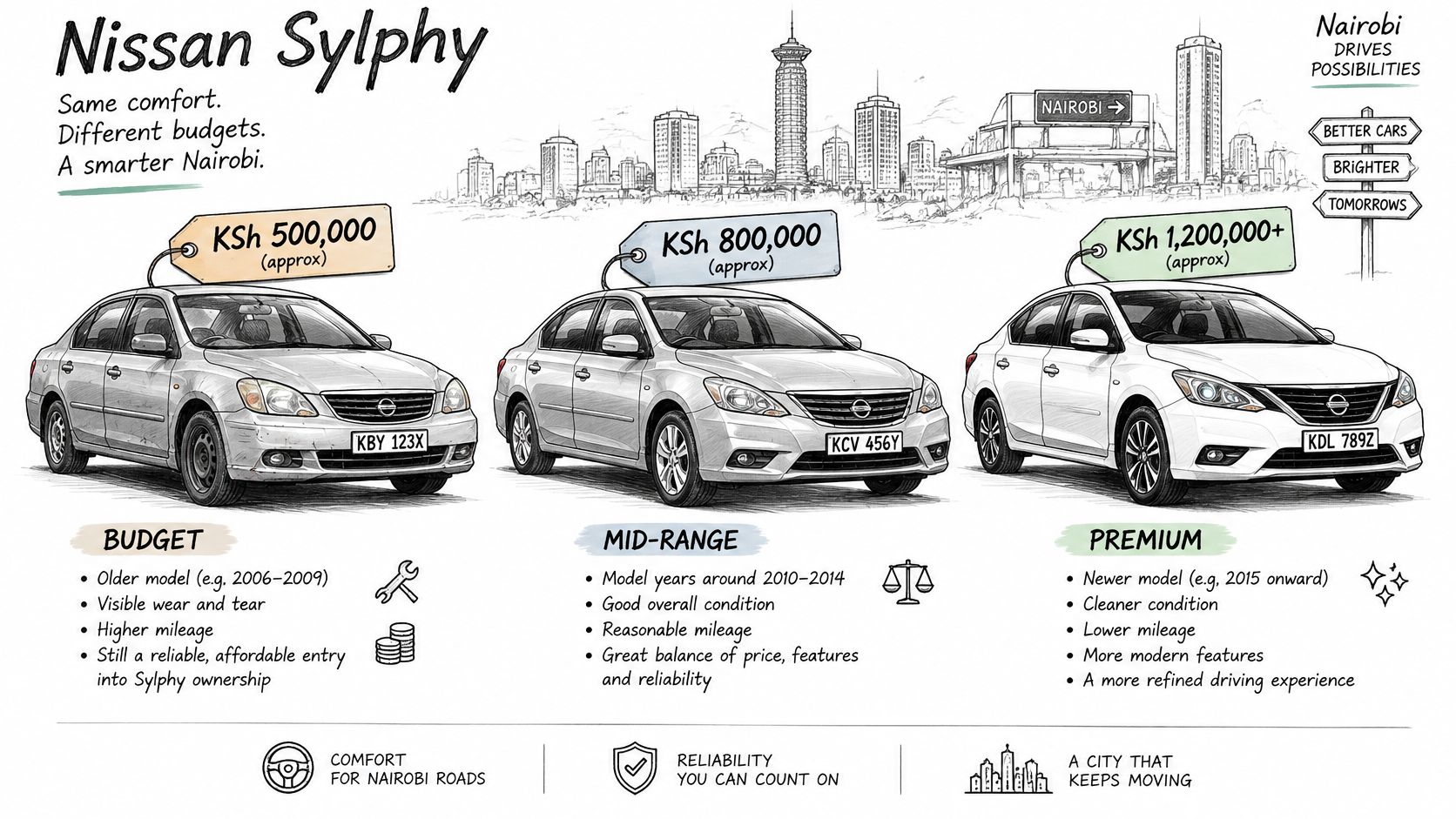
A lower purchase price can leave less room for repairs, while a higher one may reflect newer age or better documentation. Treat these budget bands as working guides, then weigh each car's mileage, condition and import status.
Under about KSh 1,000,000
At this level, expect older cars or higher mileage. Deferred maintenance may mean several repairs are due together, including work on the suspension, brakes or transmission. An independent pre-purchase inspection with a diagnostic scan can reveal issues that should factor into your offer and repair budget.
Around KSh 1,500,000
This working band can offer more choice across model years and grades. Compare mileage and service records carefully: a newer car with limited maintenance evidence may carry more risk than an older, well-documented one. For context on what else buyers may find at this budget, see these affordable cars for sale in Kenya.
Around KSh 2,000,000
This band may include newer examples, but the advertised price alone does not establish a car's condition or value. Check whether its mileage, equipment and maintenance records support the premium, and consider whether it is imported or locally used when comparing options.
A Sylphy above these working bands can still make sense if its condition and documentation justify the difference. Brill Motors buys trade-in vehicles, so buyers can ask about current stock and trade-in options.
Running Costs and Automatic Transmission Ownership
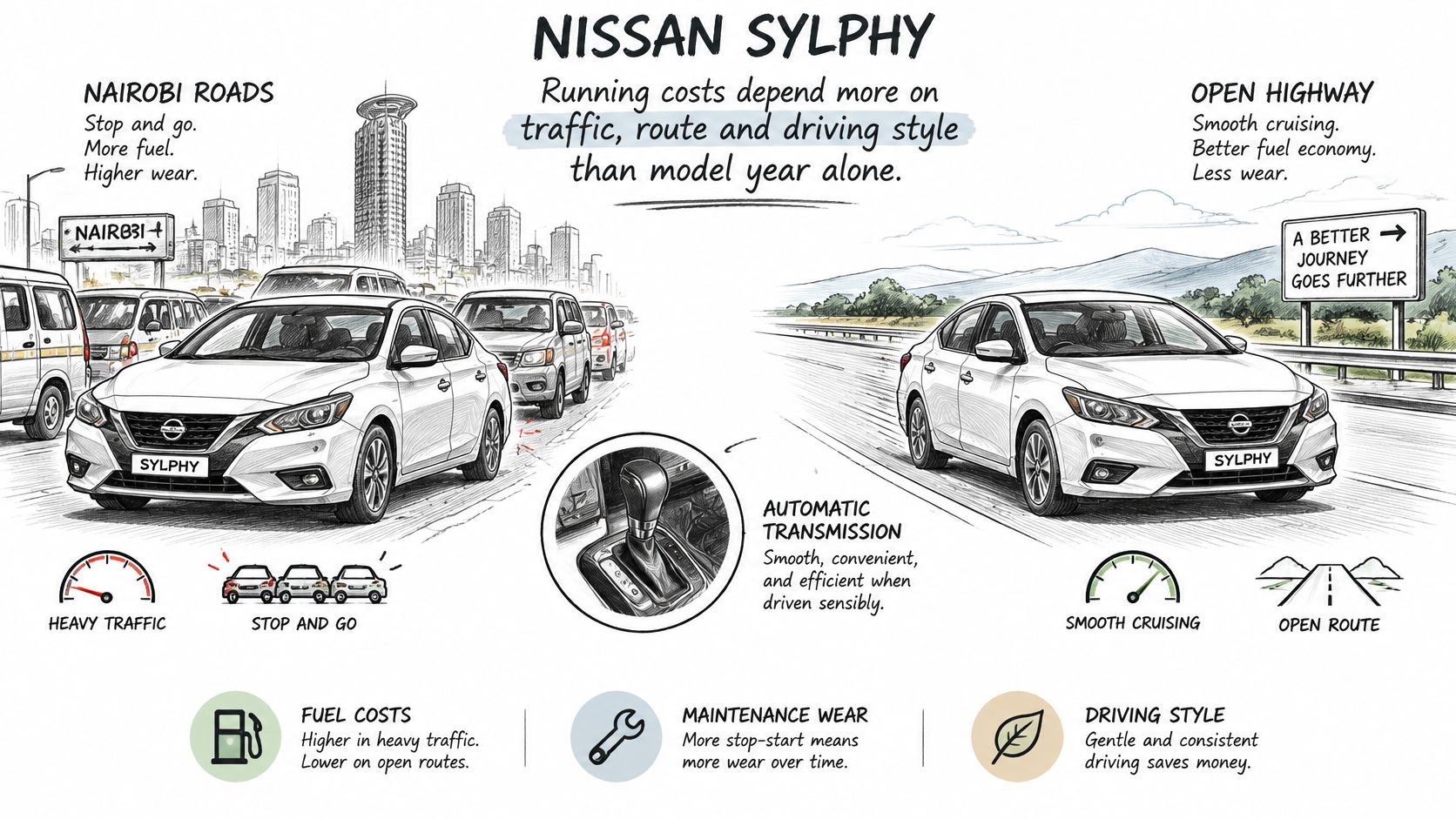
A Sylphy used for a slow Nairobi commute can cost more to fuel than the same car driven steadily on an open road. Monthly running costs depend on route and driving conditions as well as engine size, transmission condition and maintenance history.
Fuel use in Nairobi traffic
Stop-and-go traffic increases fuel consumption compared with steady highway driving because the engine repeatedly accelerates from rest and spends time idling. The 1.8-litre petrol and 1.5-litre petrol versions may therefore have different fuel costs, but without a comparable test or a measured route, a fixed difference cannot be stated. For a realistic budget, track your weekly distance and base the estimate on the traffic conditions you face.
The CVT question
Many Sylphys use a continuously variable transmission, or CVT. It provides smooth acceleration, but relies on the correct fluid and timely servicing. Ask for records showing fluid changes. Shuddering, whining or slow engagement can point to fluid problems or wear.
If records are missing, allow for a fluid service and a professional transmission check when setting your offer. On a test drive, check that the car moves away cleanly, accelerates without judder and holds speed without the revs fluctuating.
A simple monthly running cost plan
- Fuel: Estimate weekly kilometres using your regular route, especially if you spend much of the commute in traffic.
- Insurance: Request a quote for the specific Sylphy before agreeing on its purchase price.
- Routine service: Set aside money for a service after purchase if the maintenance history does not confirm when it was last completed.
- Repair reserve: Keep a monthly allowance for tyres, brakes, suspension and cooling-system repairs.
For a CVT Sylphy, the transmission record deserves particular attention in that first-year budget. If the service history is incomplete, account for the cost of checking and servicing the transmission before deciding whether the asking price leaves enough room for ownership costs.
Common Faults and Weak Points to Look For
A knock over a speed hump is a reason to inspect the suspension before discussing price. Suspension wear can also show up as uneven tyre wear or loose steering. Struts, bushes and ball joints may need replacement, so get a repair estimate if the car knocks during a test drive.
In stop-start traffic, brake wear can build quickly. Check for pulsing through the pedal and a lip on the edge of the discs, both signs that the discs may need attention. Include their condition in your assessment of the car.
Cooling system condition matters in traffic, where overheating can turn a minor repair into a larger concern. Inspect the radiator, hoses and water pump for signs of wear. Watch the temperature gauge during a longer drive and ask when the coolant was last changed.
With an automatic, note any judder when pulling away, delay before drive engages, or whine that rises with road speed. These symptoms can point to fluid condition or transmission wear. Compare them with the service records before deciding what the car is worth.
Accident repairs can affect value and may conceal structural damage. Use the body-condition checks described earlier when assessing the panels.
Test the electrical and comfort equipment before you make an offer. Check the infotainment system, air conditioning, every window and both mirror controls. Price any faulty feature into your offer, rather than finding out after purchase.
Inspection and Paperwork Before You Pay
A Sylphy with clean documents and a matching chassis number is easier to assess than one with a gap between its paperwork and physical identity. Imported road vehicles entering Kenya are subject to inspection. The Kenya Bureau of Standards road vehicle inspection code of practice states that all imported road vehicles are subject to inspection and only right-hand-drive vehicles shall be allowed into the country.
Check that the vehicle's identity, steering position, roadworthiness and safety compliance agree with its documents. For the tax computation, export invoice and valuation basis, use the guidance in the landed-cost section. This checklist focuses on confirming the car you inspect is the car described in its records, and assessing its condition before payment.
One consolidated checklist
- Chassis number: Match it across the car's body, logbook and import documents. Any discrepancy requires investigation.
- Engine capacity: Check the logbook against the engine fitted to the car.
- Registration and ownership records: Confirm the seller has the right to sell and that the ownership history is clear.
- Cold start: Start the engine when cold. Listen for rattles, smoke or an uneven idle that clears as it warms.
- Diagnostic scan: Stored fault codes can reveal problems that a short drive may not show.
- Test drive: Check automatic shifts, listen for suspension noise over humps and confirm the car brakes in a straight line.
When to stop
If the chassis number on the car does not match the number on its documents, stop the purchase, whatever the price.
Arrange an independent pre-purchase inspection before paying a deposit. It costs far less than a transmission repair or an ownership dispute. Ask the inspector for written findings, then use each finding to discuss the offer. A written report makes specific faults and follow-up questions clear to both parties.
Check Live Sylphy Prices at Brill Motors
The figures in this guide are indicative. A Sylphy's current price depends on its year, grade, mileage, condition and whether it is locally or foreign used. Check live listings to compare the cars available now, then assess each vehicle on its own details.
Brill Motors sells locally used and foreign used cars, and has a showroom at Garden City Mall in Garden City, Nairobi. You can call or WhatsApp +254 758 243 058 to enquire about a specific car or arrange a viewing.
If you have a car to sell or exchange, Brill Motors buys vehicles directly from owners and accepts trade-in vehicles. Ask for a vehicle valuation alongside your Sylphy enquiry so you can compare the value of your current car with the price of the one you are considering.
Start by browsing current Nissan listings and filtering by budget. Shortlist a few options, then compare mileage, engine size and service records rather than relying on model year alone. Before paying a deposit, arrange a viewing and an independent inspection.
Browse current Nissan stock and compare prices by year and budget at Brill Motors. Shortlist cars that fit your budget, then call or WhatsApp us to arrange a viewing and inspection.