

 SIGN UP
The invoice price is only the first layer of the Subaru Outback price in Kenya. A locally used car and a foreign-used import carry the same model name yet trade in different tiers, because the import's advertised figure includes every cost of getting it registered in Kenya while the local car's figure largely does not. Treat any range you see quoted as indicative for 2026, and confirm the price of a specific car against live listings.
The overseas asking price is a weaker anchor than it looks. On a simplified import calculation, a car invoiced at a KSh 2,000,000 customs value builds like this:
| Stage | Amount (KSh) |
|---|---|
| Overseas invoice (customs value) | 2,000,000 |
| Landed total, still before two further levies, port charges, clearing and registration | 3,625,000 |
The invoice accounts for barely more than half of the landed total. The rest accumulates at the border, before dealer margin and before registration is finished, which is why two Outbacks advertised at the same money can sit on very different cost bases.
A sound comparison therefore separates three numbers: what the car is worth in Kenya for its year, mileage and condition; what it cost to land and register; and what the chosen engine and drivetrain will cost to run each month.
Current Subaru Outback Price Range in Kenya
The advertised price of a Subaru Outback in Kenya only makes sense once you know which market the car sits in. A locally registered 2012 car, a foreign-used 2018 import and a low-mileage 2021 XT carry the same model name yet compete in different price tiers, and the bands below reflect that split.
Indicative Subaru Outback price bands in Kenya, 2026
The ranges below are sampled from advertised asking prices for Outbacks across Kenyan used-car listings and dealer stock.
| Category | Typical model years | Indicative price (KSh) | Main price driver |
|---|---|---|---|
| Locally used, 2.5-litre petrol | 2010 to 2014 | 1,000,000 to 1,800,000 | Age, mileage and service history |
| Locally used, 2.5-litre petrol | 2015 to 2018 | 1,500,000 to 2,400,000 | Mileage, condition and accident history |
| Foreign used, 2.5-litre petrol | 2016 to 2019 | 2,300,000 to 2,900,000 | Landed cost, mileage and documentation |
| Foreign used, XT turbo or late model | 2019 to 2021 | 2,900,000 to 4,500,000 | Engine variant, trim and equipment |
| Newer foreign used or low mileage | 2022 onwards | Above 4,500,000 | Year, mileage and import status |
Treat these bands as indicative ranges rather than live quotes, and compare them with current vehicles on our Subaru listings, where stock changes as cars arrive and sell.
How to read the bands
A car at the top of its band should earn that position. Look for lower mileage supported by records, a clean body, working equipment, consistent service history and clear registration status. A car near the bottom may still be sound, though you should expect higher mileage, older tyres, worn suspension parts, incomplete records or costs that have yet to be folded into the quoted figure.
Position within a band also signals where your money goes. A locally used car priced high in its range usually arrives with Kenyan registration settled and maintenance evidence you can inspect. A foreign-used car at the top of its range carries landing and duty costs already paid, so the premium reflects expenses a cheaper import would push onto you after purchase. The band tells you where to start asking questions, and the condition evidence decides whether the asking price holds up.
Budget rule: Keep part of your budget back for inspection findings, servicing, tyres and transfer costs. Spending every shilling on the purchase price leaves no room to correct deferred maintenance.
With KSh 1,500,000 to KSh 2,000,000, you are usually choosing between an older locally used Outback and a younger car with higher mileage or more history to verify. Condition and evidence should drive that choice, since a well-documented older car can cost less to own than a newer one with gaps in its records.
Our shop lists 116 vehicles available, and listings can be filtered by makes including Audi, BMW, Honda, Isuzu, Lexus, Mazda, Mercedes-Benz, Mitsubishi, Nissan, Peugeot, Porsche, Subaru, Suzuki, Toyota, Volkswagen and Volvo. Filter first by budget and body needs, then examine individual Outbacks against the bands above.
Price Drivers Beyond Tax and Depreciation
Mileage moves value only when you read it against maintenance evidence. Say two 2016 Outbacks are offered side by side. One shows 60,000 km less and carries full dealer stamps, invoices for gearbox servicing and matching tyres. The other has gaps in its records and needs tyres. The first car can justifiably cost more because the buyer is purchasing lower near-term risk, not just a smaller odometer number.
A high-mileage car with complete records can also be better value than a low-mileage car with no history. Mileage tells you how much use components may have had, while records show whether fluids, brakes, suspension parts and scheduled items were replaced on time.
Trim, equipment and working condition
The standard 2.5-litre, XT turbo and Wilderness versions occupy different price positions. A sunroof, leather seats, reversing camera, parking sensors and driver-assist safety systems can lift value, but only when they work properly. Faulty electronics don't add value just because they appear in an advertisement. They add a repair estimate that should be deducted from what you're willing to pay.
Accident history has a similar effect. Mismatched paint, uneven panel gaps, overspray on rubber trims and inconsistent panel dates point to previous repair. A professionally repaired cosmetic scrape is different from structural damage, so the question is repair quality and extent. A clean, straight car normally commands more because the next buyer will apply the same discount when you sell.
Provenance and deal terms
A locally used car may have Kenyan service invoices, previous-owner history and a registration trail you can test. A foreign-used unit may present well but require closer checks on its import and mileage documentation. Neither origin guarantees condition. Provenance matters because it changes how much of the car's past you can verify.
Seller terms can also make identical headline prices unequal. Confirm whether a figure includes registration, transfer and any outstanding import costs. A lower price that excludes items you'll still have to pay isn't lower in total.
For a fixed budget, rank the drivers this way:
- Mechanical and accident condition: The largest immediate risk to your budget.
- Verifiable mileage and service history: Evidence that supports or undermines the asking price.
- Included costs: Registration, transfer and import status change the final total.
- Trim and equipment: Valuable after the first three items check out.
- Colour and cosmetic extras: The weakest reason to stretch a budget.
Tax determines what an import cost to bring in. These drivers determine whether one specific car deserves its position within the Kenyan band.
Engines, Trims and Fuel Use by Variant
Variant choice changes both purchase price and monthly spend. The 2025 model year gives a consistent basis for comparing fuel ratings, while the engine outputs show why performance versions should be judged on purchase price and fuel budget together.
Subaru Outback engine, transmission and fuel use by variant, 2025 model year
| Variant | Engine | Power | Torque | Transmission | Highway (L/100 km) | City (L/100 km) |
|---|---|---|---|---|---|---|
| Standard 2.5-litre | 2.5-litre boxer, direct injection | 180 hp | 178 lb-ft | Lineartronic CVT | 7.35 | 9.05 |
| XT turbo | Turbocharged direct injection | 260 hp | 277 lb-ft | Lineartronic CVT | 8.11 | 10.69 |
| Wilderness | Turbocharged direct injection | 260 hp | 277 lb-ft | Lineartronic CVT | 9.05 | 11.20 |
The Subaru published specification identifies the standard engine as a 2.5-litre, direct-injection, four-cylinder horizontally opposed BOXER engine producing 180 horsepower and 178 lb-ft of torque, paired with a Lineartronic continuously variable transmission. The same source gives the turbocharged engine 260 horsepower and 277 lb-ft of torque, with both configurations using symmetrical all-wheel drive.
That drivetrain is central to running costs. You are maintaining an all-wheel-drive system and a CVT rather than a simpler two-wheel-drive estate layout. On XT and Wilderness versions, you are also maintaining a turbocharged direct-injection engine.
What the fuel figures mean in Kenya
The official Subaru specification for the 2025 Outback rates the standard 2.5-litre at 32 miles per US gallon on the highway and 26 miles per US gallon in city driving, the XT at 29 highway and 22 city MPG, and the Wilderness ratings convert to approximately 9.05 L/100 km highway and 11.20 L/100 km city. Converted approximately, the standard figures are 7.35 and 9.05 L/100 km, while the XT figures are 8.11 and 10.69 L/100 km.
These are laboratory estimates, and Nairobi use can sit above them. Traffic, all-wheel-drive operation, tyre pressure, load, air-conditioning use and the condition of the CVT and engine can all raise real-world consumption.
Use your own distance before choosing. For 1,500 km of mixed driving in a month, estimate a blended consumption between the city and highway figures, divide the distance by 100, multiply by that consumption, then multiply the litres by the pump price on the day you budget. The XT uses roughly 0.8 to 1.6 additional litres per 100 km in these ratings, so its stronger overtaking performance carries a recurring cost.
A cheaper XT can lose its purchase-price advantage through fuel spend if most of your driving is slow urban work.
Matching variant to buyer
Choose the 2.5-litre for commuting and lower running costs. It gives adequate performance without the XT's higher fuel rating. Choose the XT if you regularly overtake on highways, travel with full loads or value the extra torque enough to fund it monthly. Consider the Wilderness for rough access roads, accepting the highest fuel figures in this comparison.
Confirm the engine, gearbox and drivetrain against vehicle-identification records, not the badge or trim name in an advertisement. For an Outback, the premium only makes sense when the variant's capability matches the roads and loads you carry.
Landed Cost of an Imported Outback
An overseas price becomes a Kenyan price through a sequence of charges applied to expanding subtotals. That compounding is why the final amount surprises buyers who add one tax percentage to the invoice.
CIF means the vehicle invoice value plus insurance and freight. The Kenya Revenue Authority guidance on importing a motor vehicle states that imported vehicles attract import duty of 25% of the CIF customs value. For vehicles above 1,500cc, covering most Outback petrol variants, it gives excise duty at 25% of the customs value plus import duty, then VAT at 16% of customs value, import duty and excise duty combined.
Illustrative landed-cost charges on a KSh 2,000,000 CIF import
| Charge | Basis | Example amount (KSh) |
|---|---|---|
| CIF value | Invoice value plus insurance and freight | 2,000,000 |
| Import duty | 25% of CIF | 500,000 |
| Excise duty | 25% of CIF plus import duty | 625,000 |
| VAT | 16% of CIF, import duty and excise duty | 500,000 |
| Import Declaration Fee | 3.5%, basis to confirm with KRA | 70,000 on a CIF-only illustration |
| Railway Development Levy | 2%, basis to confirm with KRA | 40,000 on a CIF-only illustration |
| Subtotal of CIF, duty, excise and VAT | Before IDF, RDL, port, clearing and registration | 3,625,000 |
Work through it in order. Import duty is KSh 500,000. Excise duty is then calculated on KSh 2,500,000, producing KSh 625,000. VAT applies to the resulting KSh 3,125,000 and adds KSh 500,000. The subtotal reaches KSh 3,625,000 before the Import Declaration Fee and Railway Development Levy.
Why the invoice may not settle the tax bill
KRA may value a vehicle under its Current Retail Selling Price, or CRSP, framework rather than accepting the purchase invoice as the final taxable basis. Two similar cars bought at different overseas prices can therefore produce closer Kenyan tax bills than the buyer expected. A cheap auction result doesn't automatically create a cheap landed car.
Rates and policy treatment can change, and the basis for each levy should be confirmed with KRA or a licensed clearing agent before money is committed. Our guide to imported cars for sale in Kenya is useful background when comparing an already-landed car with one you'd import yourself.
Taxes aren't the only additions. Budget separately for freight, marine insurance, port charges, clearing, inspection, registration and dealer margin. Ask for written confirmation of which items a quoted Kenyan price already includes. Insurance premiums, government charges and third-party fees are not automatically refundable by us, so a buyer shouldn't assume those amounts can be recovered if a transaction changes.
The practical lesson is direct. Compare imports on their fully landed and registered totals, and compare locally registered cars on purchase plus transfer and immediate maintenance. Comparing an overseas invoice with a Kenyan showroom price mixes two different stages of the same process.
How Age Affects Used Outback Valuation
Age changes customs value through a fixed depreciation schedule before condition is considered. The Kenya Revenue Authority public notice on used motor vehicles sets out depreciation from 20% for vehicles more than one year up to two years old to 65% for vehicles more than seven up to eight years old.
KRA depreciation by age of used vehicle
| Age since manufacture or first registration | Depreciation applied |
|---|---|
| More than 1 up to 2 years | 20% |
| More than 2 up to 3 years | 30% |
| More than 3 up to 4 years | 40% |
| More than 4 up to 5 years | 50% |
| More than 5 up to 6 years | 55% |
| More than 6 up to 7 years | 60% |
| More than 7 up to 8 years | 65% |
The calculation applies depreciation to the Current Retail Selling Price according to years since manufacture or first registration. A larger depreciation percentage removes more of the CRSP before customs value is established. That lower customs value then flows through the tax calculation.
Why exact dates matter
Consider a car sitting just either side of a band boundary. A small difference in its recorded first registration date can move it from one depreciation band into the next, changing customs value by a full step rather than by a few days' worth of value. Model year alone is too blunt for this calculation.
Record these items separately for every car:
- Model year and first registration: Both affect age classification.
- Engine displacement and trim: These identify the variant being valued.
- Drivetrain and mileage: Core specification and use indicators.
- Auction condition and service history: Evidence used to adjust for the individual vehicle.
A single model-wide price hides those distinctions. It also makes a trade-in discussion harder because the dealer must value the actual car, its local registration status and its condition, not an average Outback.
For dealership valuation or trade-in purposes, the defensible benchmark is a landed-cost calculation adjusted for registration status and condition, not a foreign auction price alone. We offer vehicle valuation for sellers and trade-in support for buyers exchanging a current car.
If you're comparing the Outback with its saloon relative, the breakdown of Subaru Legacy price in Kenya shows the same valuation logic applied to a different body style. The important point remains the exact age basis, because one registration date can change the starting number before negotiation begins.
Is an Outback Worth the Premium for Your Use
The Outback earns its premium when you regularly use its space, ground clearance and all-wheel drive. It is harder to justify if you pay for those features but spend nearly all your time in slow Nairobi traffic, where fuel, parking, tyres and routine servicing dominate the cost of ownership.
For city commuting, the estate body is practical, but its size can be a constraint in tight parking. Fuel consumption will sit closer to the city side of the official ratings when journeys involve long queues and air-conditioning. A buyer doing short urban trips should therefore scrutinise the premium over a smaller or simpler car.
Upcountry use changes the answer. Gravel, broken access roads, wet surfaces and loaded family trips make ground clearance and standard all-wheel drive more valuable. They don't make the Outback immune to pothole damage. Suspension condition, tyre sidewalls, underbody protection and wheel alignment still determine whether the car can handle rough roads without generating repair bills.
Apply a three-step test
- Identify the main use: Classify your driving as city, mixed or rough road based on where most kilometres will be covered.
- Compare running costs: Use the variant fuel figures to estimate monthly spend for the 2.5-litre against the XT or Wilderness.
- Price the benefit: Decide whether extra space, clearance or power solves a recurring problem in your routine.
Ownership costs extend beyond fuel. Keep tyres matched and confirm the correct size is available within your budget. Set aside money for CVT servicing, all-wheel-drive components, suspension wear and imported parts where local stock is limited. A locally used car may have a clearer parts and service trail, while a Japanese foreign-used unit may need more checking to establish what has already been replaced.
Decision test: If all-wheel drive and load space would only matter twice a year, you're probably buying capability you won't use often enough to justify its running costs.
A city-focused buyer seeking lower costs will usually find the 2.5-litre the better fit. A buyer travelling upcountry regularly or carrying full loads may reasonably pay more for the Outback formula. Comparing it with the Forester price in Kenya also helps if you're deciding between the Outback's longer estate body and a more upright SUV shape.
Pre-Purchase Inspection Checklist for an Outback
Inspect the individual car, not the model reputation. An Outback can present cleanly while hiding worn suspension, mismatched tyres or an unhealthy CVT, and those items quickly change the value calculation.
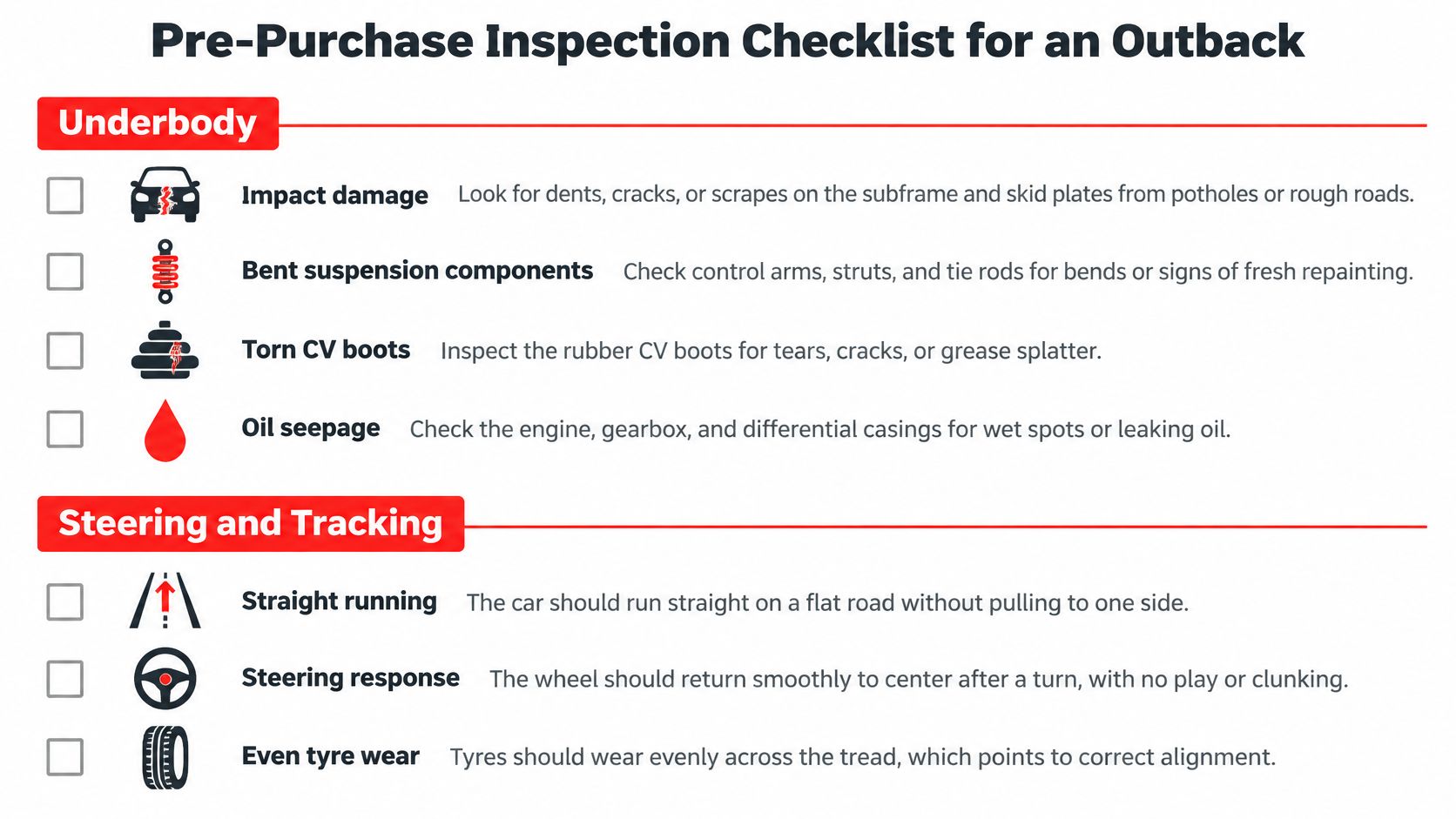
Underbody and steering
- Impact damage: Look beneath the front and rear for scraped, dented or freshly painted components.
- Suspension components: Check for bent arms, damaged struts and torn bushes.
- CV boots: Inspect for splits, cracks and grease thrown around the joint.
- Oil seepage: Look for wet areas around the engine, gearbox and differentials.
- Straight tracking: On a level road, the car should run straight without pulling.
- Steering feel: There should be no vibration, clunking or excessive free play.
Drivetrain, tyres and engine
- CVT engagement: Take-up should be smooth from stationary, with no delay or shuddering during acceleration.
- Temperature behaviour: Watch for overheating signs during a longer test drive.
- Warning lights: Confirm lights illuminate at start-up and clear as they should.
- Tyres: Make, size and tread depth should match closely, with no uneven wear across the tread.
- Oil leaks: Inspect visible seals and the ground after the car has stood.
- Cold start: Listen for abnormal noise, smoke or unstable idling from cold.
Matching tyres matter because differences in rolling circumference can place additional stress on an all-wheel-drive system. Uneven wear may also reveal alignment, suspension or previous impact problems that need pricing into the deal.
Equipment and fit
Test the reversing camera, parking sensors, tailgate operation and roof rails. The 2024 Subaru Outback specification lists dimensions converting to approximately 4.87 metres long, 1.88 metres wide, 1.68 metres high with roof rails and 2.75 metres between the axles.
- Parking fit: Measure your home and workplace spaces against those dimensions.
- Visibility aids: Confirm camera image, sensor response and mirror adjustment.
- Load access: Open and close the tailgate repeatedly and check its struts or powered operation.
- Specification check: Compare equipment with the specific model year rather than assuming every import is identical.
Road test the car on a hill and through a stop-start section. The hill exposes weak acceleration, CVT behaviour under load and cooling problems. Stop-start driving reveals hesitation, brake judder, steering knocks and electrical faults that a short compound drive can hide.
We have a showroom at Garden City Mall in Nairobi where customers can view vehicles in person. Bring a mechanic for a full inspection before payment, and price any findings into your offer instead of treating them as problems to solve after purchase.
Confirm the Paperwork Before You Commit
Documents determine whether the car you've inspected is the car you're legally and financially buying. Request them before paying a deposit, while you can still walk away without trying to unwind the transaction.
Ask for the logbook and confirm its status. For an imported car, request proof of import duty payment, the customs valuation basis and inspection documentation. Check the first registration date because it affects age classification, then compare the service history with the mileage record for gaps, inconsistent figures or evidence that scheduled work was skipped. A sale agreement is only binding when the buyer is at least 18 years old and legally competent under Kenyan law, so confirm the names on the contract match the person paying.
Confirm inclusions and warranty terms in writing
Ask which costs the advertised price includes. Registration, transfer and import charges should be identified individually, not covered by a vague statement that the car is ready. If anything remains payable, add it to the purchase price before comparing the car with another Outback.
Selected vehicles come with an 8-month warranty covering specific mechanical or structural issues, as set out in the warranty policy provided during the sale. Ask for the applicable terms in writing before paying and confirm what is covered for that specific vehicle. If a term offers a replacement vehicle instead of a repair, check how the price difference is settled: where the replacement costs more the buyer pays the difference, and where it costs less the difference is refunded or credited.
The warranty adds to your statutory position rather than replacing it. Under Kenyan law, a refund is required where the vehicle was materially misrepresented or a substantial qualifying defect cannot be repaired within a reasonable time.
Don't treat a verbal assurance as a substitute for the logbook, tax evidence, service records and written sale terms.
Practical next steps
- Request the file early: Ask for the logbook, duty evidence and service records for any Outback on your shortlist before money changes hands.
- Confirm a specific vehicle: Reach us by phone or WhatsApp at +254 758 243 058 to check availability and documents.
- Value your current car: Ask about a valuation or trade-in if you are selling an existing vehicle, since we buy trade-in vehicles from customers.
- Price the financing: Assess any loan against the full cost, including insurance, immediate servicing and any amount the loan does not cover. A manageable monthly payment does not make an overpriced or poorly documented car good value.
The strongest purchase is rarely the lowest advertised Subaru Outback price in Kenya. It is the car whose year, mileage, condition, variant, landed status and paperwork can all be verified, with enough money left to run it properly. When you are ready to compare a specific Outback against the checks above, browse the current Subaru stock and book a viewing at the Garden City Mall showroom through Brill Motors.