

 SIGN UP
Subaru Legacy prices in Kenya vary widely, from around KSh 685,000 for an older 2001 model to over KSh 2.3 million for a 2012 example, so buyers must compare condition, mileage and import status rather than year alone. If you've been scrolling through adverts this week, you've probably already felt that confusion. Two cars with the same badge can look similar in photos, yet one costs more than double the other, and neither seller is necessarily wrong.
That spread is normal for this model in Kenya. The Legacy has been sold here for many years, in saloon and estate forms, with different engines, gearboxes and trim levels, and through very different routes into the country. Once you understand how those routes affect tax, condition and paperwork, the prices start to make sense and you can judge value properly instead of chasing the newest year plate.
Why Subaru Legacy Prices Vary So Much in Kenya
You search for a Legacy on your phone after work and the results don't line up. One car is priced like a small hatchback, the next costs as much as a newer SUV, and a third car that's several years newer sits somewhere in between. It's tempting to assume someone's overcharging, but in most cases the gap reflects real differences you can't see in a thumbnail.
What Actually Moves the Price
Model year matters, but it's only one part of the picture. A clean, well serviced older car with genuine mileage and complete paperwork can be worth more than a newer car with accident repairs, a tired gearbox or missing service records. Sellers price what they believe a buyer will pay for that specific unit, not for the nameplate in general.
Import status changes the cost base completely. A foreign used Legacy has passed through purchase, freight, inspection and Kenyan taxes, while a locally used car carries a history of Kenyan fuel, roads and maintenance. Neither route is automatically better, but they shouldn't be compared as if they were identical.
Other factors stack up quickly:
- Condition and mileage: Interior wear, suspension noise, oil leaks and tyre condition all point to money you'll spend after purchase.
- Engine and drivetrain: Engine size affects duty on imports, and all wheel drive components add cost when they need repair.
- Location and urgency: A seller in Nairobi with ready stock and clean documents can ask more than someone selling urgently upcountry.
- Registration status: A car that's fully registered and ready to transfer is worth more than one with paperwork still pending.
A cheap Legacy that needs immediate work on the gearbox, tyres and suspension is rarely cheap once you've finished paying for it.
That's why a single headline figure for Subaru Legacy price in Kenya would mislead you. You need price bands, then you need to place each car you view inside the right band based on evidence, not hope.
Current Price Ranges for Subaru Legacy Models
A buyer I spoke to recently couldn't understand why a 2019 Legacy 2.5i AWD was advertised at KSh 977,500 while a 2012 model on another listing sat at KSh 2,390,000. That inversion is real, and it tells you more about this market than any average figure could.
Real asking prices show how wide the spread runs. A 2001 Subaru Legacy has been listed at KSh 685,000, other examples have sat around KSh 1,254,000, and the top of the observed range reaches KSh 2,399,999. Sorted by price, the observed listings look like this:
| Model Year | Asking Price | Notes |
|---|---|---|
| 2001 | KSh 685,000 | Older locally available example |
| 2019 | KSh 977,500 | Legacy 2.5i AWD, foreign used example |
| Example in range | KSh 1,254,000 | Mid band asking price |
| 2012 | KSh 2,390,000 | Higher priced example |
| Example in range | KSh 2,399,999 | Top end asking price |
The gap between the lowest and highest figures is KSh 1,705,000, roughly 248.9% above the older car's asking price. That's a market with bands, not a tariff.
The 2019 car is the lesson worth keeping. It undercuts a car seven years older because trim, auction condition, tax already paid and how the seller acquired the unit all feed into the final ask. Sort listings by year alone and you will overpay for some cars and wrongly dismiss others.
For budgeting purposes, the market splits into three working bands. Below KSh 1 million you mostly find older or higher mileage cars that reward a thorough inspection before you commit. Between KSh 1 million and KSh 1.5 million is the busiest range, where two similar looking cars can differ sharply in condition and history, so viewing matters most here. Above KSh 2 million you should expect newer or better specified examples with paperwork strong enough to justify the ask.
Treat every figure above as an asking price rather than a verified completed sale. Confirm the specific car, its documents and its condition in person before you treat any number as a valuation.
How Import Taxes and Duties Shape the Final Price
Most foreign used Legacies reach Kenya through the import market, and that history explains a large part of the final price. A U.S. International Trade Commission review reported that 82.6% of Japan's motor vehicle exports to Kenya in 2019 were used vehicles, worth US$444.4 million out of US$538 million in total Japanese motor vehicle exports to Kenya. The same review noted used vehicles historically accounted for as much as 85% of Kenya's automobile market.
That Japan linked supply matters because many Kenyan foreign used Subaru vehicles come through that channel. The price you see in Nairobi therefore starts long before the car reaches Thika Road. It includes the overseas purchase cost, freight, insurance, exchange rate movements and Kenyan taxes applied in sequence.
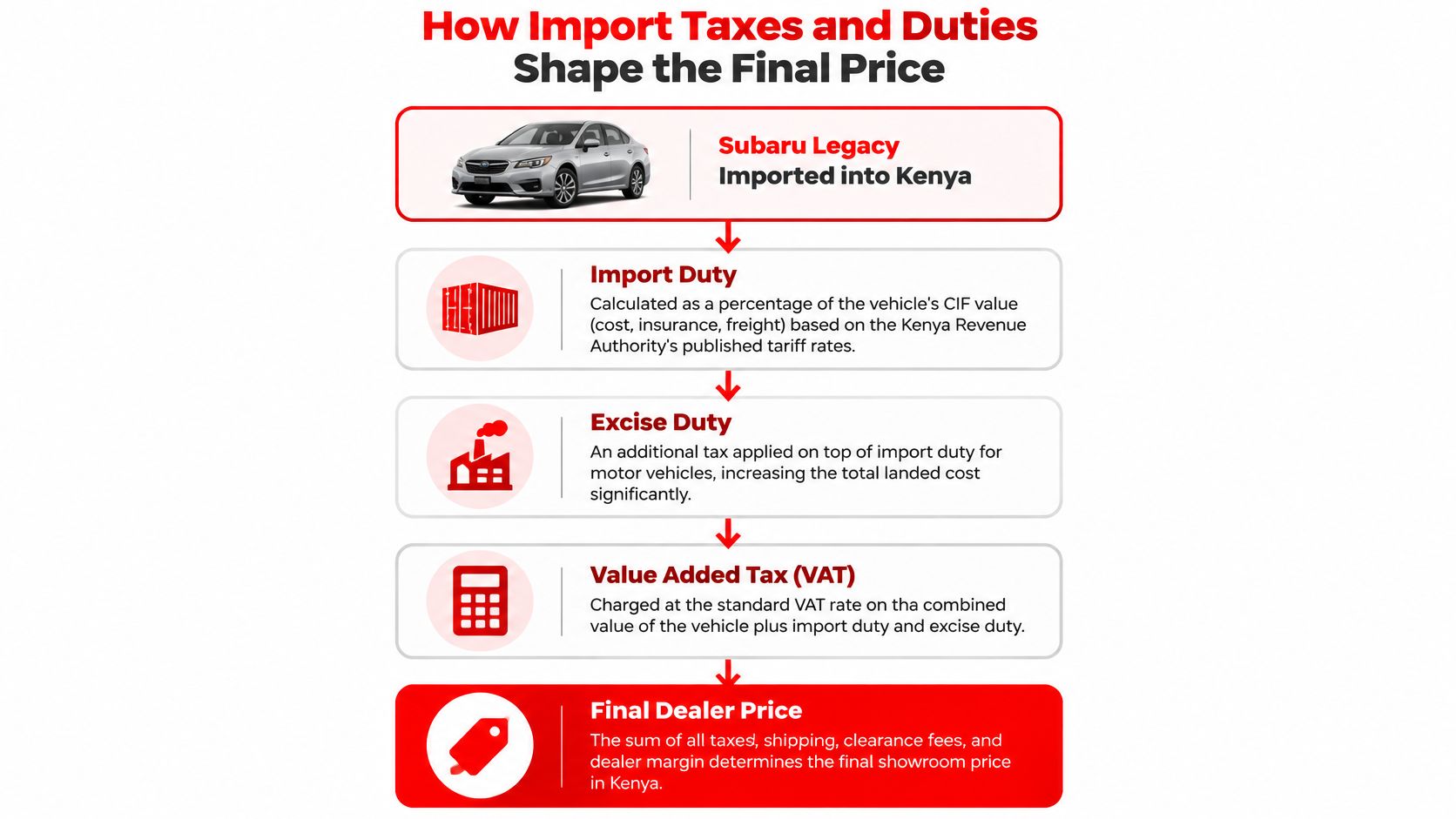
Tax policy has also changed over time. Kenya previously replaced a flat duty of KSh 200,000 for cars older than three years and KSh 150,000 for newer cars with a 20% value based levy in the 2016/17 budget period. Under Kenya Revenue Authority guidance on motor vehicle import procedures, import duty is listed at 25% of customs value, excise duty at 20% of the relevant tax base, and VAT at 16%, plus Import Declaration Fee and Railway Development Levy charges.
Why Overseas Prices Mislead
Buyers often compare a Nairobi asking price with an overseas advert and wonder where the difference went. The answer is cumulative tax. Each charge builds on the value before it, so the final landed cost rises faster than many first time buyers expect.
Practical rule: Never judge a Kenyan retail price against an overseas purchase price alone. Compare landed cost with landed cost.
Vehicle age and engine capacity also feed into the calculation, alongside CIF value and freight. Two Legacies bought abroad for similar money can land in Kenya at different total costs if their customs values or engine classifications differ. Confirm current rates with KRA or a licensed clearing agent before you import, because Finance Act changes can alter what you'll pay.
Understanding the Customs Valuation Process
Ask any clearing agent in Mombasa where first time importers get caught out, and valuation comes up fast. A Legacy bought cheaply at auction abroad doesn't get taxed on what you paid for it. Under KRA's explanation of motor vehicle import valuation, customs works from the vehicle's Current Retail Selling Price (CRSP), adjusted for depreciation. Your invoice goes in the file. The valuation base is CRSP.
That one detail changes how you should read every asking price. Two Legacies of the same year and spec can sell for very different money overseas, yet land at nearly the same customs value, because the CRSP reference for that model is fixed regardless of who negotiated harder. The reverse holds too. Pay a premium for a clean car and the valuation base stays anchored to CRSP, so the premium doesn't inflate your duty.
Once the customs value is set, the charges stack in a fixed order:
| Stage | What applies |
|---|---|
| Customs value | CRSP adjusted for depreciation |
| Import duty | 25% of customs value |
| Excise duty | 20% for engines up to 1,500 cc, 25% above 1,500 cc |
| VAT | 16%, applied after import duty and excise join the base |
| Final layer | Import Declaration Fee, Railway Development Levy, port handling, inspection, registration and inland transport |
Most Legacies on Kenyan yards sit above the 1,500 cc line, which places them in the higher excise bracket. Engine capacity alone can separate two outwardly similar cars by a meaningful amount of tax, before condition or mileage even enter the discussion.
So when a seller quotes an import price, ask for the full breakdown from customs value through registration, not just the CIF or auction figure. A dealer who hands over that paper trail gives you numbers you can verify line by line. A single overseas price gives you nothing to check.
Age Rules and Registration Requirements for Imports
Take two Legacies, both built in 2017. One was first registered in Japan that same year. The other sat unregistered until 2019. In an advert, both get described as "2017 models." Under Kenyan import rules, only one of them may still qualify to enter the country.
The ceiling comes from KEBS requirements for inspection of road vehicles: an imported used vehicle must generally be no more than eight years old from its year of first registration, and the year of first registration must sit within one year of the manufacture year. Our second car fails that second condition outright, whatever condition it is in.
That gap between dates is where buyers get caught. Sellers quote whichever year makes the car sound newer. Ask for both dates from the documents before you treat an asking price as realistic.
Cars That Age Out
A Legacy too old to import today is not worthless. Plenty of older ones already hold Kenyan plates, and they change hands constantly as locally used vehicles. The mistake is pricing one of them off fresh-import listings. An older registered car sells on its Kenyan service history and physical condition. Eligibility rules stop mattering once the car is already in the system.
KEBS also requires imported vehicles to pass inspection, with compliant cars receiving a certificate of roadworthiness. No certificate, no smooth registration. Paperwork delays on a car you have already paid for are expensive, so verify before deposit, not after.
Four questions to get answered in writing: What year was it first registered? What year was it manufactured? Does the certificate of roadworthiness match the chassis number on the car? Is it already registered here, or still clearing?
If you want the bigger picture of how imported cars for sale in Kenya move through this process, that guide covers it. For the specific Legacy in front of you, though, the documents beat any general rule.
Locally Used Versus Foreign Used Legacies
Every Legacy for sale in Kenya falls broadly into one of two groups, and the trade offs differ. A locally used car has already been registered and driven here. A foreign used car arrives through the import market and may be unregistered when you first view it. Price alone won't tell you which suits you better.
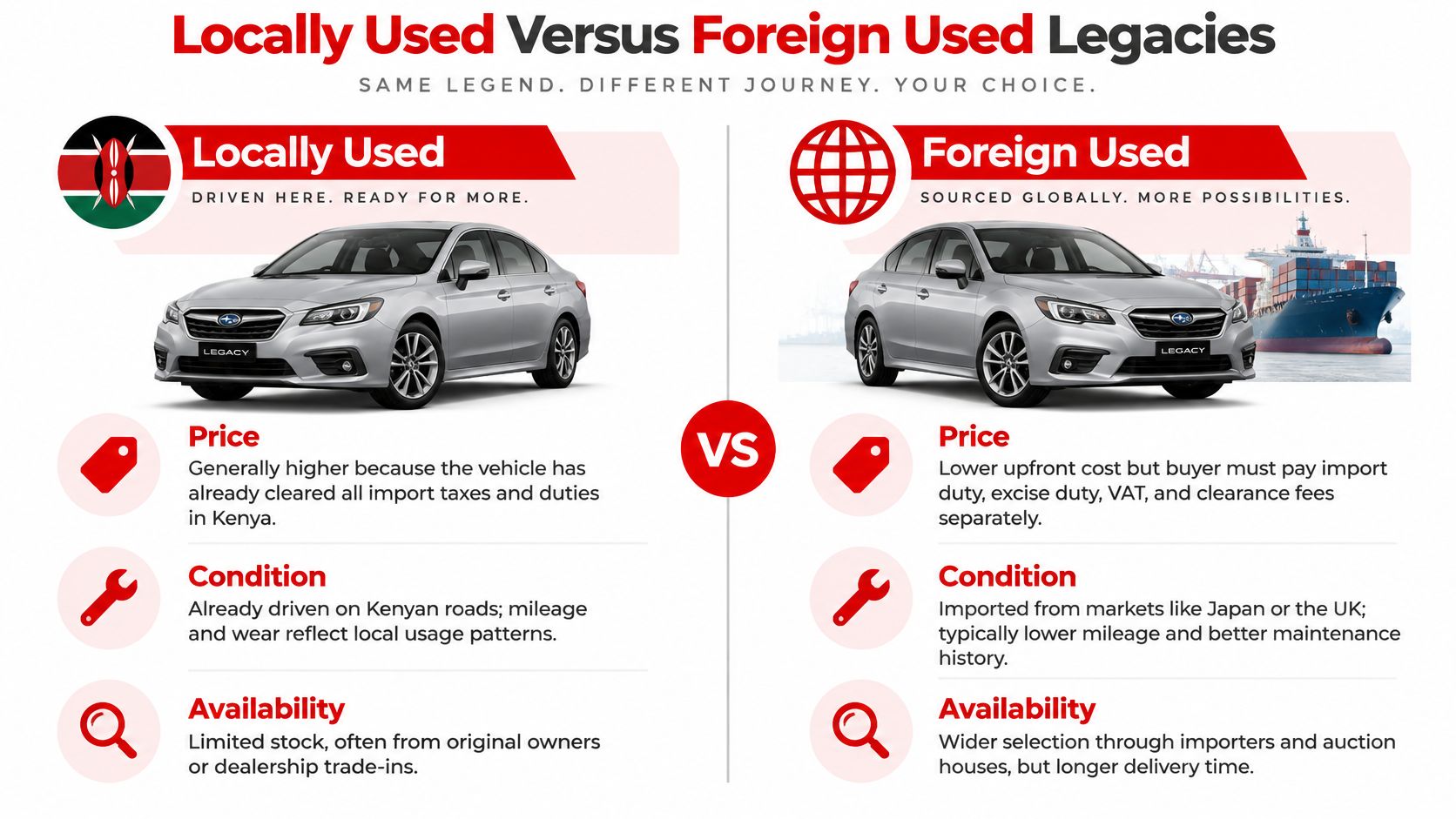
Locally used Legacies are often easier to verify in person. You can inspect how the car has coped with Kenyan roads, ask about local service history, and check the transfer documents directly. The downside is honest wear. Suspension components, tyres and interiors may show real local use, and mileage may be higher. That isn't a reason to walk away, but it should be reflected in the price.
Foreign used Legacies can present with lower mileage and cleaner interiors, depending on grade and source. The risk sits in what you can't easily verify, including prior accident repair, inconsistent mileage records, or gaps in import documentation. A tidy cabin doesn't prove a clean history, so paperwork checks carry extra weight here.
A Simple Way to Compare
- Locally used strengths: Immediate viewing, Kenyan registration history, easier transfer checks.
- Locally used risks: Higher wear, variable maintenance quality, older age profile.
- Foreign used strengths: Potentially lower mileage, wider choice of newer years within the import age limit.
- Foreign used risks: Import tax already embedded in price, documentation gaps, hidden prior damage.
The earlier example of a newer foreign used car priced below an older locally used one shows why you shouldn't assume either category is always cheaper. Condition, grade, specification and seller circumstances can reverse the expected order. If you're browsing locally used Subaru vehicles, compare each car on documents, inspection results and total cost to put right, not on category labels.
Buy the specific car in front of you, with its papers and faults visible, not the idea of a Legacy.
What to Check When Viewing a Subaru Legacy
A viewing is where an advertised price either holds up or falls apart. Take your time, view in daylight, and don't let a polished exterior rush you. The Legacy rewards careful inspection because its boxer engine and all wheel drive system are strengths when maintained and expensive distractions when neglected.
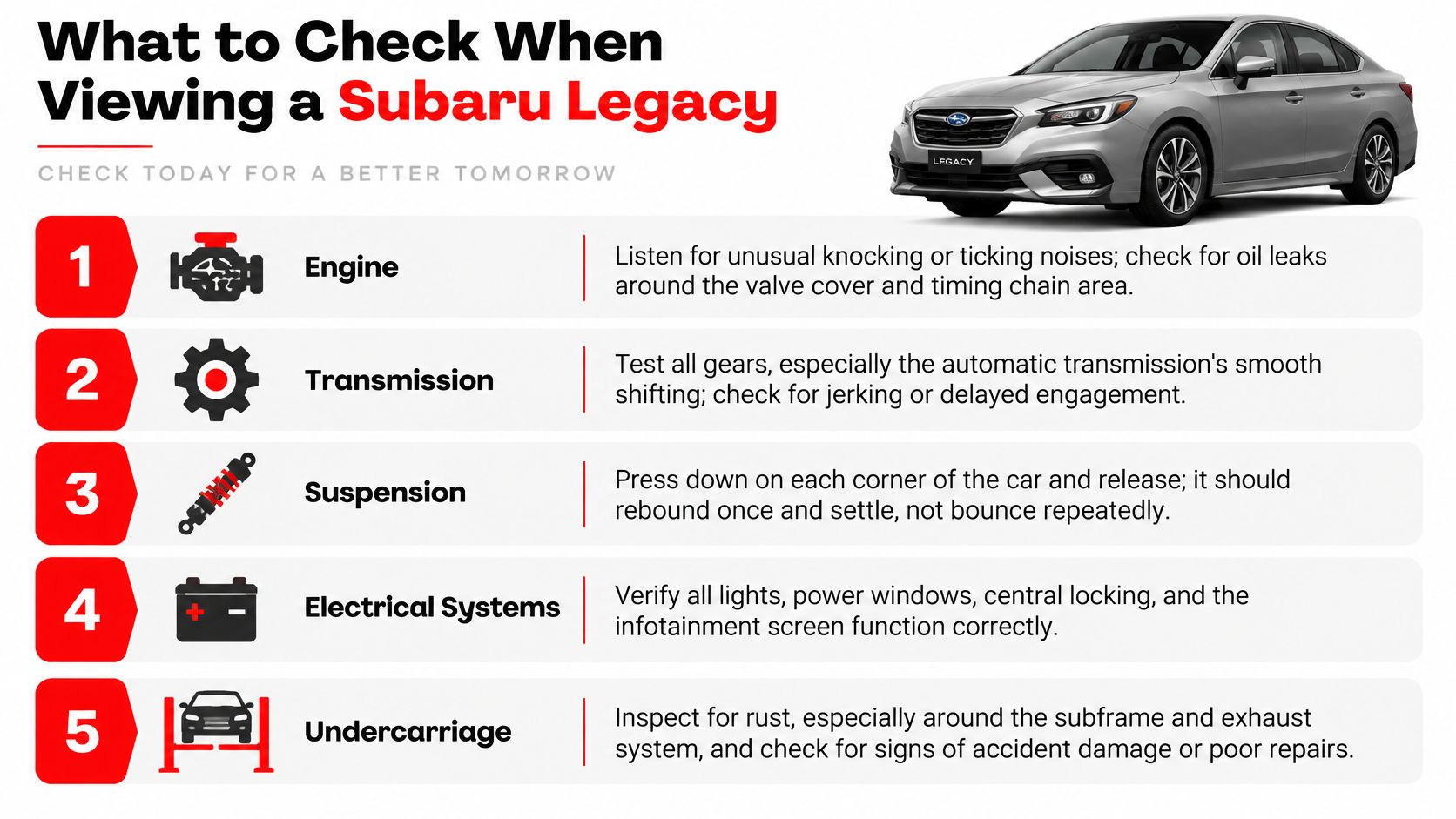
Use this checklist once, thoroughly, for each car you seriously consider:
- Engine start and idle: Start from cold, listen for knocking or ticking, and look for oil leaks, coolant loss or warning lights that stay on.
- Gearbox behaviour: Drive through all gears, check for jerking, hesitation, delayed engagement or harsh changes under light and firm acceleration.
- All wheel drive system: Test at low speed on full lock for binding or unusual noise, and ask when drivetrain fluids were last changed.
- Suspension and steering: Drive over uneven ground, listen for clunks, and check whether the car tracks straight without pulling.
- Body and undercarriage: Look for uneven panel gaps, mismatched paint, rust around arches and underneath, and signs of poor accident repair.
- Mileage consistency: Compare the odometer reading with pedal wear, seat condition, steering wheel shine and service records.
- Tyres and brakes: Uneven tyre wear can point to alignment or suspension issues, and mismatched tyres matter on an all wheel drive car.
- Electrics: Test lights, windows, locks, air conditioning, dashboard functions and any fitted infotainment system.
- Service history: A documented history with receipts carries more weight than verbal assurance, especially for oil and cooling system maintenance.
- Paperwork: Verify registration documents, import papers where applicable, and that identification numbers match the vehicle.
During the Test Drive
Drive long enough for the engine to reach normal temperature. Watch the temperature gauge, listen after you stop, and check again for leaks where the car was parked. If the seller discourages a proper drive or an independent inspection, treat that as information about the car, not just the seller.
A Legacy that passes these checks can justify a stronger price. One that fails several of them needs a discount large enough to cover repairs, plus a margin for the faults you haven't found yet.
Running Costs and Ownership Advice for Buyers
A buyer drives out of the yard having spent his full budget on the car itself. Three months later he is back asking about an engine job he cannot afford. I have watched that pattern repeat often enough in Nairobi yards to say it plainly: budget for the running costs alongside the purchase price.
Fuel is the cost you feel first. The Legacy's all wheel drive system adds traction and stability, but driving all four wheels uses more fuel than a comparable two wheel drive saloon, and slow Nairobi commuting widens the gap compared with steady highway driving. Judge the car against your actual route rather than brochure figures.
Servicing is where Legacies either stay cheap or get expensive. Use the correct engine oil, keep the cooling system in good order, and hold to proper intervals instead of stretching them to save small amounts. Older Subarus suffer when coolant condition, oil leaks and early signs of overheating get ignored, because that neglect turns manageable maintenance into major engine work. In my experience, service history shapes your monthly spend more than the year on the logbook. A well-kept older Legacy will usually cost less to run than a neglected newer one.
The smaller bills add up too. Tyres need consistent sizes and wear across the all wheel drive system, with alignment budgeted at replacement. Brakes and suspension wear faster on cars that have covered rough local roads. Insurance quotes vary by year and engine size, so get a figure for the specific car before you commit. Cheap, incorrect parts often cost twice when the job has to be repeated.
If you are weighing a taller Subaru instead, the guide to Forester price in Kenya compares budget and use case directly. The Legacy suits buyers who prefer saloon or estate handling with all weather traction, while the ownership discipline stays similar.
One habit pays off at resale. Keep records of every service and repair, because a documented history supports your asking price far better than a verbal summary when you sell or trade in.
Finding Your Subaru Legacy at Brill Motors
Once you know your price band, preferred engine size and whether you want locally used or foreign used, the search becomes much simpler. You're no longer comparing every Legacy advert in Kenya. You're looking for cars that match your budget, pass inspection and come with documents you can verify.
At Brill Motors, you can view vehicles in person at the Garden City Mall Rooftop Car Yard, Thika Road, Nairobi. Seeing the car at the yard lets you check condition, sit in it, start it from cold and ask direct questions about history and paperwork before you commit. That's a better basis for a decision than photos and a headline price alone.
Current stock and live prices change as cars arrive and sell, so use the general bands in this guide for planning and check current listings for the exact figure on a specific car. If you need help structuring the purchase, the services available include financing, vehicle valuation, trade ins and selling your car. A trade in can also simplify the move if you're replacing your current vehicle with a Legacy.
Bring your checklist, your budget ceiling and your questions about service history and registration. Take the test drive seriously, inspect the underbody and paperwork, and don't feel pressured to decide on the spot. A good Legacy will still look like good value after proper scrutiny. That's the standard you should apply to every car, whether it's priced below KSh 1 million or above KSh 2 million.
Visit Brill Motors to browse current Subaru stock and live prices, ask about financing or a trade in, and arrange a viewing for a Legacy that fits your budget. You can also come to the Garden City Mall Rooftop Car Yard on Thika Road in Nairobi to inspect cars in person, check the paperwork and take a proper test drive before you buy.