


 SIGN UP
About 80% of vehicles imported into Kenya are used, and imported used cars dominate Nairobi's retail market. That is why provenance and compliance matter before you pay a deposit.
Imported stock is not a side market in Kenya, it is the market. KRA puts annual vehicle imports at roughly 70,000 to 80,000 units, with about 80% used, and the International Energy Agency has also described Kenya's imported vehicle flow as overwhelmingly second-hand KRA. For a buyer scanning imported cars for sale in Kenya, that means the primary task is not just finding a nice-looking unit, it is separating clean paperwork from expensive problems.
Why imported used cars dominate the Kenyan market
A Nairobi buyer scanning saloons, hatchbacks, SUVs, or station wagons is usually looking at imported stock. That shapes everything that follows, from asking price to resale value, parts availability, and whether the car can be registered without surprises.
Imported vehicles dominate because the market is built around them. KRA notes that Kenya relies heavily on imports, and the practical effect is clear on the ground. Buyers expect to find the widest choice in imported stock, so sellers price, inspect, and present cars with that reality in mind KRA.
The resale side matters too. A model that is common on Kenyan roads is easier to move later, and a buyer usually has a better chance of finding body parts, trim pieces, and routine service items without waiting for weeks. Rare models can still be good buys, but they punish shortcuts. If the paperwork is weak or the trim is unusual, the next owner will ask harder questions.
That is why I tell buyers to treat provenance as part of the car itself. A clean body means very little if the export documents, inspection records, or customs trail do not line up. The headache usually starts at registration or clearance, not on the showroom forecourt.
For Nairobi buyers, the practical test is simple. Check whether the unit has a traceable history, whether the steering setup suits local use, whether the age on paper matches the condition in front of you, and whether the import trail looks complete enough to survive scrutiny.
Common import origins and what they mean for buyers
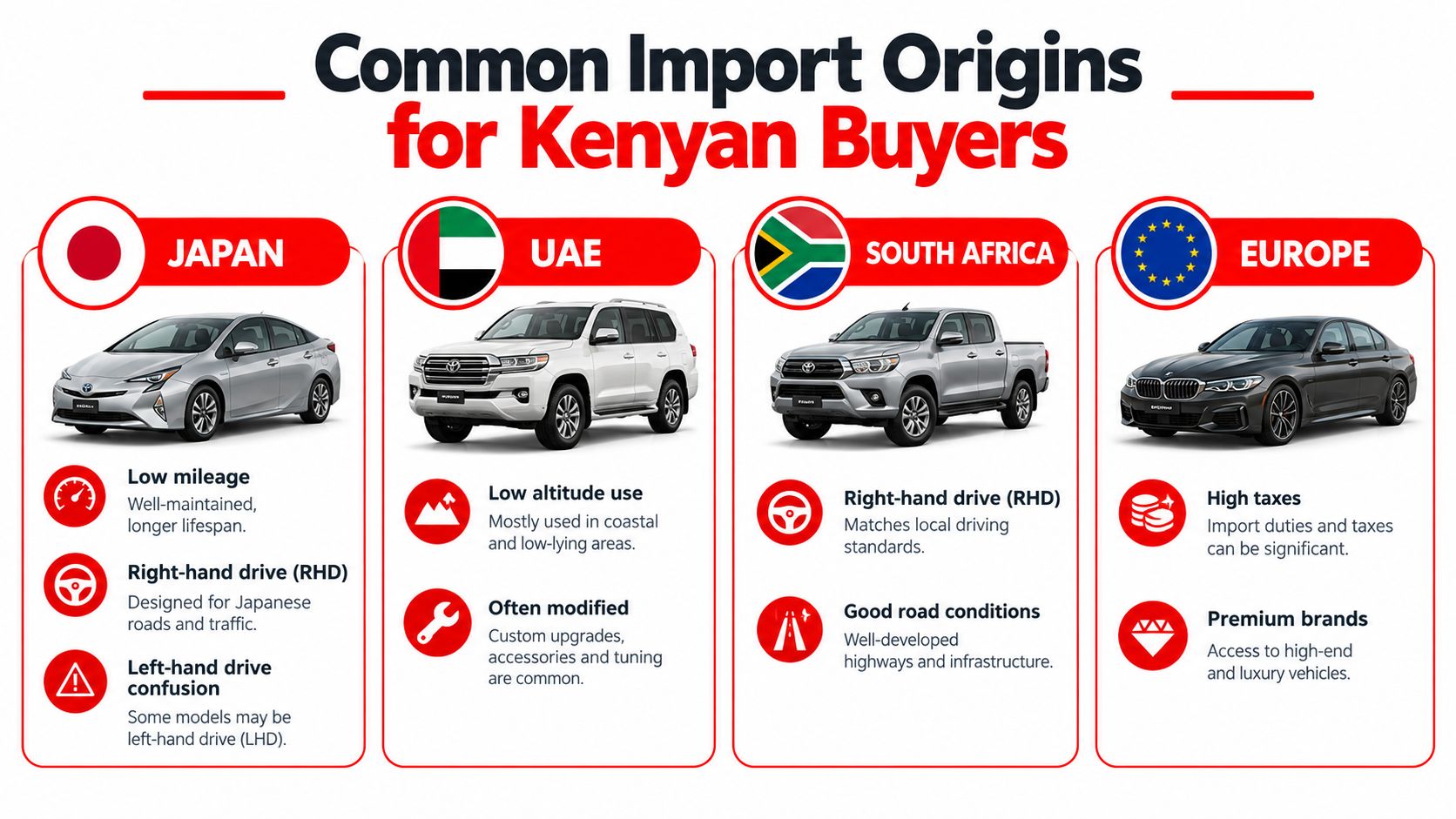
The country of origin changes the way a car feels on the ground, but it does not remove the need to inspect it properly. Japanese units are often attractive to Kenyan buyers because they tend to come with clearer auction-style records and traceable paperwork. That helps when a buyer is trying to keep the purchase inside a sensible budget and wants a unit with a cleaner history trail.
UAE stock can look very appealing on first glance, especially when the model is newer or the trim level is richer. The caution is that appearance can hide hard use, and a car that has lived a harsh life needs close attention to suspension, cooling and interior wear. South African units often suit buyers who want right-hand drive cars with a familiar driving position and road manners, while European imports can offer strong engineering and premium finishes, but often demand more patience with parts, maintenance and compliance details.
Match the origin to the use case
A daily Nairobi commuter needs something different from a rural family haulier or a light workhorse. A Japanese compact may make sense for city use, while a sturdier SUV or station wagon may suit mixed roads better. European premium cars can be rewarding when bought carefully, but the ownership experience changes fast if the car's maintenance history is thin or the parts network is awkward.
The origin tells you what to expect, not what to trust. I have seen buyers overpay for a shiny import because they assumed a newer plate or a nicer interior meant less risk. It doesn't. What matters is whether the car's history, paperwork and condition line up with the way the car was used.
A clean import is one where the paperwork, the mileage story and the wear pattern all tell the same story.
Kenya's vehicle age and compliance rules
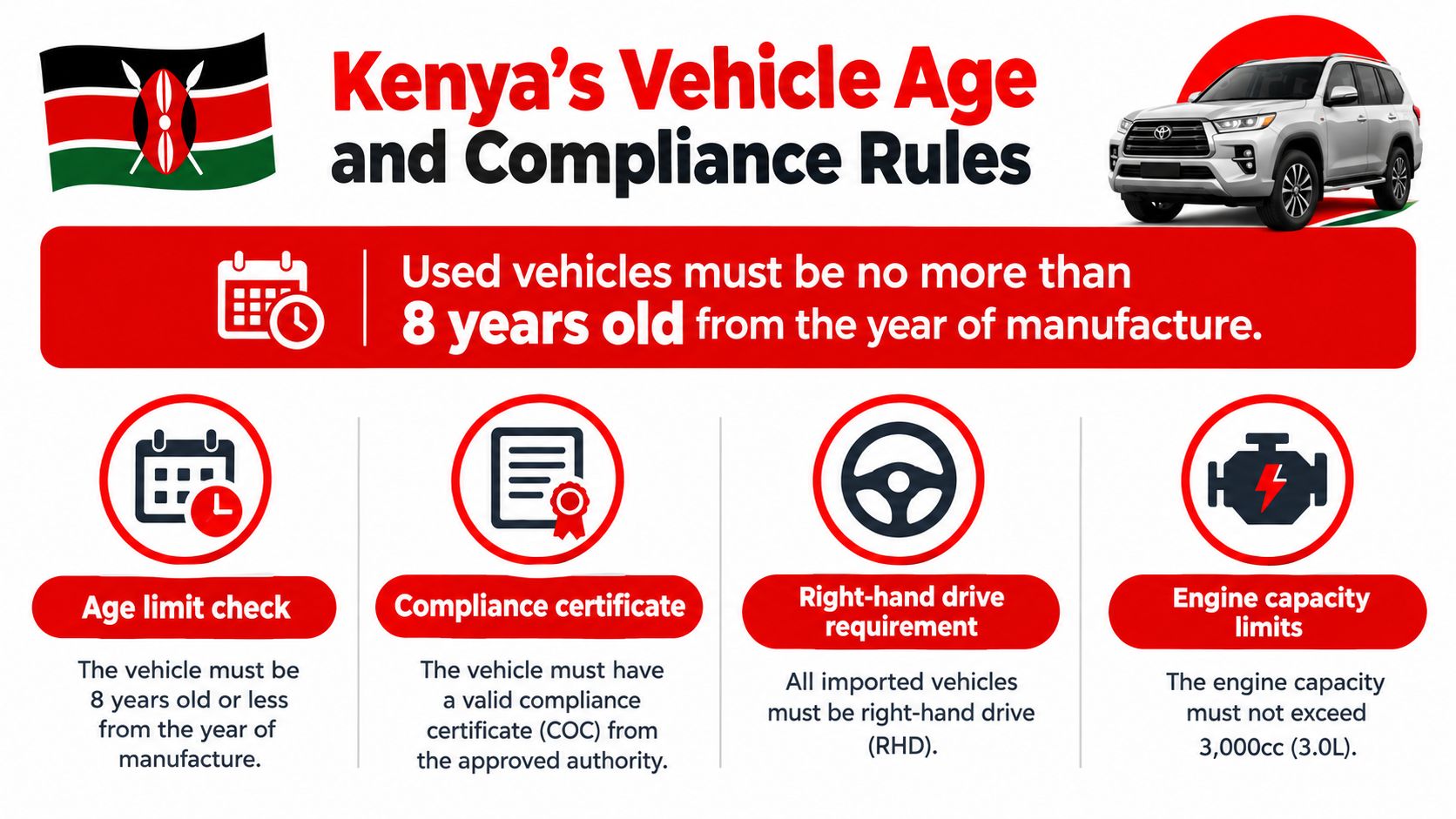
Eligibility comes before price. If a car cannot clear registration, the deal fails no matter how good it looks on the yard. Kenya's used-vehicle rules generally require a vehicle to be no more than eight years old from the year of first registration, and KEBS also requires the gap between manufacture and first registration to be less than one year, with compliance to Euro IV emissions KEBS.
What to verify before you leave a deposit
Start with the first-registration date on the original logbook or export papers, then compare it with the manufacture year. If those dates do not line up cleanly, and the car falls outside the eligibility window, walk away. A fresh polish does not fix an ineligible file, and the registration problem will stay with the buyer.
The steering side matters too. KRA says left-hand-drive vehicles are not allowed for registration unless they are imported for a special purpose, and KEBS inspection guidance says converted road vehicles are not allowed for importation into Kenya KRA KEBS. For normal road use in Kenya, a right-hand-drive car with clean supporting documents is the safer choice.
The paperwork must match the car in front of you. KEBS' PVOC manual sets out the pre-shipment compliance process used for imported vehicles, and KRA requires the supporting import documents to be in order before clearance KEBS. Missing, inconsistent, or hard-to-explain papers are not a small slip. They are the kind of problem that turns a purchase into customs delays and avoidable costs.
Understanding landed cost and tax bands
A low sticker price overseas can be misleading. In Kenya, the bill is built from CIF, duty, excise, VAT and levy charges, so the number you see on the auction sheet is only the starting point. KRA states that import duty is 25% of CIF, excise duty is 20% for vehicles up to 1,500 cc and 25% above that threshold, VAT is 16% of customs value plus import duty and excise duty, with a 2% Railway Development Levy and 3.5% Import Declaration Fee on CIF KRA.
A worked example shows why engine size changes the final figure fast. Using a hypothetical CIF of KSh 1,000,000, import duty comes to KSh 250,000, excise duty at 20% comes to KSh 250,000, VAT at 16% of KSh 1,500,000 comes to KSh 240,000, while IDF adds KSh 20,000 and RDL adds KSh 15,000 KRA. That is before port charges, inspection, registration, storage and clearing. In practice, those extra costs typically add a further KSh 50,000 to 150,000, depending on the vehicle and the handling involved.
Smaller engines often look friendlier on paper because the tax stack follows customs value and classification, not the asking price alone. A car that looks affordable at source can move into a much higher bracket once excise is applied, especially if the engine size pushes it into a different band. Buyers working with a ceiling such as KSh 1 million, KSh 1.5 million or KSh 2 million should ask for the full landed estimate before paying a deposit.
Buyer warning: if the seller only quotes the overseas purchase price, you still do not know what the car will really cost in Kenya.
For a practical sense of how one popular Toyota range is usually positioned in the market, see the current Toyota model guide and compare it with the landed estimate you are being given. The useful figure is the one you can register, insure and drive, not the sticker price alone.
Inspection checklist before buying an imported car
A clean import can still hide expensive repairs, so the first inspection should be physical. Start in daylight and walk around the car slowly. Look at the panel gaps, especially between the bonnet, doors and tailgate. Even spacing usually points to careful assembly, while one side sitting tighter than the other can signal previous damage or poor rework.
Check the paint from different angles. A colour shift between panels, overspray around rubber seals, or a different texture on one door often means the car has been repainted. Tyres tell their own story, too. Uneven wear on the inside edge can point to alignment issues, feathering can suggest suspension wear, and one tyre brand mixed with three others can mean the seller cut corners after an accident repair.
Crouch down and inspect the underside. Fresh underseal sprayed too neatly, crushed jacking points, bent control arms or oily suspension parts are all worth a closer look. Open the bonnet and look for fresh clamps, mismatched bolts, or wiring that has been wrapped and rewrapped. Those are the details that usually show up after a quick cosmetic fix.
A short test drive should be enough to expose the lazy repairs. Listen for knocks over rough road sections, feel for steering pull, and check whether the brake pedal bites evenly. Automatic cars should shift cleanly without hesitation or jerking. Manual cars should not slip under load. If the vehicle has had steering or trim modifications, the work should look factory-level, not improvised.
Mileage claims also need context. A low-reading cluster means little if the seat bolsters, pedals and steering wheel are worn smooth. For buyers comparing body style and running costs, a hybrid SUV guide can help frame the choice before you commit to one unit.
The best inspections are simple and stubborn. If the body, the road test and the wear patterns all agree, the car deserves serious attention. If one part of the vehicle tells a different story, walk away.
Where to view imported cars and how to proceed safely
The safest purchase path is still a physical viewing, because imported stock can look very different in person from how it reads on paper. A reputable Nairobi dealership should let you inspect the vehicle, check the paperwork, and ask direct questions about age, import status and clearance before money changes hands. Official registration queries should be checked through the relevant government channels, not guessed at from a sales pitch.
Proceed in a sequence that protects the buyer
First, inspect the vehicle in daylight and confirm the chassis details on the car against the documents. Next, ask for the import and inspection paperwork and make sure the age and steering position line up with Kenya's rules. Only then should you discuss payment, transfer and registration.
Brill Motors operates from Garden City Mall Rooftop Car Yard on Thika Road in Nairobi, and customers can view vehicles in person, ask about vehicle valuation if they are selling, and discuss trade-ins or financing where relevant. If you are narrowing your search to SUVs, the current SUV stock guide can help you think through body style before you come in. A careful buyer uses the viewing to confirm what the listing cannot prove on its own.
The best imported car purchases in Kenya are the ones where the buyer does not have to hope the paperwork is fine. They can see it, check it, and match it to the car. That is the difference between a clean transfer and a long customs headache.
If you want help choosing a compliant imported car, checking the paperwork, or comparing current stock against your budget, visit Brill Motors or come to the Garden City Mall yard on Thika Road. You can inspect the vehicles in person, ask about trade-ins or valuation, and move forward only when the car and the documents both make sense.