

 SIGN UP
You've found a car that looks affordable, the seller says it's clean, and the monthly payment appears manageable. Then the mechanic spots worn suspension, the logbook details need checking, and the amount required to put the vehicle properly on the road is far higher than the advertised figure. For a first-time Nairobi buyer, the wrong bargain can become an expensive daily headache.
The right affordable car isn't just the one with the lowest price. It's the one with a sound engine, supportable parts, acceptable fuel use, clean ownership records and a total cost you can carry after purchase. This guide focuses on affordable cars for sale in Kenya, with practical advice on imported and locally used vehicles, budget bands, inspections and the costs many buyers forget.
Navigating the Affordable Car Market in Kenya
A young professional leaves Thika Road before sunrise, hoping to replace matatu fares with a dependable hatchback. Her budget looks sufficient on paper, but she also needs insurance, fuel, servicing and a reserve for the first repairs. The attractive car is not necessarily the sensible car, especially if its history is unclear or its specification is difficult to support locally.
Kenya's market gives buyers plenty of choice because imported used vehicles form the main supply. The Kenya Revenue Authority's vehicle information records approximately 70,000 to 80,000 motor vehicles imported annually, with about 80% being used vehicles. That means roughly 56,000 to 64,000 pre-owned units enter the market each year. Japanese makes such as Toyota, Nissan, Mazda, Subaru and Honda are consequently common, but availability alone doesn't make a particular car good value.

Start with use, not appearance
A compact hatchback suits a daily Nairobi commute. A station wagon makes more sense for a family, business errands or regular luggage. An SUV can offer useful ground clearance, but its tyres, suspension, engine size and fuel consumption may cost more to maintain. Buying for image while budgeting like a hatchback owner is a common mistake.
Before viewing any car, write down your actual use:
- Daily route: Consider traffic, rough sections and parking space.
- Passenger needs: Decide whether you need rear-seat comfort or load capacity.
- Fuel budget: Compare engine size and fuel type, not just the purchase price.
- Repair support: Choose a model local technicians understand and parts suppliers commonly support.
- Exit plan: Think about how easy the car will be to value and sell later.
For a useful starting point on one of Kenya's most searched makes, review this Toyota cars price guide, then check the specific vehicle's condition rather than assuming the badge tells the whole story.
Understanding Used Vehicle Regulations and Supply
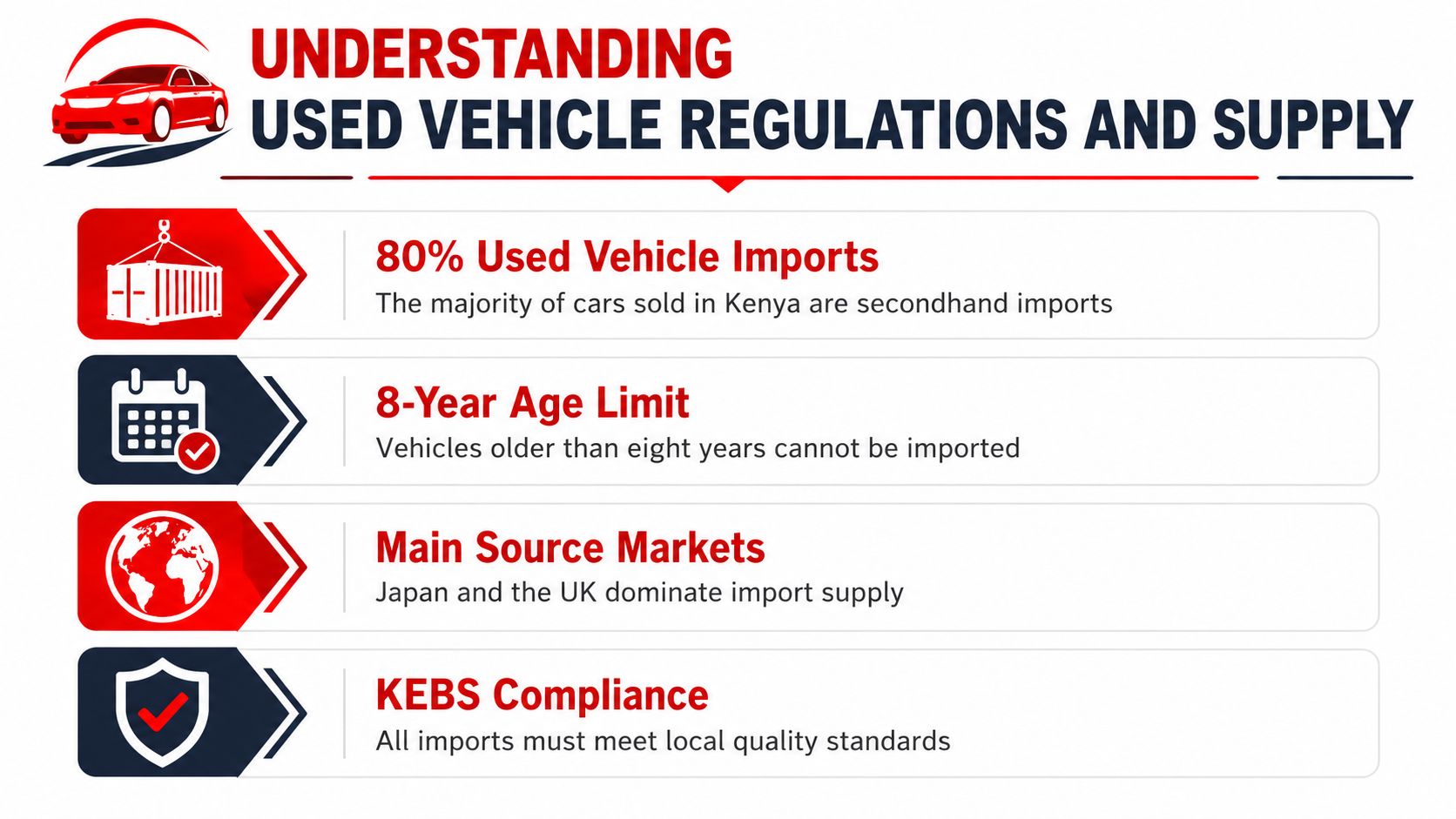
You can save money on the wrong car and still lose badly. In Kenya, the trouble often starts before the car reaches the yard. If an import fails the age rule, carries inconsistent papers, or was converted the wrong way, the cheap asking price means nothing.
Start with the basic split. A locally used vehicle has already lived on Kenyan roads, so you can inspect its service history, wear from local driving conditions, and ownership record here. A foreign-used import needs more scrutiny. You are relying on export documents, inspection records, first-registration details, and compliance with Kenyan entry rules, not just the seller's word.
KRA states that used vehicles imported into Kenya must generally be no more than eight years old from the year of manufacture or first registration, meet the applicable inspection requirements, and pass roadworthiness checks before clearance. That one rule alone cuts out a large part of the older stock many buyers see advertised abroad. A low overseas price does not matter if the vehicle is not eligible for import.
Check eligibility before comparing price
Do not begin with colour, trim, or auction photos. Begin with legality.
The KEBS road-vehicle inspection standard says the gap between year of manufacture and first registration should not exceed one year. It also lists right-hand drive and Euro IV emissions compliance among the key preliminary requirements for applicable imports. That is why the first-registration date matters as much as the build year in the advert. Ask for the export or deregistration record and confirm both match the vehicle details. If the car was converted from left-hand drive to right-hand drive, leave it alone. It is not allowed under the cited import inspection requirements.
Paperwork is part of the vehicle
Many buyers inspect the body and engine, then treat documents like a formality. That is a mistake. The papers are part of the car's value.
KEBS requires document validation for certain used vehicles imported without a Certificate of Roadworthiness. Its public notice on used-vehicle document validation states that importers must submit copies of the logbook, deregistration certificate or export certificate for validation in the specified circumstances. From 14 July 2025, only vehicles with validated import documents must undergo destination inspection in those circumstances.
Practical rule: If the chassis number, logbook, export records and inspection documents do not match, stop the purchase.
Urban demand keeps smaller, cheaper-to-run cars moving quickly, especially in Nairobi. That makes hatchbacks, saloons, station wagons and compact SUVs easier to source than large, thirsty cars, but supply alone is not the point. The right buy is the one that passes the rules cleanly and stays affordable after registration, repairs, fuel and routine maintenance.
Best Affordable Cars Under KSh 1 Million
At this level, condition beats trim, age badge and cosmetic shine. A clean, mechanically honest car can serve you well, while a neglected example with fresh paint may consume the money you thought you were saving. Keep part of your budget for transfer, insurance, servicing and repairs rather than spending every shilling on the purchase.
Toyota Spacio, Nissan AD Voyager and Subaru Forester can appear in this broad affordability tier, but they suit different owners. The Spacio prioritises cabin flexibility. The AD Voyager makes sense for practical carrying duties. The Forester offers ground clearance and stronger road presence, but you should expect more attention to fuel use, suspension and drivetrain condition than with a small hatchback.
| Model | Engine Type | Common Use | Key Consideration |
|---|---|---|---|
| Toyota Spacio | Petrol | Family errands and flexible passenger use | Inspect automatic transmission behaviour, cooling system and suspension |
| Nissan AD Voyager | Petrol | Business errands and load carrying | Confirm body condition, rear suspension and service history |
| Subaru Forester | Petrol, often all-wheel drive | Mixed city use and rougher roads | Check cooling, oil leaks, drivetrain operation and underbody condition |
Choose the cheaper-to-own car
A small petrol car usually makes more sense for a buyer whose driving is mainly urban and whose household has modest passenger needs. The Spacio offers more usable space than a tiny hatchback, but its age makes condition particularly important. Listen for transmission hesitation, inspect the cooling system and check whether the cabin electronics work properly.
The AD Voyager is a work-focused choice. Look beyond the body panels to the load area, rear suspension, tyres and signs of overloading. A vehicle used heavily for business may have a tidy exterior but tired mechanical components.
The Forester is the tempting option for rough roads. Don't buy it merely because it looks capable. Confirm that the engine starts cleanly, there's no persistent smoke, the temperature remains stable and the all-wheel-drive system behaves correctly. A cheap SUV can become expensive if the previous owner ignored routine maintenance.
Use this Toyota Corolla buying guide to compare the ownership logic of a mainstream saloon against older wagons and SUVs. The principle is simple: buy the soundest example you can verify, not the most impressive badge you can barely afford.
Top Value Cars Between KSh 1.5 Million and KSh 2 Million
This is often the more sensible band for a buyer who can stretch without damaging their finances. You may find a newer, better-equipped car with a stronger service record, cleaner interior and less immediate refurbishment work. That doesn't mean every vehicle in this range is automatically good. It means the buyer has more room to prioritise condition.
Mazda Demio, Toyota Fielder and Honda Fit each solve a different problem. The Demio suits urban driving and easy parking. The Fielder is the practical choice for passengers, luggage and business use. The Fit gives you a clever interior and useful cabin space in a compact footprint.
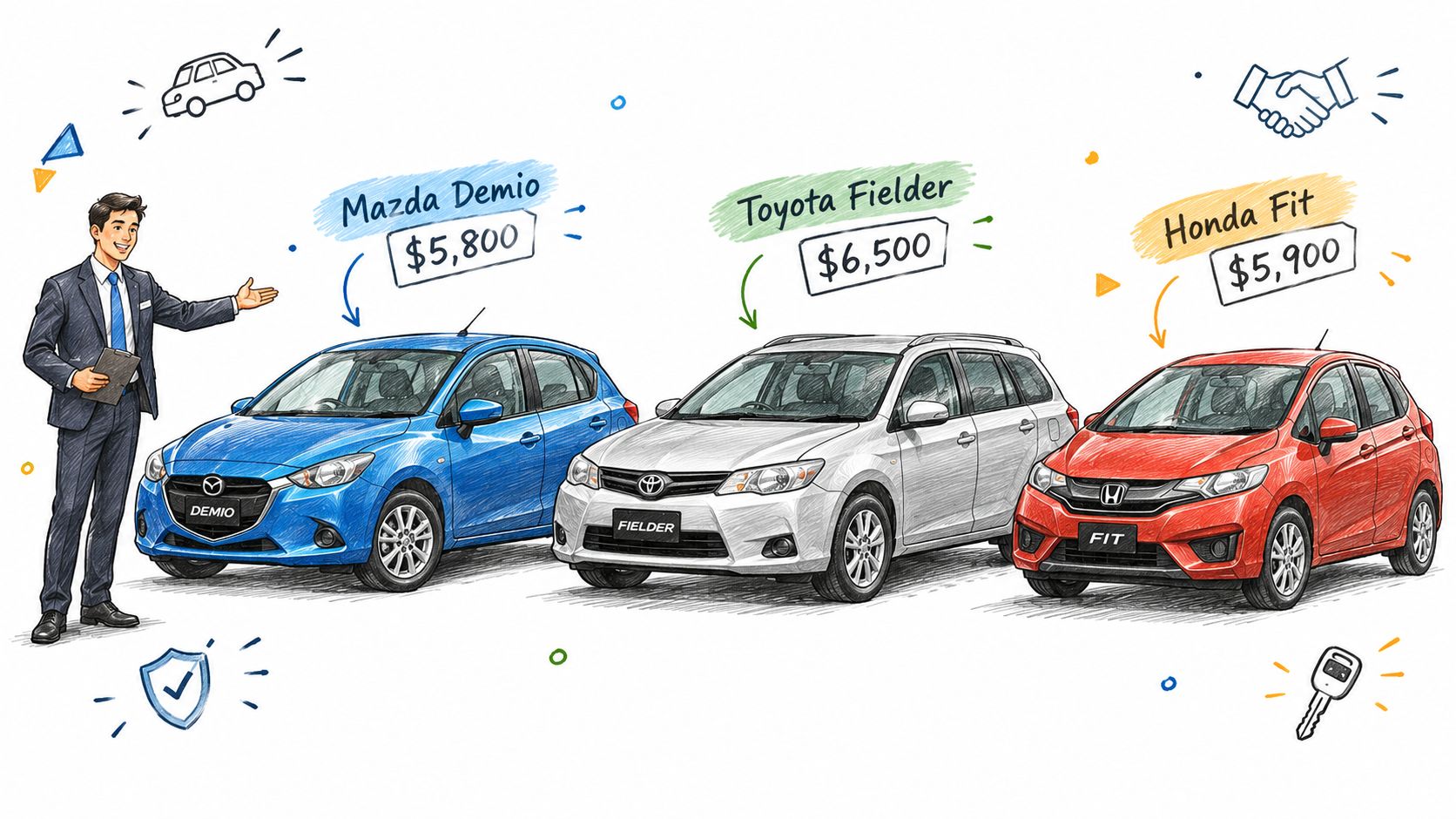
Mazda Demio for city work
The Demio is easy to place on crowded streets and practical for a commuter who rarely carries large loads. Check the automatic gearbox for smooth engagement, inspect the suspension over uneven surfaces and confirm that the air conditioning and electrical controls work. A small car still needs a complete mechanical inspection.
Toyota Fielder for versatility
The Fielder is the strongest all-rounder of the three if you regularly carry people, luggage or equipment. Inspect the tailgate, rear suspension and floor for signs of hard use. Check whether the engine and transmission respond smoothly, and don't overlook tyre matching. Four mismatched or heavily worn tyres can indicate deferred maintenance.
Honda Fit for efficient practicality
The Fit's flexible cabin is useful, but the interior should not distract you from the drivetrain. Check cold starting, transmission operation, steering feel and warning lights. Ask for service records and compare the recorded mileage with the vehicle's general wear, including the steering wheel, pedals and driver's seat.
A higher purchase price can be cheaper ownership if it prevents repeated repairs, poor fuel use and immediate replacement of worn components.
Make a five-year ownership comparison on paper. Include servicing, tyres, insurance, fuel, likely suspension work and the money you'll lose if you buy a car that's difficult to resell. A cheaper older vehicle may win the purchase-price argument and lose every other one.
Essential Pre-Purchase Inspection Checklist
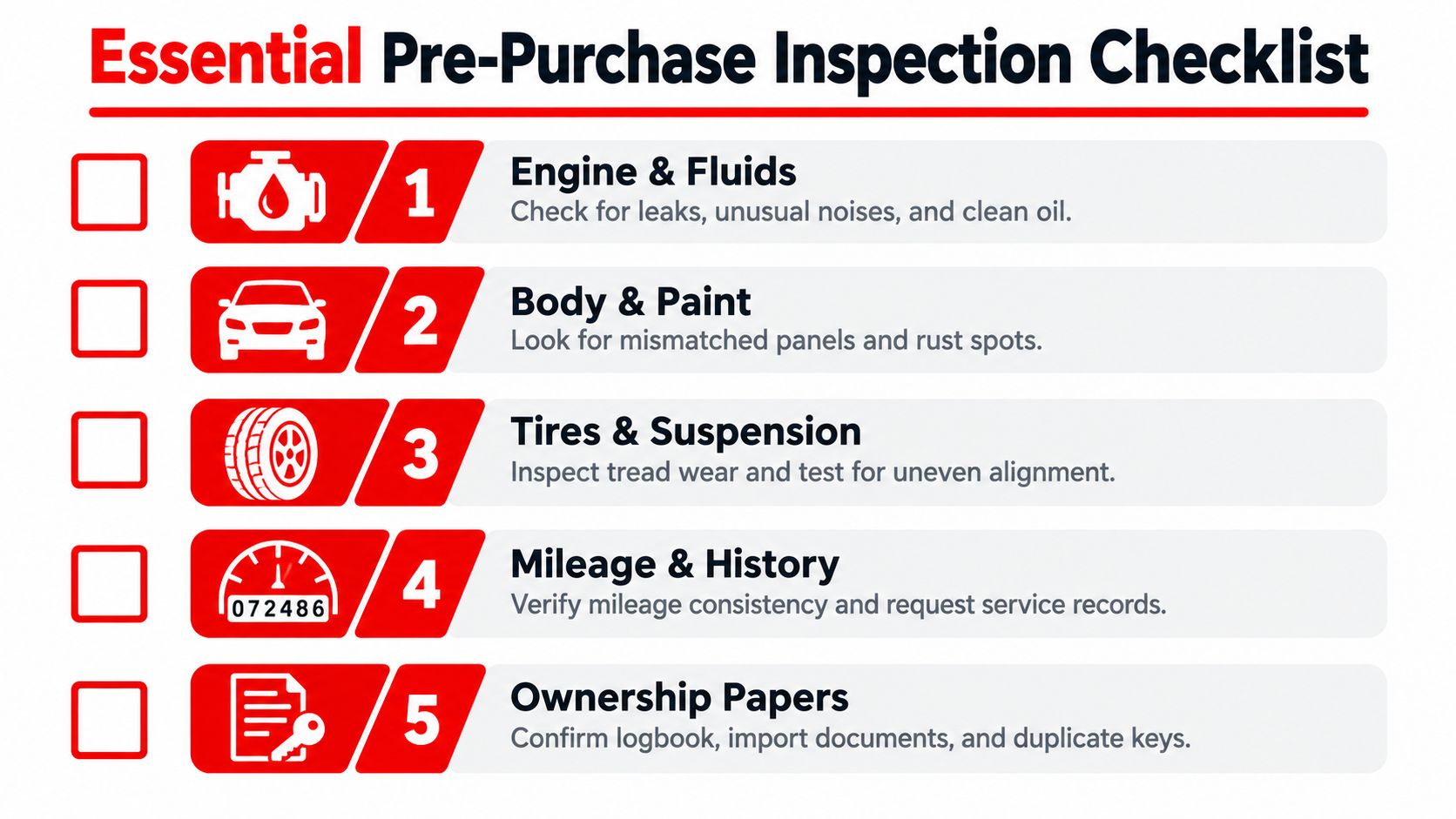
Never pay because the paint is bright or the seller is putting pressure on you. A proper inspection should start with the vehicle cold, continue through a road test and finish with document verification. If the seller won't allow reasonable checks, walk away.
Mechanical checks
- Engine and fluids: Inspect for oil or coolant leaks, unusual noises, excessive smoke and a dirty or milky oil appearance. Check that the engine reaches operating temperature without overheating.
- Compression and response: A compression test can reveal internal engine wear that a short idle test won't show. The engine should start without excessive cranking and respond cleanly when accelerating.
- Transmission: Test automatic engagement from park into drive and reverse. Watch for delays, harsh shifts, slipping or abnormal noises.
- Cooling system: Examine the radiator, hoses, expansion tank and fan operation. Overheating damage can be costly even when the car initially drives well.
- Suspension and steering: Drive over uneven ground and listen for knocks. Check whether the car pulls to one side, wanders or produces uneven tyre wear.
- Undercarriage: Look for structural damage, fresh welds, fluid leaks and rust. Pay special attention to suspension mounting points and the floor.
Body and electrical checks
Walk around the vehicle in daylight. Mismatched paint, uneven panel gaps and overspray can suggest accident repairs. Check the windscreen, lights, mirrors, door locks, windows, dashboard warnings, air conditioning and central locking.
The road test should include gentle braking, firmer braking where safe, a turn at low speed and normal acceleration. The car should track straight, brake without vibration and remain free of unexplained warning lights.
Records and ownership
Match the physical chassis number with the logbook and import documentation. Verify ownership through the appropriate official process, confirm that the seller has authority to transfer the vehicle and ensure the registration details describe the car you're viewing.
Ask for service records, previous inspection documents and both keys where available. Compare mileage against the service history and wear on the driver controls. An odometer reading without supporting history is only an assertion.
Hidden Costs and True Affordability in Kenya
The advertised price is only the beginning for an imported vehicle. Your real budget may include customs charges, registration, insurance, inspection, transfer, initial servicing, tyres, battery and repairs discovered after purchase. For a locally used car, tax exposure may differ, but transfer and mechanical preparation still matter.
KRA lists import duty, excise duty, VAT, the Import Declaration Fee and Railway Development Levy as separate charges in its motor-vehicle importation guidance. Confirm current rates with KRA or a licensed clearing agent before committing to an import.
The 2025 Current Retail Selling Price changes deserve particular attention. The import-duty component used in the CRSP framework rose from 25% in 2019 to 35% in 2025, while maximum excise duty increased from 30% to 35%, according to KRA's guidance. These figures are not a shortcut to calculating your final bill because customs valuation can involve the CRSP schedule and depreciation rules, not just the advertised purchase price.
Build an all-in budget
Write down the following before you negotiate:
- Vehicle cost: The agreed purchase figure.
- Tax and clearance exposure: Confirm the current calculation with KRA or a licensed clearing agent.
- Registration and transfer: Establish which costs are included and which remain yours.
- Insurance: Obtain a realistic quotation for the exact vehicle.
- Immediate mechanical work: Budget for fluids, filters, battery, tyres and known faults.
- Running reserve: Keep money aside for routine servicing and unexpected repairs.
An older import isn't automatically cheaper. Shipping, compliance, valuation and refurbishment can remove its apparent advantage. For buyers considering lower running costs, compare the ownership case carefully in this guide to hybrid cars for sale in Kenya, but still verify battery condition, service history and specialist support before purchase.
Where to Buy and Final Buying Tips
The buying decision should follow a clear order. First, set a budget that includes the costs after purchase. Second, choose a body style that matches your daily life. Third, shortlist mainstream models with accessible parts and competent local repair support. Finally, inspect the actual vehicle and verify its records.
For a strict budget, a sound hatchback or practical wagon usually beats an ageing SUV. Between KSh 1.5 million and KSh 2 million, a Demio, Fielder or Fit may give you a better balance of age, comfort and maintainability, provided the individual car has a clean history. Around the KSh 2 million mark, an SUV can offer useful clearance, but you must accept the possibility of higher fuel, tyre and suspension costs.
Brill Motors operates a showroom at Garden City Mall Rooftop Car Yard, Thika Road, Nairobi, and also provides financing, vehicle valuation, trade-ins and support for people selling their cars. View the actual vehicle, ask direct questions and request the documents before making a commitment.
The cheapest car is the one that fits your life, survives inspection and doesn't exhaust your budget after you drive it away.
Use your checklist once, thoroughly. Don't let a clean interior, urgent seller or attractive monthly figure replace a cold-start inspection, road test and ownership verification.
Visit Brill Motors to view current stock of affordable cars in Kenya and check vehicles by budget, body type, fuel type and mileage. You can also visit the Garden City Mall Rooftop Car Yard on Thika Road for showroom viewing, financing guidance, vehicle valuation or a trade-in discussion.