

 SIGN UP
You're standing in a Nairobi yard, looking at a saloon on one side and a raised hatchback on the other. The saloon is cheaper to run, but the SUV has the ground clearance, boot space and driving position your family keeps asking for. The question is whether that extra money buys useful ability or just a bigger body.
For most buyers, the answer depends on roads, passengers and budget, not badge appeal. A compact crossover can make school runs easier without becoming difficult to park, while a larger four-wheel-drive vehicle makes sense for regular upcountry travel. This guide groups the main choices by KSh budget band and daily use case, then covers the checks and paperwork that buyers commonly overlook.
Why Nairobi Buyers Keep Choosing SUVs
An SUV earns its place on Nairobi roads when it solves a daily problem. The raised seating position gives you a clearer view through traffic, the extra ground clearance helps over estate speed bumps, and the larger boot makes it easier to carry school bags, shopping and luggage without filling the cabin.
That doesn't mean every buyer needs one. A hatchback is often the sharper financial choice for a single commuter who spends most of the week in town. It's easier to squeeze into tight parking spaces and usually costs less to fuel, service and insure. A saloon also remains sensible if your routes are mainly paved and you rarely carry bulky loads.
The roads decide more than the badge
A Nairobi SUV must cope with more than smooth tarmac. You'll encounter patched roads, drainage channels, broken edges, steep ramps and unmarked speed bumps. A compact crossover with sensible ground clearance is enough for this work. You don't need a heavy off-roader just because one section of your route becomes rough during the rainy season.
For school runs, the useful features are straightforward:
- Easy rear access: Children can climb in without the low seating position of a saloon.
- Usable boot space: A proper boot matters when the vehicle carries bags, shopping and weekend luggage.
- Manageable size: A compact SUV is easier to place in estate lanes and shopping-centre parking.
- Comfortable suspension: This matters more than aggressive styling on broken urban roads.
A larger SUV becomes worthwhile when your family travels with several passengers and luggage, or when you regularly leave the tarmac. The trade-off is clear. More weight and a larger engine usually mean higher running costs, wider turning circles and more expensive tyres.
Practical rule: Buy the smallest SUV that handles your real roads and passenger load. Bigger isn't automatically better.
The market is moving towards practical utility
Kenya's used-car market is projected to grow from USD 1.28 billion in 2025 to USD 1.54 billion by 2031, while SUVs and MPVs are identified as the fastest-growing vehicle type, with a 4.44% CAGR through 2031, according to Kenya used-car market projections. Hatchbacks still held 42.36% share in 2025, so SUVs haven't replaced smaller cars. They're gaining momentum because buyers increasingly want one vehicle that can manage commuting, family duties and occasional travel.
That growth doesn't make every SUV a good purchase. It means more choice, more variation in condition and greater need for disciplined inspection. A shiny exterior can hide neglected suspension, a tired automatic gearbox or incomplete service records.
Start with your routine. If you commute alone, carry little and stay on good roads, a compact SUV or hatchback may be enough. If you carry a family, travel with luggage and face poor road surfaces, the SUV premium becomes easier to justify. The next decision is how that choice fits your money.
How the Kenyan SUV Market Really Works
Kenya depends heavily on imported vehicles, and that shapes the SUV stock you see in Nairobi. The Kenya Revenue Authority states that the country imports about 70,000 to 80,000 vehicles annually, with roughly 80% of those imports being used vehicles, as summarised in Kenya vehicle import market information. The same market report estimates that SUVs and crossovers represented about 33.6% of vehicle import value, or roughly USD 420 million.
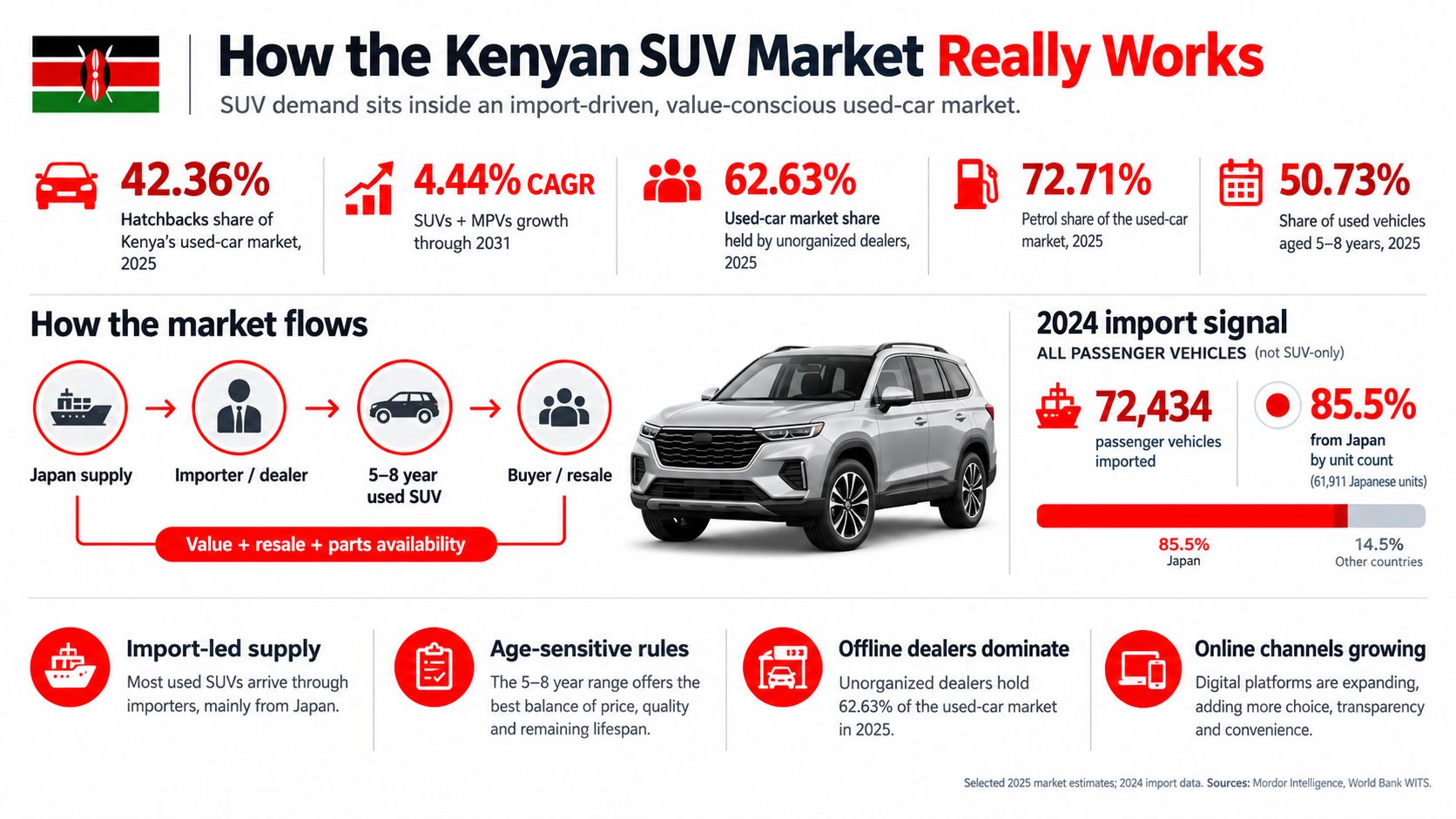
Imported stock gives buyers access to models and trims that may not have been sold locally in the same form. It also creates uncertainty if the vehicle's history isn't properly documented. A foreign-used SUV may have spent its earlier life on different roads, in a different climate and under a different service regime from a locally used vehicle.
Locally used and foreign-used are different purchases
A locally used SUV should have a traceable Kenyan ownership and servicing history. Check whether the logbook details are consistent, whether the chassis number matches the vehicle and whether the mileage makes sense against service invoices and inspection records.
Foreign-used stock needs a different line of questioning. Ask for import documentation, inspection evidence and a credible explanation of the vehicle's previous use. Don't treat a low mileage figure as proof of a good vehicle. The physical condition of the steering wheel, pedals, driver's seat, tyres and suspension should support the mileage claim.
Model year also needs context. A newer vehicle can still be a poor purchase if it has been badly repaired, while an older SUV with consistent servicing may be the safer choice. Trim level affects equipment, engine size, drivetrain and resale appeal, so compare like with like rather than judging two vehicles by their registration year alone.
Why import costs affect the asking price
The final price of an imported SUV reflects more than the overseas purchase cost. Freight, insurance, customs valuation, taxes, port handling, inspection, repairs and local preparation all influence the amount a Kenyan buyer sees. Rates and procedures can change, so confirm the current position directly with KRA or use a licensed clearing agent before committing to an import calculation.
The practical lesson is simple: a suspiciously cheap SUV deserves more questions, not instant excitement. It may need substantial mechanical work, have incomplete documents or carry a trim that is harder to maintain locally.
For a useful model-by-model starting point, review the Toyota cars price list, then compare the actual vehicle's engine, trim, mileage and condition. A model name alone doesn't tell you what you're buying.
SUV Picks by Budget Band
Budget should narrow the shortlist, not decide the car without an inspection. The live Kenyan used-car benchmarks available for this guide put the median asking price across active used-car listings at about KSh 2,494,500, with a Toyota RAV4 benchmark around KSh 4,200,000 and a Toyota Land Cruiser benchmark around KSh 7,300,000. Those figures show why “SUV price” is too broad to be useful. Brand, trim, engine, age and condition create large differences.
The bands below are guides for organising a search. Brill Motors' current listings should determine live prices.
| Budget band | Typical models | Common engines | Years to target | Guide price range |
|---|---|---|---|---|
| Below KSh 2,494,500 | Mazda CX-5, Nissan X-Trail, older Toyota RAV4 | Petrol, with diesel available on selected examples | Older, well-maintained examples | Below the market median, subject to condition |
| KSh 2,494,500 to KSh 4,200,000 | Subaru Forester, Mazda CX-5, Toyota RAV4 | Petrol, turbo petrol on selected trims, diesel on some imports | Mid-generation examples with records | Around the median to the RAV4 benchmark |
| KSh 4,200,000 to KSh 7,300,000 | Toyota Harrier, Honda CR-V, higher-spec RAV4 and larger Toyota SUVs | Petrol, hybrid or diesel depending on model and import specification | Newer or higher-trim examples | Around the RAV4 benchmark to the Land Cruiser benchmark |
Below the market median
You'll find older RAV4s, earlier X-Trails and selected CX-5 examples here. The advantage is a lower entry cost and simpler access to popular parts. The compromise is age, mileage and the likelihood that suspension bushes, cooling components, air-conditioning parts or interior fittings need attention.
For this band, prioritise a clean engine, straight body and complete ownership history over leather seats or a large touchscreen. Walk away from an SUV that starts with heavy smoke, has warning lights on the dashboard or shows uneven tyre wear that suggests suspension or alignment problems.
A buyer comparing smaller vehicles as well should read cars under KSh 1 million in Kenya, but don't force a hatchback budget onto an SUV that needs costly repairs.
Around the middle band
The middle band gives you the strongest balance for many Nairobi households. A Forester offers confident road manners and useful clearance, but turbocharged versions need especially careful servicing checks. The CX-5 is comfortable and composed, while an X-Trail can appeal to buyers who need a practical cabin and flexible family use.
Petrol is generally the safer choice when you want wider servicing familiarity and fewer diesel-specific components. Diesel can make sense for high-mileage travel, but only if the engine, turbo system and emissions equipment have been properly maintained.
The upper band
The higher band brings newer examples, better equipment and larger vehicles such as the Harrier or premium trims of familiar models. You're paying for more than size. The vehicle may offer a quieter cabin, stronger resale demand, better safety equipment or a more polished drivetrain.
Don't assume a higher price removes inspection risk. A premium SUV with a neglected automatic transmission is still a bad purchase. At this level, insist on consistent service records, a clean test drive, functioning electronics and paperwork that matches the vehicle.
Matching the SUV to Your Daily Use Case
A budget shortlist becomes useful only after you decide how the SUV will spend its days. The best commuter SUV is not the best family tourer, and neither is automatically the right vehicle for rough rural roads.
City commuting
Choose a compact crossover for daily movement between home, office, school and shopping. The Mazda CX-5, Toyota RAV4, Honda CR-V and smaller Forester variants offer a useful balance of visibility, boot space and manageable size. A naturally aspirated petrol engine is often the straightforward choice for a driver who values predictable servicing and spends most of the week in traffic.
Check the turning circle, parking sensors, air-conditioning and automatic gearbox behaviour. Fuel economy depends on traffic, tyre pressure, engine condition, driving style and route, so don't accept a seller's promise without considering your own commute.
A large seven-seater is unnecessary if the third row will remain folded permanently. You'll carry extra weight and occupy more road space without using the capacity you paid for.
Family and upcountry travel
Families travelling with luggage need a proper boot behind the last occupied row. A seven-seater can work well when you regularly carry more passengers, but inspect access to the third row and check whether luggage space remains useful with all seats in use.
For mixed Nairobi and upcountry driving, prioritise suspension condition, tyre quality and a comfortable cruising position. Four-wheel drive is useful when it matches your route, but it increases mechanical complexity and doesn't excuse poor tyres or reckless driving. A well-maintained two-wheel-drive SUV will often serve a family better than a neglected four-wheel-drive example.
Rough roads and regular off-tarmac driving
If your route includes deep ruts, loose surfaces, steep tracks or muddy sections, look for an SUV with suitable clearance, strong underbody protection and a drivetrain designed for that work. A low-clearance crossover can handle a short rough section, but it isn't the right tool for repeated punishment.
Diesel may suit drivers who cover long distances and need strong low-speed pulling ability, while petrol can be easier to maintain for mixed city use. The correct choice depends on service access and the actual vehicle's condition. A diesel SUV with a tired turbo or injector system can become an expensive ownership lesson.
KRA's published tax guidance states that vehicle import duty is 25% of CIF, excise duty is 20% of CIF plus import duty, VAT is 16% of CIF plus import duty plus excise duty, while import declaration form duty is 2% of CIF and the railway development levy is 1.5% of CIF. Read the KRA vehicle tax guidance and confirm the current calculation before importing or assessing an imported vehicle.
What to Check Before You Pay
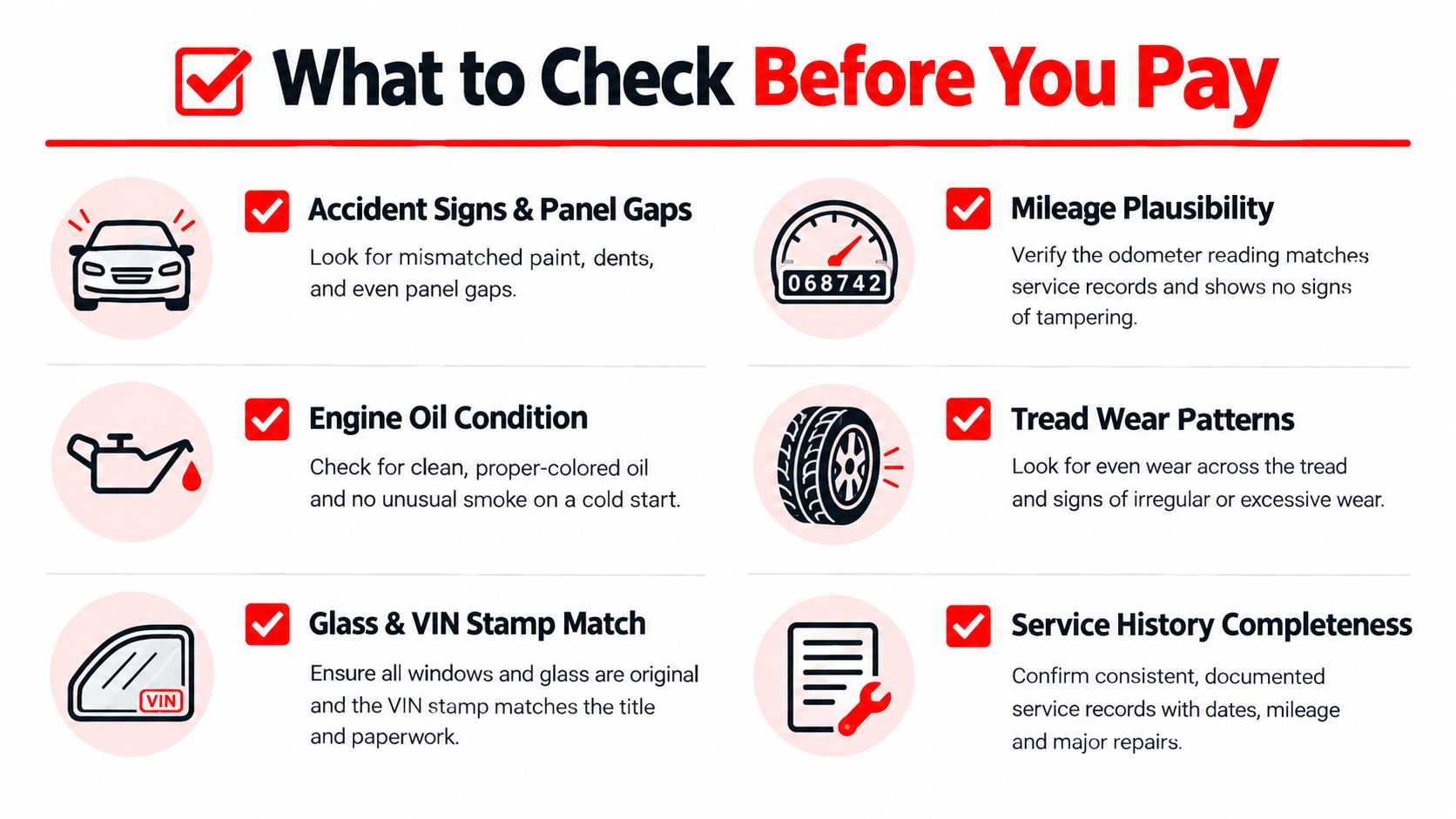
A viewing should test the SUV, not just confirm that it looks clean. Take your time, ask for a cold start and drive over the type of roads you regularly use. If the seller refuses a proper inspection, treat that refusal as useful information.
Start with the structure and history
Walk around the vehicle in daylight. Look for uneven panel gaps, mismatched paint, overspray on rubber seals, ripples in the body and lamps that don't match. These signs don't automatically prove a major accident, but they require an explanation and supporting repair evidence.
Check the chassis number on the vehicle against the documents and inspect the glass markings where appropriate. Then compare the odometer reading with service records, tyre wear, pedal wear and seat condition. A mileage figure only becomes credible when the rest of the vehicle supports it.
Test the mechanical systems properly
Inspect the engine oil and coolant condition, then ask for a cold start. Watch for excessive smoke, rough idle, unusual knocking and warning lights that disappear suspiciously quickly. During the test drive, the gearbox should select gears without harsh engagement, slipping or delayed response.
Drive over speed bumps and uneven sections at a sensible speed. Listen for knocks from the suspension, feel for steering pull and check whether the vehicle brakes evenly. If the SUV has four-wheel drive, confirm that the system engages correctly and that the relevant warning lights behave as expected.
Test the air-conditioning, windows, central locking, lights, audio system, reversing camera and dashboard controls. Small electronic faults can indicate poor repairs or become irritating ownership costs.
Confirm the import and ownership trail
Locally used vehicles need a coherent Kenyan ownership and servicing trail. Imported vehicles need import paperwork and evidence that they met inspection requirements. KRA says imported vehicles must comply with Kenya Bureau of Standards requirements under Legal Notice No. 78 of 15 July 2005 and KS1515:2000, the Kenya Standard Code of Practice for Inspection of Road Vehicles. KRA also says vehicles should be presented for inspection by a proper customs officer before customs entry is processed, as set out in its motor vehicle import procedures.
Brill Motors offers showroom viewing at Garden City Mall, along with vehicle valuation and trade-ins for owners changing cars. Bring your own mechanic if you want an independent assessment, and don't pay a deposit until the vehicle, price and paperwork are clear.
A buyer considering a pickup or a tougher work vehicle can also review the guide to a Toyota Hilux for sale in Kenya, but the same discipline applies: inspect the vehicle before paying and verify every document.
Paperwork and Ownership Transfer in Kenya
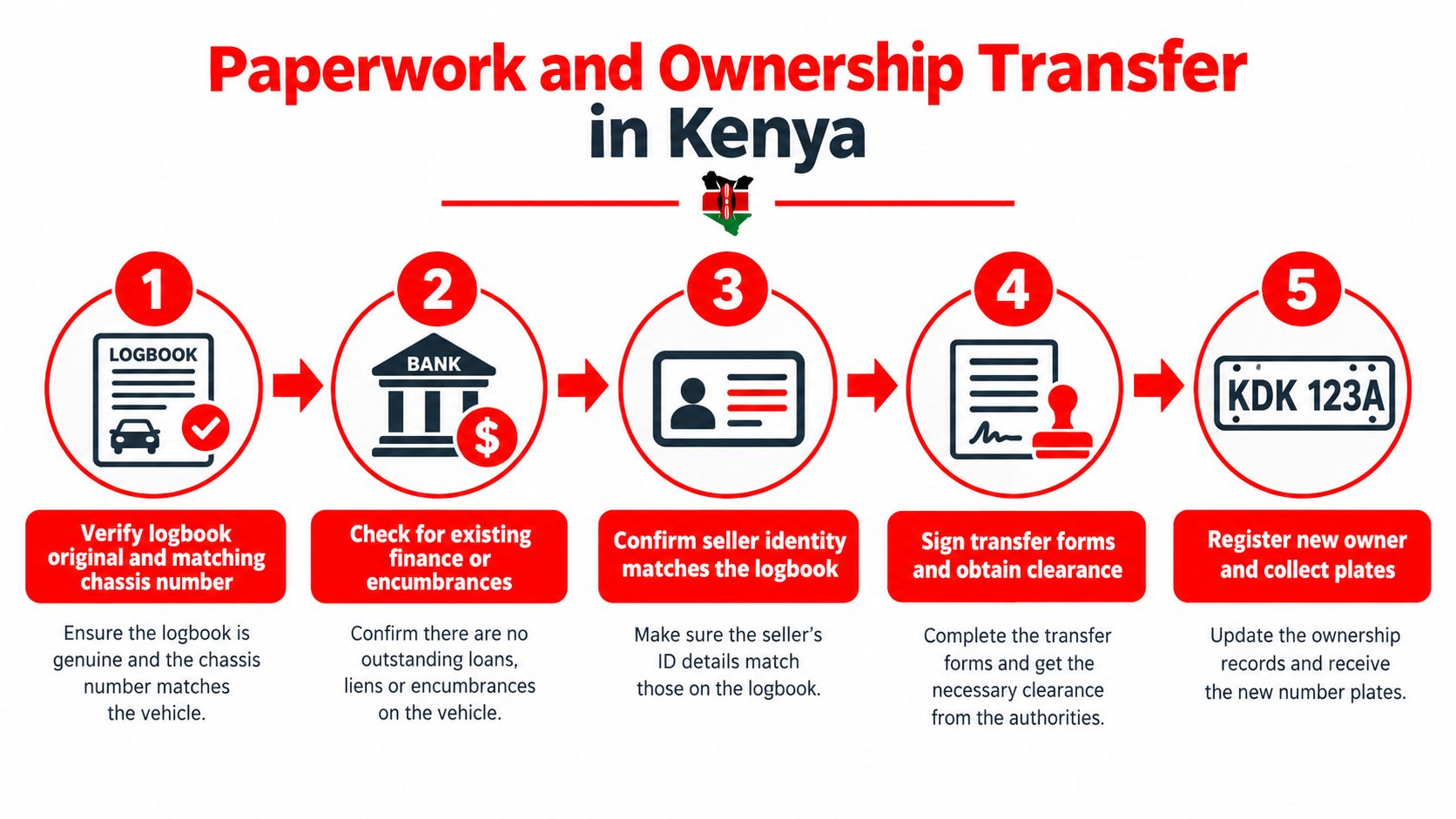
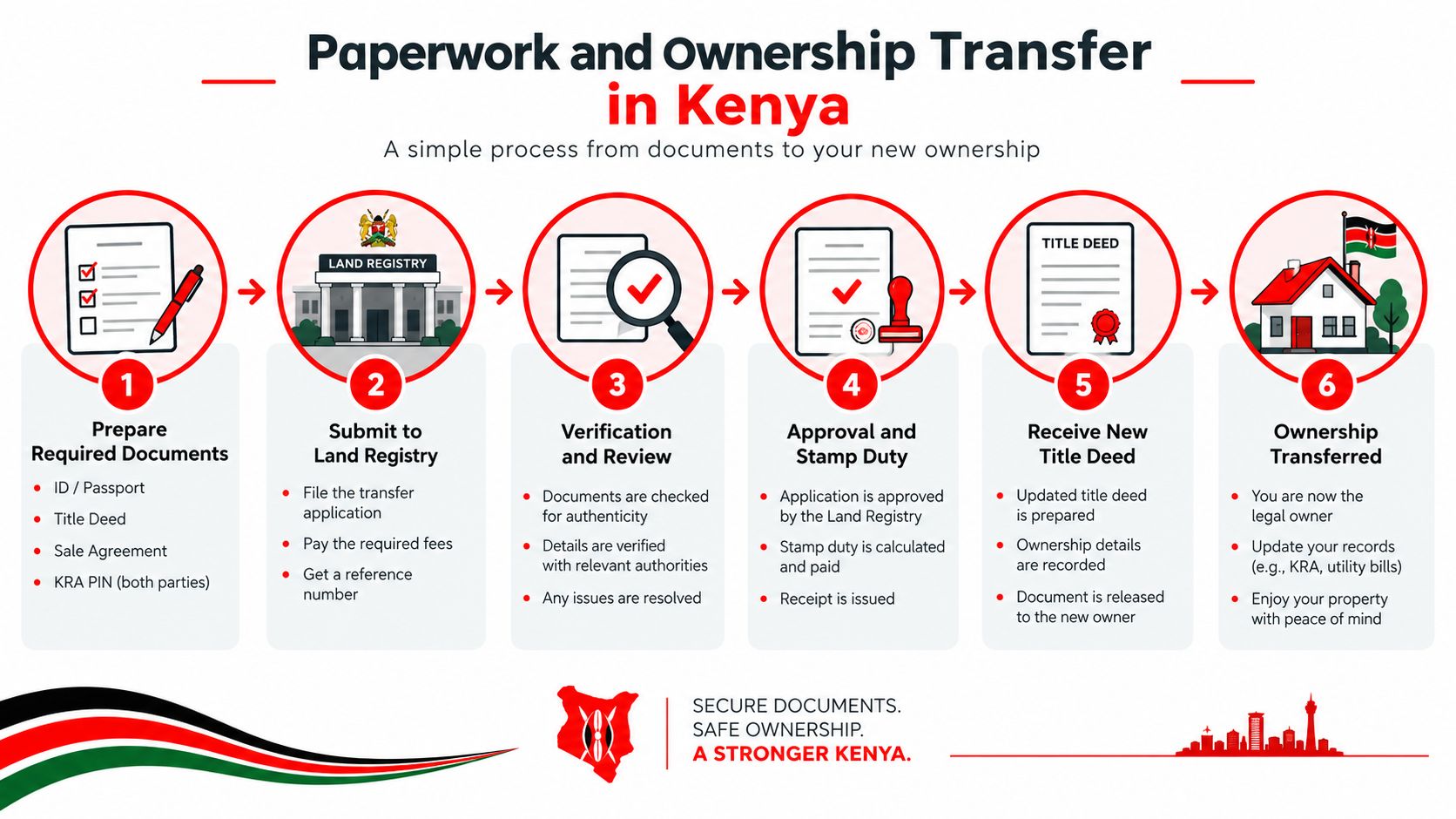
The SUV becomes yours only when the ownership record is properly transferred. Start with the original logbook and confirm that the registered details match the seller's identity, chassis number and vehicle information. Check for finance interests, encumbrances or other restrictions before agreeing to complete the transaction.
For a locally used vehicle, ask for a clear ownership trail. For an imported vehicle, keep the import and inspection documents with the purchase file. Insurance should begin at the point required by your insurer, and full cover is sensible for a recently purchased SUV because repairs and replacement parts can be costly.
Complete the digital transfer
NTSA's online ownership transfer process runs through the eCitizen and NTSA platform. The buyer must receive and accept the transfer request, and the application moves forward only after the buyer confirms the details, according to this NTSA ownership transfer explainer.
Transfer fees vary by engine capacity. One published NTSA explainer gives a range of KSh 2,210 to KSh 6,465, so confirm the exact amount before finalising the transaction. Keep copies of the sale agreement, payment record, identification documents and transfer confirmation.
Financing through a dealership can help a buyer organise the purchase and paperwork in one process, but read the repayment terms carefully and confirm what insurance and ownership conditions apply. A seller replacing an existing car can also request a valuation or use a trade-in to reduce the amount needed for the next SUV.
View current SUV stock at Brill Motors, filter by budget and model, then arrange a showroom viewing at Garden City Mall Rooftop Car Yard on Thika Road. If you're replacing your current vehicle, ask about a valuation or trade-in before choosing your next SUV.