


 SIGN UP
July 2025 is the date that resets every imported Audi A6 quote. The Kenya Revenue Authority's guide to importing a motor vehicle confirms that a vehicle's customs value is deduced from the Current Retail Selling Price matrix, that the matrix is updated periodically, and that a new motor-vehicle CRSP release was issued for July 2025. A landed-cost estimate built before that release is out of date.
Prices for the A6 in Kenya spread wide enough that one headline figure misleads. Two saloons from the same model year, both described as clean, can sit millions of shillings apart once mileage, service records, drivetrain and import status are laid out side by side. The car advertised lower often carries an unbooked repair bill, and the charges KRA applies on top of the customs value can erase what looked like a saving on the sticker.
Read an Audi A6 price in a fixed order. Generation first, engine second, condition and paperwork third, then the duty arithmetic on top of whatever the seller is asking. A realistic budget starts with the tax figure, not the advertised price.
Audi A6 Price in Kenya by Model Generation
Generation sets the floor and the ceiling before condition enters the conversation. The bands below are the indicative guide ranges Brill Motors observes across its own stock and Nairobi asking prices following the July 2025 CRSP release, and any individual car moves inside its band on model year, mileage, condition, drivetrain and whether it is locally used or imported.
| Generation | Model years | Indicative KSh band | Biggest price driver |
|---|---|---|---|
| C6 (first generation) | 2005 to 2011 | KSh 750,000 to 1,400,000 | Mileage and service history |
| C7 (second generation) | 2011 to 2018 | KSh 1,400,000 to 3,500,000 | Year, condition and local or imported status |
| C8 (current generation) | 2018 onward | KSh 3,500,000 to 6,500,000 | Trim, drivetrain and first registration date |
Treat that table as a measuring stick. It shows whether a car is priced sensibly for its age. Value is a separate question, because two cars inside the same band can still differ by more than a million shillings, and the cheaper sticker is not automatically the cheaper car to own.
How to place one car inside its band
A 2012 C7 with about 150,000 km on the clock, a full service book and recent timing and suspension work sits near the bottom of the C7 band. A 2017 C7 with roughly 60,000 km, one Nairobi owner and stamps from a main agent sits near the ceiling of the same band. The gap between those two cars is the price of five years and 90,000 km, and it is the difference a buyer usually forgets to budget for.
A car advertised well below its band deserves suspicion rather than celebration. Kenyan law requires a refund where a vehicle was materially misrepresented or a substantial qualifying defect cannot be repaired within a reasonable time, which means a suspiciously cheap A6 is often cheap because something about it has not been disclosed.
Practical rule: never compare two A6 listings unless they share a generation, a model year and a drivetrain. Anything else is noise dressed up as a bargain.
The codes C6, C7 and C8 are the fastest way to place a listing. A seller advertising "Audi A6, 2014" could be offering either side of a facelift, with different engines and different trim levels, so match the model year, engine and trim before you compare a single shilling. If a listing will not state all three, ask before you travel to see the car.
One headline number for the A6 hides all of that spread. A buyer who compares a 2013 diesel with a 2019 petrol quattro and draws a conclusion about "the market" learns nothing useful. Compare like with like, weight the asking figure against the duty position and the running costs a German premium car carries, and expect stock to move: live figures sit on our Audi listings, and they change as cars arrive and sell.
Engines and Trims That Set the Price
The engine moves the price more than the year does. A tidy four-cylinder car and a rough six-cylinder car from the same model year can cross over in price, because the buyer of the bigger engine is paying for performance and accepting the fuel and servicing bill that comes with it. Decide the engine first, then shop within the years that engine was offered.
| Engine | Fitted to | Running cost and parts note | Best for |
|---|---|---|---|
| 2.0 TFSI four-cylinder petrol | C7 and C8 | Lower fuel use and easier parts sourcing | City driving and daily commuting |
| 3.0 V6 supercharged petrol | C6 and C7 | Higher fuel use and premium-grade servicing | Buyers who want power |
| 3.0 TDI diesel | C6 and C7 | Better highway economy, fuel quality matters | Long-distance and business use |
| 3.0 TFSI petrol (55 TFSI) | C8 | Higher fuel use, check the service history closely | Buyers wanting a current model |
| 3.0 TDI diesel (50 TDI) | C8 | Strong highway economy, diesel-trained mechanic needed | Long-distance buyers wanting a current model |
Drivetrain adds a second layer. Quattro all-wheel drive lifts the asking price and adds a driveline to service, including the extra differential and transfer box work that a front-wheel-drive car never needs. Front-wheel drive is cheaper to buy, lighter on fuel and simpler to maintain. On Nairobi tarmac, most buyers don't need all four wheels turning, and the premium is better spent on a cleaner car.
Petrol or diesel, decided by your week
A diesel rewards the buyer covering long distances on decent fuel, who has a diesel-trained mechanic within reach and who understands that injector and turbo work is a real cost, not a hypothetical one. A petrol suits short city runs, where a diesel's particulate filter never gets hot enough to clear itself and the savings evaporate.
Decide the engine before the year. A well-kept 2014 2.0 TFSI is a cheaper car to own than a rough 2016 3.0 TFSI, whatever the badge on the boot says.
Engine capacity also feeds into the duty charged on an imported car, so a bigger engine costs more than its fuel bill suggests.
Before agreeing a price, confirm the engine three ways: the badge on the boot, the engine number and capacity on the registration document, and the VIN decoded against the build spec. A car advertised as a 3.0 that turns out to be a 2.0 is a pricing problem, an insurance problem and a resale problem all at once.
What Moves an Audi A6 Price Up or Down
Why do two A6s from the same year sell for very different prices? Six factors do almost all of the work, and they rank in a clear order from most to least influential.
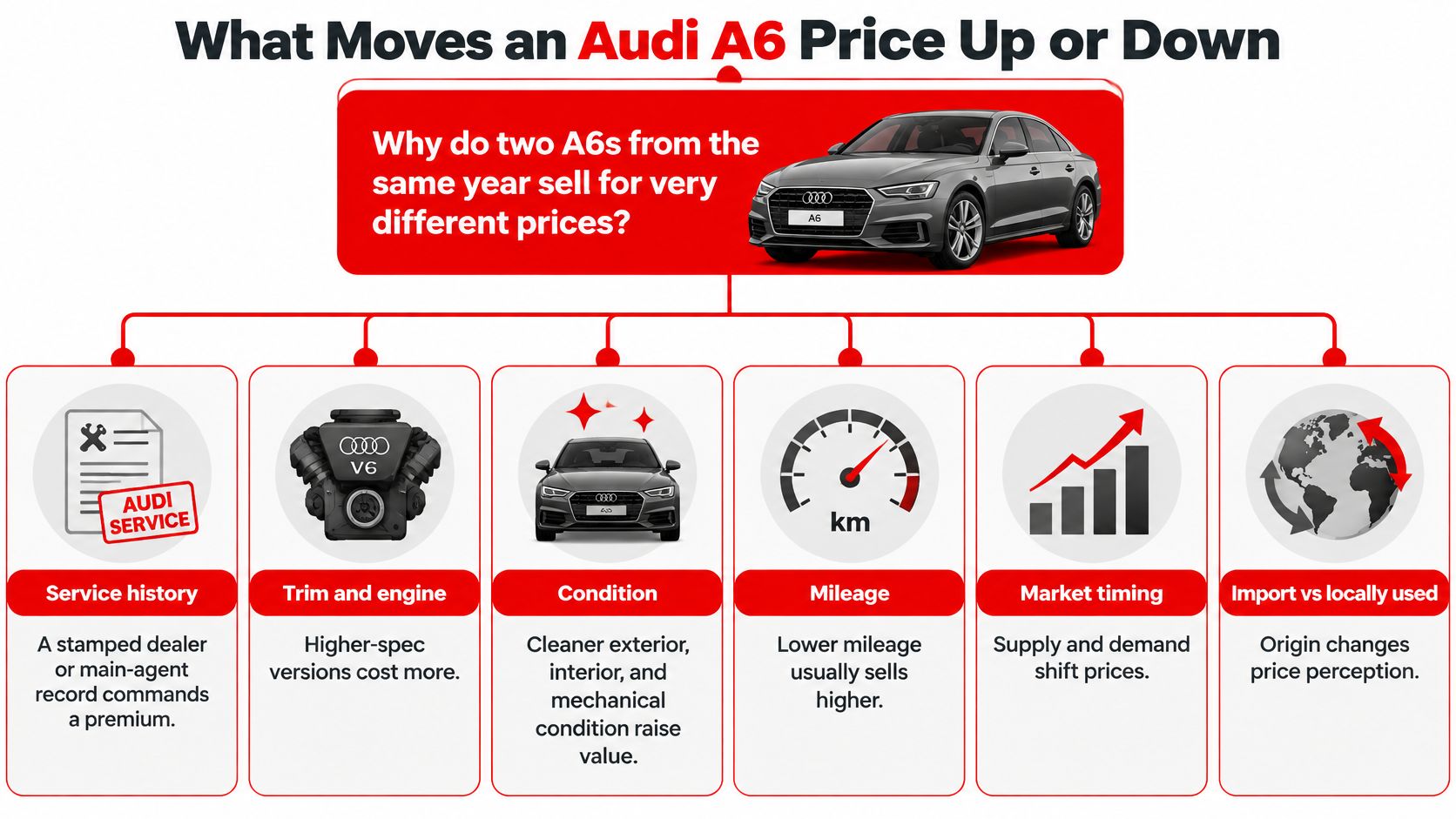
- Service history. A stamped record from a main agent or a recognised Audi specialist is the single biggest lever. Gaps force the buyer to assume the worst about what wasn't done, and the price drops accordingly.
- Mileage measured against age. A 2015 car at 180,000 km prices below an identical 2015 car at 90,000 km even when both present clean, because the higher-mileage car is closer to the next round of wear items.
- Condition and accident history. A car with documented panel repairs sells below a straight one, and a repaired structural hit sits far lower again. Paint depth readings and a diagnostic scan settle arguments that a description can't.
- Parts and labour exposure. Audi components and specialist labour cost more than a mainstream Japanese saloon. A car due for suspension arms, a water pump or an electronic module is priced down to reflect that bill, whether or not the seller admits it.
- Import status. A foreign-used car carries clearance costs that a locally registered example has already absorbed, and buyers discount for the uncertainty.
- The seller's side. A trade-in offer follows the same logic in reverse, because what a dealer can pay depends on what the car will need before it sells.
That last point matters if you're selling. We buy trade-in vehicles from customers, and the offer reflects the same six factors a retail buyer would weigh. If you want to see this valuation logic applied to a different Audi body shape, our Audi Q5 price in Kenya guide walks through it step by step.
Locally Used or Imported and the Full Landed Cost
The advertised figure is only the first line of the calculation. The gap between that number and the final landed cost is where most import budgets fail, because Kenya's charges build on each other rather than sitting side by side. A cheap car abroad does not convert into a cheap car in Nairobi.
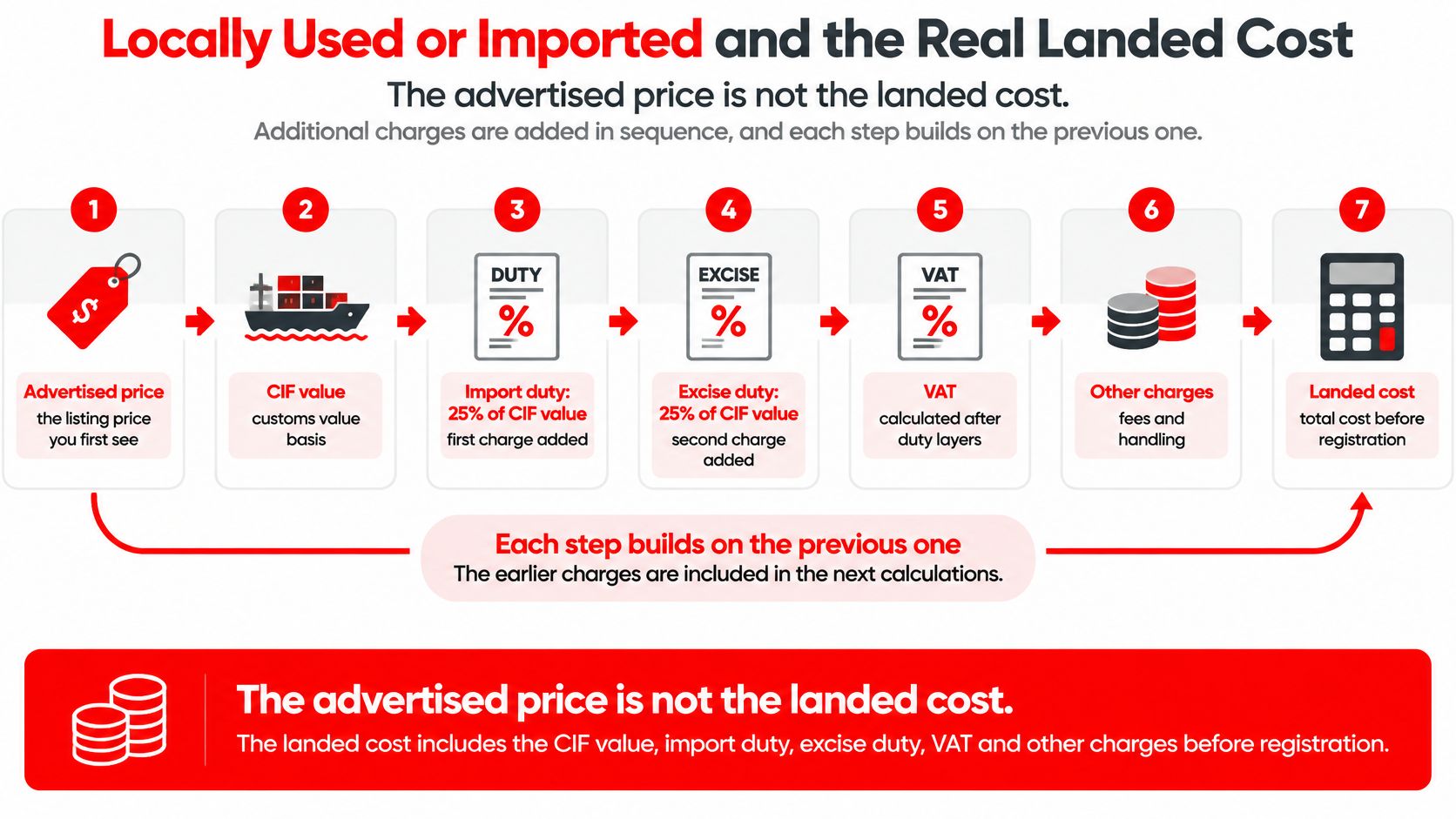
The Kenya Revenue Authority's procedures for motor vehicle importation set import duty at 25% of customs value, excise duty at 25% for vehicles above 1,500cc, VAT at 16% of customs value plus import duty and excise duty, the Railway Development Levy at 2% of CIF value and the Import Declaration Fee at 3.5% of CIF value. Almost every A6 engine clears the 1,500cc threshold, so the 25% excise band applies. Confirm current rates with KRA or a licensed clearing agent before you commit money.
Take a hypothetical CIF value of KSh 2,000,000. Import duty comes to KSh 500,000, excise duty to KSh 625,000, and VAT to KSh 500,000, with a levy of KSh 40,000 and a declaration fee of KSh 70,000. Those illustrative taxes total KSh 1,735,000, or 86.75% of CIF, giving a pre-registration subtotal of KSh 3,735,000 before port, shipping, storage, inspection, clearing and registration are added.
Ask for the worksheet, not the quote. A serious seller can show the valuation basis, the duty lines and whether registration is included. If they can't, the quoted number is a wish.
Timing matters too. KRA expects imported vehicles to be cleared through Customs within 21 days of arrival, with duties generally paid before clearance, as set out in KRA's facts for taxpayers. A car sitting at the port past that window accumulates storage and penalties that never appear in the advert.
The buyer's test is simple. Set the locally used asking price against the full landed estimate for a comparable import, then decide. We sell both foreign used cars and locally used cars, so the comparison is one we make with customers regularly; the guide to imported cars for sale in Kenya covers the paperwork side in more detail.
Inspection, Paperwork and Ownership Costs
Start with the documents, because they decide whether the car can be registered at all. An imported A6 must be less than eight years old from its year of manufacture or first registration, and used imports need a roadworthiness inspection by a Kenya Bureau of Standards-appointed agent in the exporting country plus the pre-shipment documents, according to KRA's importation procedures.
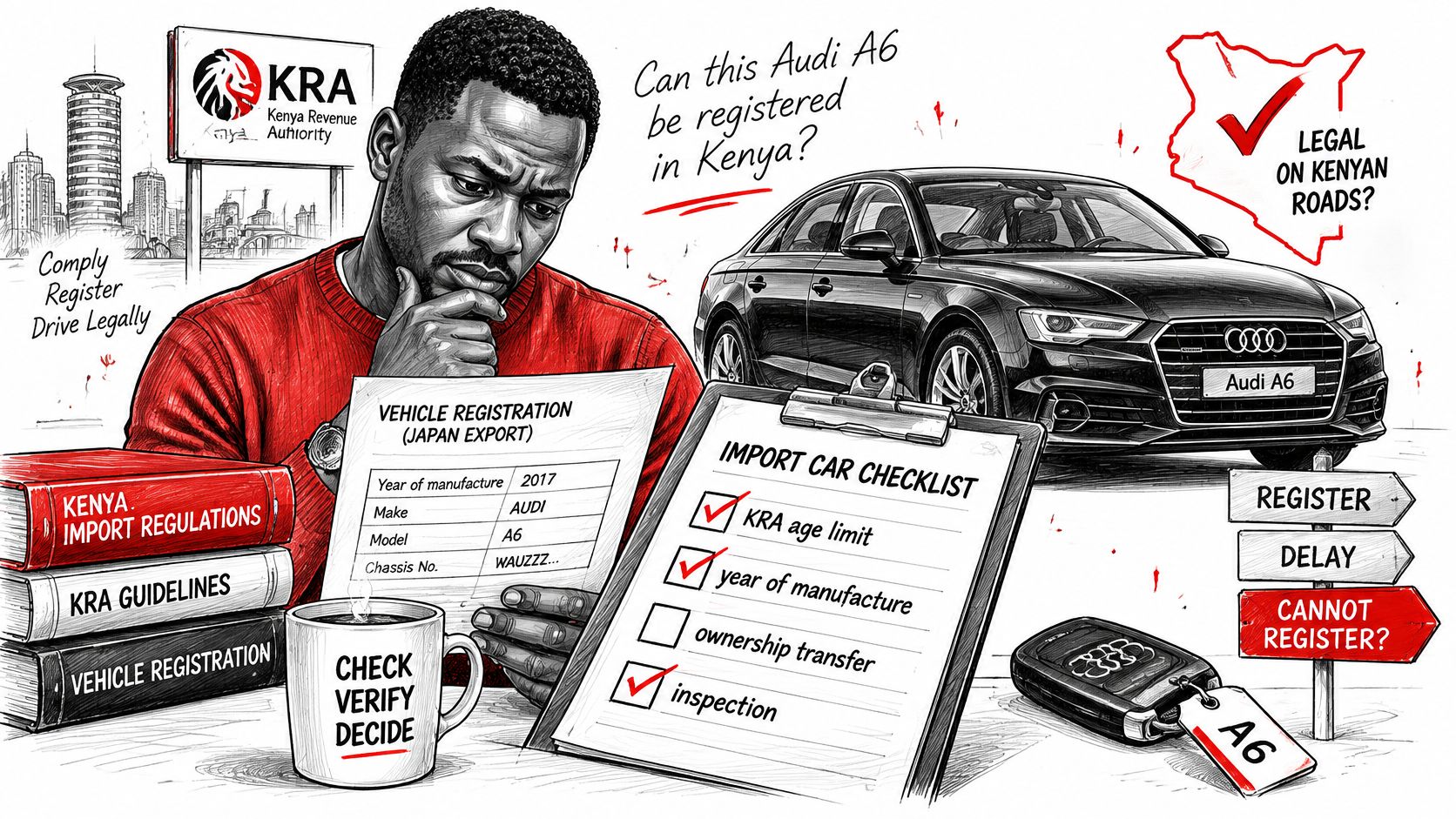
Check the first-registration date against the advertised model year, the logbook name against the seller's ID, the customs status, and the original import documents where the car came in. A missing inspection certificate turns a bargain into a car that cannot be cleared.
The condition checklist, once
- Cold start and warning lights. Arrive before the engine is warm and watch what stays lit.
- Service history gaps. Match the stamps to the mileage and look for missing years.
- Oil leaks. Check around the sump, the rocker cover and the turbo lines where fitted.
- Fluids. Coolant colour, oil level and condition, and any sign of mixing.
- Diagnostic scan. Pull stored fault codes rather than trusting a cleared dash.
- Suspension, steering and tyres. Uneven tyre wear points to alignment or worn arms.
- Paint and panels. A depth gauge finds filler that a photograph hides.
- Test drive. Work through every gearbox shift, listen for whine, and brake firmly from speed.
Then budget for ownership, which is where a cheap purchase turns expensive. Specialist servicing, parts sourcing, insurance, fuel and a first-year repair reserve can outweigh a lower sticker price within twelve months. Every sale we make comes with a written Vehicle Sale Agreement setting out the vehicle details, the purchase price, any deposit, payment timelines, delivery terms and who handles which documents. Selected vehicles also carry an eight-month warranty on specific mechanical or structural issues, as set out in the warranty policy provided at the sale.
Matching Your Budget to an A6 Before You Visit
Fix the budget band before you look at a single car. The band decides which generation you are shopping in, and it stops you spending afternoons viewing cars that were never realistic. The ranges below reflect the asking-price spread we see across the vehicles we list.
- Under KSh 1,500,000. Older C6 territory with higher mileage. Hold back a repair fund and put the inspection ahead of any negotiation.
- KSh 1,500,000 to KSh 2,500,000. Well-kept C6 cars or earlier C7 examples with a clear service record and a known history.
- KSh 2,500,000 to KSh 3,800,000. The C7 range opens up properly, with full-history cars and a wider choice of engines and drivetrains.
- KSh 3,800,000 and above. Late C7 models or entry C8 cars, where the first registration date and drivetrain matter as much as the mileage.
Once the band is fixed, work in a set order. Shortlist by year, engine and whether the car is locally used or imported. For an import, it is the landed figure after KRA charges that belongs inside your band, not the advertised foreign price, so run that estimate before you compare cars. Then book a viewing or request a valuation so the numbers are confirmed on the actual car rather than on a description.
You can filter listings by make, with Audi sitting alongside BMW, Mercedes-Benz, Porsche, Volkswagen, Toyota, Lexus and the rest of the range. Browse our used Audi stock to see what is available now, view cars in person at our showroom at Garden City Mall, Nairobi, or call or WhatsApp +254 758 243 058 to ask about a specific car before you travel.
An Audi A6 is a car you buy on paperwork as much as on paintwork, and Brill Motors sells both foreign used and locally used cars, so we can put a locally registered example next to an import and show you what each one really costs to own. We also buy trade-in vehicles from customers, which means a valuation on your current car can be settled against the A6 you are considering. Visit Brill Motors to see current stock, or come to our showroom at Garden City Mall and inspect the cars yourself.