

 SIGN UP
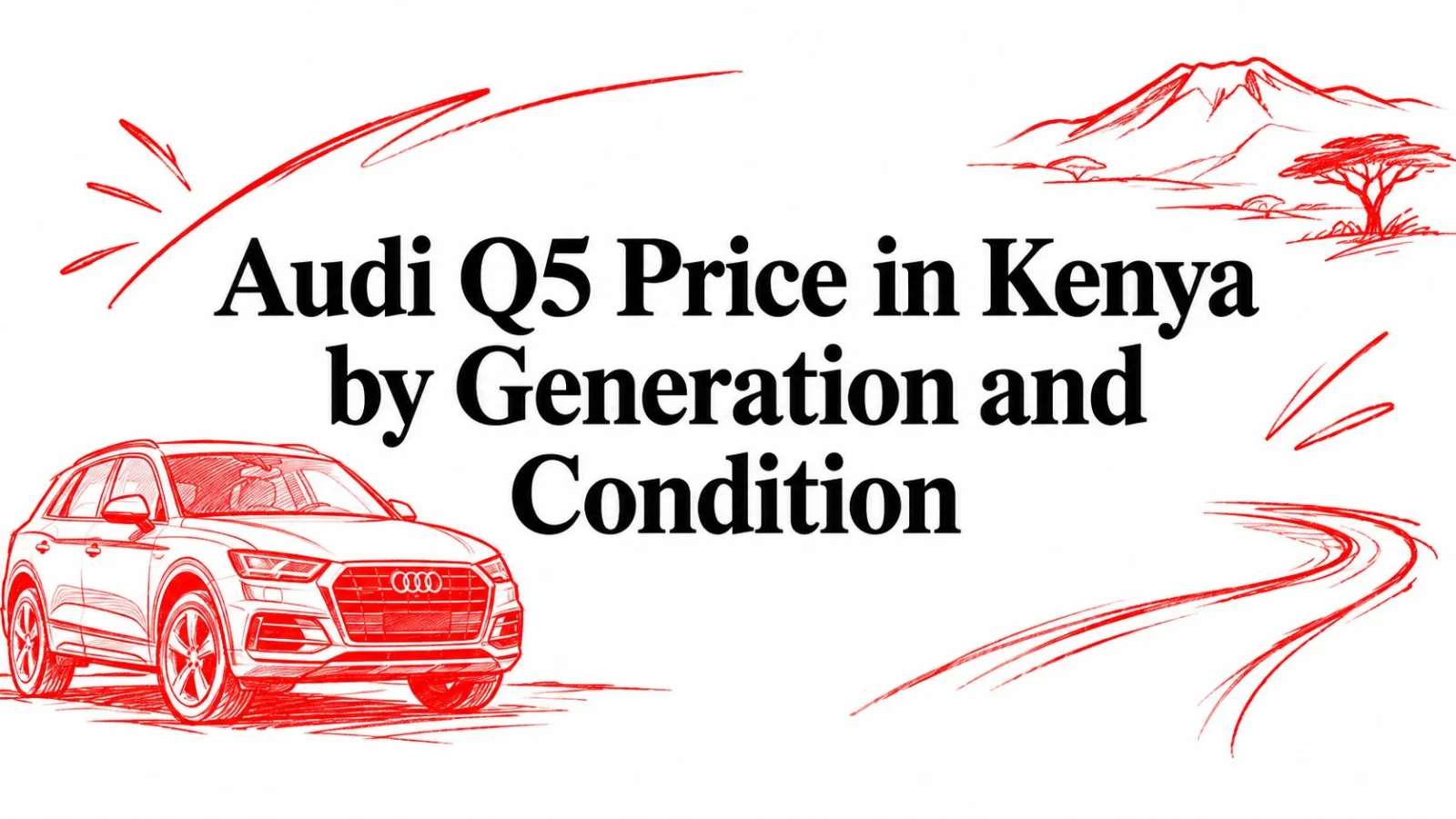
Used Audi Q5s in Kenya are advertised at roughly KSh 3.9 million to KSh 8.5 million, depending on model year, mileage, body style and trim. That spread reflects the vehicle's specification and condition, not dealer margin alone, and the right price depends on what you can verify before paying.
You might be weighing a locally used Q5 against a familiar Japanese SUV or a fresh import. My advice is to treat the Q5 as a working family car, not just a premium badge: match the generation and engine to your budget, inspect the mechanicals properly, budget for ownership costs, and check that the paperwork supports the asking price.
What an Audi Q5 Costs in Kenya Today
The KSh 3.9 million to KSh 8.5 million asking-price range is a useful starting point, not a promise of what every Q5 should cost. Two cars at the same price can be very different vehicles. The lower end tends to be an older or higher-mileage 8R, while newer FY-generation cars, low-mileage examples and Sportback body styles sit higher. A Kenya-focused listing page gives a mid-market reference near KSh 4.8 million, but advertised prices aren't completed sale prices.
At a Nairobi viewing, don't compare a Q5 and a Toyota by badge or purchase price alone. Compare the vehicle in front of you: generation, engine, drivetrain, service record, condition and import status. A clean, documented quattro can justify its money. A cheaper car with gaps in its history can hand you a repair bill inside months.
Practical rule: Ask what the price includes before comparing two Q5s. An advertised CIF figure for an import isn't the same as a cleared, registered car you can drive away in Nairobi.
A sound decision comes down to four things: a fair price for that generation and trim, the engine and drivetrain that suit your use, what a proper inspection finds, and whether NTSA and KRA records back up the seller's story. Running costs matter too, especially when you're choosing between petrol and diesel or front-wheel drive and quattro.
Q5 Generations Sold in Kenya and How They Differ
The generation tells you more than the shape of the grille. It gives you a rough guide to the cabin, equipment and technology you'll be living with, but condition and service history should decide whether a particular example is worth its asking price.
The 8R is the earlier Q5 and usually the entry point for buyers who want the Audi SUV shape without paying for a newer cabin. Expect older infotainment and a more straightforward interior. The 8R facelift updated the exterior, with S line styling and LED lighting on relevant specifications, and broadened the engine choices. Don't assume an S line badge means the mechanical condition is better. It's a trim, not a service record.
The FY generation moved the Q5 onto a newer platform and brought a more modern cabin, engine family and, on suitably equipped examples, Audi Virtual Cockpit. The FY facelift sharpened the styling and updated the infotainment and driver-assistance equipment. Those changes can make a newer Q5 feel more current, but they also make a full inspection and diagnostic check more important. More screens and sensors mean more systems to test, not a reason to skip the basics.
- Family commuter: Consider an earlier, well-kept Q5 if the cabin and equipment meet your needs and the service history is complete.
- Premium upgrade: An FY with documented maintenance is a more modern daily drive. Pay for the actual condition, not the newer appearance.
- Performance-focused buyer: Look at the higher-output diesel or a well-specified quattro, but keep a larger repair reserve and verify the exact engine and drivetrain.
I wouldn't pay a premium for a facelift or sportier trim if the diagnostic report, tyres or service records raise concerns. A tidy, documented example is a better buy than a newer-looking Q5 with unanswered questions.
Engines, Transmissions and Drivetrains Worth Choosing
For many Nairobi buyers, the 2.0 TDI is the sensible starting point. It offers useful low-speed pulling power and suits a driver who covers longer distances as well as urban roads. Diesel isn't automatically cheaper to own, though. A neglected vehicle can quickly cancel out any fuel-cost advantage, so check maintenance records and have the engine scanned before you commit.
The 2.0 TFSI petrol is smooth and well suited to drivers who prefer petrol, but expect fuel use to feel heavier in stop-start traffic than in a steady open-road commute. The 3.0 TDI delivers stronger performance and is the choice for someone who values effortless acceleration or needs more pulling power. Its greater complexity and the possible cost of diesel-system repairs make it a poor match for a buyer who's stretching to afford the purchase price.
Q5 variants differ by transmission and drivetrain, so verify the exact specification rather than assuming every car has the same setup. The eight-speed automatic should shift cleanly during a test drive, with no harsh engagement or hesitation. Earlier 8R examples may be front-wheel drive or quattro, Audi's all-wheel-drive system. Quattro can suit buyers who want added traction, but the system must be checked as part of the inspection.
| Choice | Best fit | Main ownership consideration |
|---|---|---|
| 2.0 TDI | Regular longer trips and buyers prioritising diesel torque | Check service evidence and diesel-system condition |
| 2.0 TFSI | Drivers who prefer petrol and a smooth response | Allow for higher fuel use in heavy traffic |
| 3.0 TDI | Performance-focused use | Budget for more complex repairs |
| Front-wheel drive | Buyers seeking a simpler specification | Confirm the actual configuration |
| quattro | Buyers who value all-wheel drive | Inspect the drivetrain for smooth operation |
My default recommendation is a well-maintained 2.0 TDI, not the most powerful engine you can find. Buy the stronger engine only if you have the budget to maintain it properly.
Price Ranges by Generation, Trim and Body Style
Generation, trim and body style set a Q5's Kenyan asking price before condition even enters the conversation. Two cars wearing the same badge can sit millions of shillings apart, and the reported examples show why.
| Generation | Typical model years | Common trim and body | Indicative KSh band |
|---|---|---|---|
| 8R and 8R facelift | Earlier Q5 examples | Regular SUV, including TDI variants | KSh 3.9m to KSh 4.5m for higher-mileage examples; confirm against current listings |
| FY | Newer-generation examples | 40TDI quattro Sport and S line | KSh 3,907,791 to KSh 4,725,990 for the cited 2020 examples |
| FY facelift | Newer examples | Sportback Highstyle S line | KSh 8,453,686 for the cited 2023 example |
The Kenyan asking-price examples cited in the first section put real numbers on that spread. A reported 2020 40TDI quattro Sport was priced at KSh 3,907,791 with 41,800 km, while a 2020 40TDI quattro Sport S line Package with 30,266 km was listed at KSh 4,725,990. That is about 21% more for the lower-mileage S line. A 2023 Sportback Highstyle S line 2.0, showing just 9,400 km, was listed at KSh 8,453,686, roughly 116% above the lowest-priced cited 2020 car.
My advice: never compare a bare 40TDI quote with an S line or Sportback quote and call it market research. Match mileage, trim and body style first, then argue about condition. For a mainstream family-SUV benchmark, the Mazda CX-5 price guide shows what a similar budget buys in a simpler car.
Treat every advertised figure as a starting point for discussion, not a confirmed transaction price. A clean logbook and consistent service history justify paying toward the top of a sensible band; missing records or evidence of repair work should pull your offer down, or end the conversation.
Import Taxes and the True Landed Price of an Imported Q5
A CIF price covers the vehicle's cost, insurance and freight. It doesn't, by itself, tell you what the Q5 will cost after customs, port handling, inland transport, registration and any preparation. Buyers comparing an import with a locally used Q5 should put both prices on the same, fully landed basis.
KRA's revised used-vehicle valuation framework took effect on 1 July 2025. KRA says the valuation uses its Current Retail Selling Price, or CRSP, framework; the revised structure includes 35% import duty, excise duty of 25% to 35% depending on engine size, and 16% VAT. The taxes are cumulative, and KRA's valuation may not match the seller's overseas invoice. Check KRA's clarification on the revised CRSP list.
An older KRA import-cost illustration for a Q5 uses a CIF figure of KSh 2,020,000 and shows KSh 505,000 import duty, KSh 631,250 excise, KSh 505,000 VAT, KSh 70,700 IDF and KSh 40,400 RDL, giving an indicative pre-registration total near KSh 3.77 million. Read KRA's motor-vehicle import guidance. Treat that arithmetic as an illustration, not a current quote: the duty assumptions differ from the revised framework, and KRA valuation, engine classification and applicable charges must be confirmed before purchase.
Don't accept a Mombasa CIF price as an all-in Nairobi figure. Get the tax basis and every clearance and delivery charge in writing.
If you're weighing an import against a locally available car, compare the full cost rather than the headline figure. This guide to imported cars in Kenya is a useful companion, but confirm current rates with KRA or a licensed clearing agent before making a payment.
What to Check at a Q5 Viewing in Nairobi
A polished body and a quiet test drive aren't enough. Take time to check the engine cold, inspect the cabin and body carefully, and ask for a diagnostic read before committing. If the seller won't allow a proper inspection, walk away.
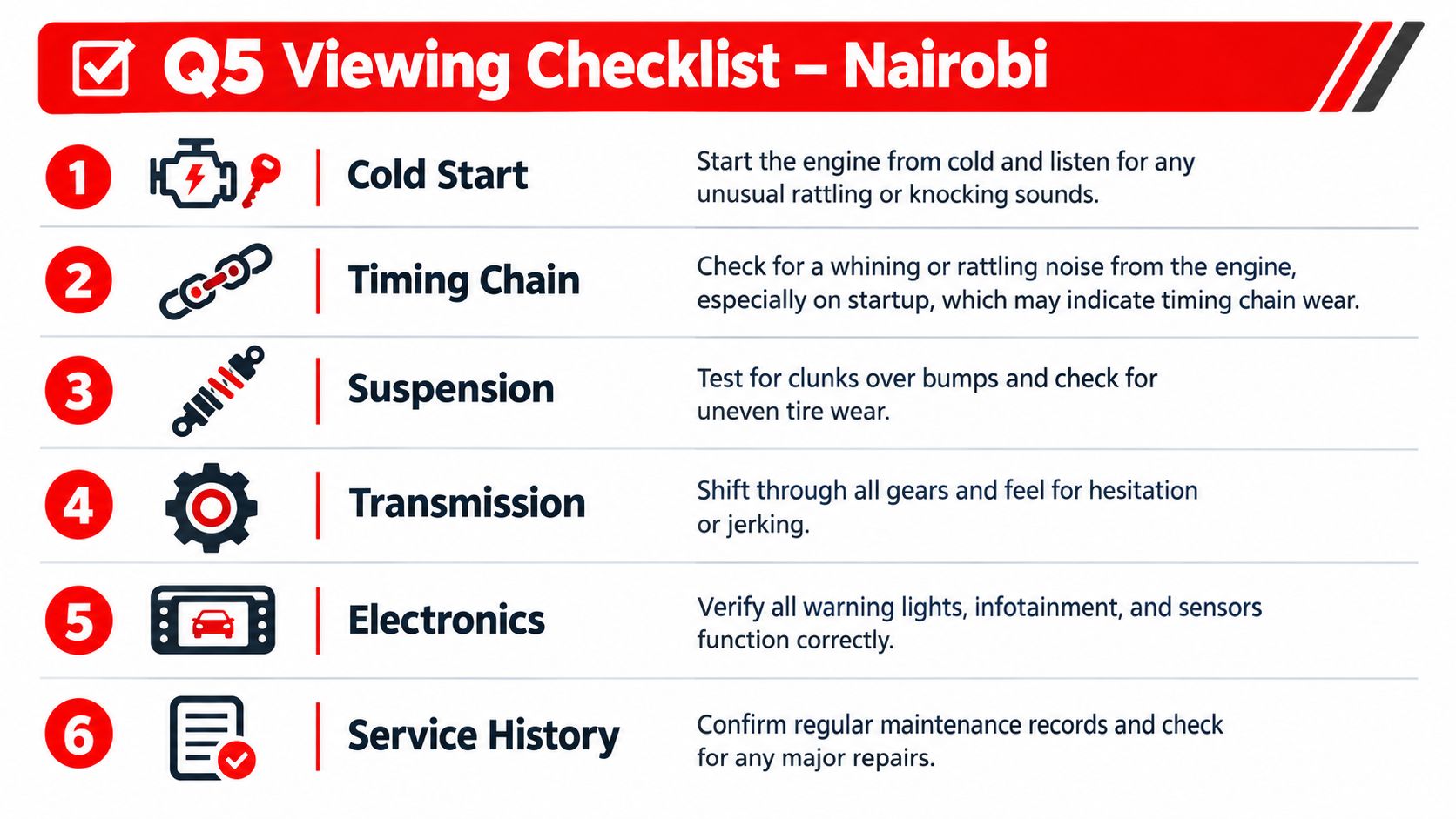
Use this checklist in order:
- Cold start: Ask for the engine to be started from cold. Listen for unusual rattling or knocking, especially during the first moments after start-up.
- Timing chain: On a 2.0 TFSI, listen for a rattling or whining noise from the engine on start-up. Treat suspicious sounds as a reason for further diagnosis, not guesswork.
- Coolant and oil: Check coolant level and look for signs of leaks around the engine, including the cam chain cover and turbo oil feed.
- Transmission and drivetrain: Drive the car through all gears. The automatic should shift smoothly, with no judder or hesitation. Check that the specified quattro or front-wheel-drive system behaves normally.
- Body, boot and tyres: Look for uneven panel gaps that may point to repairs. Check the boot floor and spare-wheel well for water marks, and inspect tyre condition and wear for consistency.
- Electronics and suspension: Test warning lights, infotainment and sensors. Drive over bumps and listen for suspension clunks.
- Diagnostics: Get an OBD diagnostic read before paying. Use a technician familiar with VAG vehicles if you can.
A visual inspection won't reveal every stored fault or past repair. If you're also comparing other family vehicles, browse this guide to an SUV for sale, but apply the same rule: inspect the actual car, not just its advert.
Five-Year Ownership Cost of a Q5 in Kenya
There's no honest one-size-fits-all figure for five years of Q5 ownership. Fuel use depends on your commute, driving habits and engine; repairs depend on the individual vehicle's condition and how it's been maintained. Build your own estimate from the car you're considering instead of relying on a generic running-cost promise.
Write down the likely costs before agreeing a price:
- Fuel: Estimate your normal Nairobi and out-of-town driving separately. A 2.0 TDI may suit regular longer trips, while a 2.0 TFSI buyer should allow for heavier use in stop-start traffic.
- Routine maintenance: Ask for a service plan and recent invoices. Budget for scheduled servicing, diagnostics and wear items rather than assuming a premium SUV will be cheap to maintain.
- Tyres and brakes: Check what the car needs now, and ask a mechanic to assess tyre wear, brake pads and discs. A set of mismatched or worn tyres is a reason to renegotiate.
- Insurance: Get an actual premium quote for the vehicle and cover you want. Don't assume the price based on a different model or insurer.
- Repair reserve: Keep money available for unexpected work. Ask the inspecting technician to assess the transmission, timing chain, turbo, water pump, suspension, quattro system and electrical equipment.
A cheaper import can lose its price advantage if it needs extensive repairs, tyres or maintenance soon after arrival. Conversely, a documented local vehicle isn't automatically sound, but a credible service history gives you evidence to assess what's been done and what may be due.
I'd rather see a buyer pay more for a Q5 with consistent records and a clean diagnostic report than save money on an undocumented car. That discount is no bargain if the next owner has to fund repairs immediately.
Paperwork That Confirms the Price Is Real
The documents should support what the seller says about ownership, mileage, import status and maintenance. Check them before you pay a deposit, not after you've fallen in love with the car.
- NTSA registration and logbook: Confirm the registered owner and match the chassis and engine numbers on the documents to the vehicle. Verify the registration through the NTSA portal.
- KRA customs assessment and payment records: Ask for evidence that the applicable customs charges have been settled. KRA says import duty, excise duty, VAT, Import Declaration Fees, Railway Development Levy and registration fees must generally be paid before customs clearance; its tax valuation may use CRSP rather than the seller's invoice. Review KRA's customs guidance on motor-vehicle charges and valuation.
- Service records and invoices: Look for a consistent history and confirm that the recorded mileage makes sense across the documents. Ask specifically about major repairs and recent maintenance.
- Inspection report: Request a written assessment covering structural condition and signs of accident or water damage.
- Tyres and recent servicing: Check tyre condition and age markings, then compare any recent service invoice with the work the car needs.
Missing paperwork isn't a minor inconvenience. Ask the seller to resolve it, and request current KRA clearance evidence if customs documents are incomplete. If the logbook details don't match the car, don't proceed until the discrepancy is resolved.
Choosing the Right Q5 and Next Steps
The right Q5 is the one whose condition, specification and paperwork fit your budget, not necessarily the newest or most powerful one. A budget-conscious buyer should focus on an 8R facelift TDI with a verifiable service history and no unresolved inspection concerns.
For a family upgrading to a more modern cabin, consider an FY TDI with quattro if the records and diagnostic report support the asking price. If the sharper appearance and newer equipment matter most, an FY facelift may suit you, but don't stretch your budget so far that you can't maintain it.
Before you decide, make sure the car's service history matches its mileage, the tyres are in sound condition, the transmission and drivetrain pass inspection, and the ownership and import documents check out. Those details matter more than a trim badge or a seller's assurance.
Visit the Brill Motors showroom at Garden City Mall for an in-person viewing, and check current listings before setting your budget.
Brill Motors offers showroom viewing at Garden City Mall, vehicle valuation and trade-ins. Browse Brill Motors for current stock, or visit the yard to discuss a Q5 that fits your needs.