

 SIGN UP
Eight years. That is the import age cutoff that removes whole Outlander model years from the Kenyan market before you ever compare two adverts.
Asking prices in Kenya run from older locally used units at the bottom of the market to newer foreign-used examples well above the middle of the spread. Year, engine size, mileage, condition, and whether the car came in as a foreign-used import or is already registered locally, decide where any single car sits. Treat that spread as a guide.
Those adverts are asking prices, not what a car changes hands for, and they are not the cost of putting one on Thika Road. Between a Japanese auction sheet and a Nairobi number plate sits a KRA charge stack that can rival the price of the vehicle itself. One overseas price becomes very different Nairobi figures once those charges land. Petrol and PHEV ownership are separate decisions. Confirm the model year is still eligible, and know the engine band, before you set any two prices side by side. Comparing two Outlanders without checking both is guesswork.
Outlander Price Bands in Kenya Today
Check the model year and the engine before you compare any two prices. A petrol Outlander and a PHEV are separate decisions, and one overseas price becomes very different Nairobi prices once KRA charges are applied.
Group what you see advertised into four bands.
| Category | Typical position | What moves the price |
|---|---|---|
| Older locally used (around 2009 to 2013) | Bottom of the local market | Mileage, service history, body condition |
| Newer locally used (2014 to 2018) | Mid local market, often close on paper to a fresh import | Trim, engine size, condition |
| Foreign-used petrol (2018 onwards, inside the age window) | Higher once freight and KRA charges sit inside the asking price | Import status, CIF value, mileage |
| Foreign-used PHEV (2019 onwards, inside the window) | Top of the market, judged apart from any petrol car | Battery health, specification, charging history |
What separates a clean local car from a tired one
In the older locally used band, the asking price on its own tells you very little. Two 2011 cars at the same figure can be far apart once you count a worn clutch, tired suspension bushes, a gearbox that shudders into second and a service book with gaps. Locally used Outlanders have spent their lives in Nairobi traffic. Drive one over speed bumps and listen for the front end. Check whether the air conditioning still blows properly cold.
Brill Motors sells both foreign-used and locally used cars, so put a clean local car next to an import only after both figures mean the same thing. A well-documented 2015 local unit and a freshly landed 2018 import can look like the same money until clearing costs sit on one side and deferred maintenance on the other.
Where the two import bands sit and why
Keep foreign-used petrol and foreign-used PHEV on separate shortlists.
A foreign-used petrol price already folds in the vehicle, the freight and the KRA charges. Mileage matters. CIF value and condition grade matter more, because duty follows the declared value. Two cars can share one overseas price and still finish far apart in Nairobi. Confirm the year is still eligible to import, and note the engine band, before you set that car against anything already registered here.
PHEVs sit at the top for different reasons: fewer units, higher specification, and a battery you inspect before you commit. A strong petrol deal is not a reason to stretch into a PHEV. A tired battery is not a bargain because the body looks newer.
Use the bands to sort a search. They are not offers, and live asking prices move as cars land and sell.
Ask this before you compare anything: does this figure include duty, excise, VAT and registration, or is it the CIF price of a car still sitting in Mombasa?
If the answer is CIF, stop. That number is not a Nairobi price. Match the budget to one band, confirm year and engine, then compare only cars whose figures mean the same thing.
How Import Charges Lift the Kenyan Price
Two Outlanders can leave the same port on the same ship and still reach Nairobi more than KSh 800,000 apart, because the Kenyan price is built from a chain of charges rather than a single purchase figure.
CIF value is the base: the cost of the vehicle, plus insurance, plus freight to Mombasa. Everything KRA charges is calculated from that base, which is why the overseas price and the Nairobi price are two different conversations.
The sequence matters, because each charge feeds the one after it.
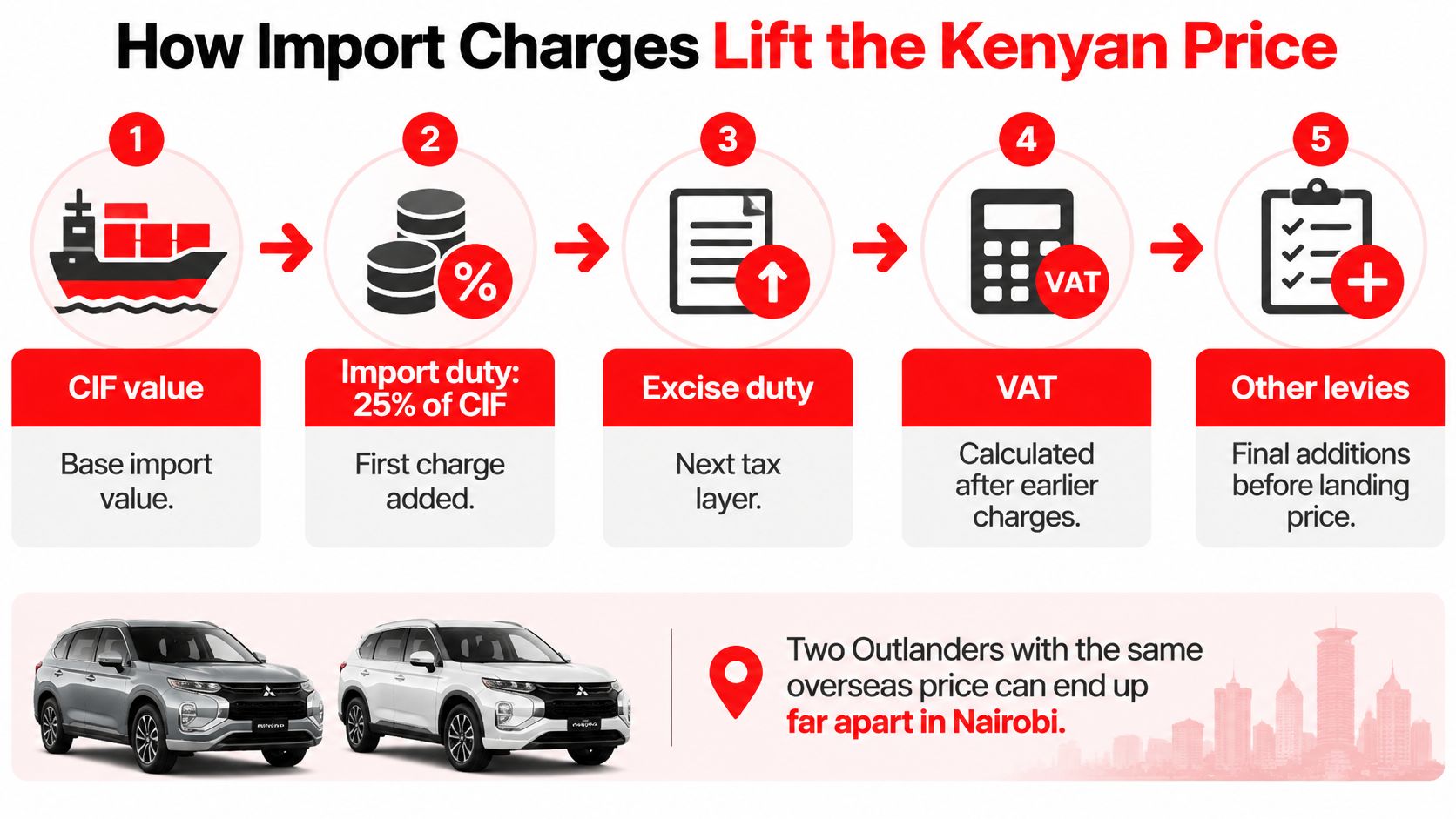
KRA's guide to importing a motor vehicle sets the stack out plainly: import duty at 25% of CIF value, excise duty at 20% of CIF plus import duty for vehicles up to 1,500cc and 25% above 1,500cc, then VAT at 16% of CIF plus import duty plus excise duty, with the Import Declaration Fee and Railway Development Levy added on top.
| Charge | Rate or rule | Applies to |
|---|---|---|
| Import duty | 25% of CIF value | All imported used vehicles |
| Excise duty | 20% of CIF plus import duty up to 1,500cc, 25% above 1,500cc | Engine size sets the band |
| VAT | 16% of CIF plus import duty and excise duty | All imported vehicles |
| Import Declaration Fee | Listed by KRA as an additional charge, confirm the amount | Imported vehicles |
| Railway Development Levy | Listed by KRA as an additional charge, confirm the amount | Imported vehicles |
A worked example on a KSh 2,000,000 CIF
Take a 2.4-litre petrol Outlander with an illustrative CIF value of KSh 2,000,000. Import duty lands at KSh 500,000. Excise at 25%, because the engine is above 1,500cc, adds KSh 625,000 on the KSh 2,500,000 running total. VAT at 16% on KSh 3,125,000 adds about KSh 500,000 more. That's KSh 1,625,000 in charges before the Import Declaration Fee, the Railway Development Levy, inspection, port handling, agent fees and registration. A car bought at KSh 2,000,000 is a KSh 3.6 million car before anyone polishes the paint.
Why a cheap invoice doesn't guarantee a cheap car
KRA can value a used vehicle using its own Current Retail Selling Price rather than the invoice you paid, and the published CRSP schedule for used motor vehicles is the document that governs it, with a revised schedule taking effect from 1 July 2025. A bargain auction bid doesn't lower the duty if KRA's valuation disagrees with it. Older price articles you find online can be based on the previous schedule and read as misleading today.
Comparing a locally registered Outlander against one that still has to be cleared? Our guide to imported cars for sale in Kenya explains how the two routes differ in practice.
What to ask before you agree a price
- Is this CIF, duty paid, or registered? Three different numbers, three different obligations.
- Which valuation applies? Ask whether the figure uses the invoice or KRA's CRSP.
- What is the all-in Nairobi figure? Duty, excise, VAT, IDF, RDL, port, agent and registration should arrive as one number.
Confirm current rates with KRA or a licensed clearing agent before you commit. Rates and valuation schedules change, and a clearing agent who handles Outlanders regularly will price the exact unit faster than any table.
Model Year, Engine and Trim Differences That Change the Price
Price moves inside a band for reasons you can check before you commit.
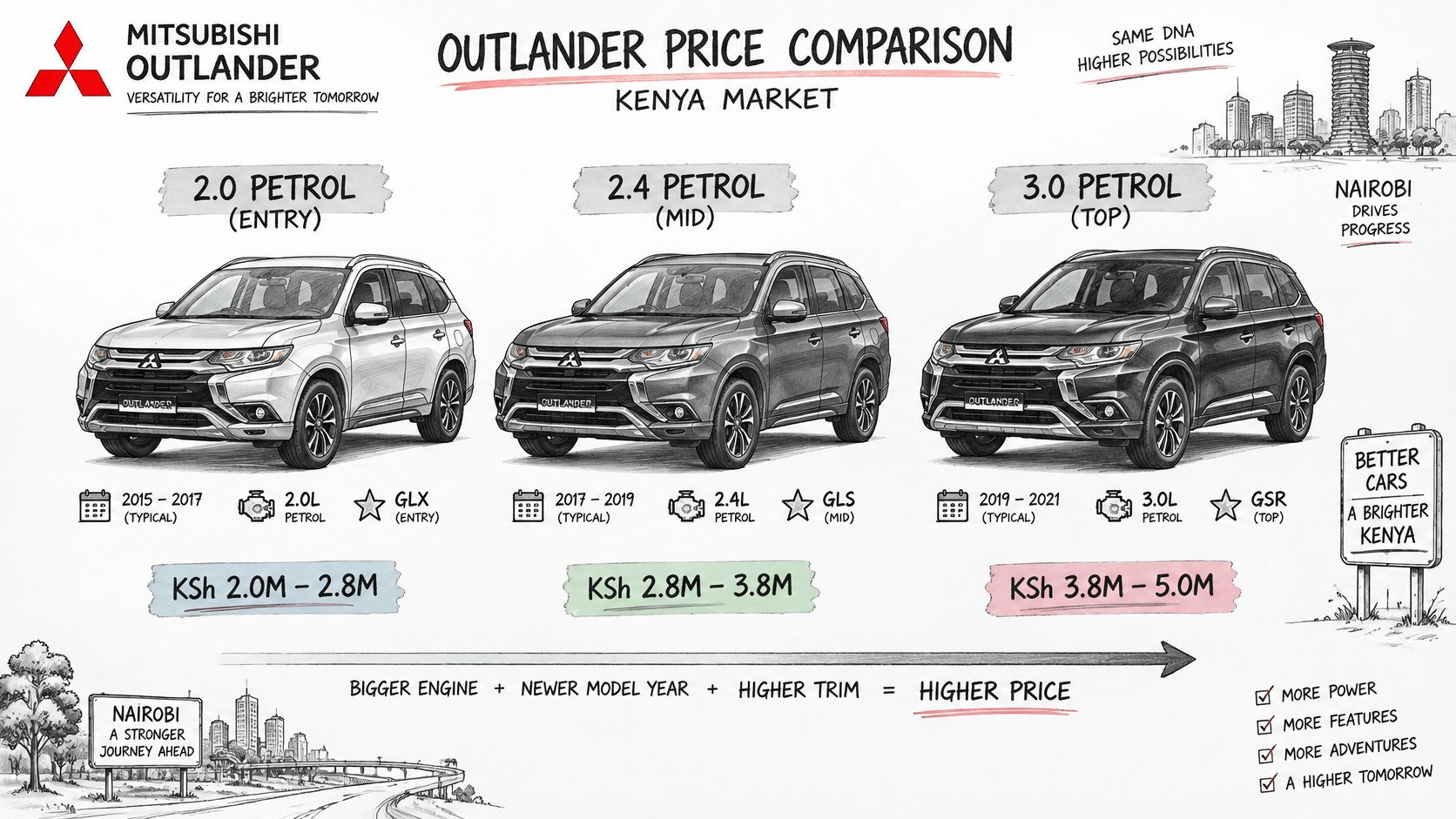
On the same lot, a 2019 car outranks a 2015 car. Engine size moves the Nairobi figure less than most buyers expect. The 2.0-litre, 2.4-litre and 3.0-litre V6 petrol cars commonly listed here are priced apart by CIF value, age, specification and condition. Confirm the excise band for the exact engine before you treat capacity as a separate tax lever. Petrol and PHEV are different buying decisions, so settle the eligible year and the engine band before you compare any two prices.
| Engine | Excise band under KRA schedule | What moves the final price |
|---|---|---|
| 2.0-litre petrol | Same petrol band as the other engines in this table | Model year, trim, CIF value |
| 2.4-litre petrol | Same petrol band as the other engines in this table | Model year, trim, CIF value |
| 3.0-litre V6 petrol | Same petrol band as the other engines in this table | Higher CIF value, specification |
| PHEV | Confirm the band with KRA for the model | Battery condition, specification, tax position |
Trim moves the number more than the badge does
Leather, four-wheel drive, a sunroof and the extra safety pack can put a high-spec 2.4 above a base 3.0 in the same model year. That is a specification choice. Buy the equipment you will use. A badge you will not notice is how budgets get spent.
Check the year against the documents
KRA's guidance on vehicle imports sets the conditions for bringing in a used vehicle, including roadworthiness, a pre-shipment inspection certificate on a foreign-used unit, and right-hand-drive compliance as a practical requirement for Kenya. A model year that was acceptable last season can fall outside those conditions this season. "Which Outlander year should I import" needs a fresh answer each January.
Match these records to the advert. Do not trust the year printed in the listing:
- Chassis or identification number on the plate, matched to the paperwork
- Manufacture date shown on the documents
- First-registration date in the country of origin
- Pre-shipment inspection certificate for any foreign-used unit
PHEV pricing has an extra variable. KRA worked examples for Outlander PHEVs differ by model and specification. A 2019 PHEV and a newer or higher-valued variant do not clear at the same tax total. Get the duty figure for the exact unit, not the model name.
Which Outlander Costs More to Own, Petrol or PHEV
The PHEV question in Kenya is usually framed as a fuel question. It's really two questions: what the car costs to clear, and what it costs to live with.
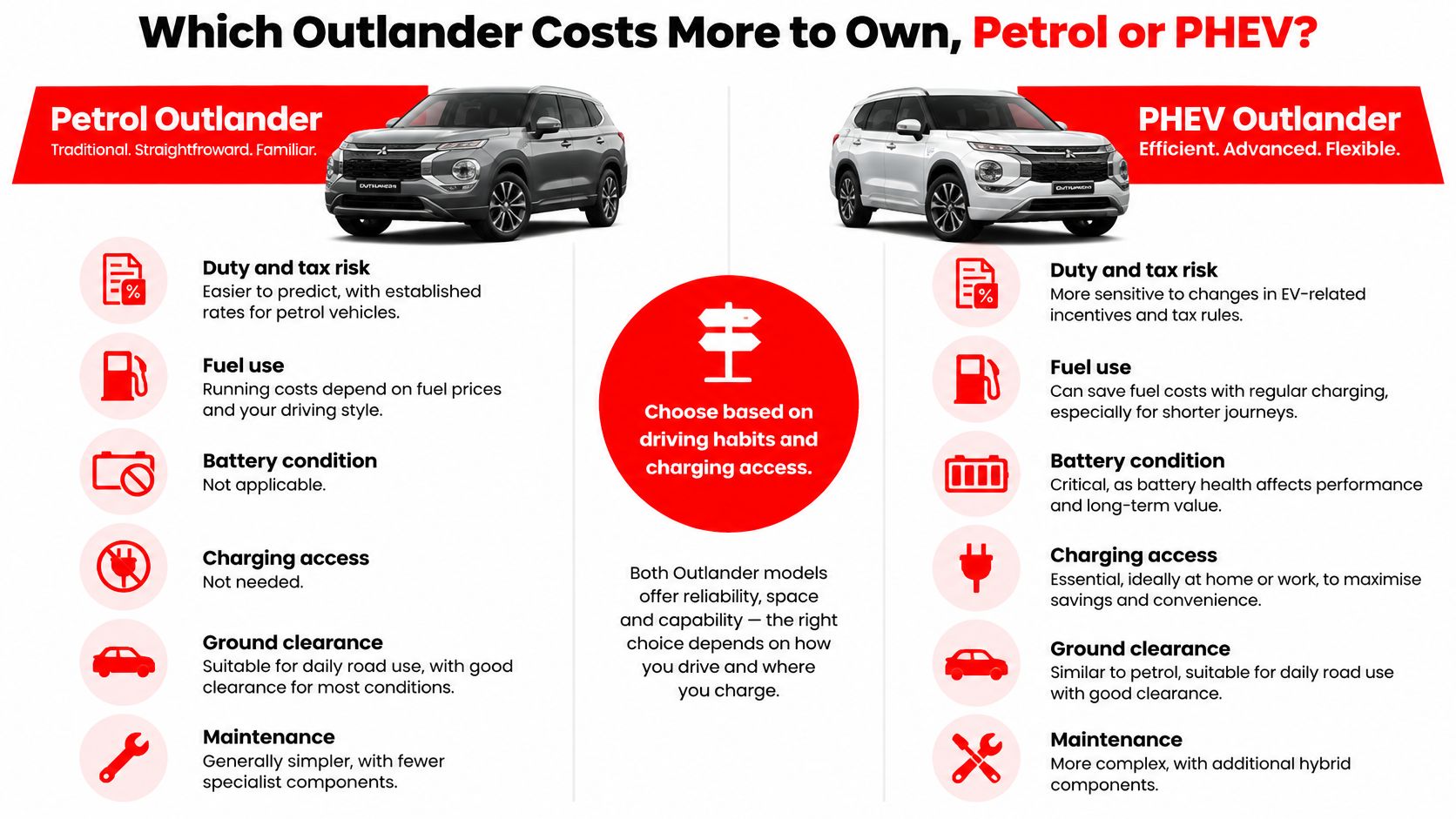
| Factor | Petrol Outlander | PHEV Outlander |
|---|---|---|
| Duty and tax risk | Set by CIF value and engine band | Varies by model and specification, confirm with KRA |
| Fuel use | Steady cost per km | Lower when charged regularly |
| Battery condition | Not a key factor | Key used-car risk, ask for evidence |
| Charging access | Not needed | Needs regular home or work charging |
| Ground clearance | Check against the model spec | Check against the model spec |
| Resale value | Ask us for a written valuation | Ask us for a written valuation |
Tax first, fuel second
A PHEV's tax position depends on the specific model and specification, so a lower running cost does not automatically make it cheaper to buy here. Pull the duty figure for the individual unit from KRA or a licensed clearing agent before you get attached to the fuel saving. On the fuel side, take consumption figures from the manufacturer's published specification for that engine rather than from an advert claim, then apply your own weekly mileage.
Where the PHEV wins is a short Nairobi commute, done mostly on charge, with a socket at home or at the office. Where it loses is long highway runs and a house with no reliable charging, because you're then carrying battery weight and paying for a system you rarely use.
A PHEV without regular charging is a heavier petrol Outlander with a battery you paid for and can't use.
Battery health is the used-car risk
Ask for evidence of battery condition, the previous owner's charging habits and any remaining warranty coverage. Vague or missing battery records aren't a reason to walk away on their own, but they are a reason to negotiate the price down and to budget for the worst case. Check the charging port for damage and look for any dashboard warnings during the test drive.
If you're still weighing hybrid ownership more broadly, our guide to hybrid cars for sale in Kenya covers the practical side of running one.
Match the car to the week you actually drive
- The daily commuter with parking and a socket charges overnight and buys most trips on electricity. The PHEV suits this buyer, provided the battery checks out.
- The family road-tripper covering Mombasa or Kisumu runs regularly gets more from a 2.4-litre petrol, and the V6 only if the fuel budget allows it.
- The buyer working to a tight budget under KSh 1.5 million is better served by an older locally used petrol Outlander with a documented service history than by stretching into a high-mileage PHEV.
Physical Checks to Make at a Viewing
Work around the car in a fixed order so you don't get distracted by the shiny bits, and take a torch and a rag with you.
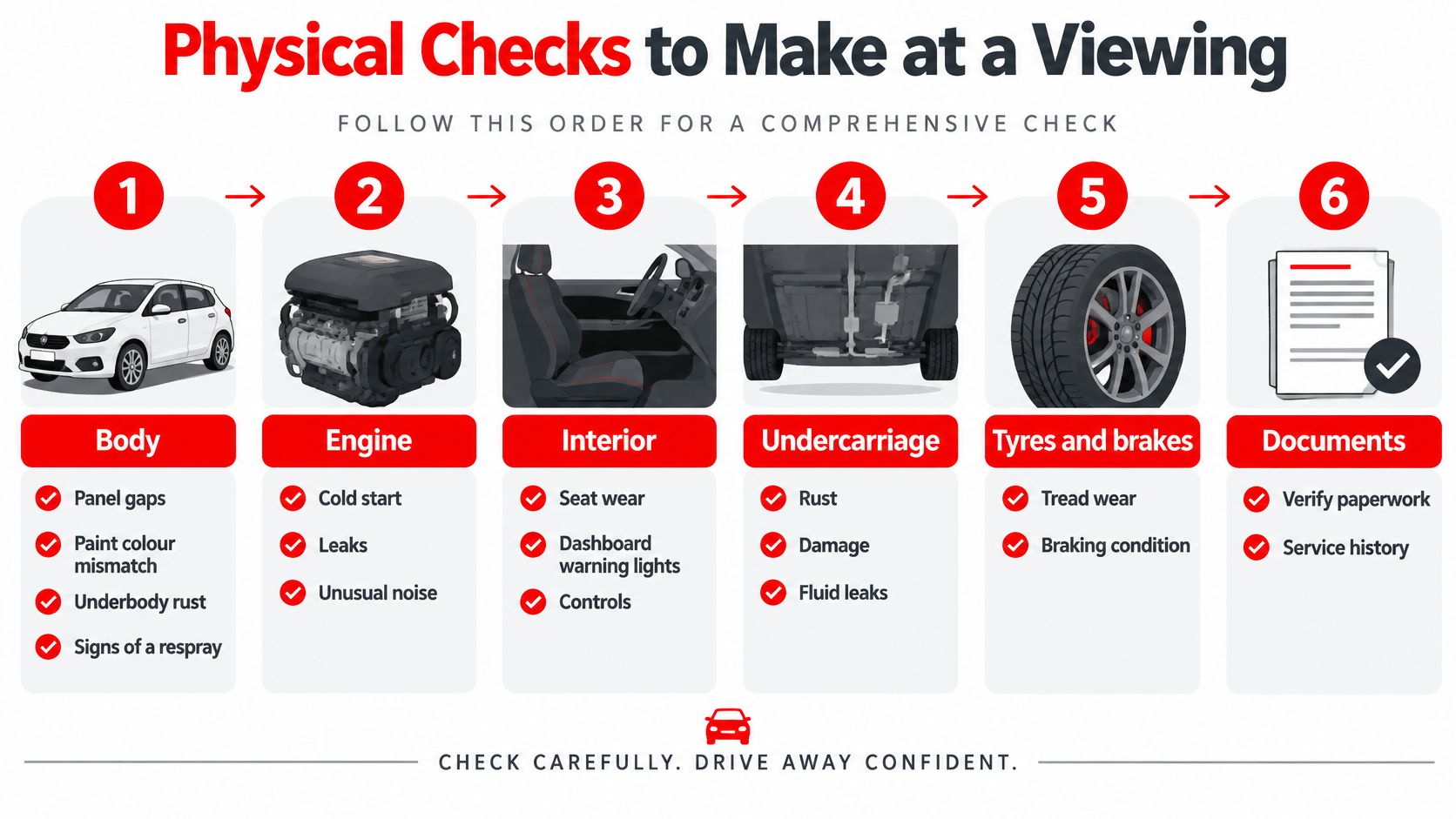
Body and paint. Walk the panels and check the gaps between them for evenness. A door or bonnet sitting proud suggests accident repair. Look for colour mismatch between panels in daylight, and run your hand along the underside of the sills and arches for bubbling rust or fresh underseal hiding it.
Engine bay, from cold. The engine should be cold when you arrive, because a warm engine hides a rough start. Check oil level and colour, coolant condition, and any seepage around the rocker cover and timing area. A coolant bottle filled to the brim on a car that has just been started is a warning, not a courtesy.
Transmission on the drive. Pull away gently and feel for shudder, then accelerate firmly and listen for whine. A CVT should move smoothly through its ratios without hesitation.
Electrics. Lights, windows, air conditioning, reverse camera and the infotainment. On a four-wheel-drive model, confirm the system engages and disengages, and watch the dashboard for warning lights that don't clear.
Tyres, brakes and undercarriage. Uneven tread wear points to alignment or suspension trouble. Check the spare and the jack. On a ramp, look for rust, damaged sills and fresh fluid leaks.
Then take the car over a mix of Nairobi roads: a bumpy stretch, a fast section and a hill. Book an independent mechanic to inspect it before any money moves.
If a seller won't let an independent mechanic put the car on a ramp, that's your answer.
Note every fault you find, ask for the fix in writing before you pay, and compare the repair cost against the asking price. Our wider SUVs for sale guide covers what else to weigh when you're shopping the segment.
Paperwork and Valuation Steps Before You Pay
The figure on the advert is only part of the money that leaves your account. Confirm what you're buying, and from whom, before you hand over a deposit.
Logbook and proof of ownership. The name on the logbook must match the person selling. Anything else, whether a deceased owner, a company or a relative, needs the supporting documents that authorise the sale.
Seller identification and KRA PIN. Needed for the transfer and for the tax record. Ask for them early rather than on the day of payment.
Import entry documents on a foreign-used car. Ask for the entry so you can match the duty and valuation lines against what you were told. If the numbers on paper don't match the numbers in the advert, stop and get an explanation.
NTSA ownership transfer. Confirm the process and the current cost with NTSA before you commit, and budget for registration and transfer on top of the price. The same applies to any duty figure: confirm the amount with KRA or a licensed clearing agent rather than relying on a number you read in an article, including this one.
Non-negotiable: nothing leaves your account until ownership is confirmed and the transfer process is understood in writing.
If the seller can't produce clean paperwork, walk away or require a written undertaking with a firm deadline attached. Keep copies of the advert, the messages and every assurance given about condition, and speak to a lawyer if a genuine dispute arises over a misdescribed car or a fault that was never repaired.
Lay the paperwork checklist next to your price comparison before you decide. A car with a clean file at KSh 2,600,000 is often better value than an identical one at KSh 2,400,000 with a gap in its history.
Confirm Your Budget and View Stock at Brill Motors
Lock the budget before the first viewing. If the figure in your head is only the asking price, a foreign-used Outlander will look cheaper than it is, and a PHEV will look like a petrol car with a plug.
Petrol and plug-in hybrid are separate decisions. Choose one, then check which model years and engine bands that choice allows, and only after that compare prices. KRA charges are what split one overseas price into very different Nairobi prices. A locally used car usually has those charges already inside the advert. A car that has just landed often still has them ahead of you. Line the two up only after both figures include the same costs.
Three answers clear most of the market: the band you can pay, locally used or foreign-used, and petrol or PHEV. Every range in this article is a guide.
Shortlist three Outlanders that pass those answers. For each, match import cost to year and engine, then read the inspection record, before you offer.
Brill Motors sells both foreign-used and locally used cars, and you can see stock at the showroom at Garden City Mall, Nairobi. Ask for a valuation, and use a trade-in if your current car's value should go toward the next one, or sell outright if you would rather not exchange.
Compare a locally used unit and a freshly landed import at Brill Motors. Call or message +254 758 243 058 with the Outlander you are considering so the price is tested against your ceiling first.