


 SIGN UP

Budget roughly KSh 270,000 to KSh 700,000 for an older locally used Nissan March in Kenya in 2026, with condition deciding where a car lands inside that spread, and KSh 1,050,000 to KSh 1,700,000 for a foreign used 2018 to 2021 example that still has to clear duty and registration. Treat those as this guide's working bands rather than a market survey.
Each band prices a separate product.
A Kenya market report on cheap cars puts used Nissan March units at approximately KSh 270,000 to KSh 350,000, with age, mileage and condition doing most of the work on that figure (The Kenya Times). The fresh-import price works like an airfare plus the journey into town: the overseas sticker is only the fare, and duty, excise, VAT, clearing and registration make up everything between landing and reaching your gate. Kenya's eight-year cap on import age widens the gap further, because it decides which model years may still be landed at all and shrinks that window with every passing year.
A single national average flattens the two scales into one number, which is why the figure you read rarely matches the figure a yard quotes you. The table below keeps them apart, so you can find your row before you start calling sellers.
Nissan March Price Bands for 2026
The ranges below are this guide's editorial estimates for 2026, set from asking prices on the ground rather than lifted from a single listing. One Kenya-focused listing guide spans roughly KSh 420,000 to KSh 700,000 for the model (Kenyan Hustle), and Kenyan market reporting puts tired older units lower than that, which is why the local rows stretch so far down.
What moves these bands more than anything else is Kenya's eight-year import age limit. Only cars eight years old or newer can enter the country, so the 2018 March is the oldest year that can still clear customs in 2026. That cut-off works like a moving floor: every January it rises by one year, the bottom import row stops being importable at all, and the cleared 2018 stock already in Kenya becomes the only way to buy that model year. A band that looks permanent on a price page can disappear from import listings within months.
Where Locally Used Cars Sit
Wear is the whole story on this side of the market. A March with tired paint, a worn driver's seat bolster and mileage past 150,000 km belongs near KSh 270,000 to KSh 500,000, and there is nothing sinister about that. The seller is pricing the years of life left in the car rather than the badge on the tailgate.
A tidier local car, straighter panels, a clean interior and receipts for recent service, more often asks KSh 420,000 to KSh 700,000. The two rows overlap because condition moves a single car through the whole spread: a 2014 example with one careful owner and 90,000 km can legitimately ask more than a 2017 car that has spent most of its life in Nairobi traffic.
Ask this before you view: "Is the car already registered in Kenya, and is this price on the road?" The answer tells you which half of the table you're shopping in.
Where the Import Bands Come From
For 2026, a fair guide is KSh 1,050,000 to KSh 1,300,000 for a 2018 car, KSh 1,150,000 to KSh 1,400,000 for a 2019, KSh 1,250,000 to KSh 1,500,000 for a 2020 and KSh 1,450,000 to KSh 1,700,000 for a 2021. Each step up buys roughly one more year of eligibility before that model ages out of the scheme, and that remaining runway is part of what the higher figure pays for.
The age rule lands on these rows unevenly. The 2018 is the live edge: it can still enter through 2026, after which cleared stock on the ground is all that remains. For this one year the same model exists on both scales at once, so a 2018 already registered in Nairobi is a finished purchase while a 2018 still waiting on a ship carries the whole clearing stack ahead of it. The 2019 to 2021 cars have eligibility left in them, which is why their bands rise steadily rather than jump. The bands assume duty, clearing, inspection and registration are inside the figure, so treat a quote below the band as a question rather than a bargain: which of those costs is still outstanding?
| Car | Guide price (KSh) | What the figure usually means |
|---|---|---|
| Older locally used, high mileage | 270,000 to 500,000 | Already registered, taxes paid, wear priced in |
| Tidier locally used | 420,000 to 700,000 | Registered, better body and history, mileage still matters |
| 2018 foreign used | 1,050,000 to 1,300,000 | Last model year that can still enter under the age limit in 2026 |
| 2019 foreign used | 1,150,000 to 1,400,000 | Overlaps its neighbours; trim and mileage move it inside the band |
| 2020 foreign used | 1,250,000 to 1,500,000 | Higher ask; check accident history and what the price includes |
| 2021 foreign used | 1,450,000 to 1,700,000 | Top of the common import range in this guide |
Reading the Table Properly
Cars move within their row on trim, transmission, mileage and history, and a manual usually asks a little less than a comparable CVT automatic. A 2014 to 2017 March keeps trading locally long after it becomes too old to import, so the oldest years never fully leave the market. They change which shelf they sit on.
Use the table to set a budget, then check live prices for the cars on the ground, where each listing carries its own year, mileage and import status. Overlapping rows are normal: a sharp 2019 with low mileage can sit above a scruffy 2020, and that is the market doing its job.
Landed Cost Mileage and Import Duty
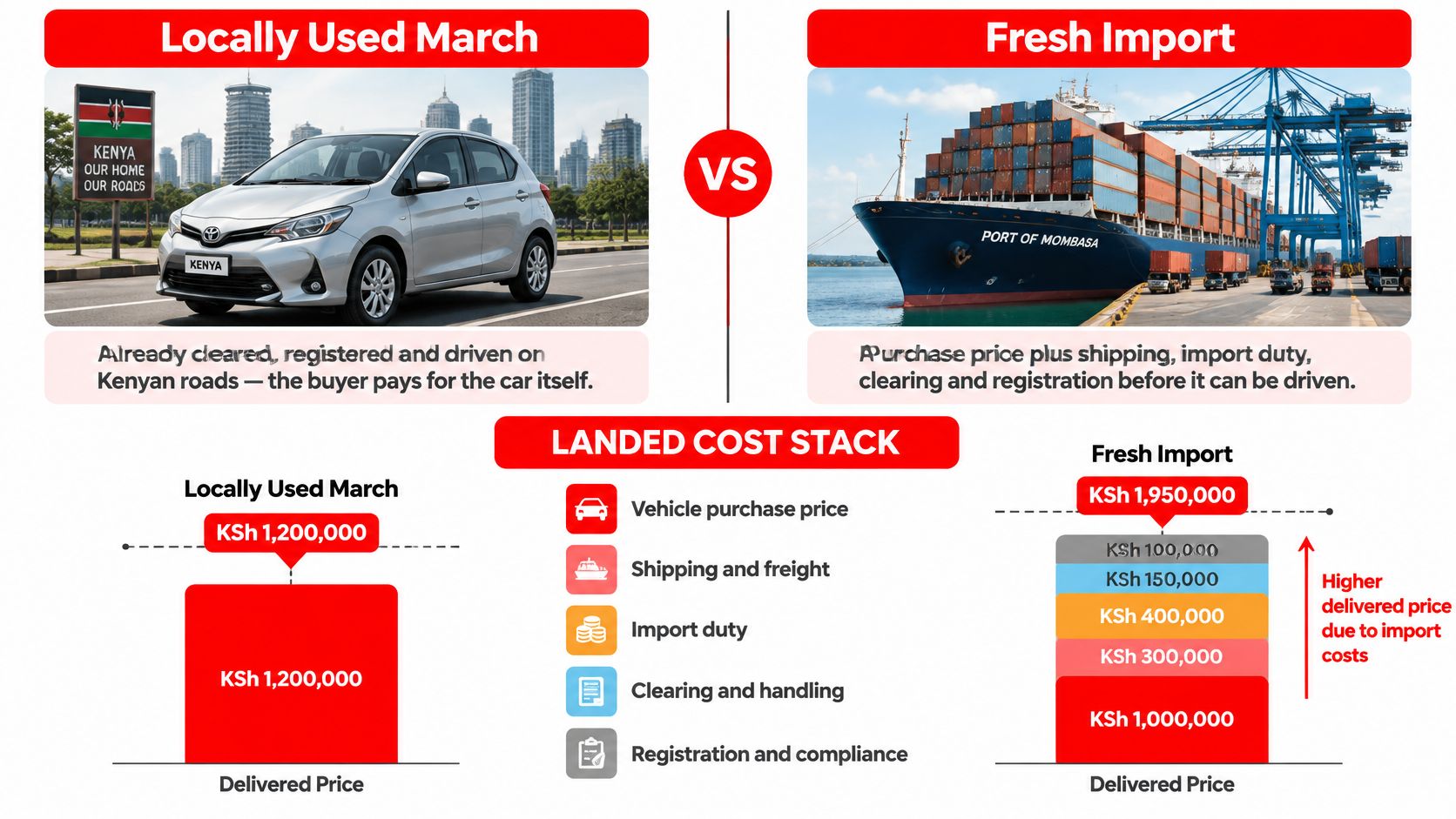
The gap between the two products becomes obvious once you write it out as a sum. On one side is a finished transaction. On the other is a stack of costs that someone has to pay before the car is legal on Kenyan roads.
A locally used March that is already cleared, registered and driving around Nairobi is the finished version. You pay for the car itself, its remaining life and the seller's margin, and nothing further is owed to customs. A foreign used March is the same car before any of that has happened.
Its final price is a stack. Start with the overseas purchase price, add freight and insurance to Mombasa, then the customs value KRA assigns, then import duty and the levies, then port and clearing charges, the pre-shipment inspection, registration, and finally the retail margin of whoever sells it to you. That is how a modest ticket abroad turns into a very different number on Thika Road.
The comparison below sets the two structures side by side.
We sell both foreign used and locally used cars, so the first useful question on any listing is which of the two you are looking at, and whether the number already carries the second stack. If you are weighing the import route against a local car, our guide to imported cars for sale in Kenya walks through what a listing should tell you.
What Moves a Car Inside Its Band
Mileage comes first. An 80,000 km car shouldn't be priced like a 160,000 km Nairobi commuter, whatever the year on the logbook says.
- Accident history and paint: mismatched colour on the door shuts, fresh underseal over repaired seams or wrinkled panels under the carpets are a discount, not a detail.
- Trim and specification: working air conditioning, intact interior plastics and a matching set of tyres all hold value in this class.
- Service evidence: receipts for fluid changes and belts tell you whether the previous owner spent money or deferred it.
- Gearbox type: a CVT that shudders, flares on take-up or hesitates before engaging should pull the price down by enough to fund a repair, because that repair is coming.
The worn CVT is the single most expensive thing to ignore on this model, and the easiest to check on a test drive. Five minutes behind the wheel tells you more than a glossy advert.
How KRA Builds the Taxable Value
The customs value isn't your invoice. KRA bases valuation on the car's Cost, Insurance and Freight (CIF) figure, and it can derive that figure from its own Current Retail Selling Price matrix rather than accept what the buyer paid abroad. A low invoice price overseas still produces a tax bill set by that matrix, so two buyers paying different amounts for near-identical cars can face very similar charges at Mombasa.
That schedule was revised with effect from 1 July 2025, the first update since 2019, and a new matrix can change an import's viability quickly (reporting on Kenya's used car price revision). Treat any older landed-cost calculation with suspicion and confirm the current matrix with KRA or a licensed clearing agent before committing.
The charges themselves are set out in KRA's procedures for importing a motor vehicle: import duty is 25% of CIF, excise duty is 20% of the combined CIF and import duty (the band both March engines fall into at 1,500 cc and below), VAT is 16% of CIF plus import duty plus excise, and on top sit the Import Declaration Fee at 2% of CIF and the Railway Development Levy at 1.5% of CIF.
Worked on a hypothetical CIF of KSh 500,000, a teaching figure rather than a quote for any particular March, the listed charges come to this.
| Charge | Basis | Amount (KSh) |
|---|---|---|
| Import duty | 25% of CIF | 125,000 |
| Excise duty | 20% of CIF plus import duty | 125,000 |
| VAT | 16% of CIF plus import duty and excise duty | 120,000 |
| Import Declaration Fee | 2% of CIF | 10,000 |
| Railway Development Levy | 1.5% of CIF | 7,500 |
| Total before port, clearing, registration, insurance and margin | Sum of the above | 387,500 |
That total lands before a shilling of port charges, clearing fees, registration, insurance or dealer margin, so the on-the-road figure is higher again. The eight-year age rule sits on the same sum, because only a 2018 or newer March can still be imported in 2026. That is why the foreign used price bands start where they do, and why each passing year removes one more model year from the pool of cars worth shipping.
Engines Fuel Use and Running Costs
The March you meet in Kenya is the K13 generation, a five-door hatch built for short city trips rather than highway overtaking. That shapes everything about what it costs to keep on the road.
The 1.2 and the 1.5
Most cars carry the 1,198 cc HR12 petrol engine. Some arrive with the 1,497 cc unit instead, which pulls a little more strongly on a loaded hill and gives away very little at the pump. Both are small four-cylinder petrol engines at or below 1,500 cc, so choosing between them moves your fuel bill rather than your duty bill. For a foreign import still to clear, that means engine size is the one variable you do not have to price twice.
| Engine | Capacity | Fuel | Gearbox often fitted | Buyer note |
|---|---|---|---|---|
| HR12 | 1,198 cc | Petrol | 5-speed manual or CVT | The usual city March, marginally lighter on fuel |
| 1.5 petrol | 1,497 cc | Petrol | Manual or CVT | Same excise band, slightly stronger |
Gearbox Choice and What It Costs Later
The manual is the simpler bet. It usually costs less to buy, less to repair, and a worn clutch is a known bill rather than a mystery. Among the March listings on sale in Nairobi, CVT cars outnumber manuals, largely because the gearbox suits stop-start traffic and the car was designed around it.
A healthy CVT is smooth and quiet. It needs clean fluid at sensible intervals and a clean take-up from rest. A box that hesitates or shudders on take-up is a repair bill you are buying with the car, so price that work into your offer rather than paying a premium for the automatic badge.
One tired gearbox can erase a year of fuel savings.
Fuel and the Weekly Budget
Fuel use is the reason buyers cross-shop this car at all. In mixed Nairobi driving a healthy 1.2 is cheap to run, better on a light highway run and thirstier in a jam, so build your weekly budget from the seller's own consumption figure on a route like yours rather than a brochure claim.
Running costs stay modest while the car is standard: plugs, filters, brake pads, tyres in a small size and ordinary suspension bushes. These service items are stocked by ordinary motor spares shops, and any independent garage that works on Japanese hatchbacks will have repaired a March before. A modified or accident-repaired example hands that advantage straight back. Annual insurance and the NTSA inspection sit on top of the purchase price.
A cheap, high-mileage March with a tired CVT can cost more per year than a slightly dearer tidy one. Browse the Nissan range to see what's available, then price the whole year rather than the first week.
What to Check Before You Pay
A viewing is a pricing exercise. Treat a registered local March and an import that still has to clear as two different products: one has to prove it can transfer today, the other has to earn a landed-cost quote at all.
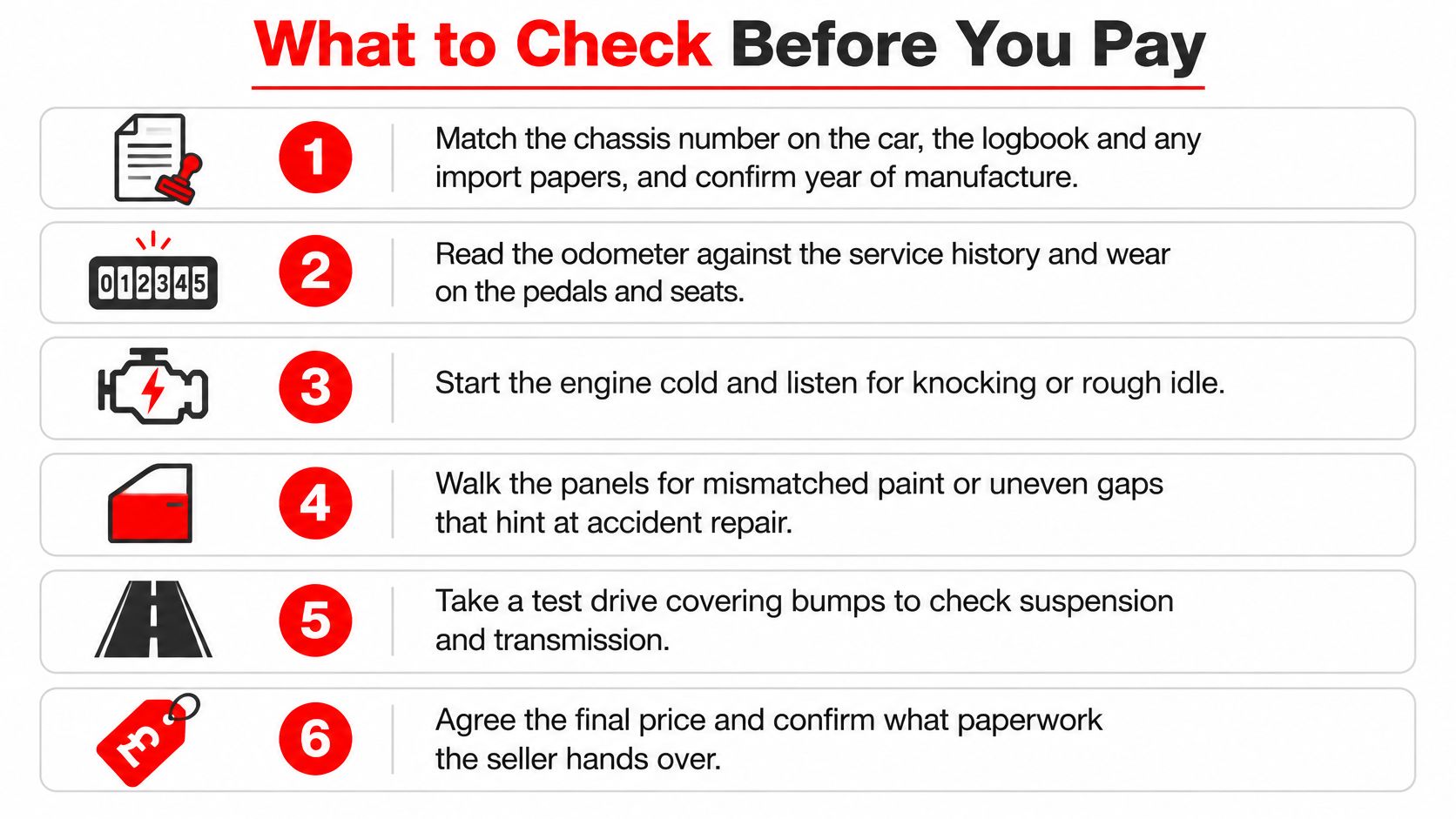
Work through them in this order.
- Match the numbers. Chassis number on the car, on the logbook and on any import papers, plus the year of manufacture. For a registered car this proves what is being transferred; for a car still to clear it decides whether the asking figure is real. A mismatch is a reason to walk away.
- Read the odometer against the interior. Pedal rubbers, seat bolsters and a polished steering wheel tell you how much time the car has spent occupied. A very low reading on a tired cabin needs an explanation before it earns a premium.
- Walk the panels. Uneven gaps, a different shade between door and quarter panel, or fresh underseal over seams point to a repair. On a small car like this, a hidden hit is worth a clear reduction.
- Start it cold. Listen for tapping on a cold start, then watch for smoke and a sweet smell from the cooling system. A cold-start fault is often the expensive kind.
- Drive the gearbox deliberately. Use a gentle pull-away, then a medium-throttle merge, and price any flare, judder or delayed engagement before paying for the automatic badge. On a manual, check the clutch bite point and listen for a crunch into second.
- Test every electrical item. Windows, central locking, wipers and especially the air conditioning, which matters in Nairobi heat when a seller says “it just needs gas” and the compressor never kicks in.
- Study the tyres. Uneven wear across a tread points to alignment or worn bushes, which is suspension money waiting to be spent.
- Ask for service receipts and any NTSA inspection record. Paperwork is the cheapest proof of care you'll ever be handed.
Two of those checks carry more weight than the rest. A doubtful odometer or a weak gearbox should move the car to the bottom of its band, and either can end the deal outright. Photos flatter paint and hide gearbox behaviour, so view in person at our Garden City Mall showroom rather than buying from a screen.
Registration Age Rules and Paperwork
A March that can't be registered isn't cheap at any price. Kenya's import age rule decides which model years are even allowed in as foreign used cars, and it sits right in the middle of the price conversation.
KRA states that a used motor vehicle must be no more than eight years old, measured from the year of manufacture or the first date of registration depending on which record applies, and it must be right-hand drive, with left-hand-drive vehicles generally not registrable for ordinary use except in specified special-purpose categories (Kenya Revenue Authority). Before clearance, a used import also needs a roadworthiness, safety and standards inspection through a KEBS-appointed agent in the country of export, plus the matching pre-shipment documentation.
The Age Cut-Off Is a Price Rule
In 2026 a 2017 or earlier March may fall outside the window, which makes its overseas asking price irrelevant. A car of the same year already registered in Kenya is a completely different case: it can be bought, sold and transferred here without any import question at all.
A car that fails the age or right-hand-drive check is not a bargain. It's an object you can't put on the road.
Before treating any import as eligible stock, verify the chassis number, manufacture year, first-registration date, steering position and inspection certificate. Also confirm the current cut-off with KRA and the KEBS website, because a rule you remember from a few years ago may not be the rule applied today.
Papers for a Local Car and Papers for an Import
For a local purchase, ask for the original logbook, the seller's identification, a signed transfer form, a search record if one is available, and proof that any loan secured on the car is cleared.
For an import, add the pre-shipment inspection certificate, the commercial invoice, the bill of lading and the customs entry once the car has cleared. Registration then runs through NTSA or eCitizen, and the insurer should be licensed by the Insurance Regulatory Authority, which you can confirm before the car is driven anywhere.
Negotiation Tips and Seller Price Bands
Price is a conversation, and the strongest opening question is what the figure includes and whether the car in front of you is locally used or foreign used. Those are two different products, and they negotiate differently.
How to Anchor an Offer
- Start on the right row. Match the car to its band in the price table rather than anchoring on the top of the range.
- Price the defects you found. A doubtful odometer, a weak CVT or a hidden respray each justify a specific, itemised reduction. If a serious defect can't be repaired within a reasonable time, or the car was materially misrepresented, Kenyan law requires a refund, so a documented fault is firm bargaining ground.
- Withhold agreement on incomplete paperwork. Don't settle a figure on a car whose logbook or customs entry hasn't been produced yet, and confirm the person signing is at least 18 and legally competent, because a binding agreement depends on it.
- Judge an import on its landed figure. Duty and clearance are already inside the ask, a point the landed cost section works through in full.
- Close on the CVT service record. Ask for the gearbox history in writing; a March with no record of fluid changes is a car you price down or leave behind.
For a local car, offer a firm figure based on mileage and condition once the total is on paper. The same local-versus-import split applies across the small hatchback class, and our Toyota Vitz price guide works through it for the March's closest rival.
Sellers get the mirror image. A tidy registered March sits in the upper local band, and a tired high-mileage one sits toward the bottom. An import can't be priced until the eight-year age rule, clearance and inspection certificate are confirmed, because a buyer who has done the checks will spot the gap and walk.
View Stock or Value Your March
The useful next step is a viewing after the numbers make sense. Pick the band that fits from the price guide above, then judge the individual car: a registered local March should show its logbook and history plainly, while a foreign used example should make clear whether the ask is landed and cleared or still before clearance. A 2018 Nissan March hatchback on our current list shows how year, mileage and price read together before you compare one car with another.
For Buyers
Book a short look at our Garden City Mall showroom and check the things messages hide: cold start, CVT response, paint under daylight, tyre wear and whether the displayed mileage matches the cabin wear. Treat any figure as a guide until records confirm it, and treat a still-to-clear import as a different product from a registered car, even when the badge and model year match.
For Sellers
If you already own a March, request a valuation or ask for a trade-in figure. Brill Motors buys trade-in vehicles from customers, so you can take an offer, put the value toward another car or sell and walk away. Call or WhatsApp +254 758 243 058, or bring the car and its logbook to our Garden City Mall showroom.
Seeing the metal settles the argument faster than a week of messages. Browse Brill Motors for current stock and enquire about a viewing before you commit.