

 SIGN UP

Most Toyota Vitz listings in Kenya sit between roughly KSh 705,000 and KSh 1,337,500, with a median around KSh 1,050,000. If you want a fair buy, that's the band to keep in your head before you even open an advert.
That range makes sense the moment you start comparing year, mileage, engine size and import status. A clean Vitz isn't priced by badge alone, it's priced by how much life is left in it, how it was brought into the country, and how expensive it will be to sort after purchase.
What a Toyota Vitz Actually Costs in Kenya Right Now
A Toyota Vitz price in Kenya starts with a simple rule, don't judge the car by the sticker alone. The market benchmark sits at a median asking price of about KSh 1,050,000, with most listings falling between KSh 705,000 and KSh 1,337,500. That is the right opening frame for a buyer who wants a sensible budget, not wishful thinking.
What pushes one Vitz above another
Year matters, but it's not the only thing. A lower-mileage car with cleaner history can sit well above a tired example from the same model year, while a high-mileage local car can dip below the median even if it looks tidy from ten metres away. Engine size, transmission, import status, accident history and seller reputation all move the number.
Practical rule: treat the asking price as a starting point, then test whether the car's history justifies it.
For older examples, the market tends to soften. A well-kept older Vitz may look cheap, but that price can hide wear in suspension, trim, tyres and cooling components. A newer car can command more because buyers are paying for lower age, lower kilometres and usually a cleaner paper trail.
The big mistake is comparing two cars only by the same badge and year. In Nairobi, service history, kilometres travelled and whether taxes are already settled can shift the number enough to make one unit look like a bargain and another look inflated. If you're buying from a yard, ask for the year, mileage, engine size and documentation before you discuss cash.
Vitz Price in Kenya by Model Year
Year is the first filter because it sets the price ceiling and the floor. Once you know the year, you can tell fast whether a listing is fair or just fishing for a hopeful buyer. Read the market in bands, not in one magic figure.
Older 2007 to 2010 Vitz cars usually sit around KSh 450,000 to KSh 650,000, while 2011 to 2013 examples usually come in around KSh 550,000 to KSh 800,000. By 2014 to 2016, the band rises to roughly KSh 750,000 to KSh 1,100,000, and 2019 to 2020 foreign-used stock is commonly seen around KSh 1,220,000 to KSh 1,480,000. For a wider used Toyota reference point, the Toyota cars price list helps place the Vitz against other Toyota models on the market.
How to read the year bands properly
The year tells you the broad lane, not the full story. A 2015 car with heavy use, tired interior trim and ordinary ownership history should not be priced like a polished 2015 example with low kilometres and a clean record. The year band tells you where the conversation should begin.
| Model year | Typical asking band | Source |
|---|---|---|
| 2007 to 2010 | KSh 450,000 to KSh 650,000 | Kenya Vitz guide |
| 2011 to 2013 | KSh 550,000 to KSh 800,000 | Kenya Vitz guide |
| 2014 to 2016 | KSh 750,000 to KSh 1,100,000 | Kenya Vitz guide |
| 2019 to 2020 | KSh 1,220,000 to KSh 1,480,000 | Kenya Vitz guide |
Use the lower end as your caution line and the upper end as your test of whether the car deserves a premium. A 2015 Vitz near the top of its band should look clean, carry proper paperwork, and drive like a car that has been cared for. If it doesn't, keep your money in your pocket.
How Engine, Trim and Fuel Type Change the Price
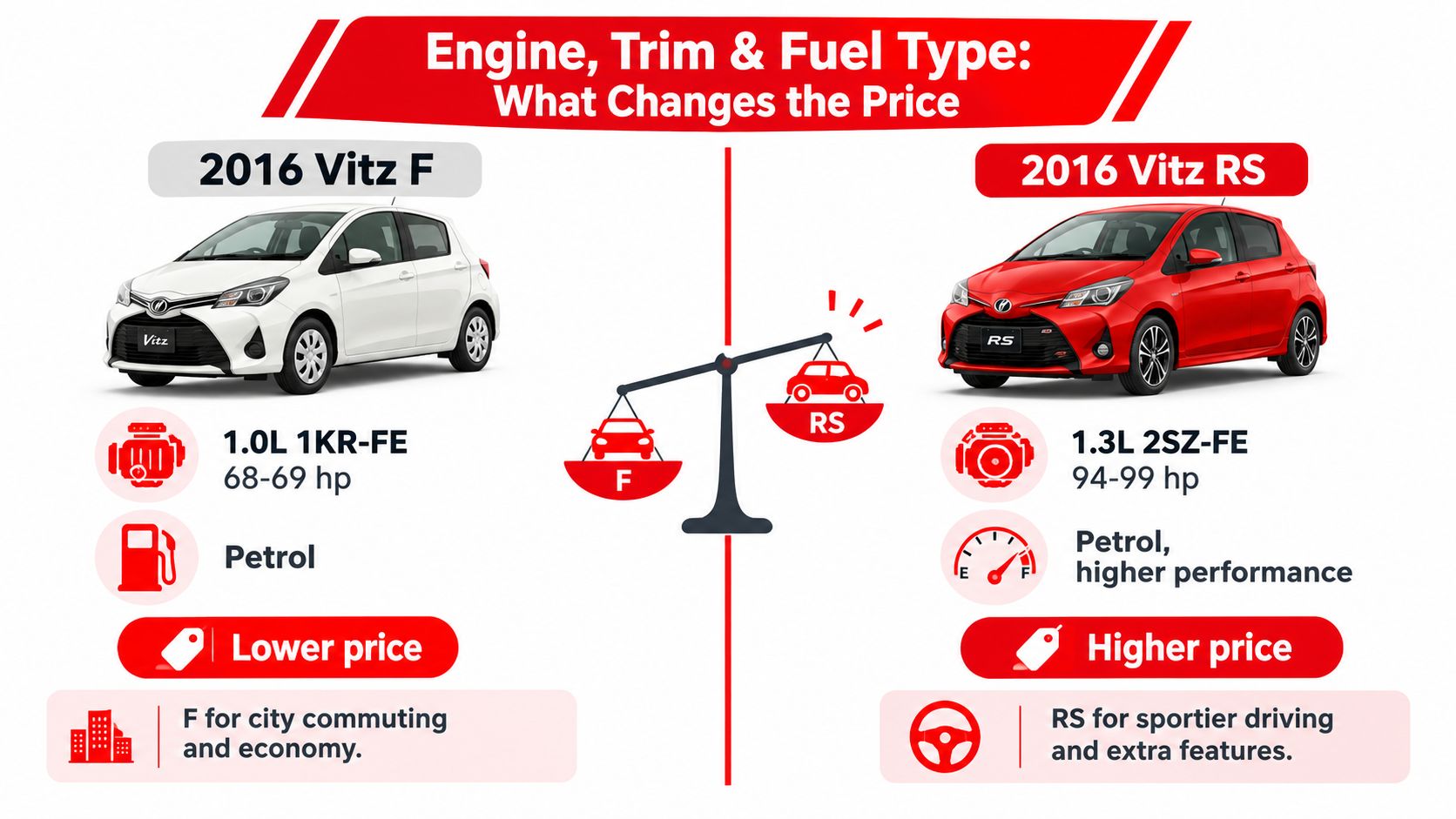
A 2016 Vitz F and a 2016 Vitz RS can sit in the same year band and still belong in different price brackets. Engine size, trim level and drivetrain intent do the work here, and buyers who ignore that end up comparing cars that do not belong in the same conversation.
The 1.0-litre 1KR-FE makes roughly 68 to 69 horsepower, the 1.3-litre 2SZ-FE makes about 94 to 99 horsepower, the 1.5-litre 1NZ-FE RS makes around 107 to 108 horsepower, and there is also a 1.5-litre hybrid. Indicative Japanese JC08 fuel figures run at roughly 21.6 to 23.2 km/L for the 1.0, 25.0 to 26.2 km/L for the 1.3, and up to about 34.0 to 34.5 km/L for the hybrid.
What that means in practice
Those fuel numbers come from a test cycle, not from Nairobi traffic, so do not treat them as a promise. Congestion, air-conditioning, tyre pressure, maintenance and driving style all pull consumption down. Even so, the hierarchy is clear. The 1.0 is the city saver, the 1.3 is the sensible all-rounder, and the RS or hybrid asks for more money because it offers more.
A Vitz should be priced for use, not for badge excitement.
If your driving is mostly short urban trips and fuel savings matter most, the 1.0 makes sense. If you split your time between town and highway, the 1.3 is the cleaner buy. Pay extra for the RS only if you want stronger pull and will use it. Pay extra for the hybrid only if the system is healthy and the running-cost advantage is real.
Mileage, Condition and Accident History
The same year can hide very different cars. Two 2015 Vitz units can look close on paper and still differ by a serious amount in actual value because kilometres, repairs and ownership history tell the true story. Any buyer either protects themselves or overpays for shine.
A 2015 Vitz in Kenya can sit from about KSh 790,000 to KSh 1,000,000 depending on mileage, ownership and whether it has had body repairs after a shunt. That spread is normal. What matters is why one car sits lower.
What a discount usually means
A cheap Vitz doesn't always mean a lucky find. It often means the seller is pricing in wear that you haven't checked yet. The warning signs are usually visible if you slow down and inspect properly.
- Odometer inconsistency: compare the reading with service stamps and general wear on pedals, steering wheel and seats.
- Panel repair history: look for respray lines, uneven panel gaps and a boot or bonnet that doesn't close cleanly.
- Ownership chain: repeated transfers can mean the car has already started to become someone else's problem.
- Mechanical fatigue: a car can still drive well while hiding suspension, cooling or ignition issues that show up later.
If the number sits well below the expected band, don't celebrate first. Ask why. A low price should trigger a slower inspection, not faster payment.
Sticker Price Versus Landed Cost
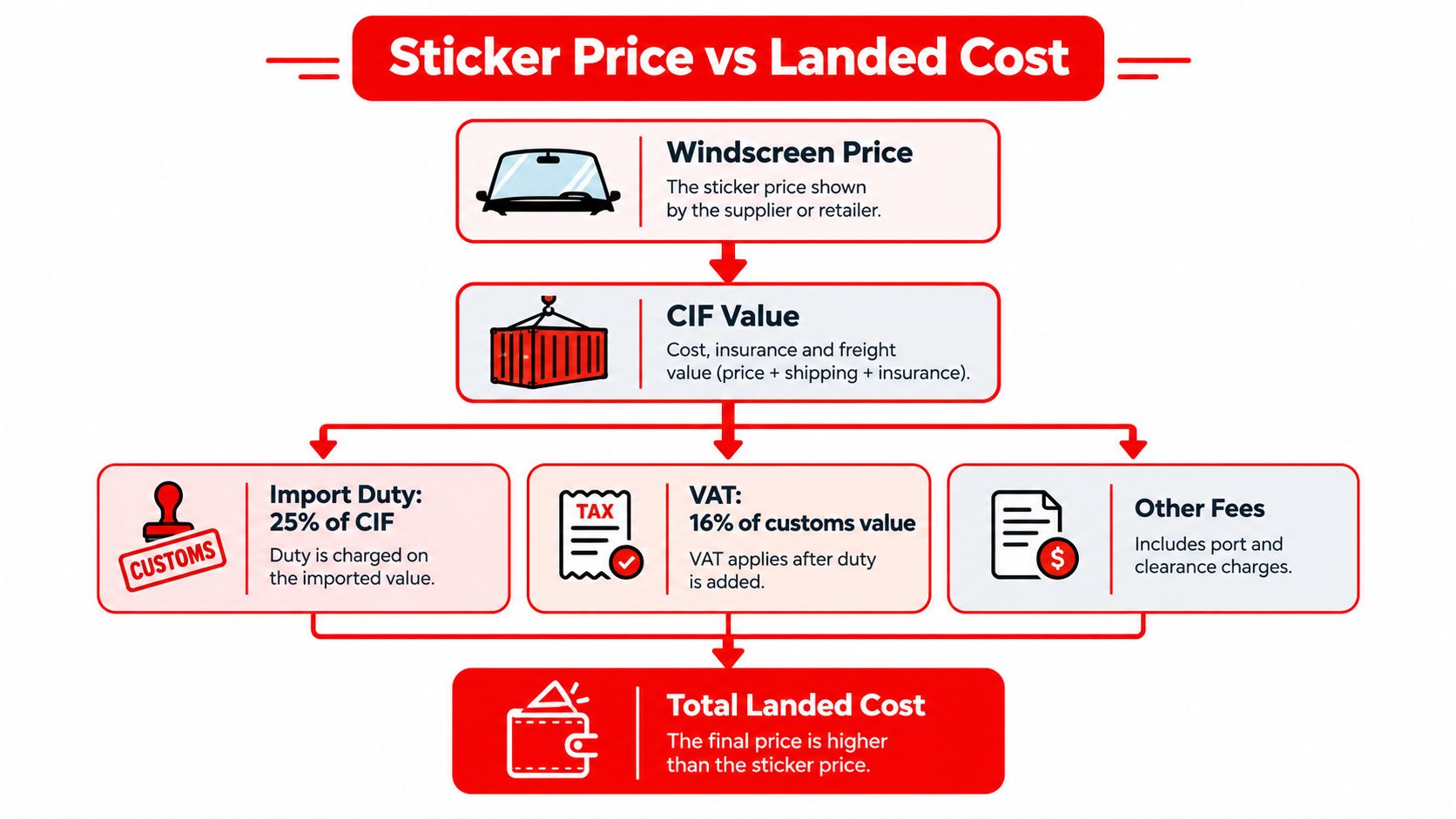
An imported Vitz looks cheap until the Kenyan bill lands. The auction sheet or foreign invoice is only the starting point. KRA's customs framework starts from CIF value, then adds import duty, excise duty, VAT, the Import Declaration Fee and the Railway Development Levy (KRA motor vehicle import guide).
Under the same KRA framework, vehicles of 1,500cc or below carry import duty at 25% of CIF, VAT at 16% and excise duty at 20%. For a Vitz import estimate, that is the price logic that matters, not the overseas sticker alone.
Why two similar imports can differ sharply
Age changes the tax bill. In the Vitz Hybrid F example, a 2018 vehicle shows estimated taxes and levies of KSh 382,639, while a 2026 vehicle shows KSh 1,093,254 under the same calculation set. That gap is why buyers get misled when they focus on the foreign purchase price only.
A low invoice can still turn into an expensive Kenyan car once customs, clearing and registration are added.
For imported stock, a serious advert should separate CIF, statutory taxes, port and clearing costs, registration, inspection and dealer margin. If you are comparing what landed stock usually looks like, imported cars for sale in Kenya gives the right context. If a seller will not break down the landed cost, you are not seeing the final number.
Import Age Rules and the Depreciation Schedule
A Vitz that cannot legally clear is not a bargain, even if the asking price looks attractive. KRA requires an imported used vehicle to be less than eight years old from its year of first registration, right-hand drive, and compliant with KEBS KS 1515:2000 inspection requirements, with a roadworthiness inspection certificate from a KEBS-appointed agent in the exporting country (KRA import procedures).
The paperwork decides whether the car enters Kenya cleanly. KRA's clearance document list includes the original commercial invoice, cancelled foreign logbook, bill of lading and pre-shipment inspection certificate. If those papers are missing or inconsistent, the price is already wrong.
How age changes the tax base
KRA says the customs value of a used motor vehicle is calculated by applying depreciation to the relevant CRSP, based on time since manufacture or first registration (KRA CRSP clarification). Per the same schedule, effective 1 September 2023, depreciation includes 20% for vehicles more than one year and up to two years old, 30% for more than two and up to three years, and 65% for more than seven and up to eight years.
That is why two similar Vitz units can end up with very different tax bills. The foreign logbook date matters, and so does the Kenyan paperwork that follows it. A low purchase price can still become an expensive car once the depreciation base, customs, clearing and registration are added. If the seller cannot explain that chain clearly, the listing is not priced properly.
Locally Used Versus Foreign Used at the Same Budget
At the same budget, a locally used Vitz and a foreign-used Vitz solve different problems. A local car around KSh 900,000 usually gives you known history, settled taxes and easier inspection. A foreign-used car closer to KSh 1,200,000 to KSh 1,400,000 is often newer and has fewer kilometres, but the import costs are already built into the price.
That price gap changes the decision fast. If you want simple ownership and immediate use, the local unit makes sense. If you are paying for lower mileage, fresher condition and a later model year, the foreign-used route justifies the higher entry cost.
Which route gives better value
The better value depends on how you will use the car. A local 2014 to 2016 Vitz may already be taxed and ready to inspect, but it can come with higher mileage and a more ordinary service trail. A foreign-used 2019 to 2020 car costs more, yet the buyer is often paying for less wear and a cleaner starting point.
If you are financing the car, do the full math, not just the sticker. Insurance, first-year repairs and registration can make the cheaper car more expensive in practice.
A local unit can need more immediate mechanical attention. A foreign-used unit can ask for a heavier upfront spend, then give you a calmer first year. Choose the one that fits your budget today and your tolerance for repairs tomorrow.
For a wider budget view, see affordable cars for sale in Kenya.
Viewing Day Checklist for a Used Vitz
Run one clean inspection, don't turn it into a guessing game. Start with the logbook ownership chain and confirm the NTSA transfer status. Then check that the chassis number on the body matches the document, because a mismatch is not a small issue, it's a stop sign.
Look at the odometer and compare it with the service stamps and general cabin wear. If the pedals, steering wheel and seats look far more tired than the number suggests, treat the reading with caution. Then walk around the car slowly and check for respray marks, uneven panel gaps and tyre wear that points to poor alignment or suspension wear.
What to carry with you
Bring what the seller will expect from a serious buyer.
- National ID: Useful for the paperwork trail and simple verification.
- Driving licence: Shows you're not just browsing.
- Proof of funds or financing pre-approval: Helps you move quickly if the car is right.
For hybrids, don't skip the system check. Make sure the hybrid display wakes properly and that the battery state looks consistent with the car's age and claimed use. Open the bonnet too, then look at coolant and oil condition rather than trusting a shiny bay.
Best habit: if the seller resists a basic inspection, the car has already told you enough.
A fifteen-minute forecourt check will not prove a car is perfect, but it will expose the lazy problems. That's usually enough to separate a fair deal from a polished headache.
Reading a Suspiciously Cheap Vitz Price
The cheapest Vitz is rarely the cheapest ownership experience. A price below the relevant band usually means one of five things, mileage is higher than stated, accident repairs were done badly, the hybrid battery is tired, import paperwork is incomplete, or the logbook trail is messy. Any one of those can turn a bargain into a repair bill.
Cheap pricing is often a negotiation signal, not a gift. If the car is below market, assume you're being invited to discover the reason yourself. That's not cynicism, it's common sense in this market.
How to translate a low advert into a decision
First, ask what the discount is paying for. Then compare the advert against the year band, the mileage, the body condition and the paper trail. If the seller can't explain the gap clearly, you're probably looking at deferred cost.
A cheap car can still be the right car, but only if the discount is real and not hiding immediate work. Use the lower asking price to negotiate, not to relax. The moment the seller starts dodging inspection questions, the value has already changed.
Negotiating a Fair Vitz Price
Every Vitz you view should have three numbers attached to it in your head. There's the target price, the opening offer and the walk-away price. The target sits inside the year and condition band, the opening offer gives you room to negotiate, and the walk-away price is the point where the car stops being sensible.
Timing helps, but only if the vehicle is already right. Viewings early in the month are often easier because sellers are more active, and a clean comparable car gives you an edge when the asking price is stubborn. If the seller won't allow a third-party inspection, that isn't a personality quirk, it's a reason to leave.
Use evidence, not noise
Bring the year band, mileage, trim and import status into the conversation. That way you're negotiating against the actual vehicle, not against the seller's optimism. A fair buyer doesn't argue for a discount without a reason, and a fair seller shouldn't expect one without proof of value.
Brill Motors supports showroom viewing at Garden City Mall, financing, vehicle valuation, trade-ins and selling your car directly, giving both buyers and sellers a single counterparty for the negotiation process (Brill Motors). If you're upgrading or selling, that structure saves time because the same price logic applies on both sides.
Quick Reference and Next Steps
If you only save one table from this guide, make it this one. It gives you the fastest read on whether a Vitz price is sensible for the year you want.
| Model year | Expected band |
|---|---|
| 2007 to 2010 | KSh 450,000 to KSh 650,000 |
| 2011 to 2013 | KSh 550,000 to KSh 800,000 |
| 2014 to 2016 | KSh 750,000 to KSh 1,100,000 |
| 2019 to 2020 | KSh 1,220,000 to KSh 1,480,000 |
The next move is simple. Compare the car's year, mileage, engine and paperwork against the band, then inspect it properly. If the numbers make sense, you're close. If they don't, keep your wallet shut.
Brill Motors can help you compare Vitz stock, check a trade-in and judge whether a price is fair for the year and trim you want. Visit Brill Motors to see current stock, or come to the Garden City Mall rooftop yard for a viewing and a straight valuation.