

 SIGN UP
In Kenya, Toyota Allion asking prices typically span KSh 650,000 for older 2006 to 2010 locally used cars to around KSh 2.7 million for 2017 to 2019 imports, with the actual figure driven by model year, mileage, engine capacity and whether the car is foreign used or locally used.
You've probably found an Allion that looks affordable, then another that looks almost identical but costs considerably more. Before you stretch your budget or dismiss the dearer car, establish what each price includes. The right Allion is the one you can afford to buy, put on the road and maintain, not the one with the lowest windscreen price.
What an Allion Costs in Kenya Right Now
Start by separating locally used cars from foreign-used cars. A vehicle already registered and driven in Kenya belongs in a different comparison group from an import awaiting clearance or registration. Don't compare their headline prices as though the remaining costs are identical.
The following bands are broad shopping guides, not live stock quotations or completed-sale values. There isn't a defensible separate local-versus-import price for every year band, so don't force a neat distinction where the evidence doesn't support one.
Typical Toyota Allion price bands in Kenya
| Model year band | Engine options | Locally used price (KSh) | Foreign used price (KSh) |
|---|---|---|---|
| 2006 to 2010 | Confirm exact capacity on documents | 650,000 to 1,200,000 | Check eligibility before considering import costs |
| 2011 to 2014 | Confirm exact capacity on documents | Approximately 950,000 to 1,500,000 | Obtain a vehicle-specific quotation |
| 2015 to 2016 | Confirm exact capacity on documents | Obtain a current valuation | Obtain a current quotation and confirm eligibility |
| 2017 to 2019 | Compare engine capacity alongside year | Within a broader advertised band of 1,800,000 to 2,700,000 | Within the same broad band, with fresh imports generally commanding a premium |
Don't manufacture a price band for the middle years by averaging the older and newer cars. Condition and registration status can make that shortcut misleading. Equally, a market-wide median is a poor buying target if it mixes vehicles you wouldn't realistically consider.
Use the Toyota cars price guide to frame your wider budget, then check current stock for live asking prices.
Budget rule: Set your maximum acquisition budget before viewing. Keep money outside the purchase price for insurance, transfer and any work identified during inspection.
Negotiate against comparable cars, not against the highest figure your lender will approve. An asking price starts a discussion; it doesn't establish fair value.
Allion Generations Sold in Kenya
Don't let an advert's generation label decide what you're buying. Sellers can use generation, facelift and new shape loosely, even though those descriptions don't necessarily identify a different platform or drivetrain.
For practical buying purposes, distinguish the earlier body, the later body and the facelifted versions of that later body. A sharper grille and revised lamps aren't sufficient evidence of an entirely new generation. The vehicle's identification records matter more than the seller's shorthand.
Earlier bodies versus later facelifts
With an older example, judge the complete car rather than its appearance in photographs. Cabin wear, previous repairs and replacement fittings can tell you more about ownership than polished paint. Don't pay extra because someone has fitted newer-looking exterior parts.
For a later-body car, establish which fittings belong to that specific version. Headlamps, bumpers, grilles and interior components should be matched to the actual vehicle rather than ordered using the model name alone.
- Body identity: Match the chassis details to the paperwork before discussing replacement panels or trim.
- Drivetrain identity: Confirm the engine and transmission fitted, rather than assuming a facelift brought mechanical changes.
- Equipment identity: Check the car's actual controls and features. An advert's trim description isn't a substitute for seeing them work.
Cars with different registration years may have similar mechanical specifications. Conversely, cars that look alike may differ in equipment or drivetrain. Ask a mechanic to identify the exact configuration before you price repairs.
My recommendation is straightforward: pay for verified condition and useful equipment, not a generation nickname. A well-kept earlier version can be a better purchase than a facelifted car with uncertain repairs. Equally, don't assume every component from an older-looking car fits a newer-looking one.
1.5L Versus 2.0L Engines and Trim Levels
Two Allions can sit side by side in a yard with the same model year and the same asking price, one on a 1,500cc engine and the other on a 2,000cc. If you are importing, that badge changes your tax bill before the car even clears Mombasa. KRA's motor-vehicle import guidance sets excise duty at 20% for engines of 1,500cc and below and 25% above 1,500cc, charged on customs value plus import duty. Confirm the current assessment before you commit. Five percentage points on the dutiable value is real money.
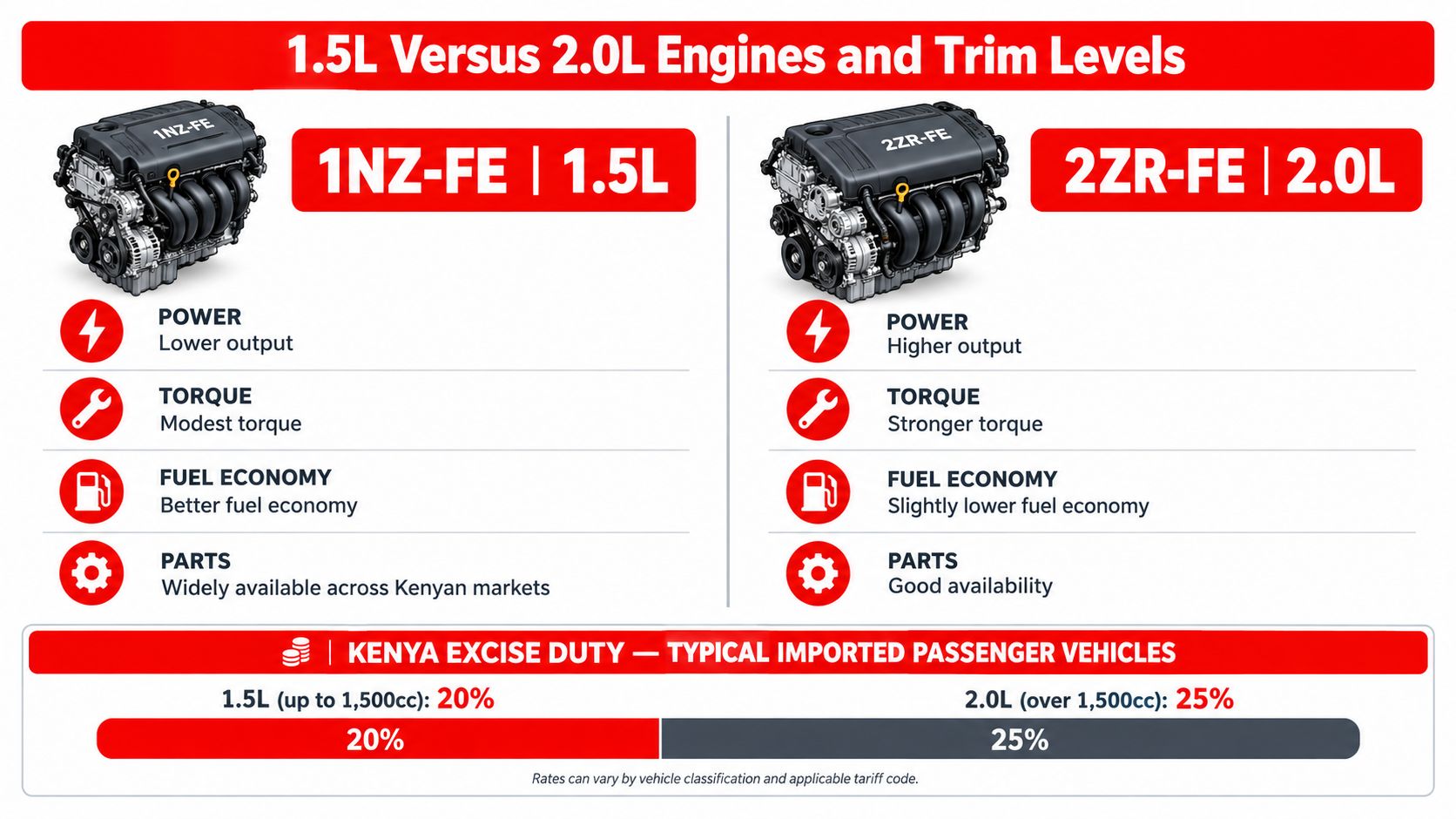
The gap between the two engines is smaller than the cost gap around them. This is how I weigh the choice:
| What matters to you | 1,500cc car | 2,000cc car |
|---|---|---|
| Import taxes | Lower excise band | Higher excise band |
| Daily Nairobi commuting | Enough power, easier on fuel | Performance you rarely use |
| Passengers, luggage, highway runs | Works harder when loaded | Stronger overtaking and load carrying |
Whatever the capacity, never accept an engine code copied into an advert as proof. Have the fitted engine identified and reconcile it with the paperwork, because a mislabelled description distorts repair quotations and import-cost estimates alike.
Fuel budgeting needs the same scepticism. An unsupported economy figure means nothing on its own. Ask for credible fuel records where they exist and weigh them against your traffic, route, load and driving style. A neglected small engine costs more to own than a well-kept bigger one. Parts deserve the same discipline: get quotations against the actual engine and chassis details, especially on expensive assemblies, because "parts are available" tells you nothing about price or fitment.
On trim, treat labels such as X, G, S, A15 and A20 as details to verify against the car in front of you. An A20 badge should mean a 2,000cc car, yet the letters on a boot lid prove nothing until the engine is checked. Pay for equipment you can identify, test and will use.
Buy the performance you will use on your actual route, at the tax band you can defend, with a badge you have verified. The rest is decoration.
How Mileage, Condition and Ownership Drive the Price
Two Allions sit in the same yard off Mombasa Road. Same year, same 1,500cc engine, same asking figure. One reads high on the odometer but carries a stamped service book, and the worn pedals and driver's seat match the reading. The other shows suspiciously low mileage, a replaced instrument cluster and a seller who gets vague when you ask where the car was serviced.
The cheaper-looking car is the expensive mistake.
Mileage only means something when service entries, inspection findings and physical wear tell one coherent story. Pay for documented use, and walk away from attractive numbers nobody can substantiate. Ownership claims get the same treatment: a single-owner car earns a premium only when the logbook and the condition agree, and a well-kept car that changed hands twice beats a neglected one-owner car every time.
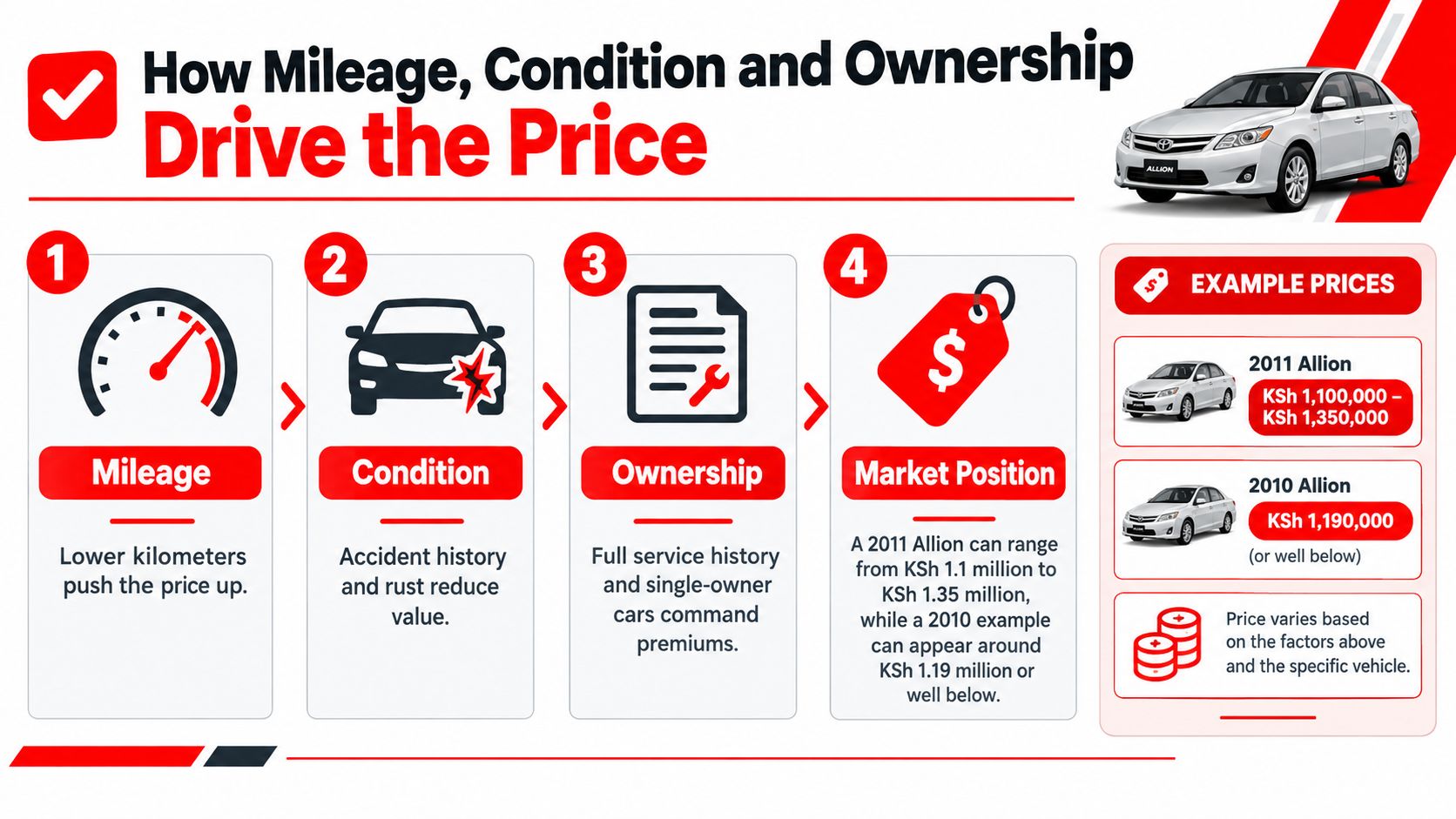
Now turn that evidence into an offer. Pull three or four comparable cars of similar age, engine capacity and registration status, and take the middle of their asking prices as your anchor. A ready-to-transfer local car and an uncleared import sit in different cost brackets, so comparing their sticker prices tells you nothing. Then adjust for what you can prove:
- Faults found on inspection: get a written repair quotation for accident repairs, warning lights, gearbox or suspension defects, and deduct that amount once. Deducting it again under bodywork, paint and general condition is double-counting, and sellers will rightly push back.
- Fresh paint: find out why it was done before treating it as evidence of serious damage.
- Gaps in the logbook or missing ownership evidence: treat this as a transfer and resale risk, not a cosmetic discount.
- Overdue maintenance: price the catch-up service, tyres and brakes you will pay for in the first month.
Condition also follows you past the purchase. Insurers routinely survey older or high-mileage cars before issuing cover, and existing damage or poor repair work can mean loadings, exclusions or a valuation below what you paid. A discount you won at the yard returns as an insurance cost, so fold that into the total price before you celebrate.
A discount is only useful when you understand the problem you're accepting. An unknown repair bill is not a saving.
If the adjusted numbers still make the ownership budget uncomfortable, drop a size rather than hunting for a cheaper Allion. The guide to Vitz prices in Kenya shows what a well-kept smaller car costs.
Landed Cost of an Imported Allion
The overseas purchase price is not the Kenyan acquisition price. Before paying, demand an itemised calculation that distinguishes money paid for the vehicle, government charges and commercial service costs.
KRA explains that used-vehicle customs valuation applies depreciation to the Current Retail Selling Price, or CRSP, of the equivalent new vehicle. Its clarification on the revised CRSP list also records an import-duty change from 25% in 2019 to 35% in 2025, and a maximum excise-rate change from 30% to 35% for some vehicles over that period.
Those historical rates explain why an old landed-cost calculation shouldn't be reused without checking. They aren't a substitute for a current assessment of your specific vehicle.
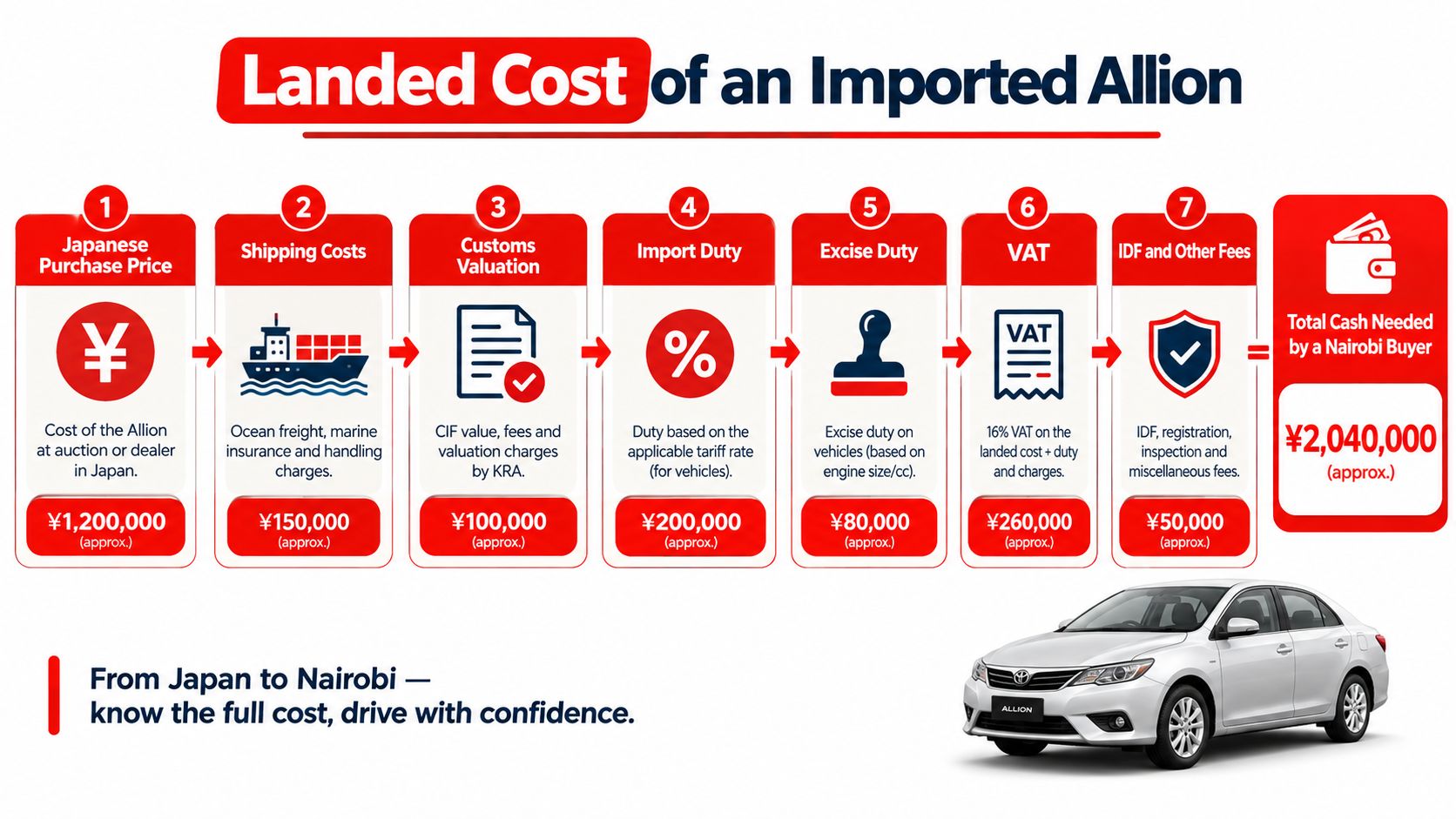
Build the calculation in stages
- Purchase and transport: Establish the vehicle price, shipping and transit insurance.
- Customs assessment: Obtain the applicable valuation, depreciation treatment and vehicle classification.
- Taxes and levies: Itemise import duty, excise duty, VAT, Import Declaration Fee and Railway Development Levy.
- Release and road use: Add clearing, applicable inspection, registration and delivery costs, then arrange insurance.
KRA's customs and border-control guidance describes staged tax calculations rather than a single surcharge on the overseas invoice. Because official pages can reflect different rate periods, have KRA or a licensed clearing agent reconcile the current calculation in writing.
A responsible worked example starts with an actual eligible vehicle and a dated quotation. Without its customs assessment, freight quote and engine details, a precise Nairobi total would be invented.
Use this budgeting structure instead:
Total acquisition cash = purchase + shipping and transit insurance + assessed taxes and levies + clearing + compliance and registration + delivery + motor insurance.
Ask which amounts are fixed, which are estimates and who bears any shortfall. A cheap overseas purchase isn't necessarily cheaper once every payable item is included.
Import Age Rules, KEBS Inspection and Registration
A cheap Allion is only cheap if Kenya will register it.
KRA's motor-vehicle import procedures say an imported vehicle must be less than eight years old from its year of first registration, meet KEBS requirements under Legal Notice No. 78 of 15 July 2005 and KS 1515:2000, and undergo roadworthiness inspection by a KEBS-appointed agent in the country of export.
First registration is the date that matters. Model-year talk, export month and seller memory do not override the documents.
| Check before you pay | If it is wrong |
|---|---|
| Year of first registration | The car can miss the admission window, turning a bargain into storage and resale losses. |
| Export-country inspection | Missing KEBS-agent paperwork can mean delays, retests or a car you cannot clear. |
| Engine capacity on documents | A 1.5 or 2.0 badge must match the papers because classification affects tax assessment and insurance. |
Ask a licensed clearing agent for the admission window, inspection route and tax treatment in writing before money leaves Kenya. For the wider purchase channel, use the imported-cars buying guide. Treat eligibility as an official check. A similar Allion already on Kenyan plates proves nothing about yours.
Why the Allion Holds Its Value in the Kenyan Market
Spend a Saturday at a Nairobi yard and watch which saloons buyers ask about twice. The Allion comes up early. That pull is real, though I would still buy on the car in front of me: condition, specification and history you can defend to the next buyer beats a reputation doing the work.
The registration data also deserves an honest read. KNBS figures put total newly registered road vehicles and motorcycles at 195,656 in 2023 and 166,514 in 2024, while station wagons grew from 61,711 to 64,204 and saloons fell from 6,378 to 5,367, according to the KNBS vehicle-registration figures.
Read it again. The saloon segment shrank.
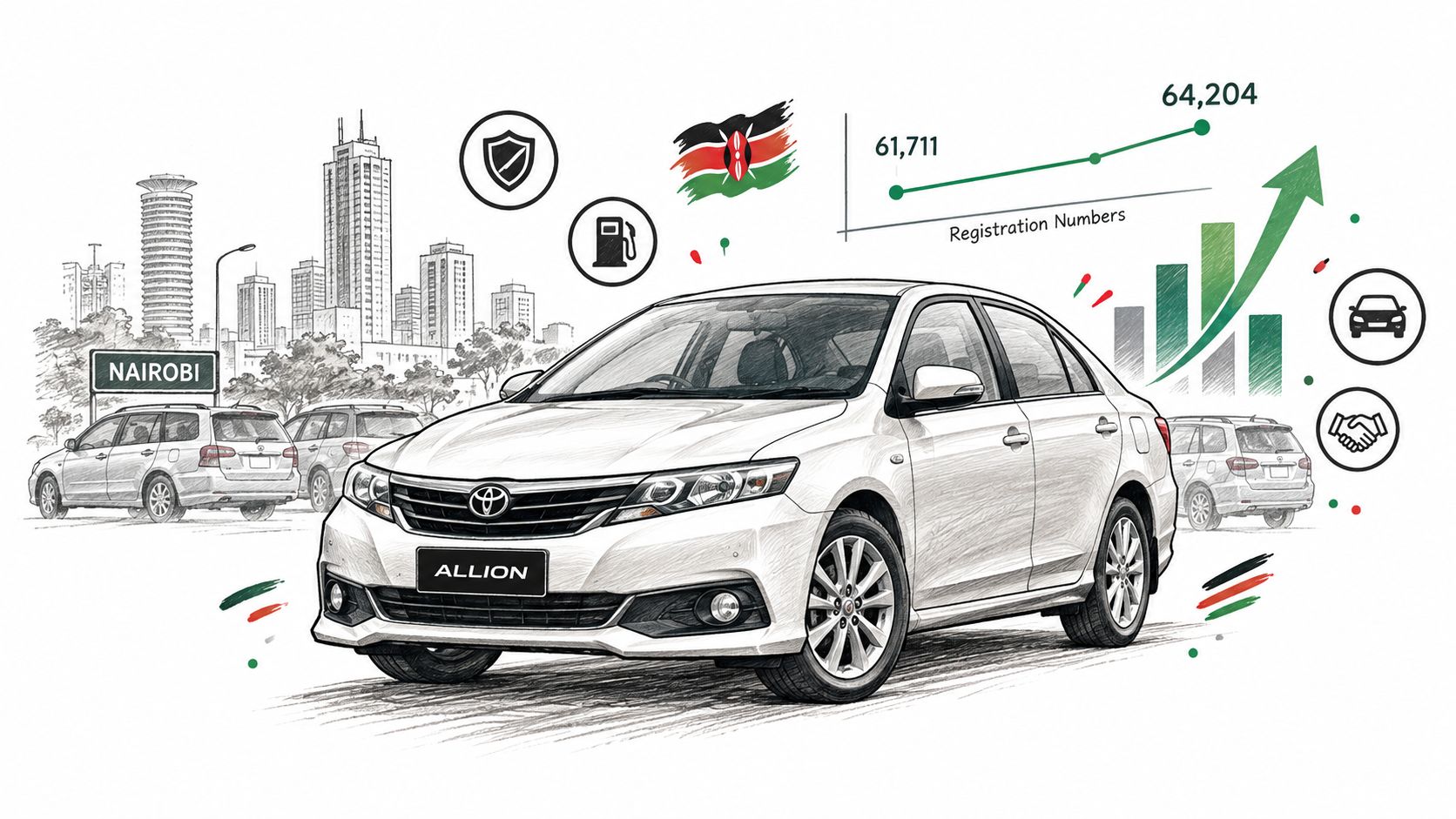
So when a seller quotes wagon growth as proof your Allion will resell fast, push back. The Allion is a saloon, and its resale strength rests on narrower ground: Toyota's parts network, buyers who trust the badge, and running costs the next owner can carry. Resale here is a total-cost conversation, because whoever buys after you is pricing the same fuel bill, cover and repair risk you priced on the way in.
That shapes what is worth paying for today. Keep every service invoice and record of substantial work, because paper converts "well maintained" from a claim into a fact. Fix real faults before polishing panels. Set your entry price as though the resale premium were zero.
Anything above that is a bonus. My rule in the yard: buy the Allion you can explain, and walk past the one you would have to excuse.
Hidden Costs That Change a Cheap Allion into an Expensive One
Two Allions at the same sticker price can leave your pocket in very different states. I have watched buyers drive off in the cheaper car, then spend their first month funding a gearbox conversation they never budgeted for. A car is too expensive if buying it leaves you unable to deal with its next repair.
Start with insurance, before money changes hands. An older Allion does not automatically qualify for the cover you expect. Some insurers decline, others attach valuations, exclusions or excesses that change what the car costs you each year. There is no safe universal age cutoff, so ask the insurer about that specific vehicle, not about Allions in general.
Then price the repairs, not the promises. A suspected CVT problem needs a specialist diagnosis and a written quotation. A seller offering a fluid change as the cure is selling reassurance, and reassurance does not fix transmissions. Suspension wear and cooling system faults deserve the same treatment: get them quoted properly or walk away.
Now do the arithmetic in order. Take the asking price. Add tyres, servicing and every defect the mechanic listed. Add fuel, routine maintenance and the actual insurance premium on offer. If finance is involved, weigh the full repayment commitment against your income, because a friendly monthly instalment can still leave no room for a single repair. If the finished figure empties your maintenance reserve, the car costs too much at that price, and cosmetic work waits until the mechanical bills are cleared.
Ownership test: Price both cars with the work they need and the cover you can actually obtain included. The cheaper purchase may no longer be the cheaper choice.
Allion Inspection Checklist for Viewings
Arrive with time to inspect the vehicle properly and, where possible, see it before the engine has been warmed. Ask permission for a meaningful test drive and an independent mechanical assessment.
Use this checklist once, methodically. Don't let a tidy cabin or an enthusiastic seller rush you past a concern.
What to inspect on the car
- Bodywork: Look for uneven panel gaps, overspray, inconsistent paint and signs of repaired structural areas.
- Engine and cooling: Check for visible leaks, coolant concerns, unusual smoke and unexplained noises. Never open a hot cooling system.
- Dashboard: Watch the warning-light sequence and ask a mechanic to investigate lights that remain illuminated or appear not to function.
- Transmission: Assess engagement, acceleration and low-speed behaviour. Jerking, slipping or hesitation needs diagnosis, not reassurance.
- Suspension and steering: Listen over suitable uneven surfaces and assess pulling, vibration or looseness.
- Cabin equipment: Operate the air conditioning, windows, locks, lights and other equipment you're paying for.
- Vehicle identity: Match the chassis details on the car to the ownership documents.
- History consistency: Compare service records, odometer information and visible wear. Ask about unexplained gaps.
A short drive around the yard isn't enough to dismiss a concern that appears only when the vehicle is warm or under load. Ask the mechanic what further testing is needed.
If anything suggests structural damage, an unresolved drivetrain fault or uncertain identity, pause the purchase. Don't agree on a repair allowance before the fault has been identified. A professional pre-purchase inspection should inform the decision, not serve as a formality after you've committed.
Paperwork and Transfer After You Buy an Allion
Once you agree the price, put the agreement in writing. Identify the vehicle, seller and buyer, record what the payment covers, and specify any agreed work or outstanding obligations.
Don't assume possession of the keys proves that ownership has transferred. Confirm the current process, required documents, fees and expected timing through NTSA before relying on a handover date.
Agree who completes each action
- Seller responsibilities: Establish who will initiate the transfer and supply the ownership and sale documents.
- Buyer responsibilities: Confirm your identification and KRA PIN details, complete the required acceptance steps and arrange suitable insurance.
- Import documentation: For a newly imported car, confirm the relevant clearance, inspection and registration records are complete.
- Payment evidence: Retain the agreement, receipts and confirmation of the agreed transfer actions.
Check whether any further inspection or number-plate action applies to that particular vehicle. Don't assume every older car or every import needs an identical procedure.
If buying through a dealership, ask for its responsibilities in writing instead of assuming it handles every administrative step. Keep copies of the completed documents and distinguish a submitted application from a completed transfer. Resolve ownership discrepancies before making an unconditional final payment.
Questions to Ask Before You Pay for an Allion
Before committing, ask for answers that change the buying decision, not another assurance that the car is clean. The useful questions concern the outstanding cost, the evidence behind the price and what happens if something remains unresolved.
Ask: “What exactly does this price include?” The answer should distinguish the vehicle from transfer, registration, insurance and any outstanding import-related charges. If financing is involved, request the full repayment commitment and conditions separately.
Turn the answers into a written agreement
Ask how the asking price was justified and whether a written valuation is available. Then establish which inspection findings have been reflected in the price, which repairs have been agreed and what evidence will show that the work is complete.
Your final questions should address payment and handover: who receives the money, what acknowledgement you receive, what remains outstanding and when possession changes. Don't allow pressure to pay immediately to replace clear answers.
My recommendation is to buy the most defensible car within your complete ownership budget. Choose the Allion whose identity, condition, costs and transfer arrangements you understand. Walk away from the one that requires you to trust explanations nobody will document.
Brill Motors offers showroom viewing, vehicle valuation, financing and trade-ins to help you weigh an Allion against your full budget. View current stock at Brill Motors, then visit the Garden City Mall Rooftop Car Yard, Thika Road, Nairobi, to assess the car and discuss the figures before committing.