

 SIGN UP
The cheapest Toyota Hilux to buy isn't always the cheapest one to own. Are you comparing the asking price, or are you checking whether the engine, drivetrain, mileage and previous work match the roads and workload you will give it?
For a Toyota Hilux for sale in Kenya, the right decision depends on use. A 2WD manual cab chassis can make excellent business sense for a contractor, while a high-spec 4WD double cab may be unnecessary for an urban commuter. The Hilux has strong local familiarity and resale appeal, but buyers still overpay when they focus on badges, accessories or a clean photograph instead of condition and specification.
Why Buying a Used Toyota Hilux in Kenya Requires Market Clarity
Kenya's used-car market was valued at USD 2.8 billion in 2024 and is projected to reach USD 4.6 billion by 2034, with used vehicles accounting for about 85% of vehicle sales in the country, according to this Kenya used-car market analysis. Pickups matter within that market because they serve farms, construction sites, logistics operators, small businesses and private households.
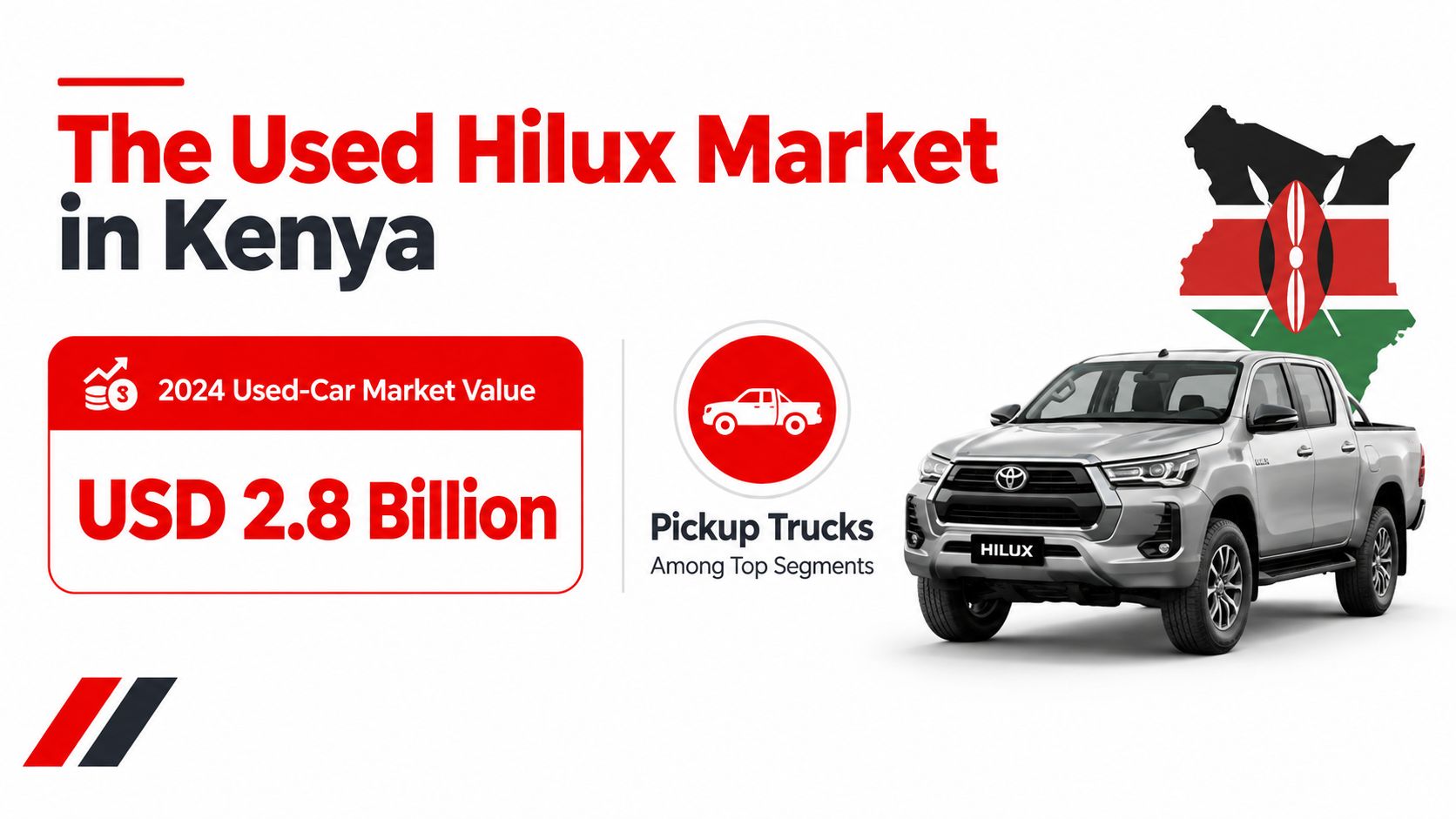
The same market analysis places the six to ten year age band at 48% of the market in 2024, which helps explain why many Hilux buyers are choosing imported used units or older local stock instead of buying new. That age range also creates a wide spread in condition. Two vehicles from the same model year can have completely different histories if one worked on rough rural routes and the other spent most of its life on paved roads.
Why the asking price can mislead you
A Hilux isn't one uniform product. A single-cab or cab chassis, a double cab, a manual 2WD and a diesel 4WD may all carry the same badge while serving very different jobs. Mileage, accident history, service records, cab configuration, engine size and suspension condition can move fair value sharply.
Historical market performance adds context. The Hilux was reported as Kenya's best-selling vehicle in 2019, when the wider market fell 7.3% to 12,981 units, while Toyota held 47% of new-light-vehicle sales in 2021, compared with Isuzu at 26.6%, according to this Kenya vehicle market report. More recent 2025 coverage reported 39.3% growth for the Hilux, with the model ranking third among Kenya's best sellers in that coverage.
That recognition supports resale, but it doesn't justify paying any price for any unit. Buyers should first decide whether they need a work truck, a family pickup or a long-distance 4WD. Then compare only vehicles with similar specifications.
Practical rule: Match the Hilux to the job before you compare the price. A cheaper vehicle with the wrong drivetrain can cost more through repairs, poor fuel economy and limited usefulness.
A sensible search starts with a specification sheet. Note the engine, transmission, drivetrain, cab type, mileage and intended workload before arranging a viewing. You can then use the Toyota used-vehicle stock page to monitor suitable vehicles without letting an attractive colour or accessory package decide for you.
Toyota Hilux Price Bands and Model Year Expectations
Price discussions around a Toyota Hilux for sale in Kenya become useful only when year, trim and condition appear together. A mid-model-year double cab with a documented service history should not be compared directly with an older cab chassis that has carried heavy loads, even if both have diesel engines.
A useful benchmark for 2019 to 2021 Hilux units is KSh 4.8 million to KSh 6.2 million, while a separate set of 2018 to 2020 units has a median asking price of KSh 5.4 million, according to Kenya Hilux pricing data. Treat those figures as a market guide, not an automatic valuation. The actual vehicle in front of you still decides whether the price is sensible.
Broader pricing data puts the median asking price at KSh 3.9 million, with most listings between KSh 2.65 million and KSh 5.79 million. The same pricing reference shows trim-level differences, with 2.5-litre units from KSh 2 million, 2.8-litre units from KSh 1.8 million and TRD examples from KSh 4.75 million. These figures come from Toyota Hilux price tracking in Kenya, and they demonstrate why one broad Hilux price is not enough.
Expected price ranges by model year and trim
| Model Year Range | Typical Price Band (KSh) | Common Trim Levels | Best Suited For |
|---|---|---|---|
| Older used units | From about 1.8 million, depending on condition | Older 2.5L, 2WD, single cab and cab chassis | Basic commercial work and budget ownership |
| 2018 to 2020 | Around 4.8 million to 6.2 million for stronger mid to late-model examples | 2.4L and 2.8L double cab, manual or automatic | Mixed family and business use |
| 2019 to 2021 | Around 4.8 million to 6.2 million for well-specified units | 2.4L 4WD, 2.8L automatic and higher trims | Frequent travel, family use and demanding routes |
| Premium and newer imported examples | Can exceed KSh 10 million, depending on specification | TRD and high-spec 4WD variants | Buyers prioritising equipment, image and newer technology |
An older unit below the mid-market range isn't automatically a bargain. Check whether the lower price reflects high mileage, a hard commercial history, worn suspension, accident repairs or incomplete documentation. On the other hand, a premium price needs a real reason, such as a stronger engine, 4WD, lower mileage, excellent records or a superior cab and equipment package.
What changes the value most
Drivetrain is usually more important than cosmetic accessories. Four-wheel drive earns its premium when you regularly use muddy farm tracks, steep terrain, construction sites or remote routes. It adds complexity and may consume more fuel, so an urban buyer shouldn't pay for it just because it looks tougher.
Cab configuration matters just as much. A cab chassis suits businesses that need to fit a specialised body or carry equipment. A double cab offers more passenger space, but you're paying for comfort and versatility rather than maximum commercial simplicity.
For a deeper comparison of Toyota pricing, use the Toyota cars price guide, then ask for a vehicle-specific figure based on inspection and specification.
Engine Options and Trim Differences Explained
The Kenyan Hilux range makes more sense when you start with torque rather than horsepower. Torque determines how confidently the pickup moves a loaded body, climbs a slope or handles a rough access road. Horsepower matters too, especially at speed, but most work-focused buyers should first ask how much load and terrain the vehicle will face.
The 2.8-litre turbo-diesel produces 204 hp and 500 Nm, paired with a six-speed automatic in the local specification published by CFAO Mobility Kenya. The 2.4-litre 4x4 variants produce between 138 and 148 hp and 400 Nm, with manual or automatic transmissions depending on trim.
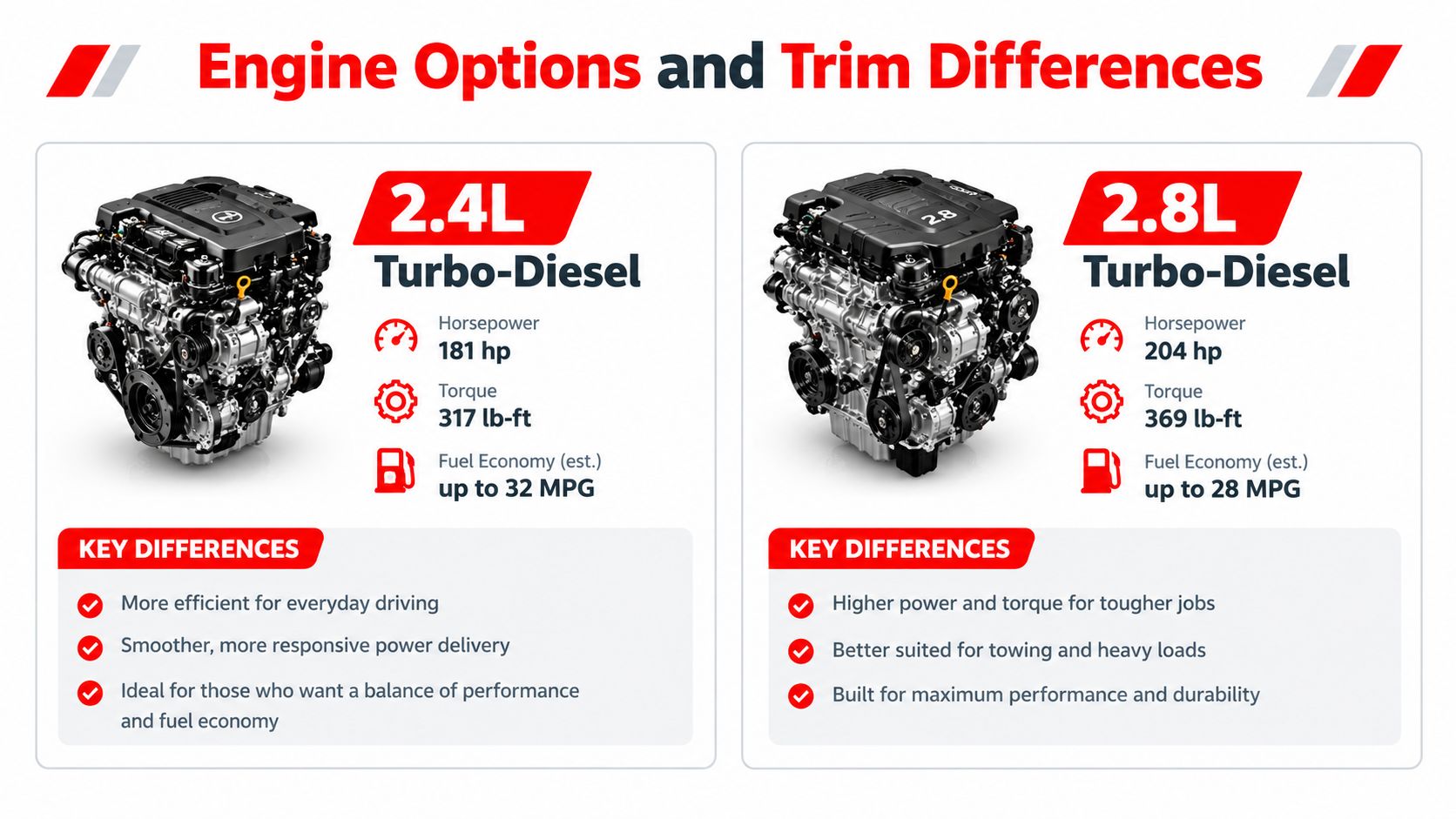
A separate Kenya-focused specification guide lists the 2GD-FTV 2.4-litre diesel at 150 PS, about 148 hp, and 400 Nm, with a real-world range of 11 to 13 km/L, depending on driving conditions, as shown in this Kenya Hilux specification guide.
Choose the engine for the route
The 2.4-litre is the sensible choice for many buyers. It gives useful torque, can be paired with a manual transmission for direct control and generally suits lighter loads, commuting and mixed personal use. A manual can also appeal to an owner who prefers a simpler driving setup and wants to control gear selection on inclines or rough ground.
The 2.8-litre is the stronger recommendation for regular heavy loads, frequent highway travel, towing or demanding rural work. Its extra torque makes the vehicle feel less strained when loaded, but you should expect to pay more upfront and budget carefully for fuel and maintenance.
Trim and drivetrain decisions
Don't buy 4WD because the badge sounds impressive. Buy it if your route needs traction. A 2WD Hilux may be the better value for Nairobi commuting, deliveries on paved roads and light commercial work, while 4WD makes sense for farms, construction access roads and regular off-road use.
Local Hilux variants are published with fuel consumption of 8.0 to 8.5 litres per 100 kilometres, an 80-litre fuel tank and a 3,085 mm wheelbase in the CFAO specification. Those figures help explain the model's long-distance practicality, but they shouldn't be treated as a promise for stop-start Nairobi traffic.
My buying view: If your work regularly loads the pickup, pay for torque and inspect the suspension. If your work rarely loads it, don't spend extra on a larger engine and 4WD that will sit unused.
The correct trim is the one that supports your work without adding equipment you won't use. Leather, large wheels and exterior styling may improve comfort or appearance, but they don't compensate for poor maintenance or a neglected drivetrain.
Essential Inspection Checklist Before You Commit
A Hilux can look solid while hiding expensive wear underneath. Inspect it cold if possible, drive it on more than one surface and ask direct questions about its previous work. A polished body and clean interior can't confirm the condition of the engine, gearbox or chassis.
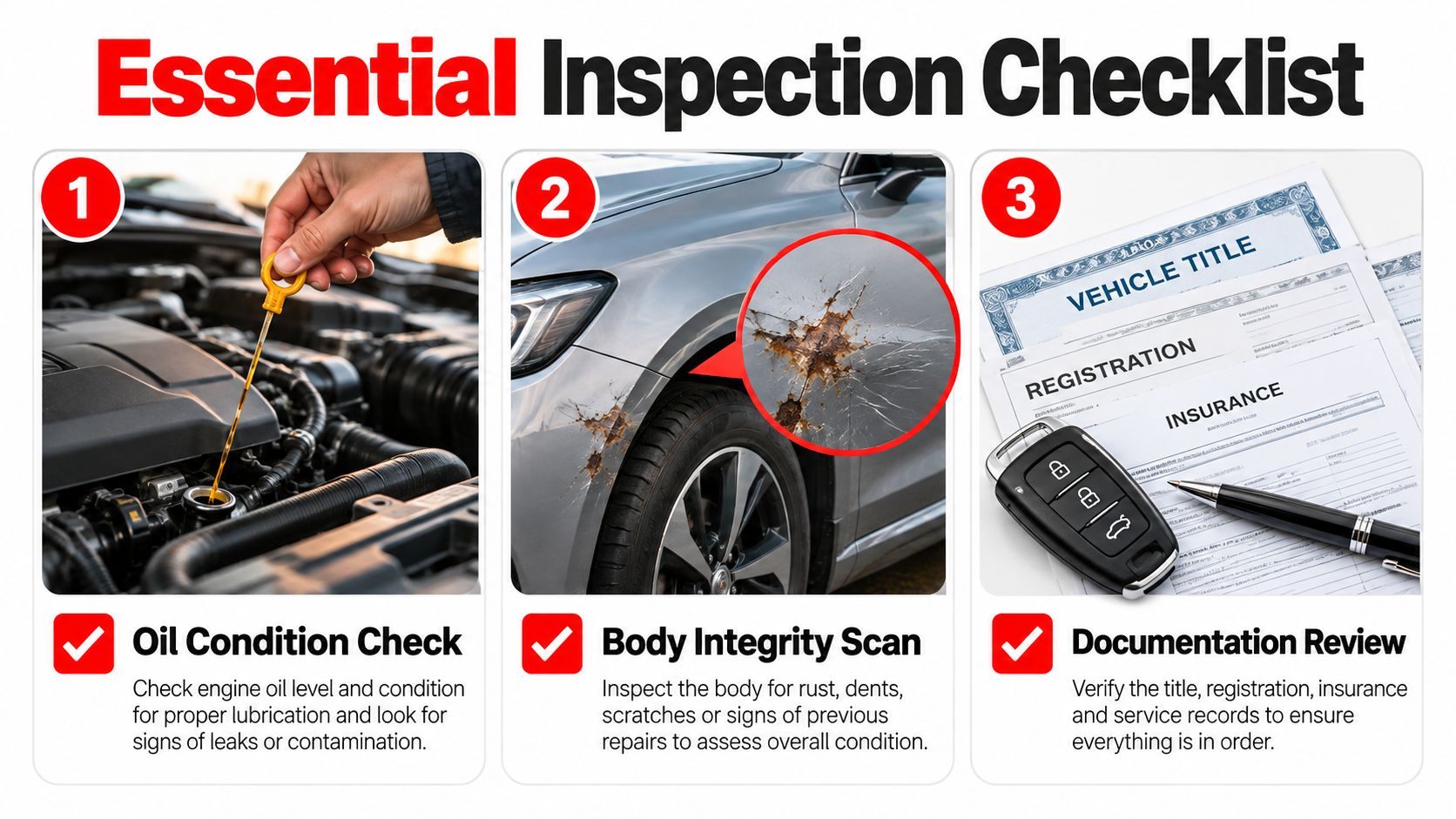
Start under the bonnet
- Oil condition: Check the oil level and appearance, then look around the engine for leaks, fresh sealant or evidence of repeated repair work.
- Cooling system: Inspect hoses, the coolant reservoir and the radiator area for stains, cracks or signs of overheating.
- Engine start-up: Listen for unusual knocking, excessive smoke or rough idling when the engine is cold.
- Transmission response: On an automatic, check for hesitation or harsh shifts. On a manual, test clutch engagement, gear selection and signs of slipping.
- Four-wheel drive system: If fitted, confirm that the system engages correctly and that warning lights clear after activation.
Inspect the body and running gear
Look underneath for chassis damage, heavy corrosion, bent components and fluid leaks. Pay close attention to suspension arms, bushes, shock absorbers and steering components, especially if the pickup has carried loads or travelled rough routes.
Examine the cargo bed for rust, deep dents, cracked mounts and signs that it has been repeatedly overloaded. A straight-looking exterior can conceal structural repairs, so compare panel gaps, paint texture and welds around repaired areas.
Test the electrical equipment, including windows, lights, air conditioning, dashboard warnings, reversing sensors and infotainment. Small faults may not decide the purchase, but several electrical problems can reveal neglected maintenance.
Complete the paperwork before payment
Ask for service records, ownership documents and identification details that match the vehicle. Confirm the chassis and registration information against the paperwork before committing funds.
Kenyan transfer guidance states that a locally used vehicle transfer is completed digitally through the NTSA portal within two weeks of purchase, with both buyer and seller using their eCitizen accounts, as explained in this Kenya vehicle ownership transfer guide. Start the process promptly and confirm the current requirements before signing.
Don't accept vague promises that transfer will be handled later. If the seller can't explain the paperwork, pause the deal until the ownership position is clear.
Running Costs and Total Ownership Considerations
The purchase price is only the first line in a Hilux budget. Your real cost comes from fuel, scheduled servicing, tyres, brakes, suspension wear, insurance, repairs and the type of work you ask the vehicle to perform.
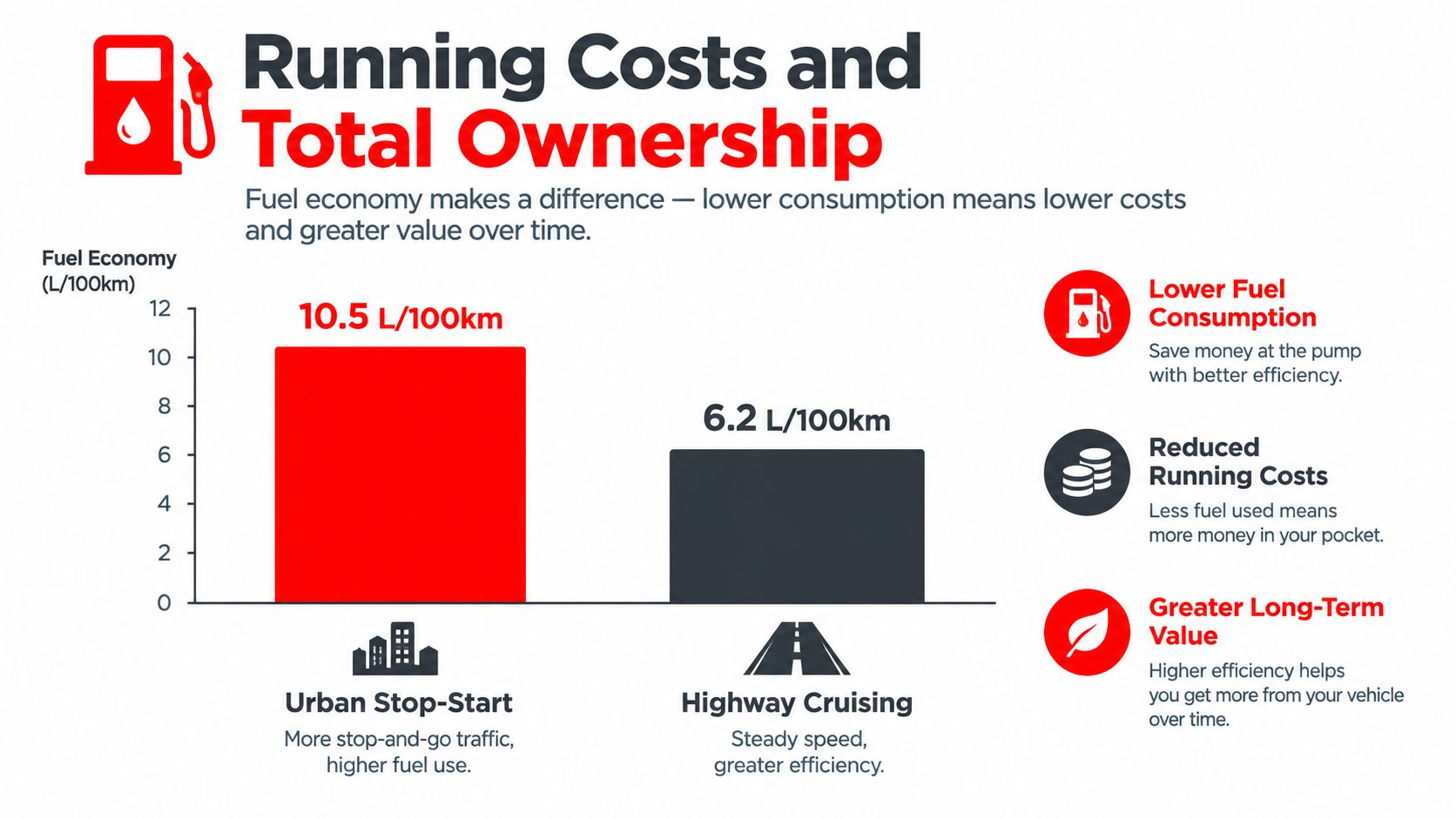
Kenyan pricing information gives a useful fuel benchmark of about 11.5 km/L in urban driving, 14.0 km/L on the highway and 12.8 km/L combined, according to this Toyota Hilux fuel economy reference. Actual consumption changes with traffic, payload, tyre pressure, driving style, terrain and mechanical condition.
Fuel is shaped by the job
A lightly loaded 2.4-litre used mainly for commuting should be easier to budget for than a heavily loaded 2.8-litre 4WD working on rough roads. The larger engine earns its keep when the load, terrain and distance demand more torque. It isn't automatically better for every owner.
Use your likely route as the test. An urban owner should prioritise a healthy engine, sensible tyre size and a transmission that performs smoothly in traffic. A farmer or contractor should prioritise torque, ground clearance, suspension condition and the integrity of the chassis.
Maintenance deserves a proper budget
The Hilux benefits from parts availability and a rugged chassis suited to mixed-terrain logistics routes, according to this Kenya used-car market report. That helps make repairs more predictable, but parts availability doesn't make neglect harmless.
Budget for regular engine oil and filter servicing, brake wear, tyres, wheel alignment and suspension components. A pickup used on rough roads may wear bushes, shocks and steering parts faster than one used for smooth urban commuting. A work vehicle should also be inspected around the cargo bed, leaf springs, underbody and drivetrain.
Insurance is another ownership cost and depends on the vehicle's value, use and policy terms. Confirm the available cover before purchase, especially if the Hilux will transport goods or operate commercially.
Calculate total ownership honestly
Before agreeing to a price, write down:
- Purchase cost: Include the vehicle price and any immediate repairs needed before daily use.
- Fuel requirement: Estimate your normal urban, highway and loaded driving rather than relying on the most favourable figure.
- Service reserve: Allow for routine servicing and age-related replacement items.
- Workload reserve: Add more caution if the pickup will carry equipment, tow or use rough roads.
- Exit value: A well-maintained Hilux should remain easier to resell than an abused example, but resale depends on records, condition and specification.
A cheap Hilux with worn suspension, poor tyres and unclear service history is not cheap. It has simply moved part of the purchase price into your first repairs.
Pick the smallest specification that comfortably handles your work. For many private owners, a sound 2.4-litre is the financial choice. For a business that regularly carries heavy loads, a properly maintained 2.8-litre can justify its higher running cost through stronger performance and reduced strain.
Where to View Your Next Toyota Hilux in Nairobi
Online photographs can narrow your search, but they can't replace a physical inspection. You need to see how the panels line up, hear the engine start, feel the clutch or automatic transmission, check the underside and sit in the driving position. A serious Hilux purchase deserves time beside the vehicle, not a decision based on a short message and a polished image.
The showroom at Garden City Mall Rooftop Car Yard on Thika Road, Nairobi gives buyers a practical place to view available vehicles in person. Come with your specification list and make the viewing about evidence: engine, drivetrain, mileage, body condition, service records and transfer readiness.
Arrive with a clear buying brief
Before visiting, decide which of these describes your use:
- Urban and family driving: Favour a clean, comfortable double cab with manageable fuel needs and no unnecessary off-road equipment.
- Construction or trade work: Prioritise chassis condition, suspension, cargo-bed integrity and load suitability.
- Farm and rural routes: Give greater weight to 4WD operation, ground clearance, torque and underbody condition.
- Fleet or delivery work: Focus on service history, operating simplicity, parts access and predictable running costs.
- Upgrade from another vehicle: Establish the value of your current car before choosing the replacement.
This prevents a common Nairobi buying mistake. A buyer arrives wanting a practical workhorse, sees a high-spec double cab with large wheels and premium trim, then pays for equipment that doesn't improve the work the vehicle must do.
Compare vehicles by evidence
If more than one Hilux is available, inspect them using the same sequence. Start with the paperwork, then the body, engine bay, tyres, suspension and test drive. Record the differences rather than relying on memory.
Ask the sales advisor for the vehicle's key specifications and clarify whether it is locally used or imported. Ask how the mileage is supported, what service records are available and whether any warning lights or mechanical concerns need attention. A straightforward answer is more useful than a general statement that the vehicle is “very clean”.
Current vehicles can be checked through the newly listed stock page, but confirm availability before travelling because stock changes. A physical viewing remains essential, particularly for a pickup whose value depends so heavily on use history.
Sellers can use the same valuation logic
If you're selling an existing Hilux, don't price it from emotion or from the cost of accessories. A bull bar, canopy or upgraded infotainment system may help the vehicle suit a particular buyer, but the core valuation still depends on year, mileage, drivetrain, cab type, service history and mechanical condition.
A vehicle valuation gives you a more structured starting point. If you're upgrading, a trade-in can also connect the value of your current vehicle with the cost of the replacement, though you should still understand both figures before agreeing to the transaction.
Bring the ownership documents, service records and any relevant repair invoices to the viewing. Clear paperwork and an organised history make it easier for a buyer to assess the vehicle and easier for you to discuss a realistic figure.
The strongest Hilux buyers are prepared before they arrive. They know whether they need 2WD or 4WD, understand the difference between 2.4-litre and 2.8-litre ownership, recognise that condition changes value and are ready to walk away from a vehicle that fails inspection. That discipline is how you secure fair value instead of merely finding a pickup with the right badge.
Brill Motors offers vehicle viewing at Garden City Mall, financing, vehicle valuation and trade-ins for buyers and sellers assessing a Toyota Hilux. View current stock online or visit Brill Motors to arrange your next step.