


 SIGN UP
The Toyota Fielder Hybrid typically returns about 22 to 28 km per litre in mixed Kenyan driving, and in Nairobi traffic that can be roughly double the efficiency of an older petrol Fielder. Whether it's the right buy depends on how much you drive, the condition of the hybrid system and whether the higher purchase price is recovered through lower fuel spending.
For a Nairobi commuter, the appeal is easy to understand. A practical wagon carries family luggage, shopping and business loads without the running costs associated with a larger vehicle. But the hybrid badge isn't an automatic guarantee of value. Battery health, import paperwork, servicing and the price difference between similar cars determine whether the saving is real.
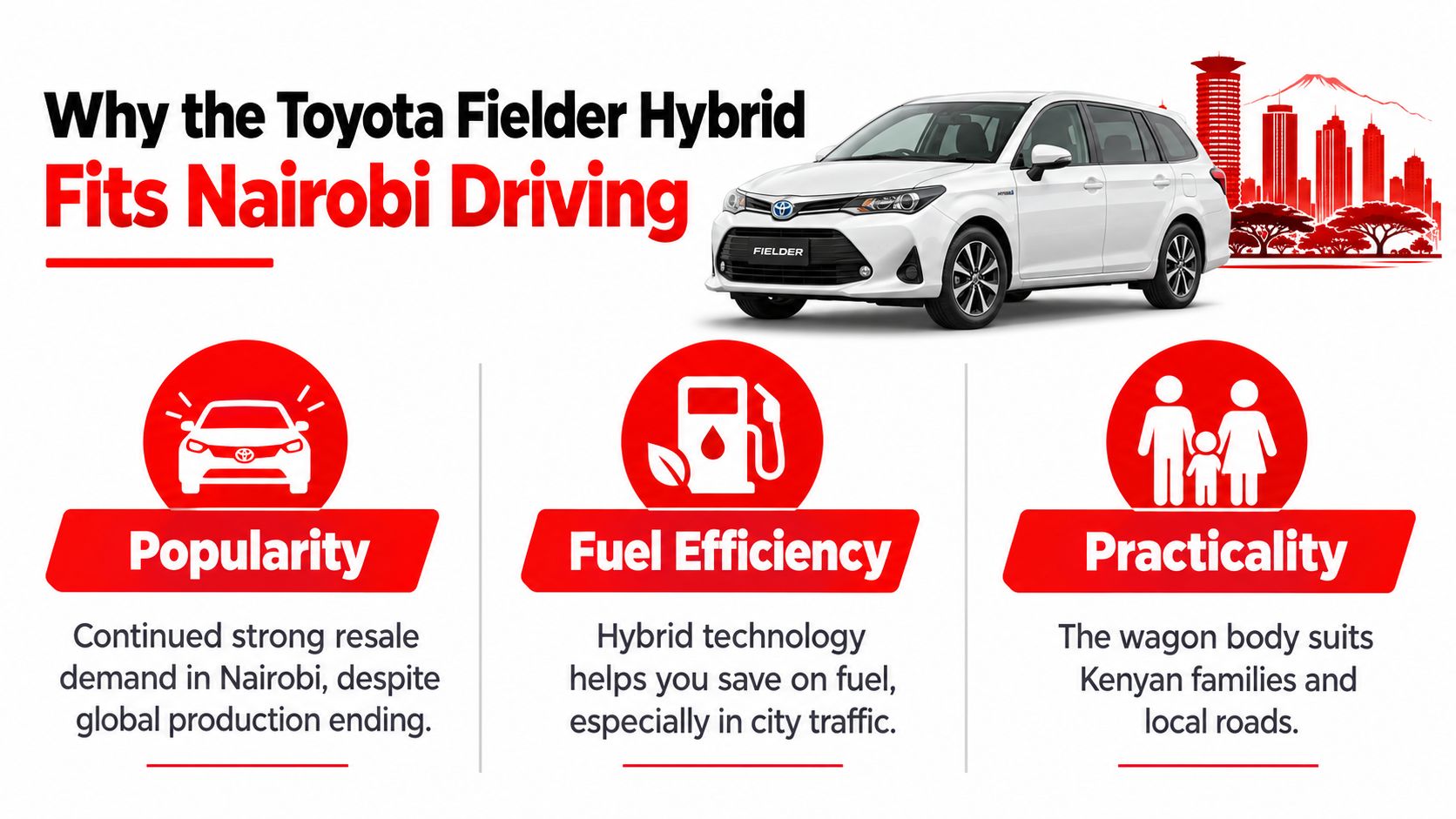
Why the Toyota Fielder Hybrid Fits Nairobi Driving
A Toyota Fielder Hybrid makes sense in Nairobi because the city rewards cars that waste less fuel in traffic. On routes like Thika Road, Waiyaki Way and the approaches to the city centre, the electric motor gets repeated chances to assist the petrol engine. Kenyan road tests and ownership reports place the hybrid at roughly 18 to 28 km/L in real use, depending on traffic, tyres, air-conditioning use and driving style. Kenyan road-test information on the Toyota Corolla Fielder supports that practical range.
That matters most for drivers who spend real time in stop-start traffic. A petrol wagon burns more fuel while pulling away, slowing down and idling. The Fielder Hybrid recovers some energy during braking and uses electric assistance when moving off, so its biggest advantage shows up where Nairobi driving is most demanding.
A wagon built around daily usefulness
The Fielder is not a sporty car, and that helps explain its appeal. Its estate body gives families more usable loading space than a conventional saloon, while the manageable footprint suits crowded estates, shopping centres and tight urban parking. Small businesses also value the flat cargo area for light equipment and deliveries.
Toyota introduced the hybrid variant in August 2013, after the Fielder name first appeared in Japan in November 2000 as part of the Corolla Fielder line. The hybrid uses Toyota's Hybrid Synergy Drive system and became a familiar Kenyan family and business wagon because it paired estate practicality with lower fuel use than petrol versions. The Kenya-focused Fielder review covers that model history and local positioning.
Practical rule: The Fielder Hybrid suits a buyer who spends regularly on urban fuel, not someone who only drives short distances occasionally.
Local demand has stayed strong even though Toyota ended global Fielder production in October 2025, as noted in the Kenyan review above. That demand supports resale, but it can also keep asking prices firm. Buyers should judge the condition of the specific car in front of them, not assume the nameplate alone makes every example a good value.
Toyota Fielder Hybrid Specs and Powertrain Explained
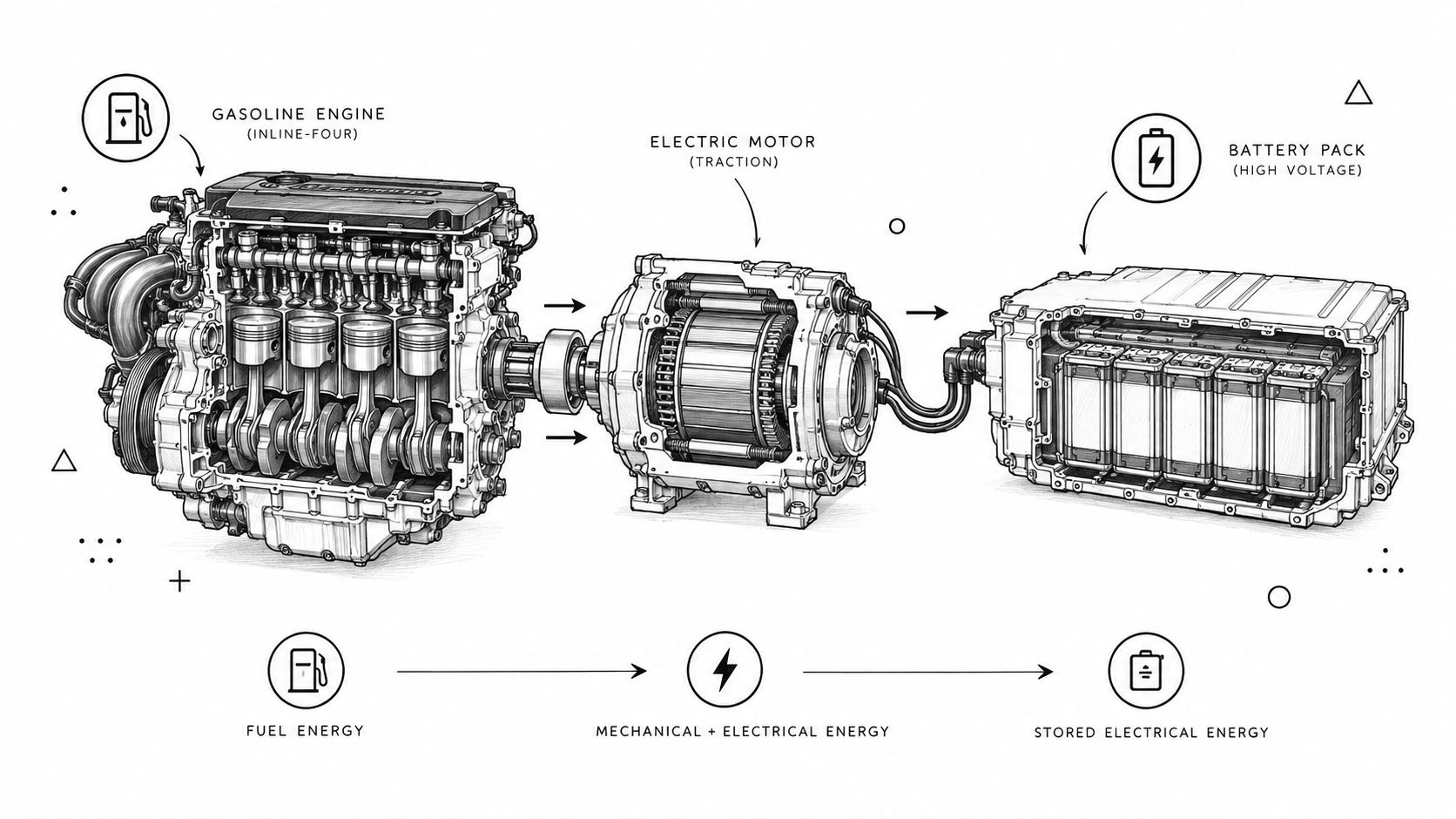
The Kenyan-market Toyota Fielder Hybrid generally uses a 1.5-litre inline-four, Toyota's 1NZ-FXE petrol engine, an electric motor and a CVT transmission. Common Kenyan-market specifications in the Toyota Fielder range at Brill Motors show front-wheel drive and a 1500 cc automatic hybrid layout. Reported combined output is around 100 hp, with 111 Nm of torque. A Kenyan Fielder Hybrid specification listing provides those commonly reported figures.
Those figures describe a powertrain built for steady urban work. The Fielder Hybrid delivers smooth, economical progress, with the electric motor helping the car move away from a junction and the petrol engine carrying more of the load as speed or incline increases. The CVT keeps the engine within an efficient operating range, although it can sound busy during firm acceleration on Nairobi's flyovers or outside-town climbs. Buyers seeking brisk overtaking should judge the car on a road test, not from the output figures alone.
What the system feels like on Kenyan roads
In slow Nairobi traffic, the electric motor can assist repeatedly during short moves and braking. Regenerative braking sends part of that kinetic energy back to the battery instead of losing it entirely as brake heat. The petrol engine therefore does less work in stop-start conditions, where a conventional wagon usually wastes more fuel. The hybrid system still depends on the petrol engine for sustained speed, heavier loads and longer climbs.
Front-wheel drive works well for ordinary Nairobi commuting and maintained intercity roads. It gives the wagon predictable road manners, while also setting a clear limit on rough access routes. Muddy tracks, steep broken approaches and badly damaged roads call for careful driving. Inspect the underside, suspension and tyres closely on a used import, because efficient power delivery cannot compensate for poor ground clearance or worn running gear.
On a test drive, prioritise smooth operation over a dramatic launch. Check that the car moves away cleanly, responds consistently and cruises without unusual engine surging. Warning lights, harsh transitions or an engine that runs constantly in light traffic deserve a proper hybrid-system inspection before purchase.
Fuel Economy and Running Costs Compared to Petrol Fielder
Fuel economy is where the hybrid earns its place, but buyers should convert kilometres per litre into their own monthly spending. A Kenyan comparison reported approximately 24 km/L for a hybrid on Nairobi routes, against 13.8 km/L for a petrol Fielder, an improvement of roughly 74% in those city conditions. The same Kenya-focused comparison gives an example of a driver covering 2,500 km per month saving about KSh 8,400 against petrol use. The Kenyan petrol, hybrid and diesel comparison contains those figures and the relevant assumptions.
That example is useful, but it isn't a promise. Your saving will depend on fuel prices, route length, traffic, tyre pressures, air-conditioning use and the car's battery condition. A hybrid with a weak battery may still move under petrol power, but it won't deliver the same efficiency as a properly functioning system.
The running-cost comparison
| Factor | Hybrid Fielder | Petrol Fielder |
|---|---|---|
| Urban fuel use | Lower in stop-start traffic, with Kenyan mixed-driving reports around 22 to 28 km/L | Commonly around 12 to 15 km/L in Kenyan conditions |
| Traffic behaviour | Electric assistance and regenerative braking support city driving | Petrol engine handles the driving and braking losses directly |
| Mechanical complexity | Includes a high-voltage battery, inverter, electric motor and hybrid controls | Simpler petrol drivetrain |
| Best financial fit | High-mileage Nairobi commuting | Lower-mileage use or a buyer prioritising simpler mechanical ownership |
| Main financial risk | Battery condition and the higher purchase price | Higher fuel spending over regular urban mileage |
The fuel-use ranges in the table are drawn from Kenyan ownership and market reporting on the Fielder Hybrid's real-world consumption. They should be treated as working ranges, not guarantees for every vehicle.
Where the hybrid premium can make sense
The hybrid usually makes the strongest financial case when the buyer drives frequently and keeps the car long enough for fuel savings to offset the purchase difference. A commuter covering only occasional short trips may not recover that difference quickly. A higher-mileage user, by contrast, has more opportunity to benefit from the system every week.
Maintenance also needs a balanced view. The petrol engine still needs normal servicing, tyres and suspension work, while the hybrid adds specialist components that require proper diagnosis. That doesn't mean a hybrid is automatically expensive to own, but it does mean you should budget for battery risk rather than pretending it doesn't exist.
Import costs can also affect the purchase calculation. Current Kenyan guidance generally treats hybrid vehicles like their internal-combustion equivalents for tax purposes by engine size, with no blanket hybrid discount. Confirm the applicable customs treatment and current charges with the Kenya Revenue Authority or a licensed clearing agent before committing to an import.
Common Issues and What to Check Before Buying
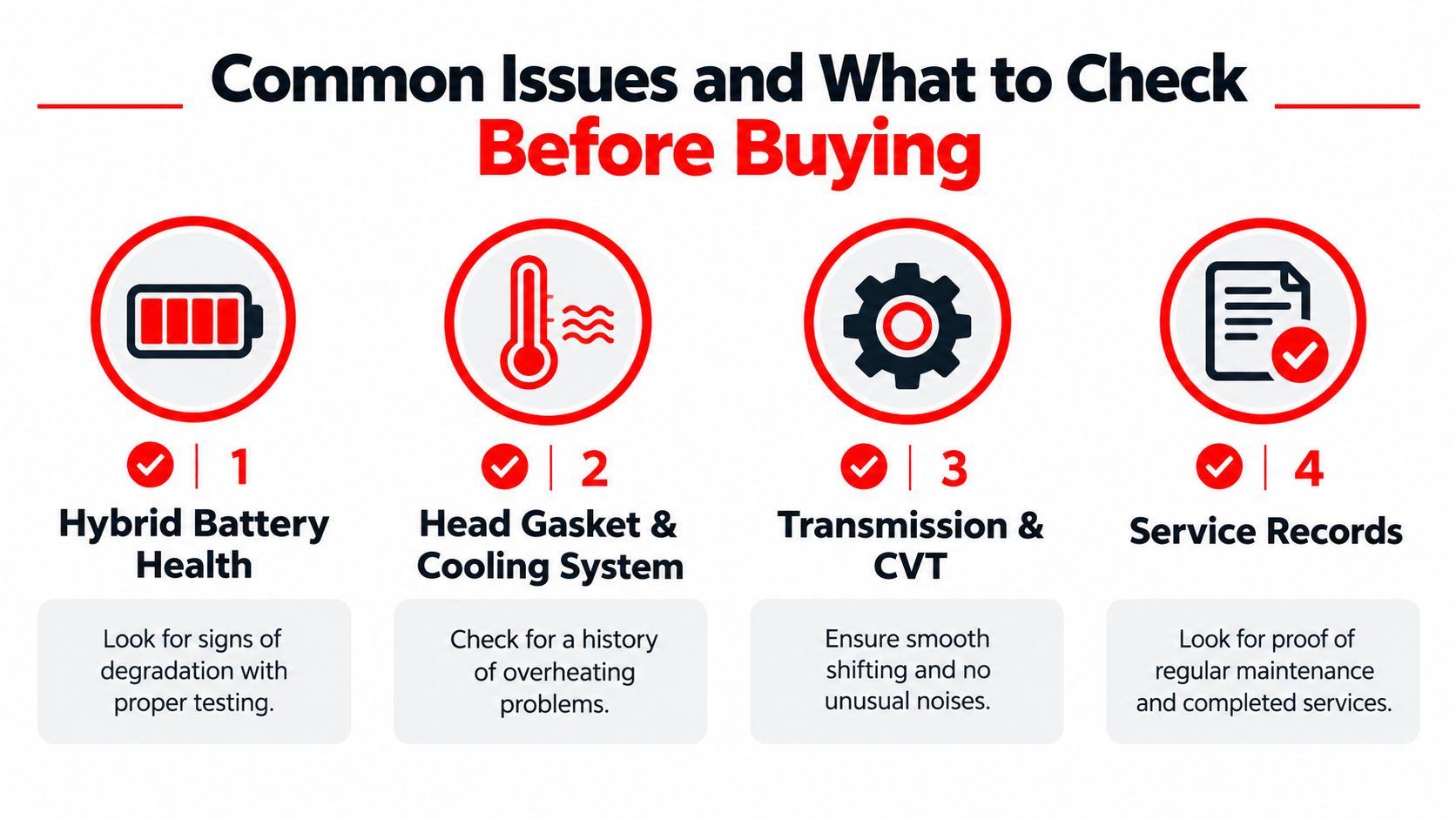
A used hybrid should be inspected as two cars in one: a conventional wagon and a high-voltage electrical system. A clean body and a quiet engine aren't enough. The battery, inverter cooling, cables, dashboard history and service records deserve the same attention as the brakes, suspension and CVT.
Start the inspection with the dashboard. Switch the car on and confirm that warning lights illuminate as part of the normal start-up sequence, then go out once the system is ready. Hybrid system, battery, engine and master warning lights that remain on need a proper diagnostic explanation, not a verbal assurance that the car “only needs a reset”.
Inspect the hybrid components
Ask for a hybrid-system health check before agreeing on a price. The inspection should consider battery performance, inverter cooling, high-voltage cable condition and whether the battery cooling intake is blocked by dust or debris. A battery gauge that changes unusually quickly, an engine that runs almost constantly or poor response when climbing can justify further diagnosis.
Check for evidence of water entry around the cabin and rear seating area. Moisture can create electrical problems and damage interior fittings, while a blocked cooling intake can raise the temperature around the battery. Look underneath the car for fluid leaks, damaged covers, bent components and corrosion.
Check the rest of the wagon
The test drive should include slow traffic, a moderate incline, firm braking and a smooth section of road. Listen for suspension knocks, steering vibration, CVT whining and drivetrain shudder. Inspect tyre wear across the tread, because uneven wear can point to alignment or worn suspension components rather than a simple need for new tyres.
Use this single viewing checklist:
- Battery and inverter: Request diagnostic results and ask whether any warning codes have been stored.
- Cooling and water entry: Inspect cooling intakes, carpets, seat areas and visible electrical connections for contamination or dampness.
- Engine and CVT: Confirm smooth starting, steady idle, predictable acceleration and quiet operation under load.
- Suspension and brakes: Test over uneven surfaces and during controlled braking, listening for knocks or vibration.
- Records and identity: Match the chassis and registration details, review service history and verify ownership information.
- Import and registration paperwork: Confirm registration, duty status and import documents through NTSA's official services and the relevant government channels before payment.
For a viewing appointment and current used Toyota stock, see the used Toyota Fielder selection. Don't let a low asking price rush the inspection. A cheaper car with unresolved battery or paperwork problems can cost more than a correctly priced example with clear records.
Toyota Fielder Hybrid Price Range in Kenya
Kenyan prices vary widely because a Fielder Hybrid's year alone doesn't tell you its condition. Mileage, battery health, import status, accident history, service records, tyres, suspension and interior wear all affect the value. Current Kenyan market guidance places 2015 to 2018 examples around KSh 1.4 million to KSh 2.5 million, while 2018 to 2019 examples commonly sit around KSh 1.85 million to KSh 2.18 million. The Kenya-focused Fielder Hybrid price overview provides those market ranges.
| Model Year | Typical Price Range (KSh) |
|---|---|
| 2015 to 2018 | KSh 1.4 million to KSh 2.5 million |
| 2018 to 2019 | KSh 1.85 million to KSh 2.18 million |
These are guide ranges, not a valuation for a specific vehicle. The wide spread among earlier examples shows why comparing only the model year can mislead you. One car may be cheaper because it has high mileage or deferred maintenance, while another costs more because it has better documentation, a healthier battery and less wear.
Choosing between cheaper and newer
A cheaper, higher-mileage unit can work for a buyer with a strict budget who has funds reserved for inspection and maintenance. It becomes a poor bargain if the initial saving disappears into battery diagnosis, suspension repairs, tyres or cooling-system work soon after purchase.
A pricier, lower-mileage import may offer better day-to-day condition, but mileage isn't proof of quality by itself. Confirm the history, inspect the hybrid system and assess how the vehicle was used. A well-maintained higher-mileage car can be preferable to a neglected low-mileage example.
For wider context on Toyota pricing, you can review the Toyota cars price guide, then compare the live vehicle details rather than relying on a broad range. The sensible target is the lowest total ownership cost, not necessarily the lowest purchase price.
Who Should Buy the Toyota Fielder Hybrid
The Toyota Fielder Hybrid suits a Nairobi buyer who drives regularly in congested traffic and wants a practical estate body without moving into a larger SUV. It also fits a growing family that needs useful boot space, or a small business user who carries light goods and values predictable daily fuel spending.
The strongest candidate usually has four characteristics:
- Regular urban mileage: Frequent traffic gives the hybrid system more opportunities to reduce petrol use.
- A need for estate practicality: The wagon shape is useful for family luggage, shopping and light business loads.
- A realistic battery budget: The buyer accepts that battery health must be checked and future risk included in the purchase decision.
- A plan to keep the car: Longer ownership gives fuel savings more time to offset any price premium.
The petrol Fielder may suit someone who drives infrequently, prioritises a simpler drivetrain or finds a well-maintained petrol example at a materially lower total cost. A different body type may be more appropriate for frequent rough-road travel, heavy towing or buyers who need substantially more ground clearance.
Before choosing, compare the asking price with expected fuel use, service needs, battery condition and resale prospects. View current Toyota Fielder Hybrid stock online or arrange a showroom inspection at Garden City Mall Rooftop Car Yard on Thika Road, where Brill Motors also supports vehicle valuation and trade-ins for customers changing cars.
View the current Brill Motors stock to compare Toyota Fielder Hybrid options by year, mileage and condition. You can also visit the Garden City Mall Rooftop Car Yard on Thika Road for an in-person inspection and discuss financing, valuation or a trade-in.