

 SIGN UP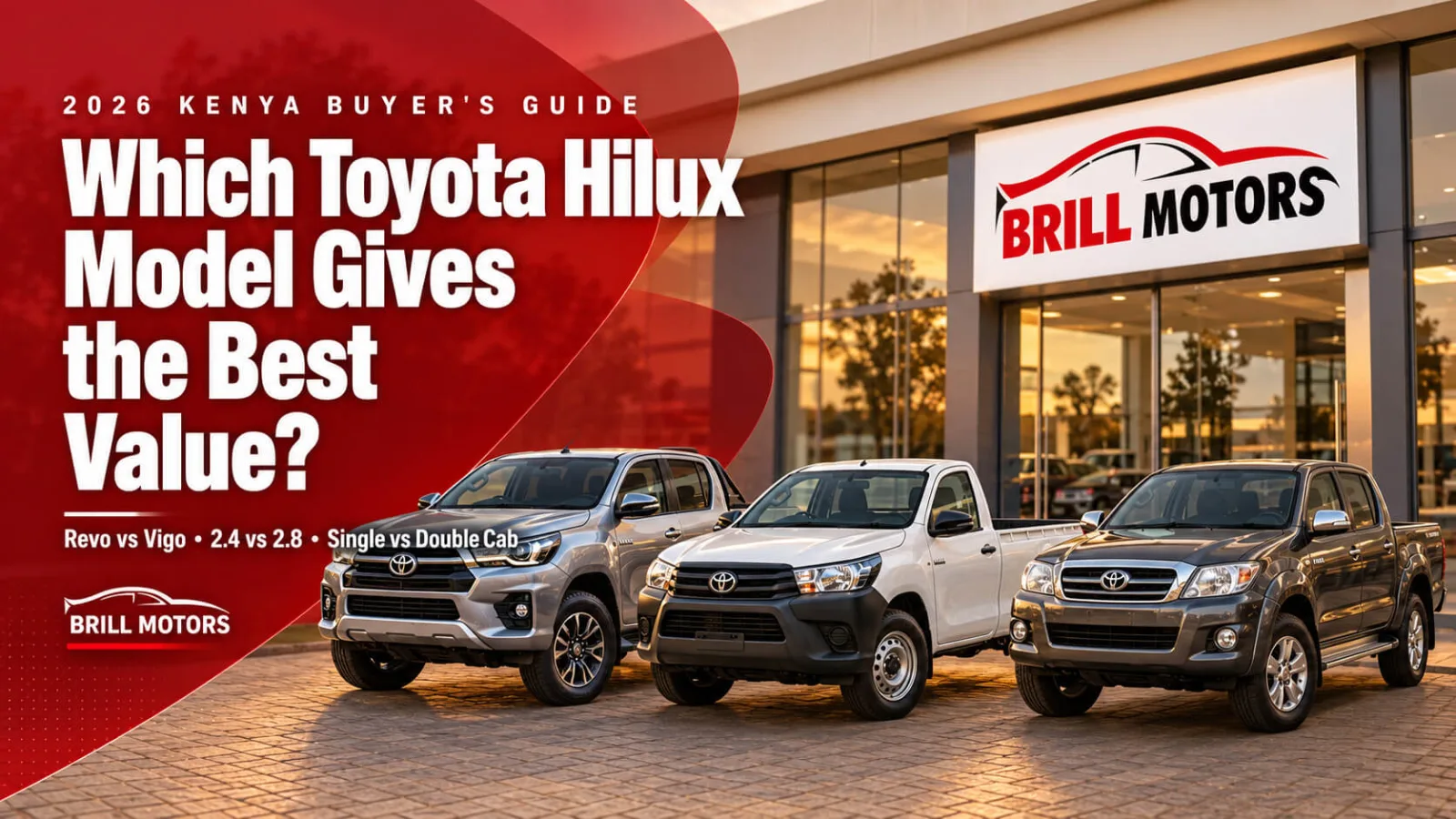
Ask ten Kenyan pickup owners which Hilux to buy and you will get ten confident answers. One swears by the old 3.0 Vigo. Another will not drive anything but a 2.8 automatic. A third tells you to skip used and go straight to Toyota Kenya. They are all partly right, because the best Hilux depends on what you need it to do, and how much you can spend.
Here is the short answer. For most families and all-round users, the smartest buy is a 2017 to 2020 Revo 2.4 double cab, locally used, at roughly KSh 3.5 million to KSh 5.5 million. For businesses that only need a load bed, a 2.4 single cab, new or used, gives the most work per shilling. If you tow or drive fully loaded every week, the extra cost of the 2.8 diesel 4x4 pays for itself.
The rest of this guide explains why, with real Kenyan prices for each of the main models, the strengths and weaknesses of each generation, and a simple checklist to use before your test drive.
Best Value Toyota Hilux in Kenya: Quick Picks by Buyer
Not everyone needs the same truck, so start by matching the Hilux to your daily routine. The table below sums up our picks, and each one is explained further down.
If you are… | Best value Hilux | Typical price (KSh) |
|---|---|---|
A family or all-round driver | Revo 2.4 double cab, 2017–2020 | KSh 3.5M – KSh 5.5M |
Towing, farming or doing heavy upcountry work | Revo 2.8 double cab 4x4 | KSh 4.5M – KSh 7.0M |
A small business or fleet owner | 2.4 single cab or cab chassis | KSh 2.9M – KSh 3.5M |
Working with a tight budget | Vigo 3.0 D-4D double cab, 2011–2015 | KSh 2.0M – KSh 3.0M |
Wanting warranty and the newest features | New Hilux from Toyota Kenya | From KSh 3.1M (single cab) |
Prices are 2026 market ranges drawn from Kenyan listings and dealer pages, and this information changes quickly. Mileage, condition, transmission and duty status move the final price, so treat these as a guide and always confirm before you pay.
Toyota Hilux Cars in Kenya: The Generations Explained
Sellers in Kenya use names like Vigo, Revo and GD-6 loosely, which can make listings confusing. Once you know the three generations on the market, comparing Toyota Hilux cars becomes much easier.
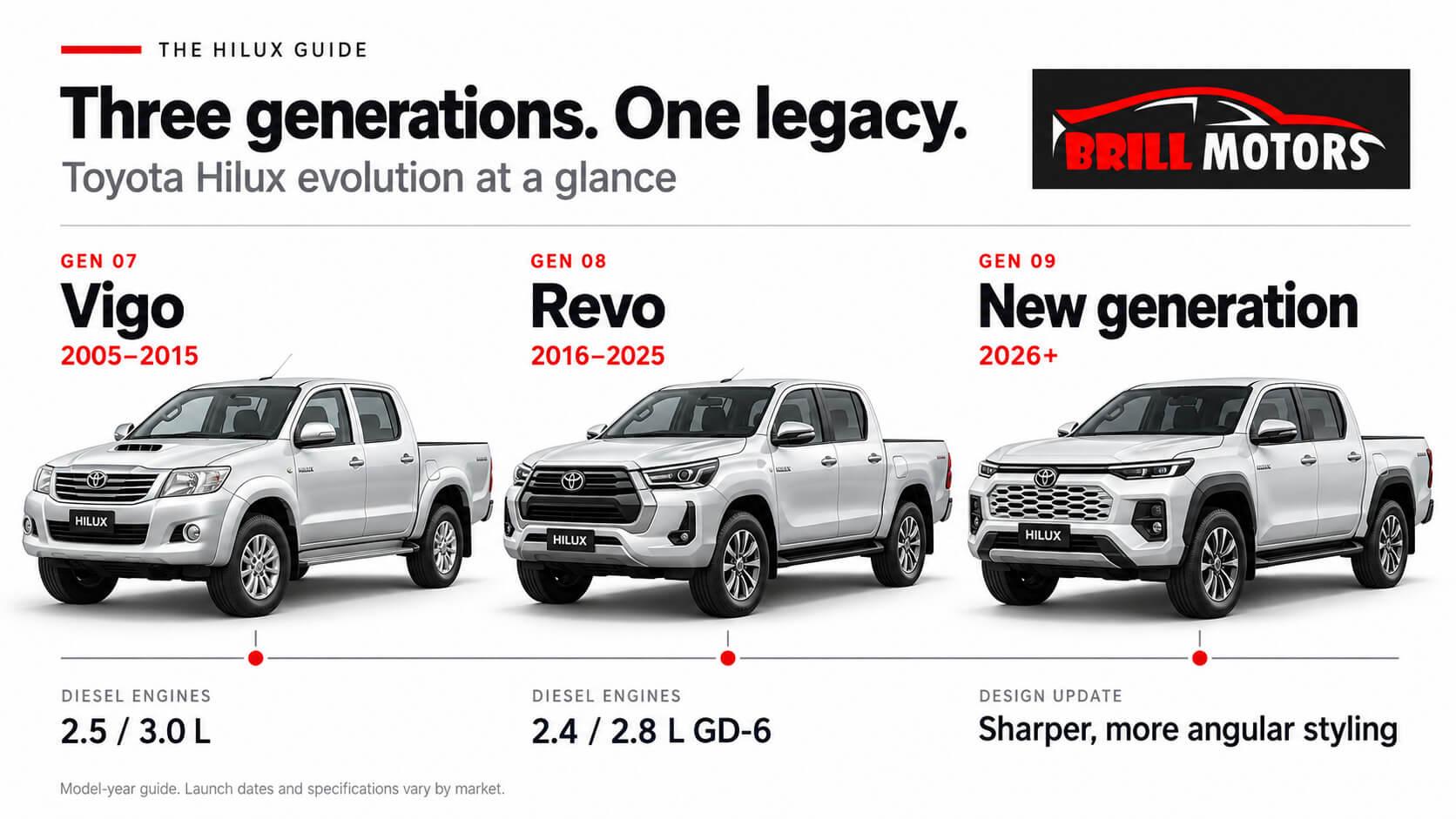
The Hilux Vigo (2005–2015)
The Vigo is the truck that made the Hilux a household name in Kenya. Most units here run the 2.5 litre 2KD or the 3.0 litre 1KD D-4D diesel engine, paired with a five-speed manual or a four-speed automatic. The 3.0 is the one to look for, because it pulls strongly when loaded and handles long climbs without strain.
Spare parts for the Vigo are everywhere, from Kirinyaga Road to small shops in Kitale and Voi. The trade-off is age. Most Vigos on sale today are more than ten years old, the cabin is basic, and safety features stop at ABS and front airbags on most units. Condition matters far more than the badge on the tailgate.
The Hilux Revo, the Eighth Generation Hilux (2016–2025)
The eighth generation Hilux, better known in Kenya as the Revo, moved the pickup closer to an SUV in comfort without softening its toughness. It brought a stronger chassis, a quieter cabin, better seating and new GD diesel engines. Two engines dominate the Kenyan market:
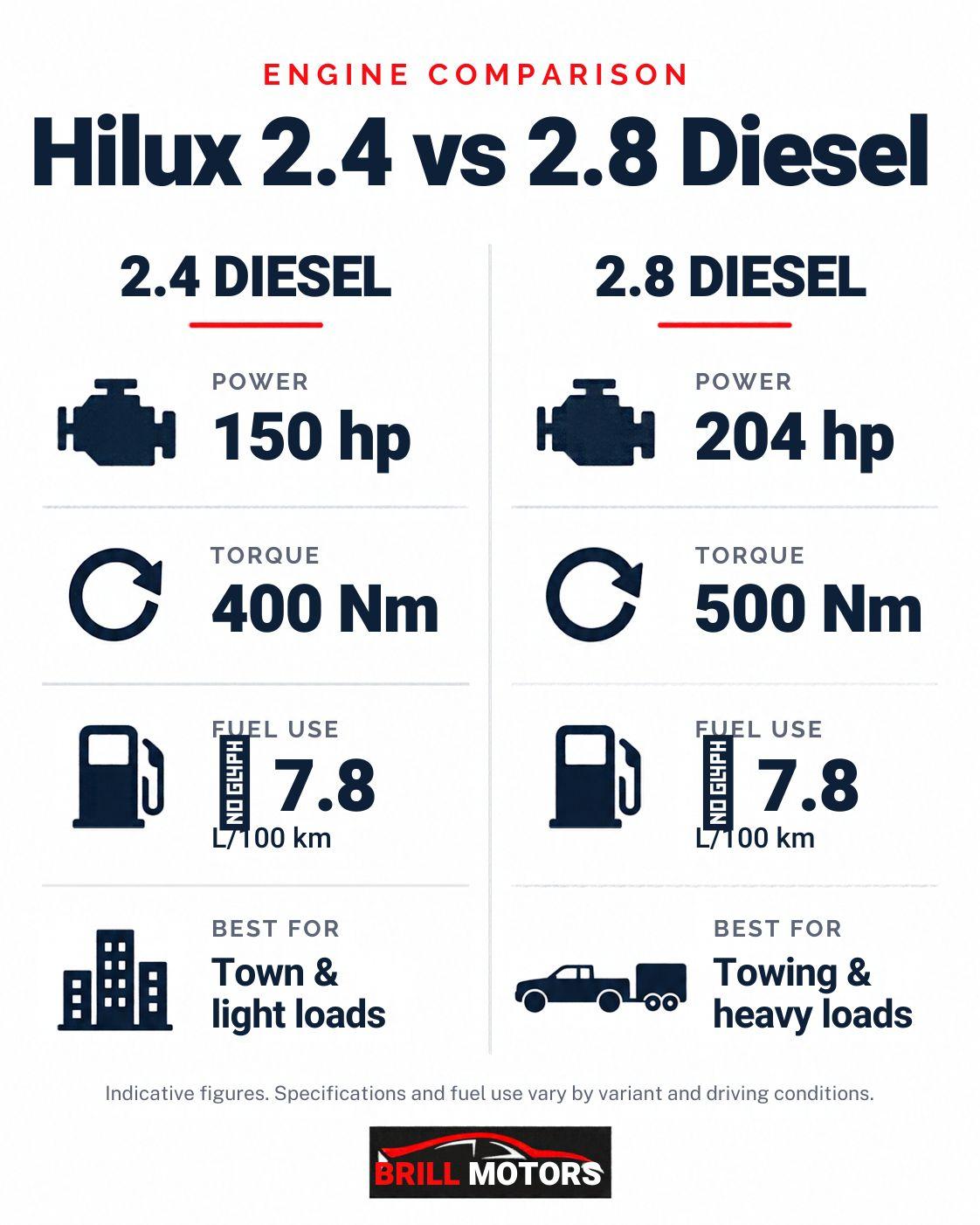
2.4 GD-6 (2GD-FTV): around 150 hp and 400 Nm of torque. It is the most common engine and the cheapest to run.
2.8 GD-6 (1GD-FTV): around 177 hp at launch, rising to about 204 hp and 500 Nm after the 2020 facelift. It is built for towing and hauling.
Most Revo models come with ABS and EBD (electronic brakeforce distribution), multiple airbags and, on many variants, stability control. The 2020 facelift added a bolder grille, a better touchscreen and that stronger 2.8 engine, which is why 2021 and newer units cost noticeably more.
The New-Generation Hilux (2026 Onward)
Toyota has now launched a new Hilux generation with a fresh design, larger digital screens and Toyota Safety Sense driver aids, plus electrified versions in some markets. For most Kenyan buyers it is still early days. Its biggest effect so far is on the used market: as owners trade up, more well-kept Revos come up for sale.
Toyota Hilux Price in Kenya (2026)
Here is what Toyota Hilux models typically sell for in Kenya right now. Use these figures to judge whether a listing is fair before you start negotiating.
Model and year | Engine | Body | Typical price (KSh) |
|---|---|---|---|
Vigo 2007–2011 | 2.5 / 3.0 diesel | Double cab | KSh 1.6M – KSh 2.5M |
Vigo 2012–2015 | 3.0 D-4D diesel | Double cab | KSh 2.0M – KSh 3.5M |
Revo 2016–2018 | 2.4 GD-6 diesel | Single cab / cab chassis | KSh 2.9M – KSh 3.5M |
Revo 2016–2018 | 2.4 / 2.8 GD-6 diesel | Double cab | KSh 3.5M – KSh 5.5M |
Revo 2019–2020 | 2.4 / 2.8 GD-6 diesel | Double cab | KSh 4.0M – KSh 7.0M |
Revo 2021–2024 (facelift) | 2.4 / 2.8 GD-6 diesel | Double cab | KSh 5.3M – KSh 7.5M |
New, Toyota Kenya entry level | Diesel | Single cab | From KSh 3,100,000 |
New, Toyota Kenya entry level | Diesel | Double cab | From KSh 4,530,000 |
New, high-spec import | 2.4 / 2.8 GD-6 diesel | Double cab | KSh 8.3M and above |
Two things stand out. First, a 2021 double cab can cost KSh 1.5 million more than a 2018 one, even though both share the same chassis and the 2.4 engine. Second, Toyota Kenya's entry-level brand new prices sit close to good used ones. A new single cab listed from KSh 3.1 million, with financing and a complimentary 25,000 km service, competes directly with a seven-year-old used truck at KSh 2.9 million.
Entry-level brand new units are usually basic work-spec pickup trucks with a manual gearbox and fewer comfort features, and some may lack EBD or extra airbags. Before you compare, confirm the exact variant, engine and drive type with Toyota Kenya, and read the full specs sheet so you have all the information you need.
Toyota Hilux Double Cab: Is It Worth the Extra Money?
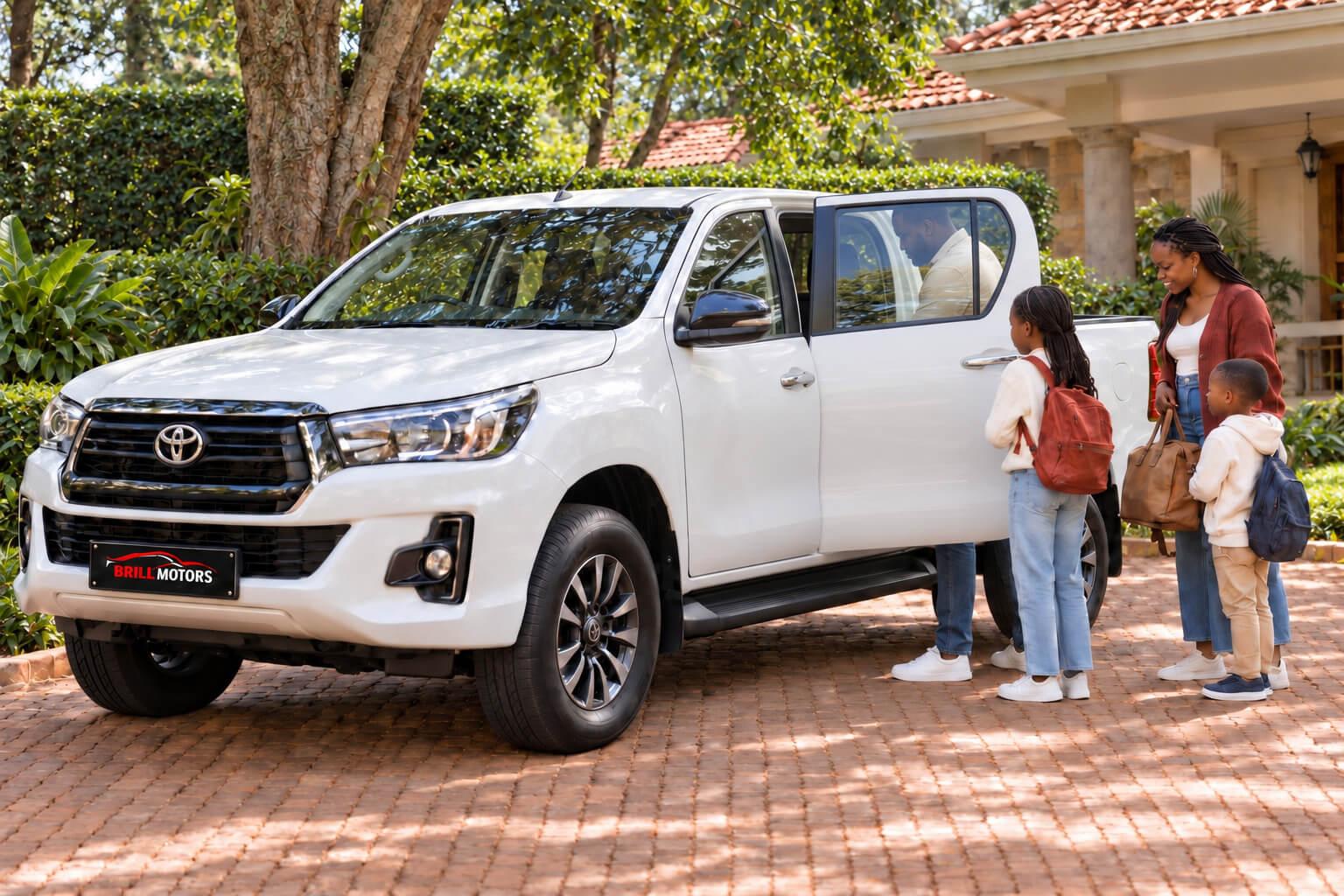
The double cab is Kenya's favourite Hilux for a simple reason: it is a family car on Sunday and a work truck on Monday. It seats five adults, carries a useful load in the bed, and is easy to resell. That popularity is exactly why a Toyota Hilux double cab costs far more than a single cab of the same year.
For most private owners, the extra money is worth it. This Toyota Hilux double cab is the vehicle most Kenyan families end up choosing. A 2017 to 2020 Revo 2.4 double cab at KSh 3.5 million to KSh 5.5 million gives you modern safety, decent fuel economy and seating for the whole family. When it is time to sell, double cab buyers are plentiful, so you recover more of your money.
The double cab makes less sense if the back seats will mostly stay empty. Its load bed is shorter than a single cab's, and you pay a premium for passenger space you will not use. In that case, a single cab is the smarter commitment.
Which Hilux Double Cab Gives the Best Value?
Within the Toyota Hilux double cab range, three models stand out:
Best overall: 2017–2020 Revo 2.4 double cab, manual or automatic. It is the sweet spot of price, comfort and running costs.
Best for towing and upcountry work: 2019–2020 or 2021+ Revo 2.8 double cab 4x4. The post-2020 engine adds real pulling power.
Best new option: Toyota Kenya's entry-level double cab from KSh 4,530,000, if a basic spec suits you and you value the warranty and financing.
Single Cab Hilux: The Value Champion for Business
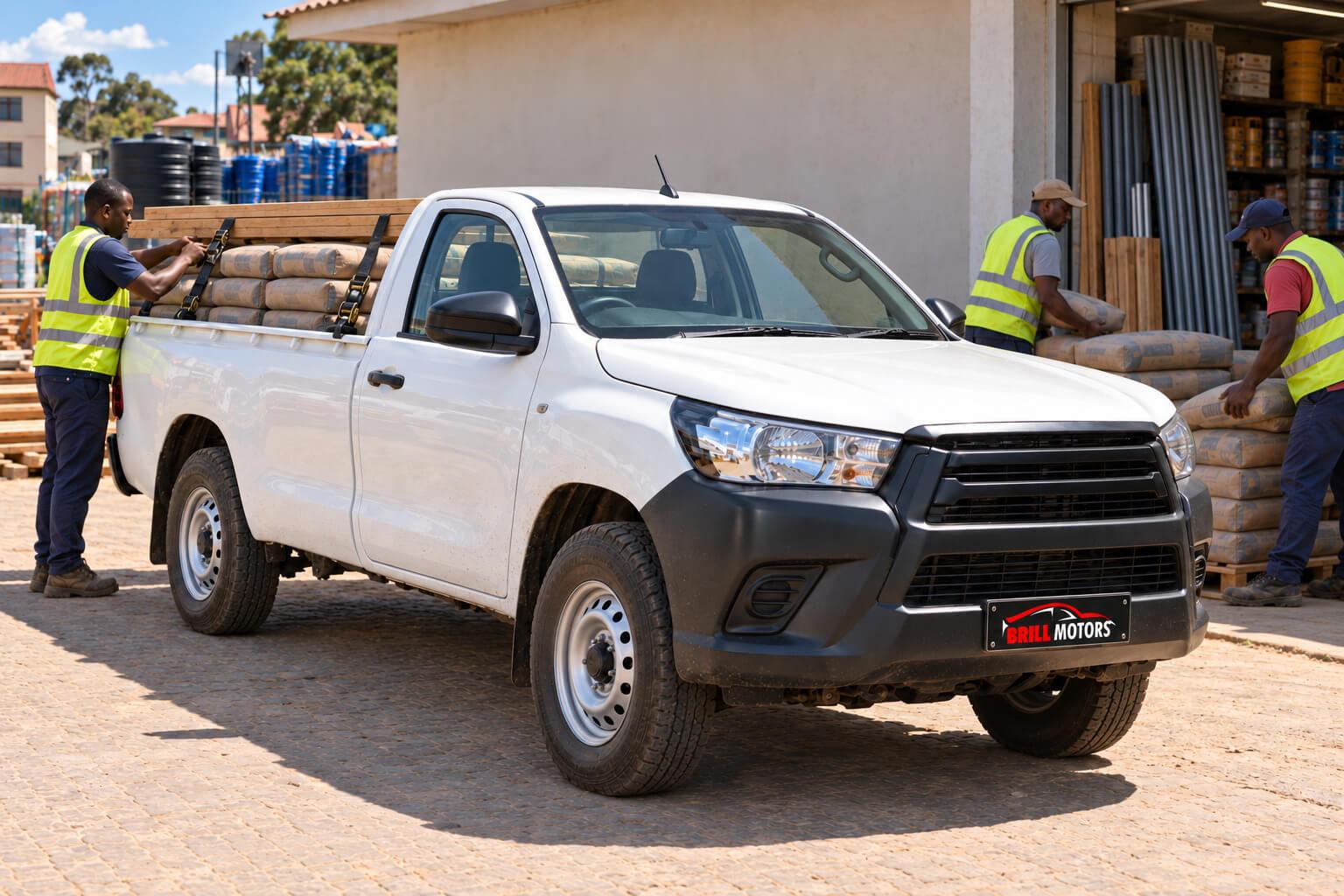
If nobody rides in the back, the single cab is the better buy, and it is not close. A single cab costs much less than a double cab of the same year, carries more in its longer load bed, and is easy to convert with a canopy, dropside or custom body.
That is why a single cab is the go-to choice for hardware shops, distributors, farmers and contractors moving materials to construction sites. A good example is the 2017 Toyota Hilux cab chassis 2.4 diesel manual currently on sale at Brill Motors for KSh 2,890,000. A double cab of the same year can cost KSh 1 million or more on top of that.
The single cab also makes sense new. Toyota Kenya lists its single cab from KSh 3,100,000 with 95% financing and a 60-month repayment period, which suits SMEs that want a predictable monthly payment and a fresh warranty. Check what is included before you sign, and compare it with a low-mileage used single cab.
Hilux Revo vs Vigo: Is the Newer Truck Worth It?
For most people, yes. The Hilux Revo costs more at purchase, but it pays you back in comfort, fuel and resale.
Factor | Hilux Vigo | Hilux Revo |
|---|---|---|
Engines | 2.5 / 3.0 D-4D diesel | 2.4 / 2.8 GD-6 diesel |
Transmission | 5-speed manual, 4-speed auto | 6-speed manual, 6-speed auto |
Ride and cabin | Firm, noisier, basic | Quieter, more car-like |
Safety | ABS, fewer airbags | ABS with EBD, more airbags, stability control on many units |
Typical age on sale | 10+ years | 4–10 years |
Resale outlook | Falling steadily | Strong |
The Vigo still makes sense if your spending stops at about KSh 3 million and you need a double cab. Buy the best-documented 3.0 you can find, and set money aside for suspension bushes, injectors and clutch work.
If you can stretch to about KSh 3.5 million, an early Revo is usually the smarter long-term buy. You get a newer truck, lower running costs and a vehicle that will still be easy to sell in five years.
Hilux 2.4 vs 2.8 Diesel: Which Engine Should You Choose?
This is the question we hear most often at our Garden City showroom. Based on our experience selling both, the short answer is that the 2.4 suits most buyers, while the 2.8 earns its premium only if you load or tow regularly.
In independent road testing by CAR magazine, both engines returned about 7.8 litres per 100 km in mixed driving. The 2.8, however, reached 100 km/h about 2.3 seconds faster and overtook with far less effort. In real Kenyan use, the 2.4 tends to use slightly less diesel in light town driving, while the 2.8 works less hard, and can be just as frugal, when fully loaded.
Choose the 2.4 diesel if you:
Drive mostly in Nairobi or on tarmac highways
Carry light to moderate loads
Want a lower purchase price and cheaper insurance
Choose the 2.8 diesel if you:
Tow trailers, boats or farm equipment
Regularly carry heavy loads on steep or murram routes
Prefer the higher trims, which usually come with the 2.8
Towing capacity varies by variant and market, and the seller should give you this information in writing, but many 2.4 and 2.8 4x4 Revos are rated up to 3,500 kg braked. Always confirm the figure for the exact unit you are buying.
Four Wheel Drive vs 4x2: Which Is Better in Kenya?
A 4x4 Hilux costs more to buy and service and uses a little more diesel. If you drive mostly on tarmac and well-graded murram, a 4x2 saves you money every month and is perfectly capable.
Four wheel drive becomes essential when your routes include black cotton soil, steep farm tracks or upcountry roads during the long rains. It also matters if you go off road for safaris or work on construction sites. A 4x4 holds its value better too, so part of the extra cost comes back when you sell.
The main disadvantages of a 4x2 are poorer traction in mud and on loose gravel, and a smaller pool of buyers when you resell. For a Nairobi-based owner who rarely leaves the tarmac, though, it is the better value.
Manual or Automatic?
Manual Hilux trucks are cheaper to buy and are favoured by fleets and upcountry operators because they are simple and easy to repair. Automatics now dominate imported Revos and make Nairobi traffic far less tiring. If you plan to resell to private buyers, an automatic double cab usually sells faster.
Kenya's 8-Year Rule and What It Means for Hilux Prices
Since 1 January 2026, KEBS only allows imported used vehicles first registered in 2019 or later. This rule shapes the Hilux market in two ways.
First, any foreign used Hilux you import today will be a 2019 or newer Revo, typically priced from KSh 5.3 million before duty if duty is not paid. Second, locally used 2016 to 2018 Revos have become better value. They can no longer be replaced by cheap imports, so demand stays firm and resale values hold up.
For most people, a well-maintained locally used Revo offers the best balance between price, condition and future resale. Imports still make sense if you want a 2021 or newer vehicle with low mileage and are ready to handle duty and clearing at Mombasa.
Running Costs and Common Hilux Problems
The Hilux is rarely the cheapest pickup to buy, but it is often the cheapest to own over time. Parts are easy to find, almost any mechanic in Kenya can service one, and the brand holds its value better than most rivals. In our experience, a well-kept Hilux is one of the easiest vehicles in Kenya to resell.
No vehicle is perfect, though. These are the common issues to know about:
DPF problems on early GD engines: Revos built between late 2015 and April 2020 with the 2.4 or 2.8 diesel had diesel particulate filter issues in some markets, causing white smoke and higher fuel use. Toyota redesigned parts of the system from May 2020. Ask whether the fix or an update has been done.
Injector wear on the Vigo: high-mileage 1KD and 2KD engines often need injector work. Poor quality diesel speeds this up.
Worn suspension and bushes: trucks that carried heavy loads on rough roads show it underneath.
Overloading damage: a sagging rear or cracked chassis rails point to years of abuse.
Plan for servicing every 10,000 km, use quality diesel, and keep an eye on suspension and the four wheel drive system. Do that, and the vehicle will usually return the favour with years of dependable work, saving you time and money.
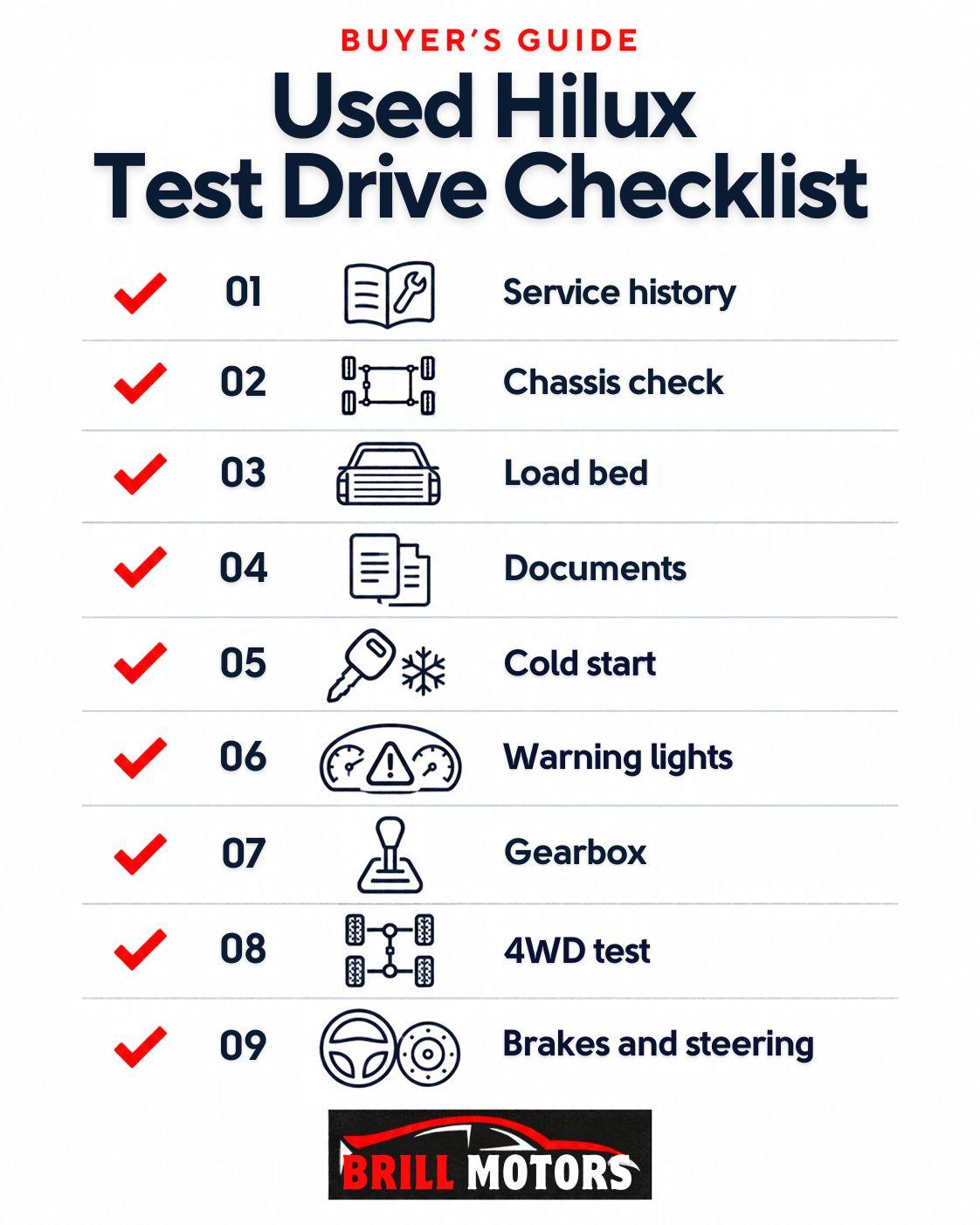
Before You Buy: Your Hilux Test Drive Checklist
A Hilux's toughness means many have lived hard lives. A careful inspection and a proper test drive tell you far more than any listing photo or advert you read online. Give yourself enough time, and if possible bring a mechanic you trust.
What to Check Before the Test Drive
Service history and mileage: match the records to the odometer. Be wary of unusually low mileage on an older truck.
Chassis and underbody: look for cracks, welding, bent parts or rust, especially on ex-fleet units.
Load bed: heavy dents and a sagging rear suggest regular overloading.
Documents: confirm the logbook, KRA records and, for imports, duty status. Ask for any accident information and read through every document before you pay.
What to Look for During the Test Drive
Cold start: arrive on time and ask the seller not to warm the engine before you get there. Listen for knocking and watch for heavy smoke.
Warning lights: all warning lights should come on at start-up and go off within seconds. A light that stays on needs explaining.
Transmission: gear changes on a manual should be smooth, and an automatic should shift without jerks or delays.
Four wheel drive: engage 4H and 4L, and the diff lock where fitted.
Brakes and steering: the truck should stop straight, with no pulling to one side.
A good test drive should include tarmac, a rough patch and some stop-start traffic. At Brill Motors, you are welcome to book a test drive at our Garden City Mall showroom and bring your own mechanic along.
Toyota Hilux vs Ford Ranger and Other Pickups
The Ford Ranger, Isuzu D-Max and Nissan Navara are all strong rivals. The Ranger often offers more features and a more refined ride for the money, while the D-Max is popular with fleets and is assembled locally. The Navara is comfortable but less common in Kenya.
Where the Hilux usually wins is long-term ownership, and it remains the pickup brand most Kenyan mechanics know best. Its strengths are parts availability, mechanic familiarity and resale value. If you plan to keep your pickup for many years or sell it on later, that experience across the Kenyan market is worth paying for.
Our Verdict: Which Toyota Hilux Should You Buy?
For most Kenyans, the 2017 to 2020 Hilux Revo 2.4 double cab is the Hilux that gives you the most for your money. It is modern, economical, easy to maintain, and its resale value is protected by the 8-year import rule.
Need towing power or heavy upcountry use? Step up to the Revo 2.8 double cab 4x4.
Running a business? A 2.4 single cab, new from Toyota Kenya or locally used, gives the most capability per shilling.
Spending under KSh 3 million? A well-kept Vigo 3.0 diesel still does the job.
Ready to find yours? Browse Toyota models at Brill Motors, or see all vehicles for sale. Selling your current car to upgrade? Get an instant offer. You can also visit our showroom at Garden City Mall, Nairobi, or call +254 758 243 058 to book a test drive. Still have questions? Our FAQs page has more information on buying and financing.
Frequently Asked Questions
How much is a new Toyota Hilux in Kenya? Toyota Kenya lists its Hilux single cab from KSh 3,100,000 and the double cab from KSh 4,530,000 for entry-level variants. Higher-spec 2.8 diesel automatic double cabs cost considerably more, often above KSh 8 million.
What is the cheapest Toyota Hilux in Kenya? Older Vigo double cab models from 2007 to 2011 sell from about KSh 1.6 million. Expect higher maintenance costs at that age.
What year is the best Toyota Hilux to buy? For value, 2017 to 2020 Revo models offer the best balance of price and features. If your money allows, a post-May 2020 unit benefits from Toyota's DPF updates and the stronger 2.8 engine.
What does GD-6 mean on a Toyota Hilux? GD refers to Toyota's Global Diesel engine family, which replaced the older KD engines. The 6 is commonly linked to the six-speed gearbox fitted to these models.
How much fuel does a Toyota Hilux use per 100 km? A Revo pickup with the 2.4 or 2.8 diesel typically uses about 7.5 to 9 litres per 100 km in mixed driving. Carrying a full load, towing and city traffic push that higher.
Is a 4x4 or 4x2 Hilux better? A 4x2 pickup is cheaper and fine for tarmac and good murram. A 4x4 is better for farms, construction work, off road driving and the rainy season, and it resells better.
What is the difference between the Hilux Vigo and the Hilux Revo? The Vigo is the seventh generation (2005–2015) with KD diesel engines. The Revo is the eighth generation (2016–2025) with the newer GD engines, a stronger chassis, better safety and a more comfortable cabin.
Why is the Toyota Hilux not sold in the USA? The US places a 25% tariff on imported light trucks, known as the "chicken tax", so Toyota sells the Tacoma there instead. Older Hilux models can only be imported once they are at least 25 years old.
Which is better, the Ford Ranger or the Toyota Hilux? The Ranger often offers more features and refinement for the money. The Hilux generally wins on reliability, parts availability and resale value in Kenya.