


 SIGN UP
You're probably in the yard with two questions in your head, and both matter. First, does a Toyota Probox suit your life in Nairobi, or are you just chasing a model with a good reputation? Second, if you buy one, how much are you really signing up to spend every month once traffic, repairs and paperwork start eating into the budget?
That's the right way to judge Probox cars for sale in Kenya. The Probox is not a normal saloon with a bigger boot, it's a compact Japanese station wagon with a practical cargo area, a short body and the kind of layout that makes sense for deliveries, small traders, family errands and budget-minded commuters. It earns its place because it does the boring work well, and boring is often what saves money.
Why the Toyota Probox Stands Out in the Kenyan Market
A Nairobi buyer usually arrives at the yard after one of two experiences. Either a saloon has been too cramped for family gear, or a hatchback has felt too soft for work, cargo and rough roads. The Probox sits in a different lane, because it was built to carry useful weight, move through tight streets and keep running without drama.
That's why it keeps pulling in buyers who want a vehicle that works hard during the week and still behaves like a sensible private car on weekends. The tall roof gives you usable space, the flat floor helps with loading, and the compact footprint is easier to live with in city traffic than a bigger wagon or SUV. If you compare it with a Corolla or Vitz, the point is obvious, the Probox is about utility first, image last.
Kenya's registration data backs up that broader appeal. Station wagons rose from 55,322 registrations in 2017 to 64,179 in 2018 and 72,512 in 2019, then fell to 57,962 in 2020 before recovering to 64,350 in 2021, while total new road-motor-vehicle registrations moved from 282,672 to 399,052 over the same period (KNBS). That is not Probox-only data, but it shows why this body style keeps showing up in Kenyan buying decisions.
Practical rule: if you need one car to carry people, goods and Nairobi kilometres without feeling oversized, the Probox deserves serious attention.
The honest filter is simple. If your daily use is light and image matters more than cargo space, look elsewhere. If you want a workhorse that can still serve family duties, the Probox is in its element.
Generations, Engines and Common Specifications
Most Nairobi buyers meet the Probox through a few familiar configurations, not a long list of exotic trims. The key is to know what you are asking for before you step into the yard, because a good-looking badge on the tailgate tells you very little about how the car will behave under load, on fuel or in traffic.
The engines you'll meet
The common petrol choices are the 1.3-litre 2NZ-FE and the 1.5-litre 1NZ-FE. The 1.3 is the calmer budget pick, it usually makes sense for lighter use and mixed city driving. The 1.5 gives you more reserve when the car is loaded, which matters if you're using it for deliveries or frequent highway runs.
Diesel versions do appear, but they're less common in everyday yard stock. That means you should judge them on condition and paperwork even more carefully, because a rare engine isn't automatically a better buy. Parts availability and mechanic familiarity matter more than the badge on the engine cover.
| Common Toyota Probox specifications by generation | ||||
|---|---|---|---|---|
| Generation | Engine | Transmission | Typical km/L | Common use case |
| Older generation | 1.3-litre 2NZ-FE petrol | Automatic or CVT | Qualitative, depends on traffic and load | City errands, lighter family use |
| Older generation | 1.5-litre 1NZ-FE petrol | Automatic or CVT | Qualitative, generally better when driven lightly | Work use, cargo, mixed urban and highway driving |
| Later generation | Petrol variants commonly seen in Kenya | Automatic or CVT | Qualitative, condition dependent | Buyers who want a newer feel and easier daily use |
| Occasional diesel units | Diesel | Automatic in some units | Qualitative, depends heavily on maintenance | Buyers who understand diesel upkeep and can verify history |
What the gearbox means in real life
A CVT or automatic isn't just a comfort choice, it changes how the vehicle feels in traffic and under load. A smooth gearbox makes the Probox less tiring in Nairobi stop-start driving, but a tired one can quickly turn a cheap purchase into a headache. On a test drive, you want clean take-up, no shuddering and no hesitation when you ask for acceleration.
A Probox with the right gearbox feels unremarkable, and that's exactly what you want.
There's also confusion around related Toyota wagons, especially the Succeed. The family resemblance is real, but buyers should focus less on nameplate debates and more on condition, service history and how the specific unit was used. A tidy, well-kept Probox will usually beat a rougher, supposedly better-specified example every time.
Price Bands and What Moves a Probox Up or Down
A Probox price only makes sense when you tie it to age, condition and registration history. A cheap unit can look smart on paper and still cost you more once the repairs start. A cleaner, better-documented car may ask for more upfront, but it often saves money later because you're not immediately chasing suspension, tyres and hidden bodywork.
For a Nairobi buyer, the broad guide is simple. Older, higher-mileage or cosmetically tired units sit lower, while locally registered, cleaner and better-documented vehicles sit higher. Imported examples can look cheaper at first glance, but once you factor in compliance, timing and registration risk, the gap narrows fast. For live figures, check Brill Motors' Toyota pricing guide.
What pushes the price up
A locally registered car with verifiable ownership history usually commands more confidence than an unclear import. Automatic or CVT cars in good condition also tend to hold better appeal for city users, because ease of driving matters in Nairobi traffic. If the cabin, cargo area and paint still look honest rather than freshly disguised, that's usually a better sign than a shiny listing photo.
What pushes the price down
Heavy commercial use, tired suspension, worn seats and obvious interior abuse all knock value down. So does missing paperwork or mileage that doesn't line up with the car's age and wear. A Probox that has clearly worked hard can still be useful, but you should never pay family-car money for a machine that has already lived a hard work life.
Buyer's rule: pay more for proof, not for polish.
If you're comparing two similar-year Proboxes, ask which one has the cleaner service trail, the better body, and the less suspicious history. That's the one worth stretching for.
What a Probox Costs to Run in Nairobi
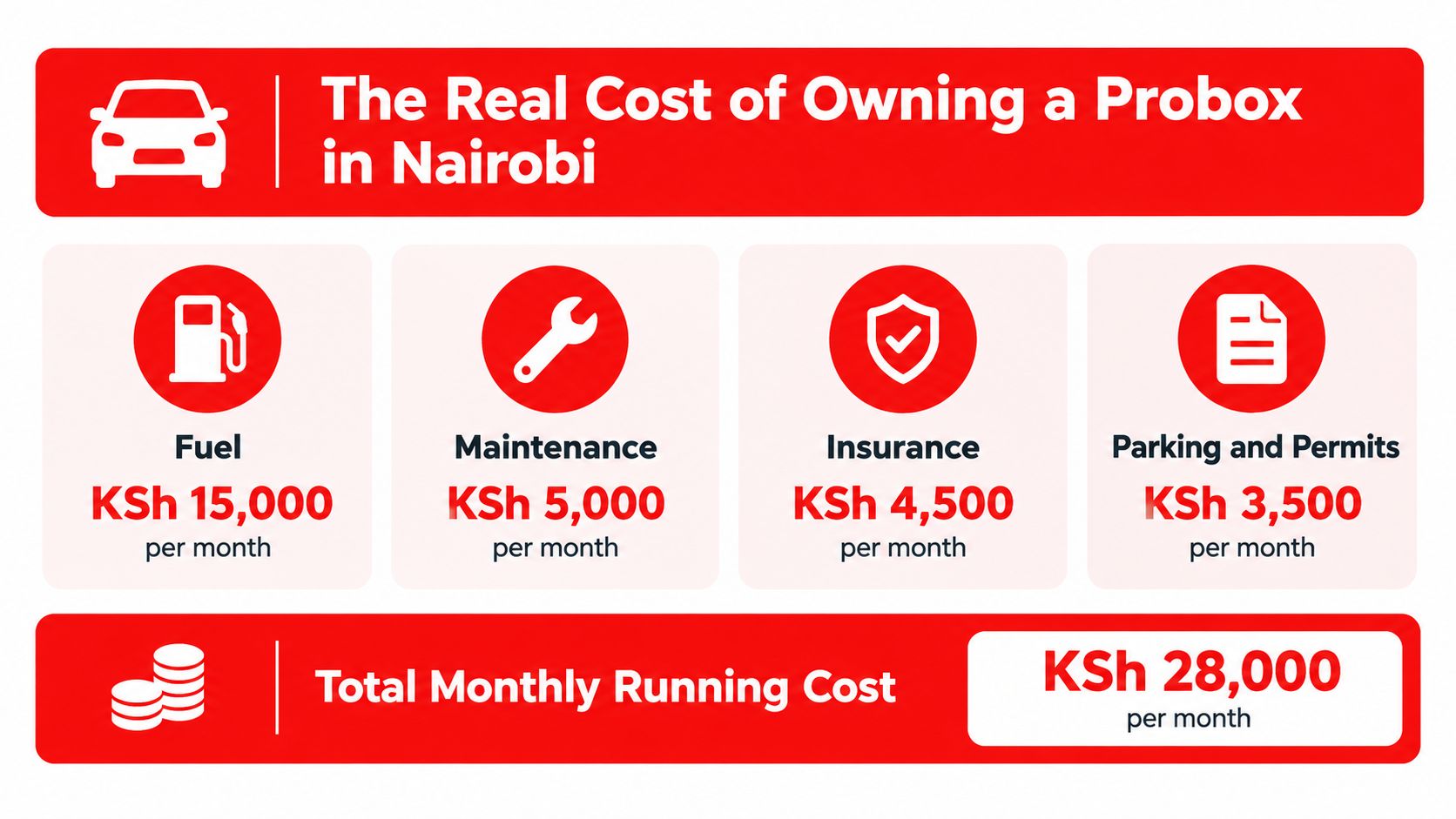
The purchase price is only the first bill. In Nairobi traffic, the true cost shows up after you drive it home, especially if the Probox is doing daily work rather than light personal use. One Kenya-focused guide puts city use at 12 to 14 km/L, while highway driving can improve to 15 to 16 km/L. Another listing source gives a higher city figure, which is exactly why you should budget from your own route, load, and traffic.
Build the budget around how you drive
If your day means long hours in town, stop-start traffic will push fuel use up and add wear. If the car carries goods or several passengers most days, the suspension, brakes, and tyres will take a beating too.
Routine servicing is often put at KSh 5,000 to 8,000, major servicing at KSh 10,000 to 15,000, and tyres at KSh 20,000 to 40,000 per set. Those numbers are useful, but they still depend on how hard the car has worked and how well it was maintained. A Probox used gently can stay affordable. A Probox that has spent its life hauling and idling in traffic will drain money faster than the asking price suggests.
What to budget for before you sign
- Fuel: base it on your real monthly kilometres and traffic pattern, not on a seller's promise.
- Routine service: keep room for oil, filters, labour, and the occasional repair.
- Tyres and brakes: commercial use wears these faster than most buyers expect.
- Suspension and mounts: Nairobi roads expose weak components quickly.
- Parking and insurance: these are part of ownership, not extras.
Pay attention to the total monthly bill, not just the sticker price. A Probox that looks cheap on day one can become the expensive one if it spends its life in traffic, carries weight, and starts asking for work every few months.
A smart buyer checks one thing before paying deposit, whether this car can stay affordable after a year of real use.
Imported Versus Locally Used Probox
A Probox that looks cheap can still be the wrong choice if the paperwork is messy. This isn't just a price debate, it's a compliance and timing issue, and that matters a lot more than many buyers realise. The Kenya Revenue Authority says imported vehicles must be less than eight years old from the year of first registration, must be right-hand drive, and must undergo roadworthiness inspection through a Kenya Bureau of Standards-appointed inspection agent in the exporting country (KRA import procedures).
The first thing to check is the first-registration date
Do not rely on a model-year label alone. KRA uses the year of first registration when applying used-vehicle treatment, and its EAC depreciation schedule ranges from 20% for vehicles more than one year and up to two years old, to 65% for vehicles more than seven years and up to eight years old, effective 1 September 2023 (KRA public notice). That can affect customs value, and customs value affects what you pay.
Why timing risk matters
Reporting on the 2025 to 2026 enforcement change says only right-hand-drive vehicles first registered from 1 January 2019 were to be admitted from 1 January 2026, with 2018 certificates expiring at the end of 2025 (The Star). If you're considering a foreign-used unit, that timing can make a supposedly attractive car a paperwork headache. A locally used Probox with clean Kenyan records can be the calmer choice when the import file looks fuzzy.
For buyers who want a direct importation perspective, the compliance questions are similar to what's discussed in Brill Motors' imported car guide. Ask for the first-registration year, RHD status, pre-export inspection record, import documents and whether taxes and clearance are included. Confirm current duty and levy rates with KRA or a licensed clearing agent, because those figures move and the wrong assumption gets expensive fast.
Short version: if the imported unit's paperwork is weak, walk away. A clean local car is often the safer buy.
What to Check When Viewing a Probox
The fastest way to waste money is to buy with your eyes only. A Probox can look clean in the panel shop sense and still be tired underneath, which is why you need a routine and not a vibe. Start outside, move inside, then finish with paperwork and a road test.
Body, underbody and cargo area
Walk around the car and look at panel gaps, paint tone and door alignment. Uneven gaps or mismatched paint can point to repair work, and that matters more on a workhorse than on a weekend toy. Then check underneath for rust, fresh underseal that may be hiding damage, and suspension wear.
The cargo area deserves proper attention because Proboxes often earn their keep there first. Water marks, bent floor sections, torn trim and obvious rust are warning signs, especially if the car has carried loads for years. If the rear has been abused, the rest of the car may have been too.
Engine, transmission and paperwork
Open the bonnet and look for oil leaks, coolant staining and rough idle. On the test drive, pay attention to how the gearbox behaves when moving off and when changing speed. A transmission that jerks, slips or shudders is a bad sign, and it's not something to “sort later” on a budget buy.
The paperwork must match the car in front of you. Check the logbook, import documents if it's foreign-used, and the inspection certificate. A vehicle inspection record for a Toyota Probox showed a 1,320 kg rating, 1,615 kg gross vehicle weight, 1,090 kg tare weight and 525 kg load capacity, which is a useful benchmark for buyers who plan to use the car for deliveries (vehicle test report). Keep cargo, passengers and accessories within the practical load limit of the specific unit, and don't treat a certificate as a substitute for a proper mechanical check.
A clean certificate doesn't fix weak compression, poor cooling or a worn transmission.
Viewing Probox Stock at Brill Motors
The sensible Probox decision comes down to three things. Choose the right engine and gearbox for your use, decide whether you want a locally used car or a foreign-used one with clean paperwork, and set a twelve-month running budget before you pay a deposit. If you skip any of those, you're guessing.
For current stock, browse Brill Motors used cars or come to the Garden City Mall Rooftop Car Yard, Thika Road, Nairobi for an in-person viewing. Brill Motors also handles showroom viewing, financing, vehicle valuation, trade-ins and selling your car, so you can compare a Probox against your budget and your current vehicle in one visit.
If you're serious about Probox cars for sale in Kenya, don't buy on headline price alone. Visit Brill Motors, check the current stock, and speak to the team about the exact Probox that fits your work, your roads and your monthly budget.