


 SIGN UP
KSh 18 million to KSh 30.9 million is a practical asking-price band for a clean foreign-used Mercedes G Wagon in Kenya, and the exact figure depends on the variant. A G 350 d, G 500, or AMG G 63 will land at very different numbers once condition, mileage, and import paperwork are taken seriously.
If you're shopping for one in Nairobi, this is not a casual SUV purchase. You're choosing between three very different machines, then adding Kenya's tax chain on top.
Where the Mercedes G Wagon Market Sits in Kenya Right Now
A serious buyer in Nairobi should treat the Mercedes G Wagon price in Kenya as a moving target, not a sticker, because recent foreign-used examples sit around KSh 18 million to KSh 30.9 million depending on trim, history, and modification level. That spread is the first warning sign. The market is split by variant and condition, and the duty chain will push each car to a different landing cost.

The same body shape can sit in very different brackets. A 2020 G 350 d was listed at KSh 18 million, a 2021 G 350 d at KSh 18.5 million, and a 2021 AMG G 63 at KSh 20.1 million, which shows how much variant and condition matter. A 2024 G 63 AMG was listed at KSh 25.5 million, while a modified 2019 G 63 AMG Brabus G700 sat at KSh 30.9 million.
A G-Wagon buyer who fixes on age alone makes a poor decision. Mileage, import trail, and modification history move the price more than the year on the logbook. A clean, well-kept car with sensible paperwork will usually cost less to own than a younger one that has been heavily altered.
For Nairobi buyers, the question is which configuration fits the job and the duty bill. Diesel G 350 d cars, petrol G 500 models, and high-performance AMG G 63 versions need separate assessment because each one lands differently after KRA charges. If you want a wider SUV shortlist before narrowing down to a G-Class, Brill Motors has a useful SUV stock page, but the first decision is choosing the right G-Wagon variant.
The Three Variants a Kenyan Buyer Chooses Between
A Kenyan G-Wagon buyer usually ends up choosing between three clear paths. The diesel G 350 d suits the buyer who wants the G-Class shape with lower strain at the pump. The G 500 is the petrol middle ground. The AMG G 63 is the high-cost, high-image option, and it changes the budget from the first quote you collect.
The diesel route
For the diesel side, the current Mercedes-Benz G 450 d gives the cleanest factory reference point, even though most Kenyan stock is the earlier G 350 d. Mercedes-Benz lists a 2,989 cc six-cylinder diesel engine, a 9G-TRONIC automatic transmission, a 100-litre fuel tank, and system output of 270 kW plus 15 kW, equal to 367 hp plus 20 HP. That is the modern replacement for the older diesel family, and it explains why the G 350 d still attracts practical buyers who want the boxy body without moving into AMG money.
The diesel buyer usually wants torque, steady highway use, and fewer shocks at the fuel station. In Nairobi, that matters. If the car will spend time on the Nairobi, upcountry, and airport run, the diesel version deserves the closest inspection because it balances comfort with restraint better than the petrol and AMG choices.
The petrol middle ground and the AMG jump
The G 500 sits in the middle. It gives petrol smoothness, a richer feel at low speeds, and the kind of refinement buyers notice in traffic and around town.
The AMG G 63 sits at the other end. It is the loudest choice in every sense, from image to performance. Buyers pick it for road presence and power first, and only then think about the cost of keeping it on the road. That is why the market treats it differently from the diesel and the standard petrol car.
| Mercedes G-Class variants commonly seen in Kenya | Engine | Transmission | Fuel Tank | KSh Band |
|---|---|---|---|---|
| G 350 d | Diesel, large-capacity six-cylinder family | 9G-TRONIC automatic | Large tank, varies by spec | Lower end of the G-Class market |
| G 500 | Petrol V8 family | Automatic | Large tank, varies by spec | Mid-range G-Class market |
| AMG G 63 | High-performance petrol V8 | Automatic | Large tank, varies by spec | Upper end of the G-Class market |
The table is deliberate. A buyer who has not decided between diesel restraint, petrol comfort, and AMG theatre is not ready to price the car properly yet.
How KRA Import Duty Builds the Final Shilling Price
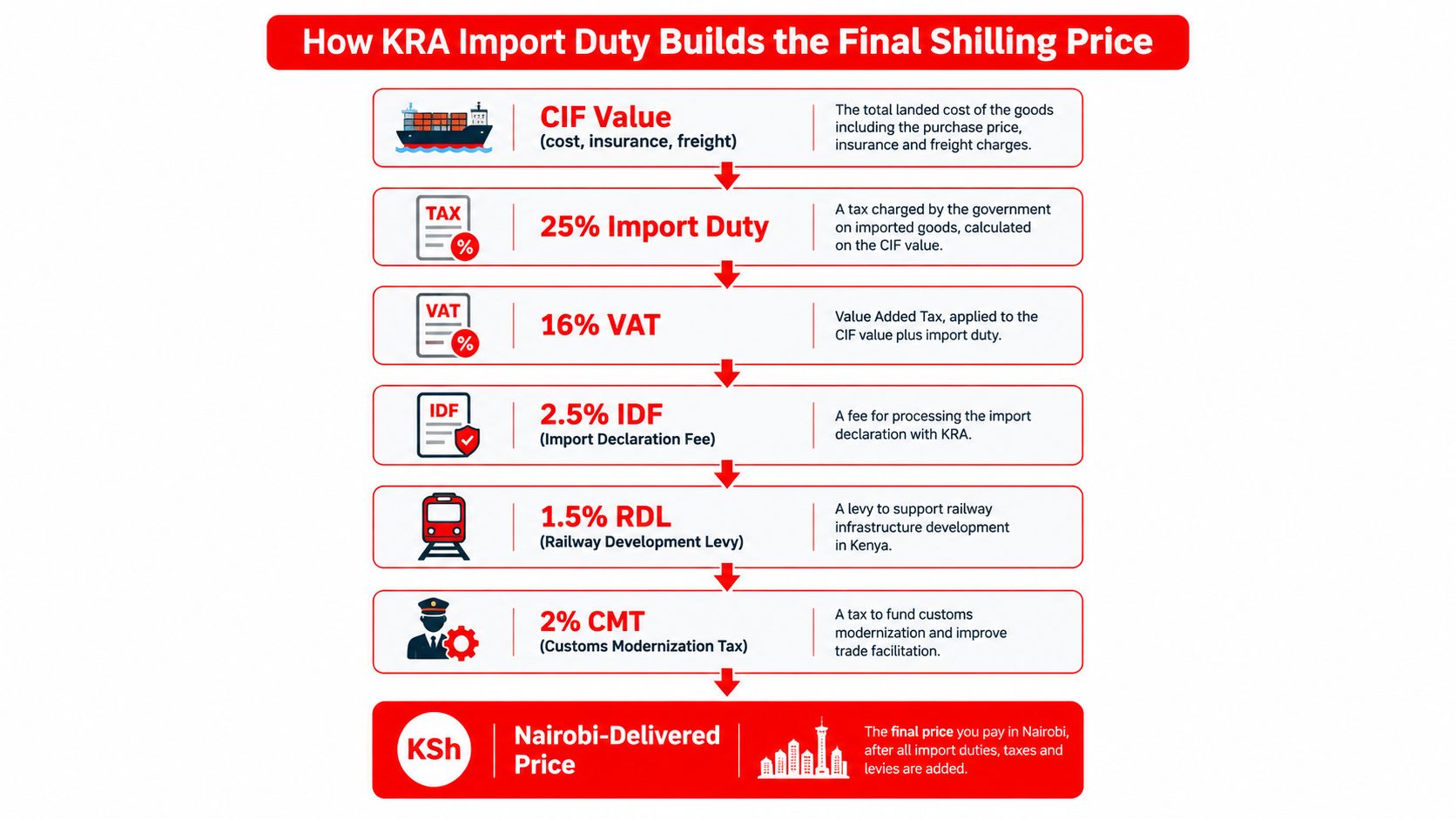
A G-Wagon can look manageable on a foreign listing, then land in Kenya at a much higher figure once KRA adds the tax stack. The starting point is the CIF value, cost, insurance, and freight, and the rest follows the customs formula set out in KRA motor vehicle import guidance.
The tax chain in plain language
KRA guidance sets import duty at 25% of the vehicle's CIF customs value. For vehicles above 1,500cc, which includes the G 350 d, G 500, and G 63, KRA guidance sets excise duty at 25% of the customs value plus import duty. VAT is 16% on customs value plus import duty plus excise duty. The same KRA material also sets out a 2% Import Declaration Fee and a 1.5% Railway Development Levy.
On a simplified KSh 10 million CIF value, the numbers move fast. Import duty alone comes to KSh 2.5 million. That makes the excise base KSh 12.5 million, so excise lands at KSh 3.125 million. VAT is then charged on KSh 15.625 million, which equals KSh 2.5 million, before the extra levies and registration costs go on top.
That is why buyers get the final figure wrong. A car that looks fair at purchase stage becomes expensive once tax is applied across the full customs value stack. For a G-Wagon, that gap is large enough to change which variant you should chase.
Buyer rule: ask for the landed-cost breakdown before you get emotional about the body colour or interior trim.
KRA also states that used vehicles imported into Kenya must generally be no more than eight years old from manufacture or first registration. If you are comparing a few G-Wagons side by side, confirm the tax basis with KRA or a licensed clearing agent, because the exact result depends on valuation and the vehicle's details.
Diesel Versus Petrol Running Costs Over Three Years
A G-Wagon that looks cheap on the floor can become the priciest one to own once fuel, tyres, brakes, and insurance start stacking up. Over three years, the split between a G 350 d, a G 500, and an AMG G 63 is not subtle.
The G 350 d is the sensible choice for long-distance use. It is the one that fits a driver covering serious mileage and regular highway trips. The G 500 sits in the middle, with smoother petrol manners and higher thirst than the diesel. The G 63 is the one that will hit your wallet hardest, because performance use drives up fuel burn, tyre wear, brake wear, and insurance exposure.
Fuel is only the first bill. A Nairobi buyer should also watch the tyre and brake cycle closely, because the heavier and more aggressively driven the car is, the faster those parts disappear. On a G-Wagon, a set of tyres and a brake refresh can shift your budget in a way that is easy to ignore at purchase and painful later.
The current G 450 d specification is a useful running-cost reference because it shows the diesel side of the family still uses a large engine, a 9G-TRONIC, and a 100-litre tank, which points to a serious SUV that needs proper servicing and specialist attention (Mercedes-Benz G-Class overview). That is the kind of mechanical load you are signing up for with a diesel G-Class, and it is why upkeep matters as much as the buy price.
Over a three-year holding period, the practical difference is clear. The G 350 d is the cheaper car to run if you drive it. The G 500 costs more to keep on the road because petrol consumption stays higher. The G 63 is the one that turns every trip into a premium event, and the extra spend follows you through fuel stops, tyre changes, brake work, and cover premiums.
If you drive mostly in town and only do short hops, the AMG badge is an expensive choice. If you spend your time on the road and want lower operating stress, the diesel is the cleaner buy.
Age Rules, KEBS Inspection and Import Paperwork
A cheap G-Wagon with messy paperwork is a bad deal. Start with the age rule, then verify the import trail before you talk price.
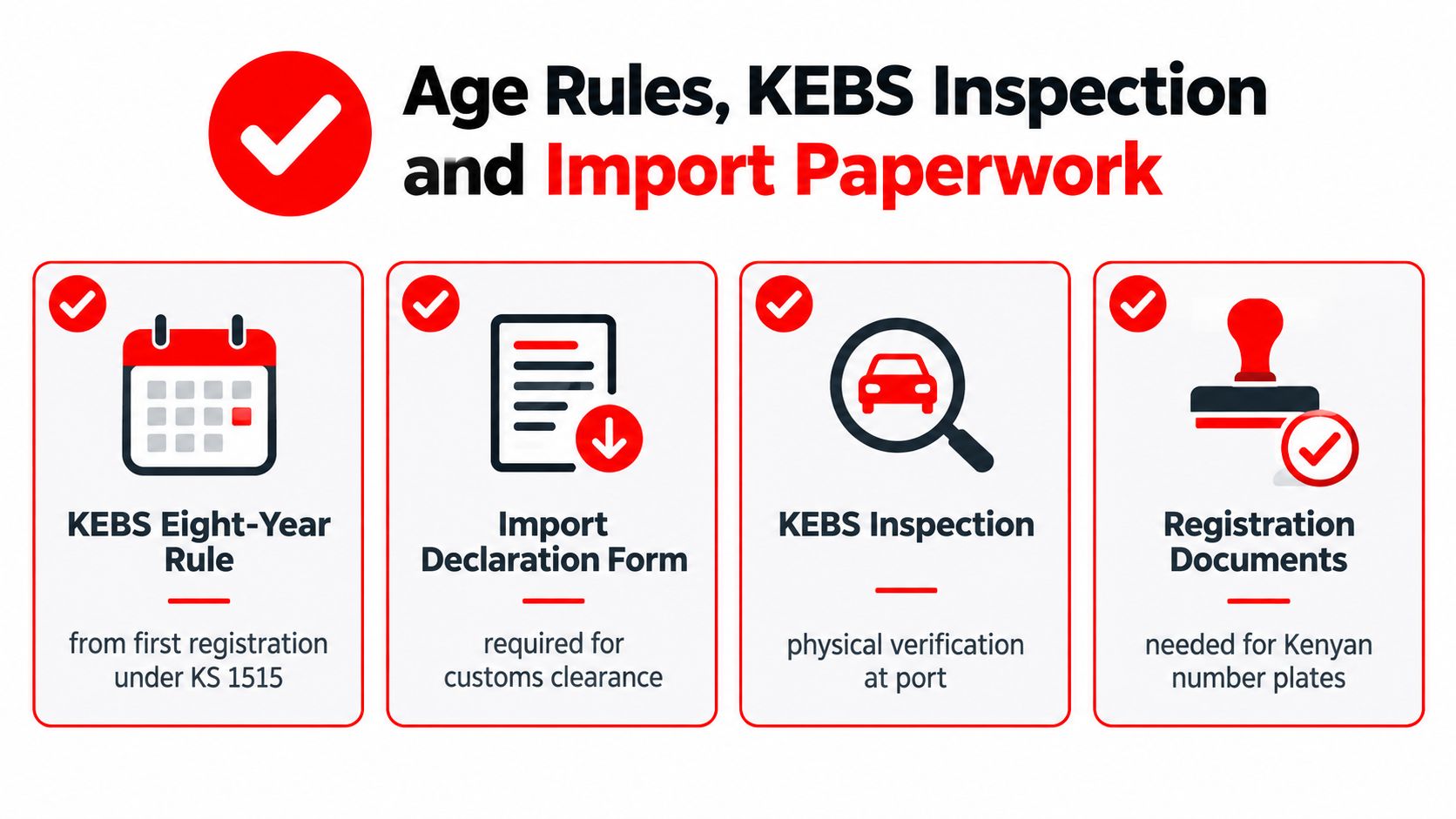
KEBS requires used motor vehicles imported into Kenya to be no more than eight years old from the year of first registration under KS 1515 (KEBS public notice). The gap between manufacture and registration must also be less than one year. That rule catches many buyers off guard, especially when a listing looks fresh but the dates do not line up.
A serious buyer checks the paperwork like a loan officer checks a file.
What to confirm before payment
- First-registration date: Match it against the year on the documents, not the seller's description.
- Import documents: Confirm the import trail is complete and consistent.
- Inspection status: Under the KEBS notice effective from 14 July 2025, only used vehicles with validated import documents are subject to destination inspection.
- Registration records: Check that the logbook, import paperwork, and identification details all match before money changes hands.
A discounted 2024 G-Wagon can still fail the basic date test if the first-registration year falls outside the rule. That is where buyers lose money, because the sticker price looks tempting and the compliance problem shows up later.
If you want a broader check on imported-car paperwork, see the guide to imported cars in Kenya. Use it as a reference point, then verify the specific car in front of you. If the records do not line up, walk away.
The Inspection Checklist That Matters Most
A G-Wagon needs a hard, methodical inspection. Polished paint and a clean cabin do not matter if the car is hiding expensive faults.
Start with the identity of the car. Match the VIN with the service records and every import document, then confirm the automatic gearbox behaves properly from a cold start before the drivetrain warms up. A diesel needs extra attention, so treat any warning light as a real fault until a proper diagnosis proves otherwise.
Then move underneath and around the car. Check for oil leaks around the engine and transfer case, listen for suspension noise, and look for looseness or a harsh ride on rough road surfaces. Signs of hard off-road use matter too, especially on the underbody, wheel arches, and trim. Uneven body gaps, poor panel alignment, rust, and underbody damage usually tell a clearer story than the seller does.
Tyres and brakes deserve the same discipline. Read the wear pattern, check remaining life, and do not stop at tread depth alone. After that, test every switch, camera, display, seat function, and control system. One dead option on a luxury SUV often points to a bigger electrical issue.
Finish with the documents. The logbook, KEBS inspection status, and NTSA records should line up before any money changes hands.
A G-Wagon can hide a lot behind a strong image, so the inspection has to be boring and exact. Bring an independent mechanic who knows imported premium SUVs, then let the paperwork and the test drive do the talking.
Rule of thumb: if a seller resists a proper inspection, the car is probably the wrong one.
Why Two G-Wagons of the Same Age Sell for Very Different Prices
In Kenya, the price difference comes from specification, mileage, provenance, trim, and modifications.
A newer car can still sit below an older one if the older unit has a stronger build sheet or rarer kit. The same logic applies to documented aftermarket work. A properly executed Brabus or AMG upgrade can lift asking price, but it can also make insurance harder to place and resale narrower if the paperwork is weak or the quality is questionable. Buyers pay for the story only when the story is provable.
Mileage and originality matter just as much. A clean, unmodified example with a straight import trail usually gives you a safer ownership path than a heavily altered car with gaps in its history. Modified G-Wagons attract attention, but the premium only makes sense when the work is well documented and the car still presents cleanly underneath.
That is why two units of the same age can land in completely different pricing brackets. A seller who points only to the model year is avoiding the underlying question. The buyer should focus on how the car was used, how complete the records are, and whether the configuration still matches the market that will buy it later.
Choosing the Right G Wagon and Next Steps
Pick the variant that matches how you'll use the car, not how it looks in a thumbnail. If you drive long distances, the diesel route makes the most sense. If you want luxury petrol refinement, choose the G 500. If you want the top-level performance image, the AMG G 63 is the one.
The smartest budget is the landed-cost budget, not the sticker budget. Factor in the KRA chain, verify the paperwork, and use the inspection checklist before you commit. If the numbers don't add up, the car isn't the right one.
You can also browse current Mercedes-Benz stock through Brill Motors' Mercedes-Benz page, then visit the yard at Garden City Mall Rooftop Car Yard on Thika Road for a proper walk-around. If you want financing, a valuation, a trade-in discussion, or to sell your current car, sort that out before the pressure of a viewing clouds your judgement.
Visit Brill Motors to check current Mercedes-Benz stock, compare live G-Wagon listings, and speak to the team about financing, valuation, trade-ins, or selling your car. If you're serious about a G-Class, come to the Garden City Mall rooftop yard and inspect the cars properly before you commit.