

 SIGN UP

Why are two Suzuki Jimnys of the same year, with similar mileage and the same body style, advertised at KSh 3,050,000 and KSh 4,350,000?
Both adverts state an asking price. A CIF value at Mombasa, a landed price in Nairobi and an on-road price that includes registration are the next three stages. The Suzuki Jimny price is that sequence, and the sequence only works if both cars are compared at the same stage.
CIF means the car, insurance and freight to the port. The landed price in Nairobi is that CIF amount plus the import charges due on arrival. The on-road price adds registration. Put the KSh 3,050,000 car next to an on-road total, or the KSh 4,350,000 car next to a CIF quote, and a KSh 1,300,000 gap is partly an accounting mismatch.
Apply the same stages when you set a selling price. Name the stage in the figure you publish, whether asking, trade-in or on-road. Otherwise a buyer is pricing a different transaction from the one you offered.
Suzuki Jimny Prices in Kenya by Model Year
How should you compare a Jimny advertised at one price with another listed far higher? Start by grouping asking prices by model year, then check whether each figure describes the same stage of the transaction. The bands below are the article's market snapshot, not verified, dated listings, so treat them as indicative guides rather than current quotes.
| Model year | Guide asking price (KSh) | What the figure usually reflects |
|---|---|---|
| 2016 | from about 1,250,000 | Older units, where condition and import route affect the figure |
| 2020 to 2021 | about 1,880,000 to 1,940,000 | Mid-band stock, with mileage and condition varying |
| 2025 | about 3,680,000 to 4,700,000 | Newer stock, often with higher specification |
For a 2016 Jimny, higher mileage and thinner service records can keep the asking price low. Import route and condition still matter, so the model year alone cannot explain the value of an individual car.
The 2020 to 2021 band is comparatively narrow. Two cars only a year apart may be advertised at similar prices, yet mileage, service history and underbody condition can make them very different purchases.
The 2025 range is wider because specification and preparation can differ. A higher asking price may reflect equipment or preparation that is not included in a lower-priced example, so compare the actual vehicles rather than the year alone.
Practical rule: compare vehicles within the same model-year band first. A KSh 2.4 million budget beside a KSh 4.4 million advert does not establish that either price is fair; the cars may differ in age, condition and specification.
These are asking prices, not completed sale prices. Negotiation, mileage, condition, registration status and financing costs can affect the final amount. A well-kept older vehicle with clear paperwork may therefore remain competitive with newer stock.
Before comparing two adverts, identify whether each figure is an asking price, CIF value, landed price or on-road price. Then check the Suzuki models currently in stock for current asking prices.
Trim, Import Route and Condition That Move the Price
A 2025 Jimny at the bottom of the top band and a 2025 Jimny at the top sit roughly KSh 1,000,000 apart, in the same model year. Specification, import route, condition and scarcity open that gap.
Specification is the largest mover, and the one a short advert hides. A Jimny Sierra is its own vehicle: a different engine, different equipment and different import documentation, so it needs its own price. Suzuki's Jimny Sierra performance and economy figures sit apart from the Japanese-market Jimny; the engine table in this guide sets the two powertrains side by side. They share a shape. They do not share a bill of costs. A listing that says only "Jimny", with no engine code, displacement or transmission, can conceal a difference in size, equipment, running costs and paperwork worth several hundred thousand shillings.
Import route decides which stage of the price you are reading. A locally used, duty-paid car and a foreign-used unit still waiting on clearance do not share a tax history. One asking price may already be close to a landed figure. The other may still be CIF, with duty, port charges and handling unpaid. That arithmetic can exceed any discount agreed on the forecourt. Neither number is the on-road total. Registration, plates, insurance and inspection still sit on top.
Condition moves the price inside a single route. Service history, bodywork, underbody and mileage against the year all change what the car is worth. On a short-wheelbase 4x4, underbody condition deserves a look before the paint. Mileage and paint are the two cheapest things for a seller to tidy.
Scarcity pulls the other way. Earlier examples are fewer. A well-kept unit with clear paperwork and an unbroken record has little competition, so its asking price holds while a rougher car nearby keeps being cut.
Use the same stages when you set a price to sell. Asking, CIF, landed and on-road are four different figures. Put both Jimnys on the same stage before you compare them. One missing fact, the engine, the duty status or the underbody, can explain the entire same-year gap.
Engine, Size and Fuel Economy Compared
A 2018 Jimny and another 2018 Jimny can carry asking prices hundreds of thousands of shillings apart, and the engine is often the whole explanation. Match the stage you are comparing. Asking price against asking price, then the same pair once each car is on the road. The test is identical when you set a price to sell: quote the powertrain you have, not the shared body.
| Specification | 660 cc Japanese-market Jimny | Jimny Sierra 1.5 litre |
|---|---|---|
| Engine displacement | 0.658 litres | 1.460 litres |
| Cylinders and layout | Three-cylinder, turbocharged | Four-cylinder petrol, water-cooled |
| Maximum output | 47 kW (64 PS) at 6,000 rpm | 74 kW (101 PS) at 6,000 rpm |
| Maximum torque | 96 Nm at 3,500 rpm | 130 Nm at 4,000 rpm |
| Compression ratio | 9.1:1 | 10.0:1 |
| Urban fuel economy | 15.1 km/L | 13.9 km/L |
| Suburban fuel economy | 17.6 km/L | 16.2 km/L |
| Motorway fuel economy | 16.7 km/L | 15.6 km/L |
The 660 cc column follows the figures Suzuki publishes for the Japanese-market Jimny. A small turbo engine needs correct oil and regular changes, so price it as a maintenance-heavy car.
That service load never appears in the economy rows. The Sierra gives up a little laboratory economy for torque, and the urban and motorway gaps are small. They do not offset a neglected turbo once the car is in Kenyan use, and they should not be used to defend a high asking price on the smaller engine.
Those are laboratory test values for one transmission configuration. Nairobi traffic, air-conditioning, driving style, road gradients and the condition of the car will all push real consumption below them.
Size explains both the appeal and the compromise. Official specifications list a length of 3,395 mm, width of 1,475 mm, height of 1,725 mm and a wheelbase of 2,250 mm, with a 40 litre fuel tank, according to Suzuki's Jimny dimension sheet. The cabin measures roughly 1,795 mm long, 1,300 mm wide and 1,200 mm high. Usable luggage space depends entirely on what you do with the rear seats.
At that footprint, a Jimny fits Nairobi parking bays and narrow residential roads more easily than a mid-size SUV. The tall body and short wheelbase do the off-road work. Luggage is the compromise: the boxy shape overstates what fits with the rear seats up, so open the boot before you commit, and before you price a sale as if it were a family wagon.
The published dimensions do one more job. They show whether a listing describes the car it claims to. A body part or ride height that does not match the official figures usually means a modification or a misdescribed model, and either one belongs in the price.
Import Costs and the Landed Price in Kenya
An invoice from the source market and the amount needed to drive the Jimny in Nairobi answer different questions. CIF and landed price are sequential stages of one pipeline, separated by statutory levies. The gap is set by the tax schedule, not by how hard either side bargains.
What CIF means
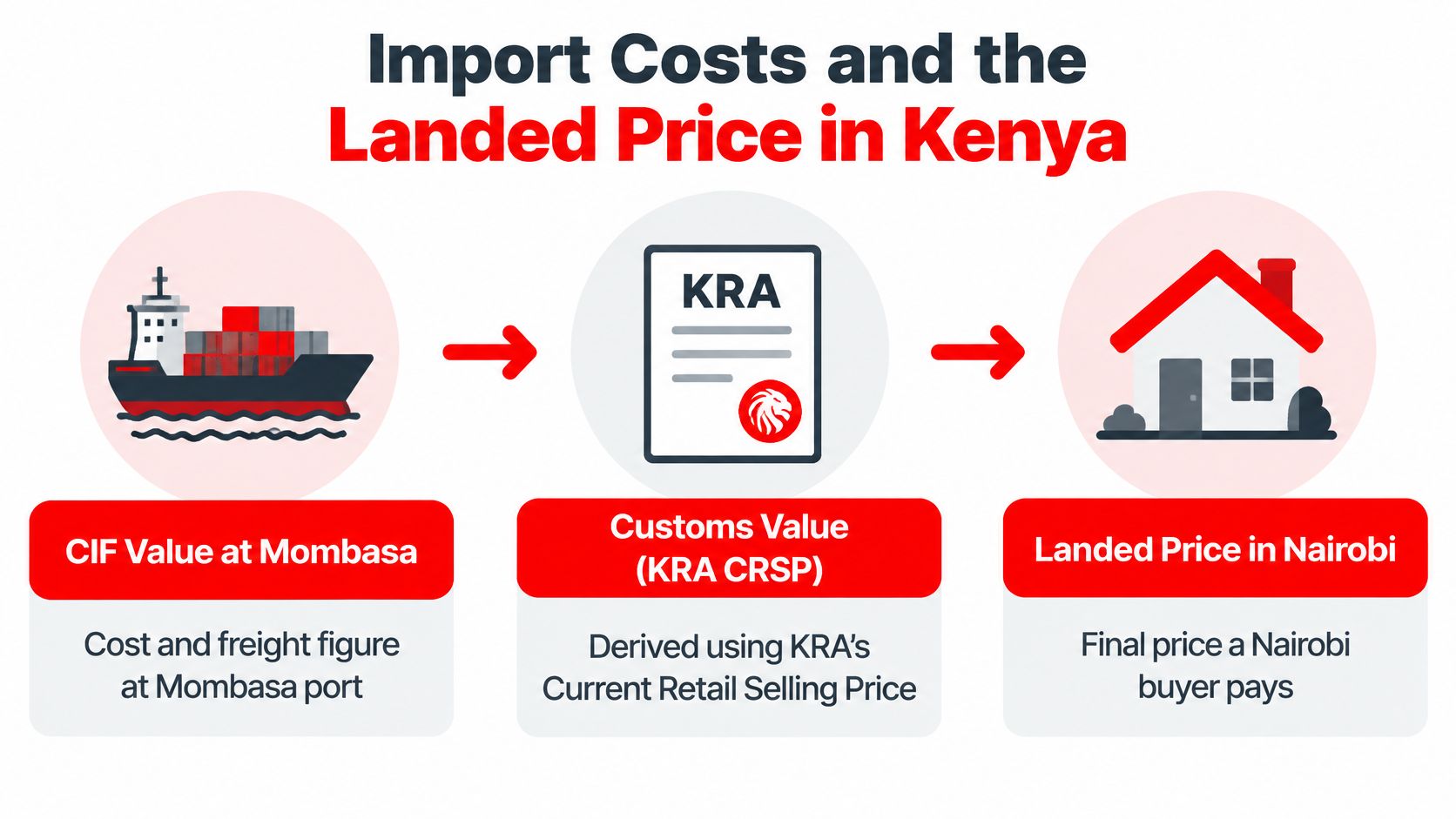
CIF is the cost, insurance and freight position at Mombasa: the price paid abroad plus the cost of moving the car. It is not the amount required to drive it home.
The customs value the tax is calculated on is not always that invoice. KRA explains in its procedures for motor vehicle imports that customs value may be derived using its Current Retail Selling Price framework, so two Jimnys bought abroad for similar money can produce different Kenyan tax bills depending on year, grade and specification.
Asking price, CIF, landed cost and on-road cost only compare when each figure is labelled as the stage it is. A low asking price can sit well below a higher duty-paid sticker and still cost more once the statutory stages are added.
The levies in the order KRA applies them
Under the rates KRA sets out in its guide to importing a motor vehicle, the sequence runs like this:
- Import duty at 25% of the customs value.
- Excise duty at 20% on CIF plus duty, for vehicles of 1,500 cc and below.
- VAT at 16% on the cumulative base of customs value, duty and excise.
- Import Declaration Fee at 3.5% of CIF.
- Rail Development Levy at 2% of CIF.
Every stage builds on the one before it, so the total is never a single percentage of the invoice. Stacking these incorrectly is the most common error in a self-made import estimate.
| Cost stage | Basis under KRA rates | Amount (KSh) |
|---|---|---|
| CIF value | Hypothetical invoice and freight value | 3,000,000 |
| Import duty | 25% of customs value | 750,000 |
| Excise duty | 20% on CIF plus duty, 1,500 cc and below | 750,000 |
| VAT | 16% on the KSh 4.5 million base | 720,000 |
| Import Declaration Fee | 3.5% of CIF | 105,000 |
| Rail Development Levy | 2% of CIF | 60,000 |
| Total before port and clearing | CIF plus all stages above | 5,385,000 |
Read the table line by line and the logic holds. Duty of KSh 750,000 lifts the base to KSh 3.75 million. Excise of KSh 750,000 lifts it again to KSh 4.5 million, and that is the figure VAT is charged on, giving KSh 720,000. The two CIF-based levies add KSh 105,000 and KSh 60,000. Total before port, clearing, registration and transport: about KSh 5,385,000.
The excise band turns on engine capacity. The Sierra figure of 1.460 litres is 1,460 cc, under the 1,500 cc line that takes the 20% rate in this schedule. The cubic capacity printed on the import documents is the assessment figure, not a rounded brochure litre.
Buyers of imported units pay all import-related costs, including duty, taxes, shipping, inspection, port charges and handling fees. Compare fully landed Nairobi prices, never CIF against CIF or CIF against a showroom figure, and ask for a written tax and fee breakdown before committing. Confirm current rates with KRA or a licensed clearing agent. If you're weighing an import against duty-paid local stock, our guide to imported cars for sale in Kenya covers how the two routes differ in practice.
A locally used, duty-paid Jimny can finish cheaper than a lower advertised import because the expensive statutory stages are already in the sticker. The same stage test applies when you set a selling price: say whether the number is an asking price, a CIF quote, a landed total or an on-road figure, or the buyer is pricing a different point on the pipeline from the one you mean.
Running Costs After You Buy
Fuel range is the first number to get straight. Multiply the 40 litre tank by the official urban figures and a Sierra returns roughly 556 km on a full tank under test conditions, while the 660 cc model returns roughly 604 km. Treat both as ceilings. Air-conditioning and stop-start Nairobi traffic will take a visible bite out of them.
Then split the rest into two buckets.
Fixed costs you carry personally
- Registration and logbook transfer, plus number plates. Confirm current fees with NTSA or on eCitizen before you budget.
- Insurance, where the rules and the covers available are set out by the Insurance Regulatory Authority.
- Inspection or roadworthiness certification, which is a buyer cost, not a seller favour.
Buyers are responsible for registration fees, logbook transfer charges, number plates, insurance, inspection or roadworthiness certification, and import duty and port fees for imported units. Build those into your budget before you negotiate the car.
Variable costs you control
- Servicing with the correct oil, especially on the turbocharged 660 cc engine.
- Turbocharger checks, which belong on the service schedule rather than on the list of things you'll get to.
- Brake pads and tyres, with a tyre suited to a short, tall vehicle rather than whatever is cheapest on the day.
- Any 4WD system service the manufacturer recommends for the mileage.
Get written quotes from a garage for each variable item before you buy. A general estimate of "about a hundred thousand a year" is not a budget, and the gap between a well-maintained car and a neglected one shows up in exactly these line items.
Inspecting a Jimny Before You Pay
Paperwork first, always. If the documents and the car disagree, nothing else on this list rescues the deal.
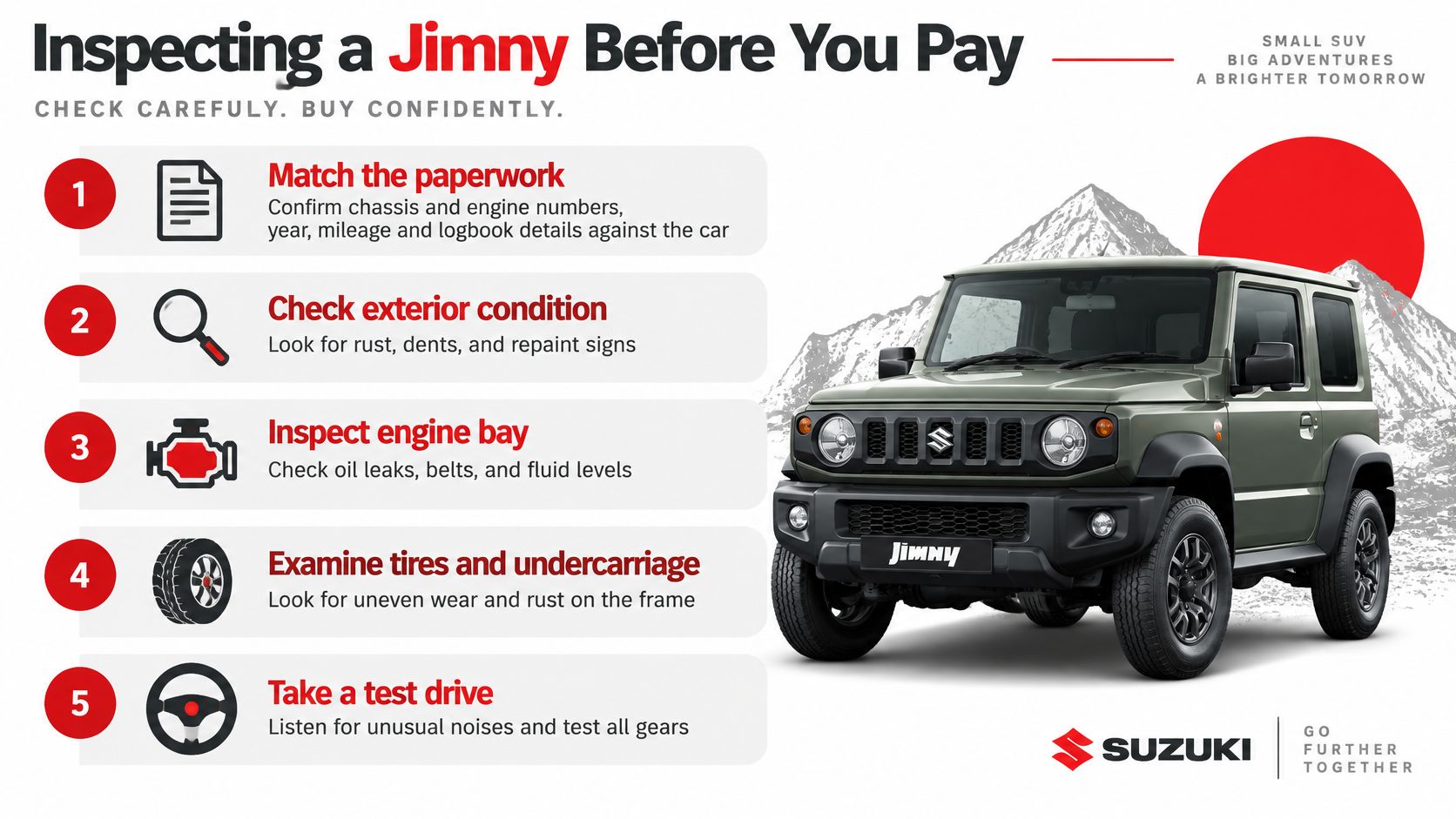
- Match the paperwork. Chassis number, engine number, year, mileage and logbook details should agree with the physical car. Buyers are responsible for verifying these details, and the dealer doesn't guarantee accuracy beyond what is disclosed.
- Confirm the specification. Read the engine code and displacement to separate a Sierra from a 660 cc car, and check the transmission while you're there. This one check can explain a seven-figure price gap.
- Look underneath. Check the chassis and underbody for rust, particularly on imported units that have spent time near salt air or on unsealed roads.
- Sit in the back. Fold the rear seats up and down and judge the luggage space yourself. The usable volume is smaller than the exterior suggests.
- Test the 4WD. Engage and disengage it, then listen for noise on the drive. A transfer system that won't come out of gear is an expensive discovery after handover, not before.
- On the 660 cc turbo, watch the start-up. Blue smoke and a thin service file are a combination worth walking away from. Ask for receipts, not reassurances.
- Ask for the service history and the receipts for any repairs, including bodywork.
- Confirm the price stage in writing. Whether the figure is asking, landed or ex-showroom changes what you owe.
Vehicles sold without warranty, known as as-is, are purchased at the buyer's risk, and defects found after handover are the buyer's problem. That's precisely why steps one to seven happen before you pay, not after.
Pricing a Jimny You Plan to Sell or Trade In
How much should you ask if the buyer will not pay a dockside figure for a car that is already in Nairobi? Use the price stages from the import-cost section, and quote only the stage you are selling.
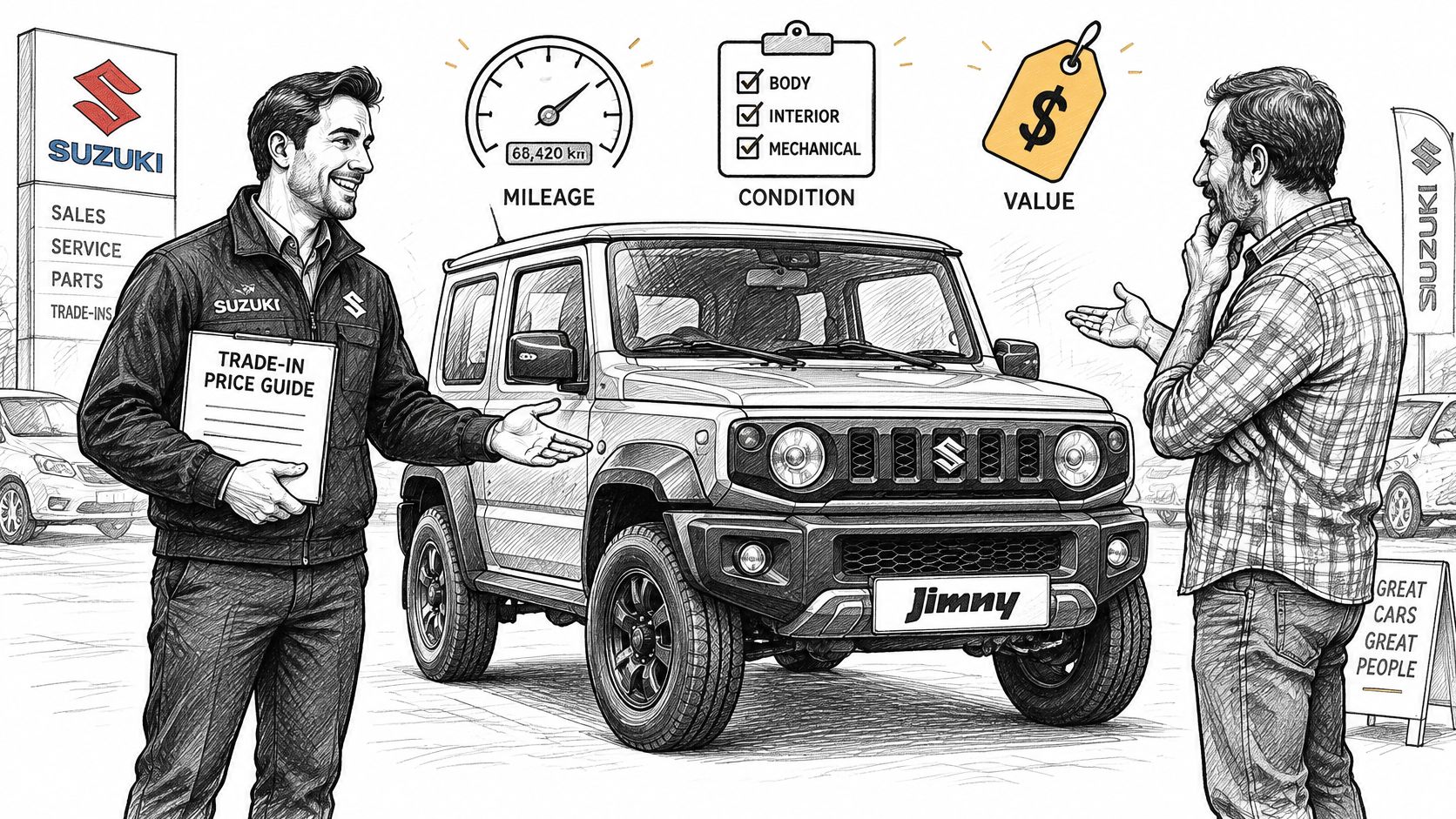
Start with the guide band for the year, then move the car inside that band for specification, import route, condition and scarcity. A Sierra with a full service file and matching paperwork can sit at the top of its band. A 660 cc car with a thin history and non-standard body parts cannot, even if the year matches a more expensive example. Same year, different car. The gap is paperwork and mechanical identity, not the badge on the tailgate.
Price what the next owner inherits. An imported unit should be quoted with its import documents and duty status, not as a CIF number. Buyers do not treat CIF as an on-road price. A listing that blurs those stages attracts enquiries and then stalls once duty, plates and insurance appear.
Fix the number only after a valuation, not before. At the Garden City Mall showroom, Brill Motors values a car in person, buys trade-ins, and will sell your car through the dealership if you would rather not run the buyer conversations yourself. On a trade-in, the agreed value goes toward the next vehicle. If that car costs more, you pay the difference. If it costs less, the difference is refunded or credited as agreed. Listings can be filtered into All Vehicles, New Vehicles, Used Vehicles, Foreign Used and Locally Used, and by make, including Suzuki, which shows where comparable cars are listed.
Set the figure, assemble the documents, and be ready to name the price stage in one sentence. A listing that does that moves. One that hides duty status or condition sits while the advert is refreshed.
Compare year, engine, mileage and local or foreign-used status on the listing with the car you intend to sell. Visit Brill Motors to see current Suzuki and other stock, or come to the Garden City Mall showroom and agree the figure in writing before you commit.