

 SIGN UP

A new Isuzu D-Max Double Cab in Kenya lists from KSh 6,949,000 for the TFS 87 manual to KSh 8,996,000 for the TFS 40 automatic. Used units sit lower, and where a unit lands depends on model year and condition.
The Isuzu D-Max Double Cab price in Kenya is built in layers. Transmission, trim, age and import charges each move the figure, so an advertised price is only the starting line. A buyer who stops at the body style will miss why two double cabs can sit far apart. A seller who prices only from a neighbour's advert will miss the same gap.
Isuzu D-Max Double Cab Prices in Kenya
The Isuzu East Africa Kenya price list puts the new TFS 87 4x4 Double Cab manual at KSh 6,949,000. The same derivative with an automatic gearbox is KSh 7,200,000, which is KSh 251,000, or about 3.6%, more. The TFS 40 4x4 Double Cab automatic is listed at KSh 8,996,000, which is KSh 2,047,000, or about 29.5%, above that entry manual. The span between the lowest and highest listed new Double Cab derivatives is KSh 2,047,000.
Those are Kenya recommended vehicle prices. They are the cleanest benchmark you have, because they isolate derivative and gearbox before mileage or import history enters the picture. Read the derivative name first. A TFS 87 and a TFS 40 are not the same truck with a different badge. Equipment changes with the name, and the list price moves with it.
| Type | Detail | Price (KSh) |
|---|---|---|
| New, TFS 87 4x4 Double Cab | Manual | 6,949,000 |
| New, TFS 87 4x4 Double Cab | Automatic | 7,200,000 |
| New, TFS 40 4x4 Double Cab | Automatic | 8,996,000 |
| Used, 2008 to 2025 model years | General guide, older units at the lower end | 1,450,000 to 3,500,000 |
How to read the used band
As a general guide, Double Cab units from model years 2008 to 2025 are often talked about between KSh 1,450,000 and KSh 3,500,000. Older units sit toward the lower end. The newest examples sit at the top. Mileage, condition, engine and documents move a unit inside that band. These are guide bands, not live offers. Current asking prices are on the listings at brillmotors.com, and they change as stock turns.
Practical rule: Find the band nearest your budget, then check the engine and drivetrain before you compare two units that only share a body style.
List prices are vehicle prices only. Insurance, registration, financing, accessories and delivery sit outside them. Budget those lines separately, or the "price" you agreed will not be the amount that leaves your account.
Model Years, Engines and Trims That Change the Price
| Engine | Years most often seen | Transmission and drivetrain | Points to check |
|---|---|---|---|
| 2.5-litre diesel | Older and mid-period units, roughly 2008 to 2020 | Manual or automatic, 2WD or 4x4 | Clutch wear, cooling system, service history |
| 1.9-litre diesel | Some imported units | Confirm on the listing | Engine size on the import documents |
The 2.5-litre diesel
The 2.5-litre diesel is the engine you will meet most often on older and mid-period Double Cabs, roughly 2008 to 2020. It is sold as a manual or an automatic, and as 2WD or 4x4. On a manual, feel the clutch. A high bite point, or slip under load in a higher gear, means the clutch is near the end of its life and should come off the price. On a high-mileage diesel, look at the cooling system: stained coolant, a soft top hose, or a temperature gauge that climbs on a hill. Where the service book is thin, ask about injector work. A diesel that starts clean and pulls evenly is a different proposition from one that hunts at idle.
A 4x4 automatic usually sits above a 2WD manual of the same year. You are paying for the transfer case, the extra drivetrain parts, and the buyers who want that layout for farms, sites and upcountry roads. Trim names do the same job. A TFS 40 and a TFS 87 are not cosmetic labels. They change equipment, and the new-list gap shows how far that equipment can move money.
The 1.9-litre diesel
The 1.9-litre diesel turns up on some imported units. Do not take the advert's engine line as settled. The capacity on the import documents is what customs and a later buyer will use. A wrong capacity in the advert can hide a different duty outcome, which is why this engine belongs in the landed-cost conversation as much as in a spec sheet.
If you are weighing this pickup against another workhorse, the Toyota Hilux pickup price in Kenya guide is a useful side reading on how year and specification move a similar body.
Match the engine and drivetrain to the job before you chase a newer year. City commuting does not need low range. Farm and off-road work does. A cheaper 2WD that cannot do the route is not a saving.
Landed Cost of an Imported D-Max Explained
The overseas invoice is not the price in Kenya. KRA's motor vehicle import procedures treat the customs value as the vehicle's CIF value, meaning cost, insurance and freight. Taxes stack on that base, not on the bare purchase price.
Work through the layers in order.
- Import duty is 25% of CIF.
- Excise duty is 25% for engines above 1,500 cc, calculated on CIF plus import duty.
- VAT is 16% of CIF plus import duty plus excise duty.
A low invoice does not lock in a low tax bill. The assessed value and the engine class both feed the arithmetic. Our notes on imported cars for sale in Kenya set that wider context for buyers who are still choosing between a local car and one still offshore.
A worked example at KSh 3,000,000 CIF
Take a 1.9-litre D-Max with a CIF of KSh 3,000,000, using the rates in that KRA guidance. Import duty is KSh 750,000. Excise duty is KSh 937,500. VAT is KSh 750,000. The subtotal is KSh 5,437,500, and that is before port, clearing, registration, storage and inspection.
| Charge | Basis | Amount (KSh) |
|---|---|---|
| CIF value | Cost, insurance and freight | 3,000,000 |
| Import duty | 25% of CIF | 750,000 |
| Excise duty | 25% of CIF plus import duty | 937,500 |
| VAT | 16% of CIF, import duty and excise duty | 750,000 |
| Subtotal before levies and logistics | Sum of the above | 5,437,500 |
On top of that subtotal, get separate quotes for:
- Port and clearing charges, which depend on the agent and how long the unit sits.
- The Railway Development Levy and the Import Declaration Fee, both named in the KRA guidance.
- Registration, storage and inspection.
KRA also requires compliance with Kenya Bureau of Standards import requirements and KS1515:2000 road-vehicle inspection standards. Ask for the customs entry, the valuation basis, the inspection papers and proof of tax paid. Those records separate a real landed cost from an advert that left the taxes out. Confirm the current rates with KRA or a licensed clearing agent before you fix a budget. Rates in a blog are a method, not a clearance quote.
Registration Age Rules for Foreign-Used Units
Kenya does not treat every used Double Cab as importable. The Kenya Bureau of Standards road-vehicle inspection code limits imported used vehicles to those no more than eight years old from the year of first registration. It also says the gap between the year of first registration and the year of manufacture should not exceed one year. A tidy model year in an advert does not settle either test.
The check, in order
- Take the year of first registration from the import documents, not the year painted in the advert.
- Subtract that year from 2026.
- Compare the result with the eight-year limit.
- Then check that manufacture and first registration are no more than one year apart.
A 2017 model first registered in 2017 is nine years old in 2026 and falls outside the limit. A 2019 model first registered in 2019 is seven years old and sits inside it. The same logic applies if the papers show a later first registration than the badge year: eligibility follows the registration year.
Older stock, sometimes described as "recent", needs the most care. A unit can look acceptable on manufacture year and still fail on first registration.
Ask for the original registration record and the import entry before you pay a deposit. If those two do not agree with the chassis you are standing next to, stop.
Only used vehicles with validated import documents go forward to destination inspection, so document validity is part of the purchase risk, not a form you tidy up after you have paid. Match the papers to the vehicle's identity and age first.
What Drives Depreciation and Resale Value
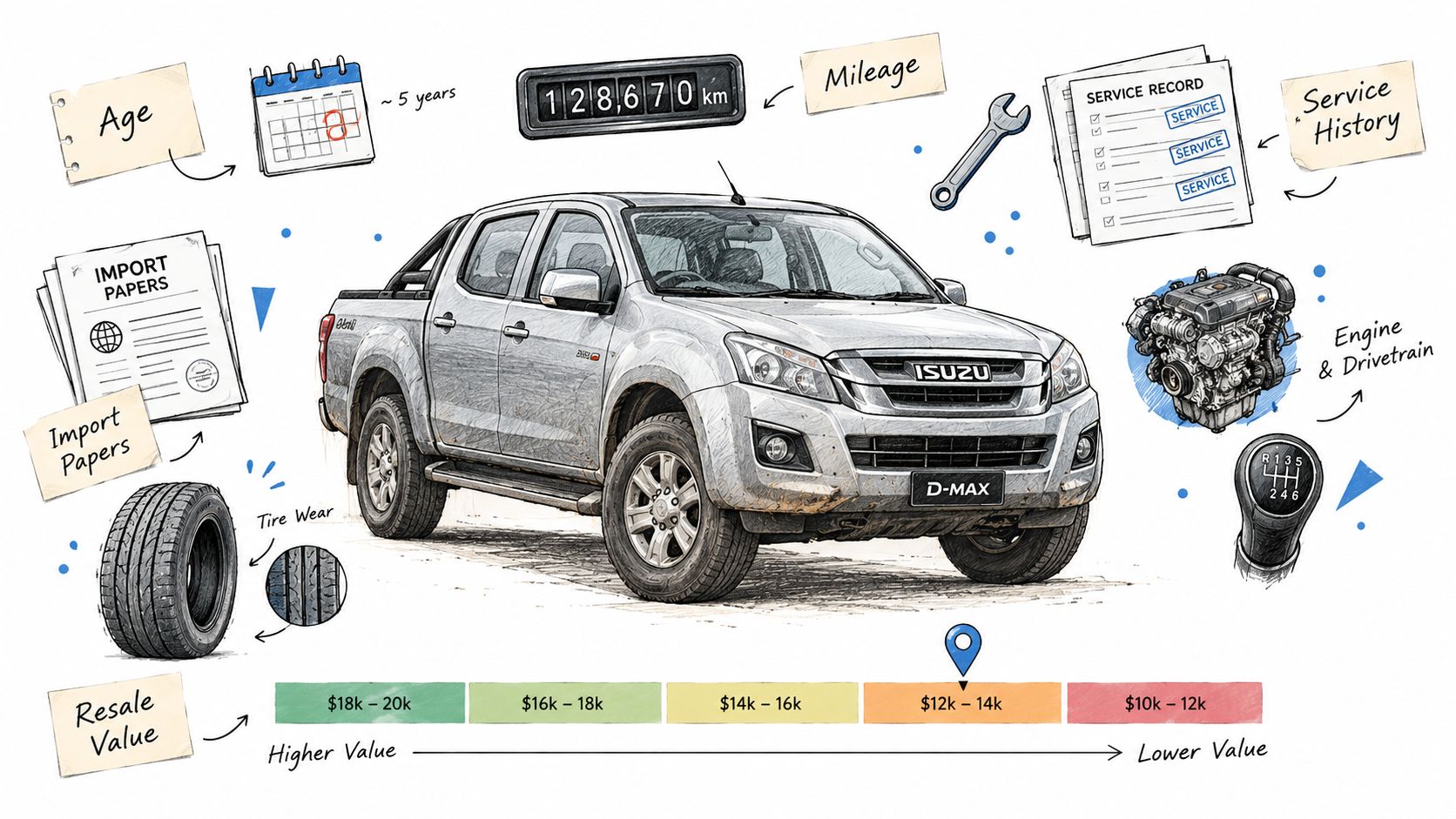
Value on a used Double Cab moves with age, kilometres, engine and drivetrain, gearbox, service history, body and cabin condition, and the import papers. Documentation is the quiet one. A clean logbook and a complete import file support a higher place in the band. Missing service stamps, or a history nobody can explain, pull the same year downward.
The steepest fall usually comes in the early years off the new list. After that, values ease more slowly. A kept 4x4 automatic and a diesel with a full book generally hold better than a high-mileage 2WD manual with gaps. Buyers pay for remaining life they can see, not for a story.
Two 2019 units, one year, two prices
Say both are 2019 Double Cabs. One has 90,000 km and a service book that matches the odometer. The other has 180,000 km and blank stretches in the record. The first has had fewer heat cycles on the turbo, a clutch or gearbox with more life left, and tyres and bushes that have not done a second lifetime. The second may still be a sound truck, but the buyer is pricing unknown injector work, unknown cooling-system age and a harder resale later. That is why the lower-kilometre unit with the book commands the better price, even when the paint looks similar.
If you are selling, a trade-in is one route. Brill Motors buys trade-in vehicles, so you can set an offer next to what a private sale might bring and choose with both numbers in hand.
Before you name a price, write down three things: age, kilometres, and paperwork. If any one of them is weak, the asking figure should already reflect it.
Inspection Checklist for a Viewing or Test Drive
The KEBS public notice on validation of used motor vehicles says imported used vehicles must comply with road-vehicle inspection requirements, including a safety inspection, and must not be more than eight years old from first registration. Only used vehicles with validated import documents are subjected to destination inspection, with that requirement taking effect on 14 July 2025. Treat the papers as part of the viewing, especially if the unit is described as newly arrived or still awaiting clearance.
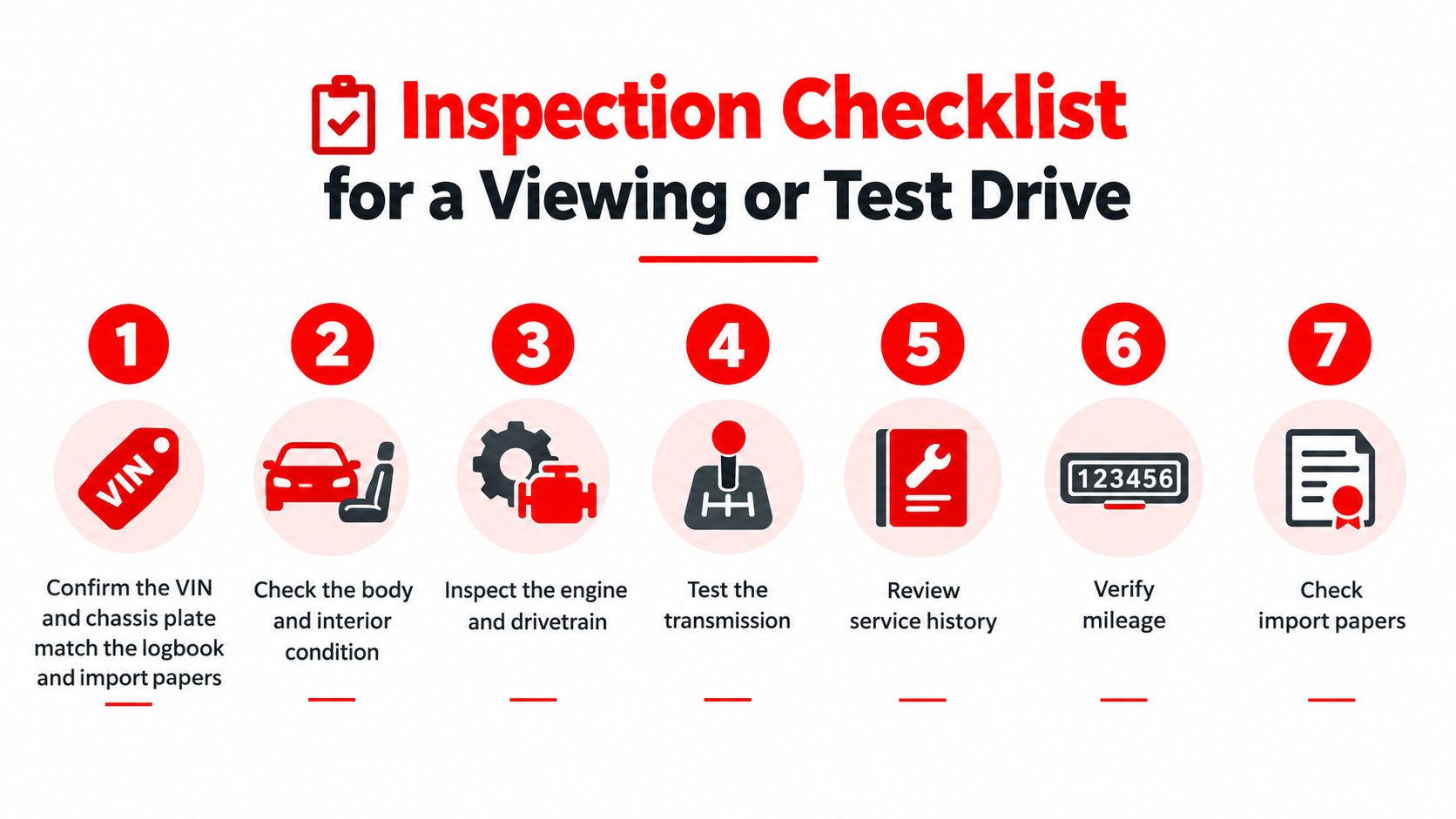
Work through the car in this order.
- VIN and chassis plate. They must match the logbook and the import papers. A mismatch is a deal-breaker. Do not negotiate it.
- Odometer against the book. Worn pedals, a shiny steering wheel and a collapsed driver's seat on a "low mileage" unit are a negotiating point if the stamps still line up, and a reason to walk away if they do not.
- Chassis and underbody. Rust, fresh weld marks or resprayed sections on the rear chassis rails are a deal-breaker until a workshop explains them. Surface scale on a bolt is a talking point.
- Cold start. Knocking, or heavy black smoke that does not clear, points to injector or turbo trouble. Persistent smoke under load is a deal-breaker without a compression and injector report. A brief puff that clears can be a service item.
- Gearbox. On a manual, a clutch that bites at the top of the pedal or slips in third is a price cut at minimum. On an automatic, harsh or delayed shifts are a deal-breaker until a specialist drives it.
- 4x4. Engage it and feel the transfer case on a short, slow test. A grind, or a mode that will not engage, is a deal-breaker on a unit priced as a 4x4.
- Tyres. Inner-edge wear or a saw-tooth pattern points to alignment or worn suspension. Budget the tyres and the bushes. It is a negotiating point, not a reason to abandon a clean truck.
- Electrics. Dead lights, weak air conditioning, a dead window or a blank screen are negotiating points. Price the parts before you agree.
- Import documents. They must be valid and must match identity and age. A file that fails that test stops the deal.
- An independent pre-purchase inspection. If the seller refuses one, treat that refusal as information.
Paperwork and Costs to Confirm Before You Pay
The vehicle price is not the whole cheque. You also carry registration fees, logbook transfer charges, number plates, insurance, and inspection or roadworthiness certification. On an imported unit, duty, levies and port charges belong in the landed-cost sum, so do not add them twice here.
Group the rest like this.
- One-time costs: logbook transfer, number plates and the first registration steps. Give each a budget line before you shake hands.
- Before-first-drive costs: insurance and the inspection or roadworthiness certificate. You should not move the truck on public roads without them.
- Recurring costs: the next insurance renewal and routine servicing. They do not change today's price, but they decide whether the truck stays affordable.
The order that keeps you safe
Confirm the logbook is in the seller's name. Check the transfer steps with NTSA through eCitizen before handover, and keep a receipt for every fee. Current fee amounts belong on ntsa.go.ke and ecitizen.go.ke, not in a fixed blog figure.
If you were materially misled about the vehicle, or you are left with a serious defect that cannot be put right within a reasonable time, Kenyan law can require a refund in those situations. Take advice from a licensed advocate on the remedy before you escalate. Raise the matter with Brill Motors first, using the contact details on the site. If it stays unresolved, the parties may try mediation or any complaint, regulatory or court process available under Kenyan law.
Check Live Brill Motors Stock Before You Decide
An advertised price is a starting point for comparison, not a substitute for checking the specific truck. Match the D-Max's year, trim and transmission to the price band you have in mind, then compare the vehicle and its paperwork in person.
Check the current Isuzu D-Max listings for available stock and prices. Listings can change, so confirm the details directly with Brill Motors by calling or WhatsApping +254 758 243 058.
Brill Motors sells locally used and foreign-used cars and has a showroom at Garden City Mall in Nairobi, where you can view vehicles in person. If you plan to trade in your current car, ask about a valuation and how its value can be applied to the vehicle you choose.
Compare the actual D-Max and its documents with the advertised details before committing.