

 SIGN UP
The Mercedes-Benz E250 price in Kenya is approximately KSh 1,800,000 to KSh 2,900,000 for locally used 2010 to 2013 cars with 120,000 km and above, and KSh 2,700,000 to KSh 3,500,000 for locally used 2013 to 2015 cars below 120,000 km. For foreign-used examples from 2019 onward below 90,000 km, use KSh 4,000,000 upwards as an indicative budget, with a live listing setting the final figure.
The bigger question is whether you're comparing the same thing. An overseas purchase price, a cleared vehicle price and a registered car ready for Nairobi roads aren't interchangeable. For imported cars, eligibility comes before price, and the complete on-road cost matters more than the number in the advert.
Mercedes-Benz E250 Prices in Kenya by Year and Origin
Indicative Mercedes-Benz E250 price bands in Kenya
| Category | Model years | Mileage guide | Indicative price guide |
|---|---|---|---|
| Locally used, older | 2010 to 2013 | 120,000 km and above | KSh 1,800,000 to KSh 2,900,000 |
| Locally used, newer | 2013 to 2015 | Under 120,000 km | KSh 2,700,000 to KSh 3,500,000 |
| Foreign-used, within the age rule | 2019 onward | Under 90,000 km | From KSh 4,000,000 |
These are general guide bands, not quotations or valuations of individual vehicles. They reflect broad Kenyan buying categories rather than a promise that every car with a particular year and mileage belongs within a fixed range. Current availability, specification and condition determine the actual asking price.
The overlap between the locally used categories is intentional. A carefully maintained older car can deserve more consideration than a newer example with missing maintenance records or unresolved faults. Registration year alone doesn't establish value.
How to judge an asking price
Start by placing the car in the appropriate category, then ask what supports its position within that band. At the lower end, expect to investigate higher mileage, cosmetic wear or incomplete records. A low price is a reason to investigate, not proof of a bargain.
At the upper end, ask for evidence rather than accepting descriptions such as clean or fully loaded. Consistent service invoices, verifiable ownership and functioning equipment make a stronger case than freshly polished paint.
Practical rule: A premium asking price should come with premium-quality evidence of condition and maintenance.
Origin needs careful interpretation too. A foreign-used description doesn't automatically mean a car is eligible for fresh importation today. An older vehicle may already have entered Kenya legally, so establish whether you're buying an existing Kenyan vehicle or commissioning an import.
Our stock includes both locally used and foreign-used vehicles. We list vehicles across Toyota, BMW, Chevrolet, Hyundai, Mercedes-Benz, Suzuki and Mazda, but the useful comparison for an E250 buyer is between cars with matching documentation, engine specification and condition.
Compare the guide with our current used Mercedes-Benz listings. Treat each live asking price as the beginning of a vehicle-specific assessment, not confirmation that every similarly aged E250 should cost the same.
What Moves the Price of a Used E250
Model identity comes first, documented condition comes next, and optional equipment comes after both. That's a more useful valuation order than choosing the newest registration plate your budget allows.
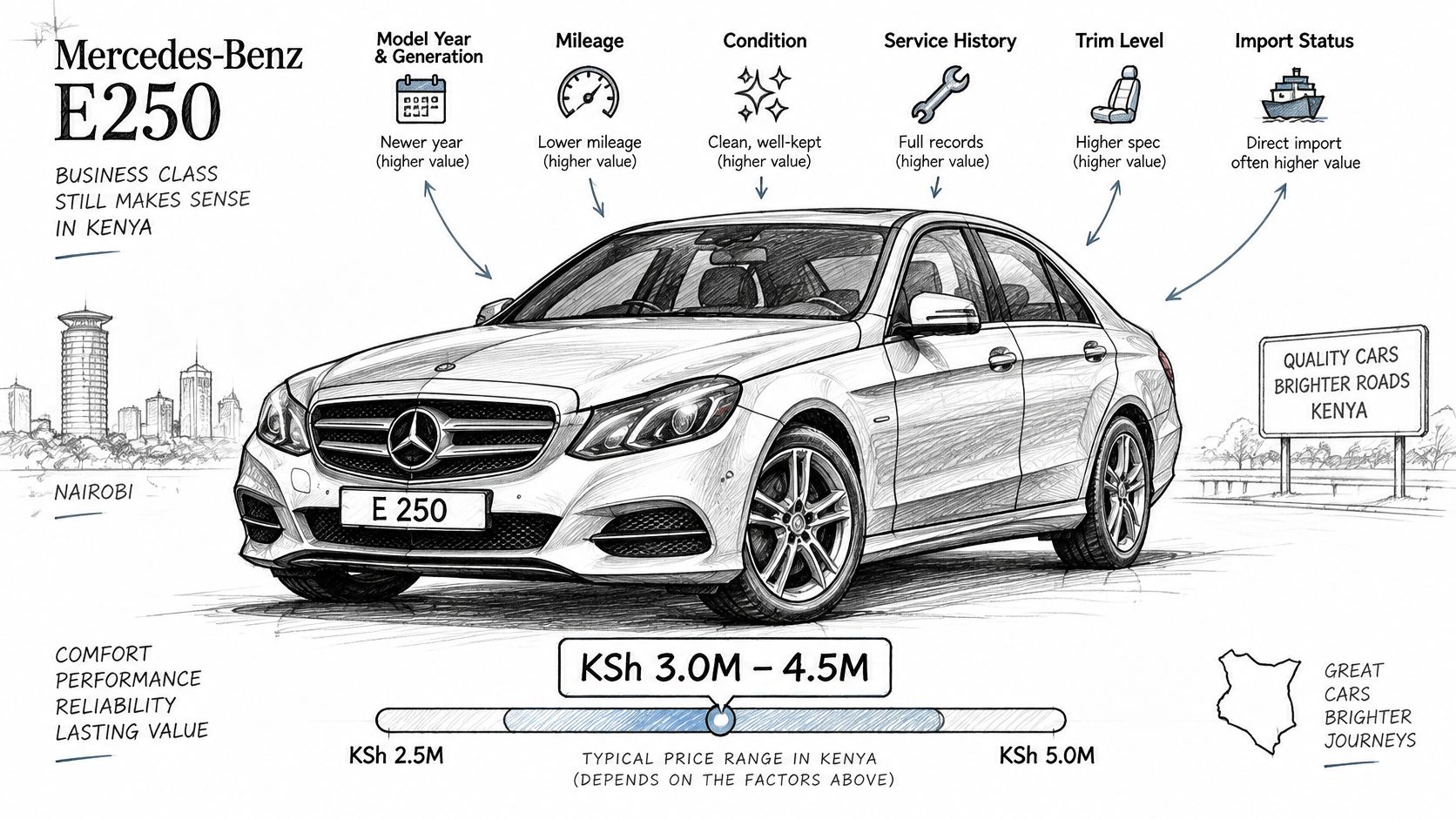
Establish exactly which car you're pricing
The E250 badge isn't enough to identify the drivetrain. Establish the chassis generation, facelift status, fuel type, engine code and transmission from the vehicle documents and chassis-linked specification.
Key E250 engine and fuel figures
| Specification | Figure |
|---|---|
| Engine | 2.0-litre turbocharged four-cylinder |
| Power | About 208 hp |
| Torque | About 350 Nm |
| Transmission | Seven-speed automatic |
| Fuel economy | About 5.8 L/100 km combined, quoted manufacturer figure |
These figures describe a reference configuration, not every E250. Use them to identify a potential specification mismatch, then confirm the actual car's engine and gearbox before comparing prices. Don't assume that a newer-looking bumper or replacement badge establishes the generation.
Mileage needs the same scrutiny. Read the odometer alongside dated maintenance invoices and recorded mileage progression, not against an assumed annual driving allowance. A low reading without supporting records isn't automatically worth a premium.
Rank the remaining differences
- Maintenance and mechanical condition: A car with documented servicing and a healthy transmission can justify a stronger offer than an apparently identical example needing immediate work.
- Factory specification: AMG Line equipment, sport packages, a panoramic roof, leather upholstery and driver assistance may matter to you, but verify that they're fitted and operational. Styling additions aren't proof of factory trim.
- Origin and ownership history: A locally used car may offer a traceable Kenyan maintenance history. An imported example needs equally convincing overseas records and import documentation.
- Accident repairs and previous owners: Repair quality matters more than a simple claim that the paint is original. Multiple owners aren't automatically disqualifying, but unexplained gaps make the history harder to assess.
Choose the factors that matter most before viewing cars. If dependable daily use is your priority, put maintenance evidence ahead of optional equipment. If you're paying extra for specification, establish the value of those features to you rather than assuming every accessory will be recovered at resale.
Import Rules That Decide Whether a Foreign E250 Qualifies
The Kenya Revenue Authority's used-vehicle guidance states that imported used vehicles must be less than eight years old, calculated from manufacture or first registration. Applied to 2026, that puts 2019 onward inside the age window, places 2018 at or beyond the threshold unless KRA confirms otherwise, and excludes 2016 and 2017 examples from ordinary fresh importation.
That distinction changes the buying decision. An attractively priced older E250 abroad isn't a realistic import merely because its mileage is low. Conversely, the age restriction on fresh imports doesn't mean an older car already registered in Kenya cannot be considered.
Establish eligibility before sending money
- Confirm the dates. Obtain documents showing manufacture and first registration, rather than relying on the model year written in an advert.
- Check the age assessment. Have KRA or a licensed clearing agent confirm eligibility for the intended import period before committing to the purchase.
- Request the pre-shipment certificate. Establish that the required inspection documentation will be available before clearance.
- Verify standards compliance. KRA's guidance also requires compliance with Kenya Standard KS 1515:2000 and a roadworthiness inspection by a KEBS-appointed agent in the exporting country.
- Reconfirm the current requirements. Check with KRA and KEBS before shipment, and include inspection and certification in your budget.
Missing paperwork isn't a minor inconvenience when the vehicle is still overseas. Ask who is responsible for obtaining each document and what happens to your payment if the car fails eligibility or inspection.
Our guide to imported cars for sale in Kenya provides broader buying context. For a locally used E250, fresh-import procedures aren't the issue, but ownership and transfer checks through NTSA and eCitizen remain essential.
Landed Cost of an Imported E250 in Kenya
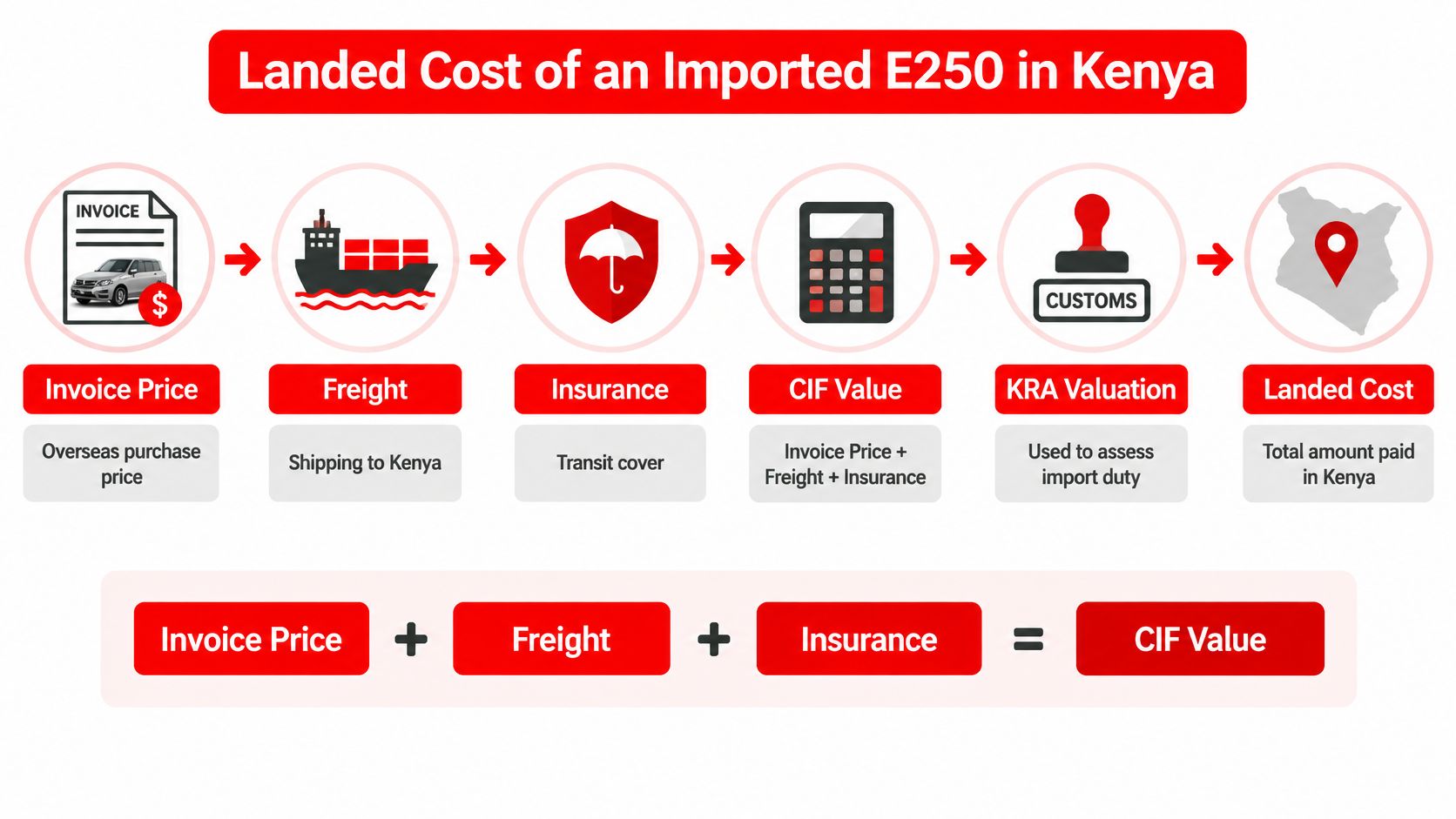
An overseas invoice is only the starting point. Add freight and transit insurance to establish cost, insurance and freight, usually shortened to CIF, then establish the customs value KRA will assess.
KRA may use its Current Retail Selling Price schedule, adjusted for depreciation, rather than accepting the invoice. Its clarification on the revised CRSP schedule identifies a revised schedule effective 1 July 2025. Ask which valuation applies to the exact vehicle before treating an overseas discount as a Kenyan saving.
An illustrative calculation, not a current tax quotation
The KRA motor-vehicle import procedure provides the published rates used in the following KSh 2,000,000 CIF illustration. These are an illustrative published-rate scenario, not confirmation of the rates applicable to your E250 today.
Illustrative statutory charges on a KSh 2,000,000 CIF import
| Charge | Calculated on | Rate | Amount (KSh) |
|---|---|---|---|
| Import duty | CIF value | 25% | 500,000 |
| Excise duty | CIF plus import duty | 20% | 500,000 |
| VAT | CIF plus import duty plus excise duty | 16% | 480,000 |
| Import Declaration Fee | CIF value | 2% | 40,000 |
| Railway Development Levy | CIF value | 1.5% | 30,000 |
| Total statutory charges | Sum of the charges above | 77.5% of CIF | 1,550,000 |
The sequence matters because excise and VAT aren't both calculated on the original vehicle value alone. Each applicable cumulative tax base must be established before the next charge is calculated.
However, KRA's motor-vehicle importing guidance also describes 25% excise duty for vehicles above 1,500 cc, rather than the excise assumption in the illustration. KRA publications have also shown different levy rates over time, so obtain the current assessment from KRA or a licensed clearing agent before budgeting.
An accurately calculated example can still be the wrong buying budget if the applicable tax rates or customs valuation differ.
Add the costs beyond customs
Port handling, clearing, inland transport, registration and inspection remain separate from the illustrated statutory charges. Storage can also matter if clearance is delayed. Request an itemised quotation showing which costs are fixed, which are estimates and who pays if the timetable changes.
Don't confuse the vehicle's CIF value with the amount you'll ultimately spend. Equally, don't compare a tax-paid Kenyan vehicle against an overseas invoice and conclude that the difference is entirely dealer margin.
Your comparison should use the same endpoint: a vehicle legally cleared, registered as applicable and ready for collection, with outstanding charges disclosed. Ask every seller for the complete on-road price in writing, including an explicit statement of exclusions.
Running and Ownership Costs After You Buy
Affordability doesn't end when you agree the purchase price. The useful question is whether you can maintain the particular E250 you're considering without postponing essential work.
Build your ownership budget from the car's condition, intended use and actual quotations. Don't apply a generic maintenance percentage to the asking price and assume that covers everything.
Budget for use, maintenance and eventual resale
- Fuel: Treat the combined consumption figure as a comparison measure, not a guaranteed Nairobi result. Stop-start traffic, short journeys, air-conditioning use and driving style affect what you'll spend.
- Scheduled servicing: Ask a specialist for a quotation based on the engine code, mileage and service history. Separate routine oil and filters from overdue work, and establish the proposed parts specification and labour charges.
- Tyres: Read the fitted tyre sizes before requesting replacement prices. Include any immediately necessary replacements in your decision, and don't assume attractive alloy wheels make their running costs acceptable.
- Insurance: Obtain a quotation before committing. Confirm the insured value, excesses, cover conditions and claims process, rather than comparing premiums alone.
- Registration and transfer: Confirm current charges through NTSA and eCitizen, and establish who will initiate and complete the ownership transfer. Don't treat possession of the keys as completion of the paperwork.
- Major-repair reserve: Have the independent inspection distinguish urgent repairs from work that can be planned. Obtain estimates for suspension, electronic or transmission concerns instead of guessing what a warning light might cost.
- Resale: Think about how your intended ownership period affects the purchase. Optional equipment may improve your enjoyment without returning its full purchase premium when you sell or trade in.
Separate predictable bills from uncertainty
A service invoice is a predictable expense. An unexplained gearbox symptom is an unresolved risk until a competent mechanic diagnoses it and provides a repair estimate.
That distinction is important when negotiating. A seller's discount doesn't necessarily compensate you for a fault whose cause hasn't been established. If the repair exposure could stretch your available funds, diagnose it before agreeing a price.
Keep enough cash available for the work you know is due, rather than spending the entire budget on acquisition. Add these ownership costs to the complete on-road price, not merely to the advertised figure.
Inspection Checklist Before You Pay a Deposit
A deposit should follow evidence, not create pressure to overlook missing evidence. Arrange the viewing so the engine can be checked from cold, the vehicle can be driven appropriately and your chosen mechanic has time to assess it.
Our showroom at Garden City Mall in Nairobi allows customers to view vehicles in person. Bring the vehicle details and your inspection requirements so the assessment stays focused on the actual car rather than its appearance.
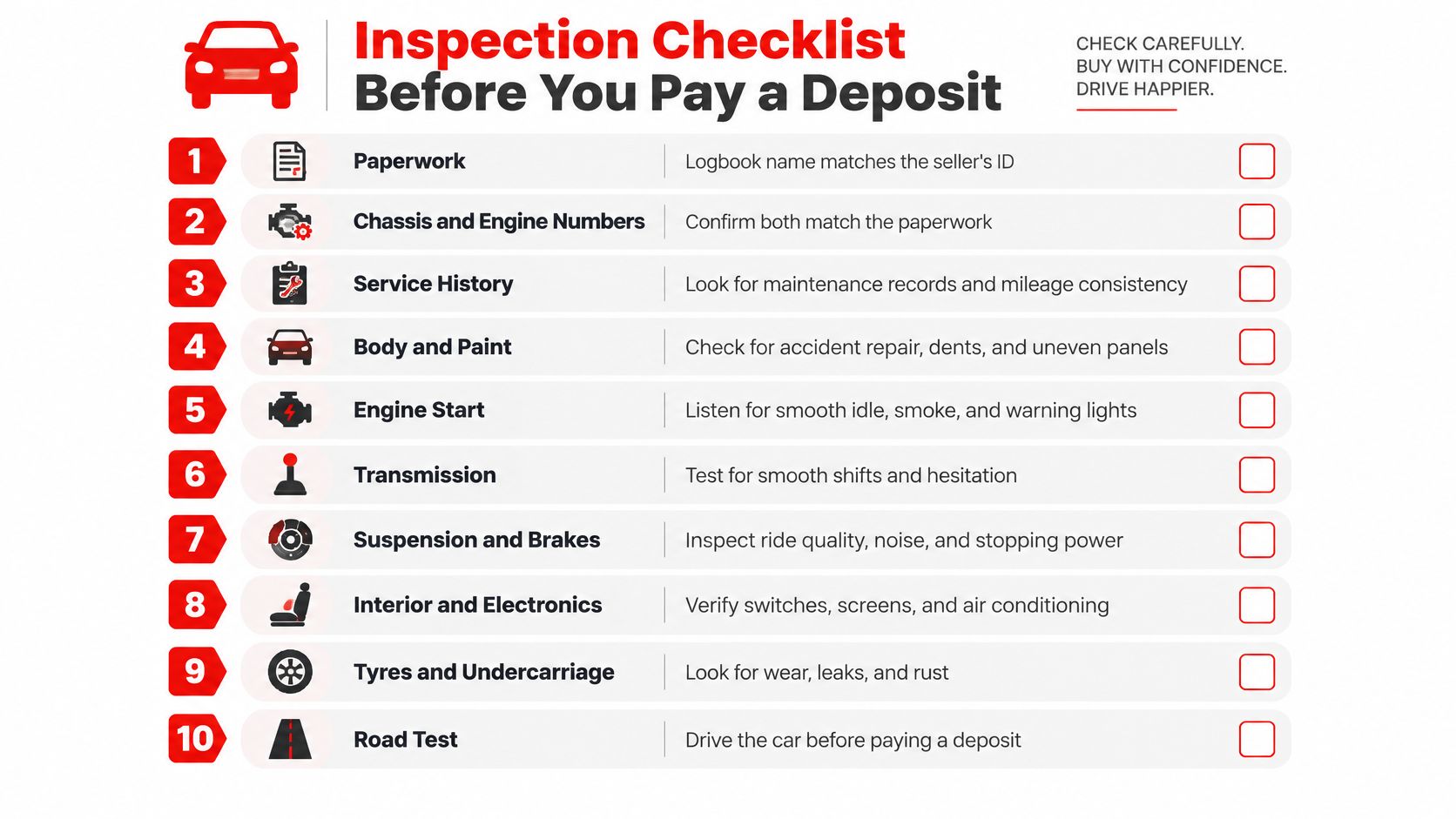
Work through the car systematically
- Paperwork and identity: Match the logbook owner to the seller's identification, establish the seller's authority where necessary, and compare the chassis and engine numbers with the vehicle.
- Service history: Read dated invoices alongside the service book, looking for consistent mileage progression and evidence of the work claimed.
- Diagnostic scan: Use an OBD diagnostic tool capable of reading the vehicle's relevant control modules, including stored faults even when no dashboard warning is showing.
- Cold start: Listen for knocking or persistent rattling, watch for smoke and assess whether the engine settles into a steady idle.
- Automatic transmission: Test forward gears, reverse and kickdown safely, noting hesitation, harsh engagement or slipping rather than accepting these as normal without diagnosis.
- Turbocharger and leaks: Ask the mechanic to investigate unusual whine and oil leakage around the turbocharger, associated pipework and valve cover.
- Electrics and cabin equipment: Operate windows, infotainment, air conditioning, sensors and fitted assistance features, and check that warning lights behave correctly.
- Brakes, suspension and tyres: Assess braking response, listen for suspension noise and inspect uneven tyre wear that may justify further alignment or damage checks.
- Body and accident history: Examine paint shade, panel gaps and signs of repair, then request supporting accident-history information instead of relying on a verbal assurance.
- Independent assessment: Book a pre-purchase inspection with a mechanic you choose and obtain written findings with repair estimates before committing.
Turn findings into a decision
A diagnostic code isn't a diagnosis, and freshly cleared codes aren't proof that the underlying problem has been repaired. Ask the mechanic to explain the cause, recommended work and whether further testing is needed.
If you're also weighing a premium SUV, our Audi Q5 price guide offers related budget context. For the E250 in front of you, however, let the inspection determine whether to proceed, negotiate or walk away.
Confirm the Full Price and Paperwork Before You Buy
Ask the seller a direct question: What is the complete amount payable before I can collect this car, and what isn't included? Request the answer in writing, with the vehicle identified clearly and any outstanding obligations assigned to the responsible party.
An attractive asking price isn't useful if registration, clearance or other compulsory costs remain unresolved. Nor does a larger payment make incomplete ownership records acceptable. Compare the written quotation with your available budget only after the vehicle and transaction have both been checked.
Make the agreement match the car
Before paying, resolve discrepancies identified in the inspection and confirm the import documents where applicable. The sale agreement should identify the vehicle, agreed price, disclosed defects, deposit terms and arrangements for transfer.
Don't pay to resolve uncertainty that the seller should clarify before the sale.
Keep copies of the advert, quotation, inspection findings, payment records and written correspondence. If a dispute develops over the description, condition or sale terms, obtain independent legal advice before releasing further money.
Kenyan law requires a refund where a vehicle was materially misrepresented or a substantial qualifying defect cannot be repaired within a reasonable time. Whether those conditions apply to a particular dispute needs individual assessment, so don't treat a general statement of rights as a substitute for advice.
Choose the payment route deliberately
We offer financing, vehicle valuation for owners looking to sell, and trade-ins that put the value of an existing car towards another vehicle. Compare the purchase price, trade-in valuation and financing obligations separately so you can see the full transaction clearly.
For vehicle enquiries or to discuss a viewing, call or WhatsApp +254 758 243 058. Confirm availability and the written price of the specific car before making travel or payment arrangements.
Brill Motors offers showroom viewing, financing, vehicle valuation and trade-ins to help you assess an E250 purchase against your budget. View current Mercedes-Benz stock at Brill Motors, or visit our Garden City Mall Rooftop Car Yard on Thika Road, Nairobi, to discuss a specific vehicle and its complete on-road price.