

 SIGN UP
A used Nissan Wingroad in Kenya is typically priced in an indicative range of about KSh 390,000 to KSh 1,200,000, and model year, mileage, condition, trim and whether the car is locally used or foreign used determine where a specific vehicle sits in that range. Treat that spread as a budget frame, not a promise that the figure on a windscreen is a fair price.
The number that should change how you read an advert is not the year on the logbook. A much older Wingroad can still be priced above a newer one when the mileage is kinder, the service file is complete and the car is already on Kenyan plates. Age is one input. It does not set the value on its own.
The second trap is the gap between the advertised price and the cost of driving the car legally. A foreign-used unit can look cheap until customs value, duty, excise, VAT, declaration charges, port work and registration are added. A locally used unit already has those costs inside the asking price. If you only compare headlines, you will either overpay for a tired local car or under-budget an import that still has to clear.
A sensible Nissan Wingroad price in Kenya starts with the year and the odometer, then asks whether taxes are already paid and whether the car could even be imported today.
Nissan Wingroad Price Overview for Kenyan Buyers
Two Wingroads with the same badge can be hundreds of thousands of shillings apart, and the cheaper advert is not automatically the better buy. The range above is a guide for cars already being discussed in the Kenyan market. It is not a live quote, and it is not a completed-sale price. Asking prices sit above what a careful buyer should pay once inspection, tyres, service and transfer are priced in.
What actually moves the price
Model year sets a rough shelf. It does not finish the job. Mileage, service history, accident history, trim, mechanical condition and local-used versus foreign-used status move a car up or down that shelf. A clean, lower-mileage example with a full file deserves more than a same-year car with a patched body and a silent service book. A foreign-used car whose taxes are still outstanding is not comparable with a car that is already registered.
Practical rule: If the advert does not say whether duty and registration are paid, assume they are not, and price the car as an import until the seller proves otherwise.
Location and documentation matter in the same way. A car in Nairobi with a clear logbook is easier to buy this week than a unit still at the coast waiting on clearance. That convenience has a price. It is not a reason to ignore a high odometer or a mismatched chassis.
Where each question is answered
Settle the budget against year and mileage first. Then separate the asking price from the landed cost, because import duty, excise, VAT and the related fees can rival the overseas purchase price. After that, check how Kenya Revenue Authority customs value is built, because a seller's figure is not the value the tax calculation uses. Engine size and trim come next, since they change both excise and day-to-day costs. Only then choose between a car already registered here and one that still has to qualify as an import. The viewing checks sit in one place, at the end of that decision, and they should be finished before any deposit.
Nissan Wingroad Price Bands by Model Year and Mileage
Use the bands below as a planning frame for a used Nissan Wingroad, not as today's stock list. Live prices move with condition and with what is on the yard. For a car you can inspect this week, use Brill Motors current listings rather than an old advert.
| Model year group | Indicative price guide (KSh) | Main price drivers |
|---|---|---|
| 2008 to 2011 | 475,000 to 950,000 | Mileage, service file, accident repairs, whether it is already registered |
| 2015 to 2016 | 450,000 to 980,000 | Odometer, trim, local or foreign used, documentation |
| 2017 to 2018 | 877,000 to 1,200,000 | Mileage, trim, import status, preparation included in the price |
Older cars, roughly 2008 to 2011
A 2008 1.5-litre automatic has been guided near KSh 475,000 in Nairobi, while a 2009 local-used example sits nearer KSh 520,000 to KSh 625,000. A 2011 car has still been guided at KSh 950,000. That spread is the point. Inside this band, a documented lower-mileage car belongs at the top. A neglected high-mileage car belongs at the bottom, or below it, once you price tyres, suspension and a tired transmission.
Mid-year cars, roughly 2015 to 2016
Nairobi guides for 2015 and 2016 cars run about KSh 490,000 to KSh 830,000, and a 2016 car is often talked about nearer KSh 625,000 to KSh 730,000. Wider market guides for 2015 cars, including Mombasa and Kiambu, run about KSh 450,000 to KSh 980,000. Same year, very different money. Mileage and a clean ownership file justify the upper half. A vague service history or an unfinished import does not.
Newer cars, roughly 2017 to 2018
2017 and 2018 units are commonly guided around KSh 877,000 to KSh 1,200,000. A 2018 foreign-used example near KSh 877,000 and another 2018 example near KSh 1,200,000 show how trim, mileage and what the price includes can move the same era by a wide margin. Do not normalise these headlines until you know the odometer, registration status, accident history, drivetrain and whether transfer and preparation are inside the figure. Otherwise the advert overstates what you can achieve at retail.
A higher price is justified by proof, not by a newer number plate. If the file is thin, pay nearer the bottom of the band.
Import Duty, Excise and Charges on Imported Wingroads
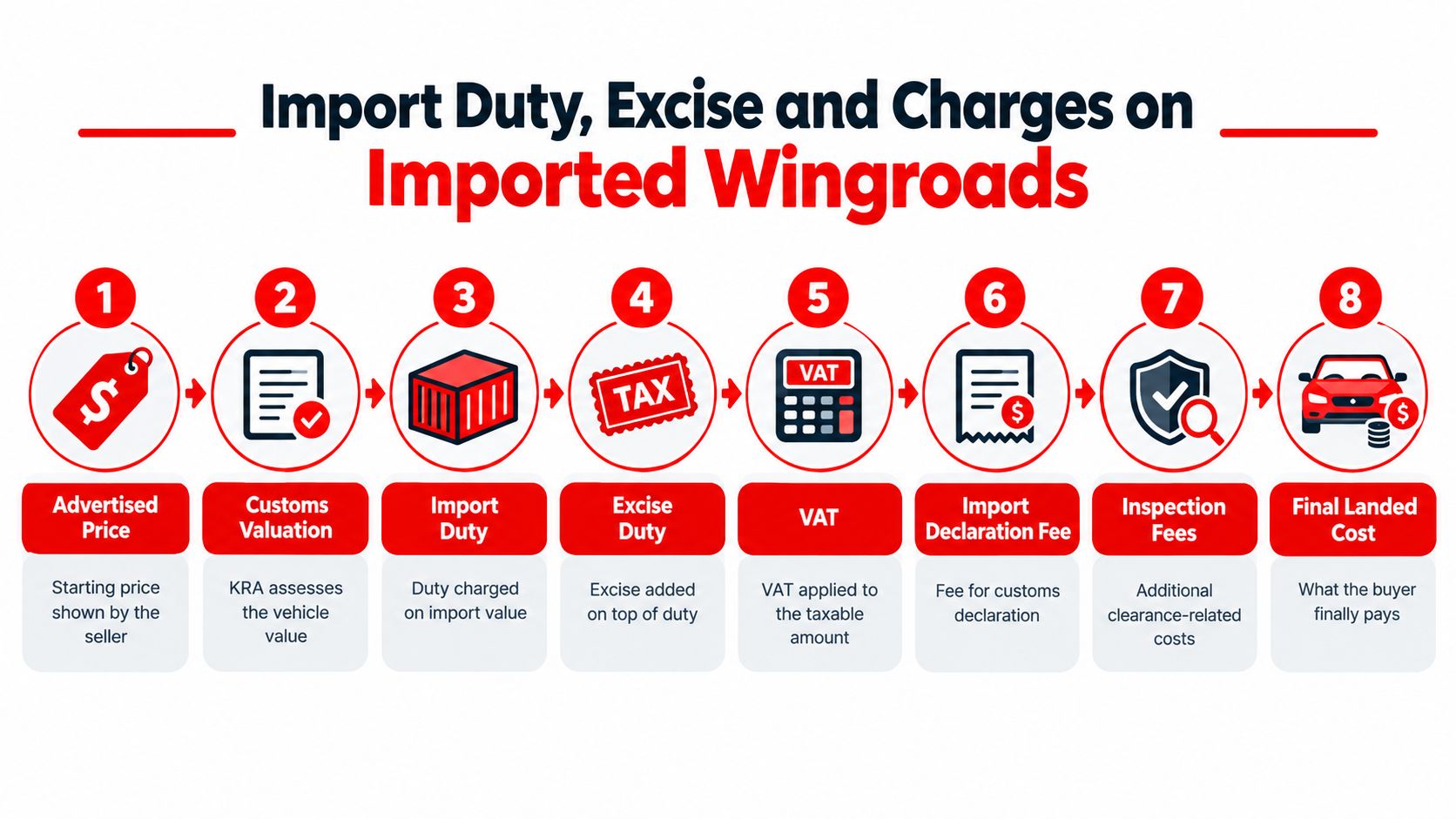
The advertised price of an imported Wingroad is the start of the sum, not the end of it. KRA guidance on importing a motor vehicle sets the tax lines, and the final retail figure also absorbs freight, insurance, port handling, clearing, inspection and registration. Confirm the schedule in force with KRA or a licensed clearing agent before you commit. Rates change, and a generic percentage from a social media calculator is not an assessment.
How the tax stack is built
KRA states that import duty is 25% of customs value. Excise duty is 20% where the engine is 1,500 cc or below, and 25% where it is above 1,500 cc. VAT is 16% of the customs value plus import duty and excise duty. On top of that, KRA identifies an Import Declaration Fee of 3.5% of CIF and a Railway Development Levy of 2% of CIF.
Take a hypothetical CIF of KSh 800,000 and the above-1,500 cc excise rate, which is the illustration that matches those rules:
- Import duty comes first, at KSh 200,000.
- Excise duty is then KSh 250,000, because the above-1,500 cc rate is applied on top of customs value and duty, not on the overseas invoice alone.
- VAT is KSh 200,000, being 16% of customs value plus those two duties.
- Those three taxes alone are KSh 650,000, before the declaration fee and the railway levy, and before port, clearing, registration and inspection.
A 1,500 cc Wingroad uses the lower excise rate, so the same CIF does not produce the same bill. Freight and insurance change CIF, and CIF changes every percentage that sits on it. That is why two cars with the same model year can land at very different costs.
What sits outside the tax lines
Port handling, clearing agency fees, inspection, registration and the first insurance premium are not inside that KSh 650,000. A foreign-used Wingroad and a locally used one of the same year are therefore different products. One price is a car. The other is a car plus a tax file you have not paid yet. Ask the seller, in writing, which of those lines are already settled.
How Customs Value Is Set Using the CRSP Schedule
Do not hand a seller's advert to a clearing agent and call it the customs value. Since 1 July 2025, KRA has valued used motor vehicles on the applicable Current Retail Selling Price (CRSP) schedule. Depreciation is applied from the year of manufacture or first registration, and the schedule is split by model specification and trim. The invoice from an overseas seller is not a substitute for that schedule.
What to verify before anyone quotes a landing cost
Collect five facts and refuse a quote that skips any of them.
- Chassis and model variant: Y12-era Wingroads are not one specification. The exact variant has to match the schedule line.
- Engine capacity: This chooses the excise band as well as the CRSP line. A 1.5-litre car and a larger engine are different tax files.
- Year of manufacture: This is not always the same as the year a seller quotes in an advert.
- First-registration date: Depreciation follows age from manufacture or first registration. A wrong date produces a wrong value.
- Trim: A higher grade is a different schedule entry, not a cosmetic extra you can ignore.
If the seller cannot show the chassis, the engine code and the first-registration date, you do not have a valuation. You have a guess.
Keep every later cost on its own line
Once the CRSP line is identified, keep the rest of the quote in separate rows: import taxes, port and clearing, registration, inspection, insurance and dealer preparation. Mixing them into one "landed" number hides the margin. Two Wingroads of the same model year can carry different landed costs and different resale room because the variant, the age clock and the unpaid charges are not the same. For a car you already own and want to price for sale, the same discipline applies. Separate what you paid to land it from what a buyer will pay for a registered, prepared car.
Engines, Trims and Model Years to Compare
Price only like with like. A 1.5-litre automatic estate is not the same proposal as a larger-engine grade with a different transmission, even when the badge and the year match. Nissan's own model pages on the Nissan site are the right place for specification detail. What follows is how those differences should change what you pay in Kenya, not a promise of a particular litre-per-100 km figure.
Engine capacity
The 1,500 cc line is the commercial one, not just a brochure one. At or below it, imported cars use the lower excise rate covered earlier. Above it, the rate steps up, and fuel use on the school run and the Thika Road commute is usually thirstier as well. For an older or high-mileage 1.5, ask about oil consumption, gearbox behaviour when hot, and whether the cooling system has been refreshed. A larger engine can feel stronger with a full load. It should cost more to clear and more to fuel, so do not pay a 1.5 price for it, and do not pay a premium for it unless you need the extra pace.
Transmission and drivetrain
Most of the Wingroads buyers compare are automatics, and many use a CVT. On a high-mileage car, a flare in revs, a shudder pulling away, or a service book with no transmission fluid history is a reason to pay less, not a detail to "sort later". A conventional automatic is a different maintenance story. Front-wheel drive is the normal layout and the cheaper one to run. Four-wheel drive, where fitted, adds tyres, differentials and a reason to walk away if the underside is oily. Neither layout is a fault. Paying the same money for both is the fault.
Trim and year
Higher grades bring alloy wheels, better audio and more airbags or driver aids, depending on the year. Those items raise the CRSP line on an import and the retail ask on a local car. They do not fix a neglected engine. Newer years, especially cars that can still meet the import age rule, command more because the supply of legal fresh imports is narrower. That premium is about eligibility and remaining life, not about a badge.
Service records are what separate a fair premium from wishful pricing. A timing-related service, fresh fluids and matching invoices beat a seller's memory. If you are cross-shopping estates in a similar budget, the same year-and-mileage discipline applies to a Subaru Legacy price in Kenya comparison. Preference on brand is fine. Pretending two different drivetrains cost the same to keep is not.
Choosing Between Locally Used and Foreign Used Wingroads
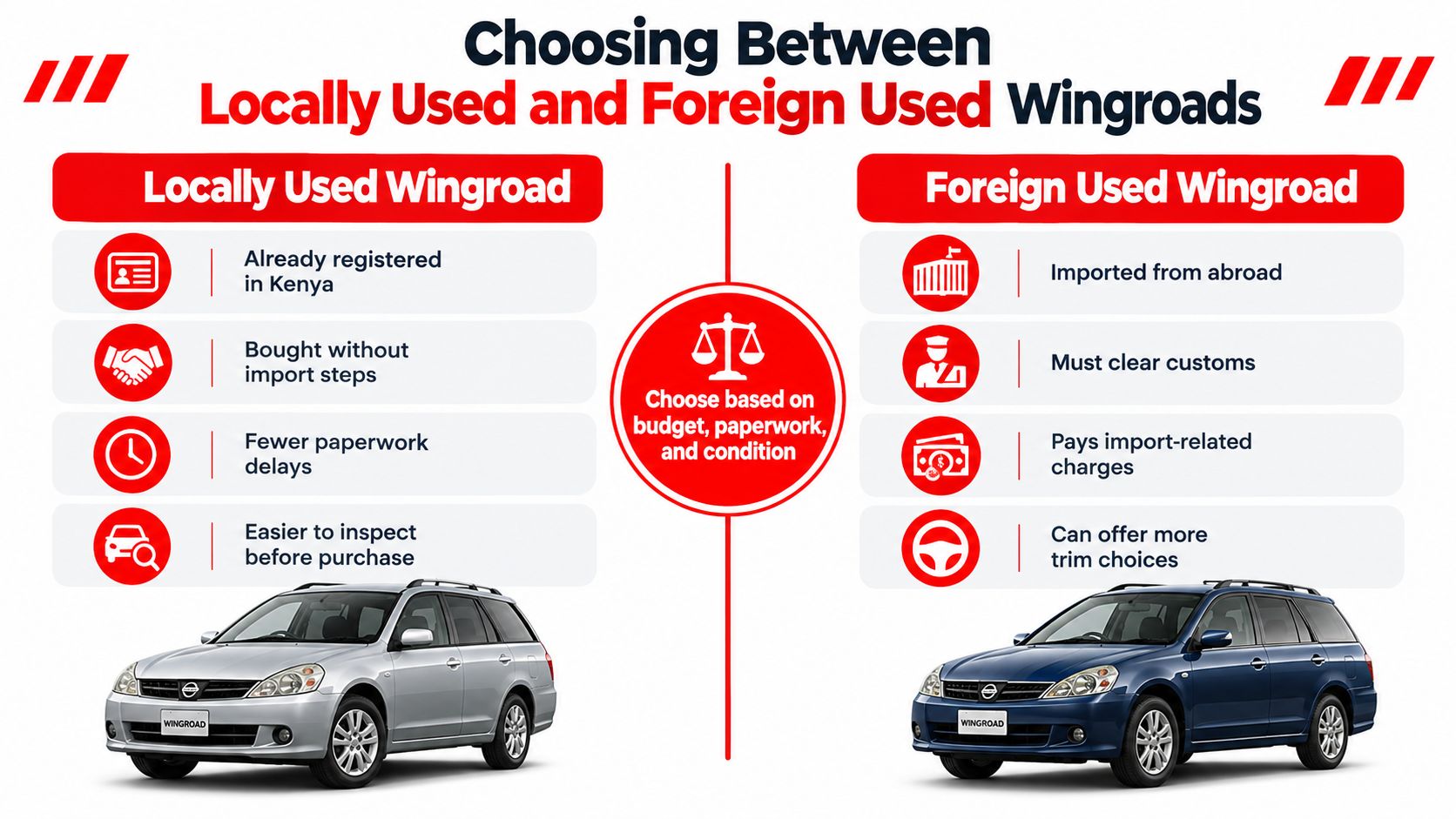
This is the decision that should come before you shortlist individual cars. A locally used Wingroad is already registered in Kenya. You buy it without a fresh import file, you can usually view it on a normal afternoon, and the price already reflects duty, clearance and the seller's margin. You pay for certainty and for time.
A foreign-used Wingroad can show a lower advert, and it can offer a trim that is scarce among local stock. That advert is not your cost. It still has to be valued, taxed, inspected and registered, on the lines set out earlier. Two cars with the same year are not the same purchase until one of them is legally on the road.
Eligibility is not the same as "for sale"
KRA's motor vehicle import procedures say imported used vehicles must be less than eight years old from the year of first registration, and they must be right-hand drive. Reporting on the rule in force from 1 January 2026 indicates that a fresh import generally needed a first-registration date of 1 January 2019 or later. Plenty of Wingroads you will see advertised are older Japanese-market cars. They can still be bought if they were cleared before the rule bit. They cannot be freshly imported just because the advert looks affordable.
That transition showed up in registrations. NTSA figures reportedly reached 31,595 vehicles in December 2025, with part of the surge put down to dealers registering 2018 vehicles before the eight-year limit took effect. A locally used 2018 can therefore carry a premium over a cheaper unit that is no longer importable. You are paying for a car that is allowed to be here, not for a newer badge.
Age compliance is not mechanical quality
A car that passes the age test can still have a huge odometer, CVT wear, accident repairs or a thin auction file. Eligibility gets it through the gate. It does not make it a good Wingroad. If your timeline is short, buy registered. If you have time, a clearing agent and a variant that still qualifies, an import can make sense, including among the wider set of imported cars for sale in Kenya. Do not start viewing until you know which of those two routes you are on.
Viewing Checks and Paperwork to Review Before You Pay
Pay nothing, not even a "booking" deposit, until the identity of the car and the papers agree. A nice test drive does not repair a bad file.
KEBS rules on inspection of road vehicles require an imported Wingroad to be right-hand drive, and imported road vehicles are inspected for conformity and roadworthiness before registration. KEBS also states that the gap between year of manufacture and year of first registration must not exceed one year. Inconsistent manufacture, registration or export documents can block clearance no matter how clean the paint looks.
Documents before the bonnet
Where a used import arrives without a Certificate of Roadworthiness, KEBS requires the logbook, deregistration certificate or export certificate for validation. From 14 July 2025, used vehicles without that certificate need validated import documents before destination inspection. At the viewing, the chassis, the logbook and the import papers have to describe the same vehicle. Missing or inconsistent papers are a serious risk, not a clerk's problem you can fix on Monday.
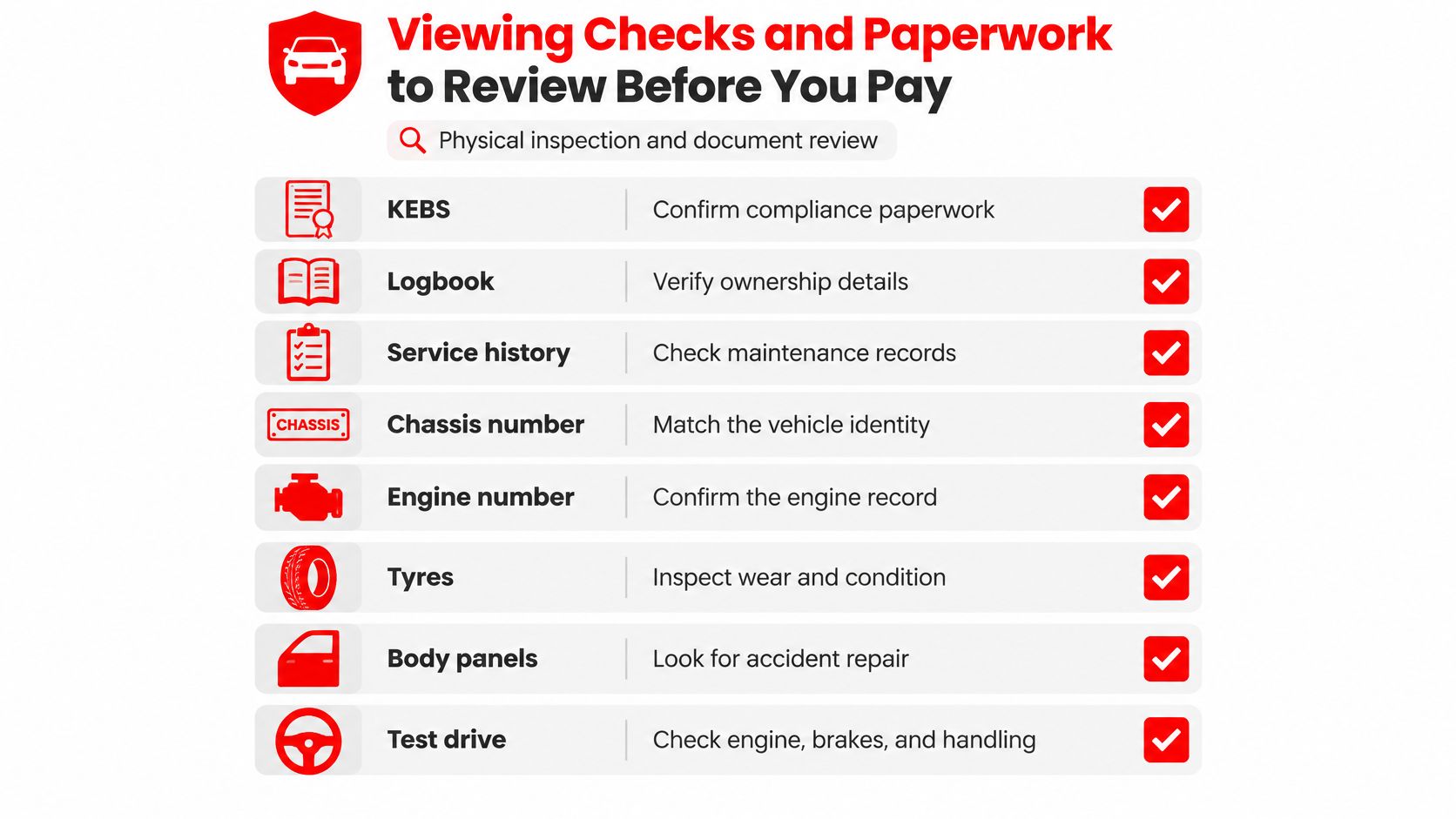
The single inspection order
Work in this order, and stop if a step fails.
- Identity: Read the chassis and the engine number yourself. They must match the logbook and any import paperwork.
- Ownership and history: Confirm the registered owner, the number of previous keepers and any accident record the seller is willing to put in writing.
- Odometer: Compare the dash with service stamps and any inspection sheet. A sudden drop in recorded kilometres is a reason to leave.
- Service file: Look for regular oil services and for transmission fluid on an automatic or CVT. A thick stack of unrelated receipts is not a history.
- Tyres and underside: Uneven wear, fresh underseal over rough metal, or a wet subframe means spend, and it should come off the price.
- Test drive: Cold start, then a hot run. Listen for CVT flare, pull the brakes, and feel the steering on a straight road.
Bring someone who will walk away. The seller's urgency is not your deadline.
Next Steps to Buy or Sell a Wingroad with Brill Motors
The advertised price is only a starting point. Before you commit, confirm whether the Wingroad is already registered and what costs are included in the quoted figure. Import eligibility and customs valuation can affect the landed cost, so a model year alone will not tell you what the car should cost.
For a purchase, set your priorities before viewing: year, engine size, acceptable mileage and whether you need a registered car. Use the relevant price band as a guide, then judge the asking price against the vehicle's condition and the costs still to pay. Ask the seller to state clearly what the price includes.
If you are selling or trading in, bring the logbook, service invoices, mileage and repair records. Those details give the valuation a sound basis. Brill Motors offers financing, vehicle valuation and trade-ins at the Rooftop Car Yard, Garden City Mall, on Thika Road. If you plan to sell your Wingroad rather than retail it yourself, review the sell your car options. Ask for a figure that states what is included, and confirm any terms before agreeing.
Check current stock and prices against the band you can afford, then view the car in person. Bring your year, mileage and documents, and make sure the quoted amount matches what you will pay.
Brill Motors buys and sells used cars from the Rooftop Car Yard at Garden City Mall. Browse the available Wingroads or visit the yard on Thika Road to compare a live car with your budget.