

 SIGN UP
The usual advice is to compare asking prices and negotiate the cheapest Harrier. That's incomplete. A lower advertised figure isn't a saving if it excludes import charges, hides deferred maintenance or leaves you with a fuel bill you haven't budgeted for.
Toyota Harrier cost is best understood as a complete ownership budget, not a single price. For a Nairobi buyer, the useful comparison is between cars with clearly stated purchase costs, documented condition and running costs that match the way you'll drive.
How a Toyota Harrier Price Is Built in Kenya
A Harrier's advertised figure covers only part of what you will pay. The full price depends on its purchase route, model year, mileage, trim and engine, then on the condition of the individual vehicle. A locally used car is priced as it stands, with its existing registration, maintenance history and wear. A foreign-used car needs a landed-cost calculation before its overseas price becomes meaningful.
At Brill Motors, we sell both foreign-used and locally used cars. Browse our Toyota stock for current vehicle details and live asking prices instead of treating a broad guide as a quotation. Our Toyota cars price guide also helps you frame a budget across the make.
Separate the purchase bill from the customs valuation
Start with two distinct records: what you pay to acquire and transport the car, and the value KRA uses to calculate taxes. They can differ, and a cheap overseas invoice does not guarantee a proportionately smaller tax assessment.
KRA's motor-vehicle import guidance explains the customs valuation framework and illustrates the calculation at 25% import duty, engine-dependent excise duty and 16% VAT. On those example assumptions, a customs value of KSh 2,000,000 produces KSh 500,000 import duty, KSh 625,000 excise and KSh 500,000 VAT, before other levies.
The 25% duty above is the rate inside KRA's illustrative structure. The headline import-duty rate has since been revised upward, so the worked example below demonstrates method only. Substitute the rate a licensed clearing agent or KRA confirms for the vehicle's assessment date.
Build the quotation in this order:
- Establish the customs value. Ask for the vehicle description, valuation basis and depreciation applied, and question any unexplained tax total.
- Identify freight and insurance. Add these to the purchase cost to establish the cost, insurance and freight amount, commonly called CIF. Skip them if the quotation already includes them.
- Calculate import duty and excise. The clearing calculation should show the applicable classification and each taxable base.
- Calculate VAT. Check that the assessment includes the relevant customs value, duty and excise components.
- Add levies and arrival costs. Keep statutory levies separate from inspection, port charges, handling and clearing-agent charges.
CIF describes a cost build-up. The customs assessment can rest on a separate valuation framework, so ask the agent to reconcile the two figures before you treat the invoice as the last word on tax.
Illustrative import cost build-up
For the worked example below, assume both the assessed customs value and the CIF base are KSh 2,000,000. KRA's customs FAQ lists the 2% Import Declaration Fee and 1.5% Railway Development Levy used here; combined with the duty structure above, the calculated tax subtotal is KSh 1,695,000, or 84.75% of customs value.
| Cost line | Basis | Amount (KSh) |
|---|---|---|
| Customs value | Illustrative used-car valuation | 2,000,000 |
| Import duty | 25% of customs value | 500,000 |
| Excise duty | 25% of customs value plus duty, 2,500,000 | 625,000 |
| VAT | 16% of 3,125,000 | 500,000 |
| Import Declaration Fee | 2% of assumed CIF | 40,000 |
| Railway Development Levy | 1.5% of assumed CIF | 30,000 |
| Tax subtotal | Before port, clearing and registration | 1,695,000 |
| Tax as share of customs value | Tax subtotal divided by customs value | 84.75% |
This illustration demonstrates the arithmetic. It excludes the separately quoted costs of bringing the vehicle through the port, clearing it and preparing it for registration, and it sets no Harrier's retail price.
Quote rule: Every total should say what's included, what remains payable and who receives each payment.
Imported-vehicle buyers are responsible for all import-related costs, including duty, taxes, shipping, inspection, port charges and handling fees. An attractive purchase price becomes useful only once those obligations are visible.
Request a written quotation with vehicle price, freight and insurance, KRA taxes, port and clearing, and registration on separate lines. If a seller describes a figure as landed or duty paid, ask for its precise inclusions and supporting documents. Compare quotations on the lines they itemise and the paperwork behind each figure.
Factors That Move a Harrier's Price
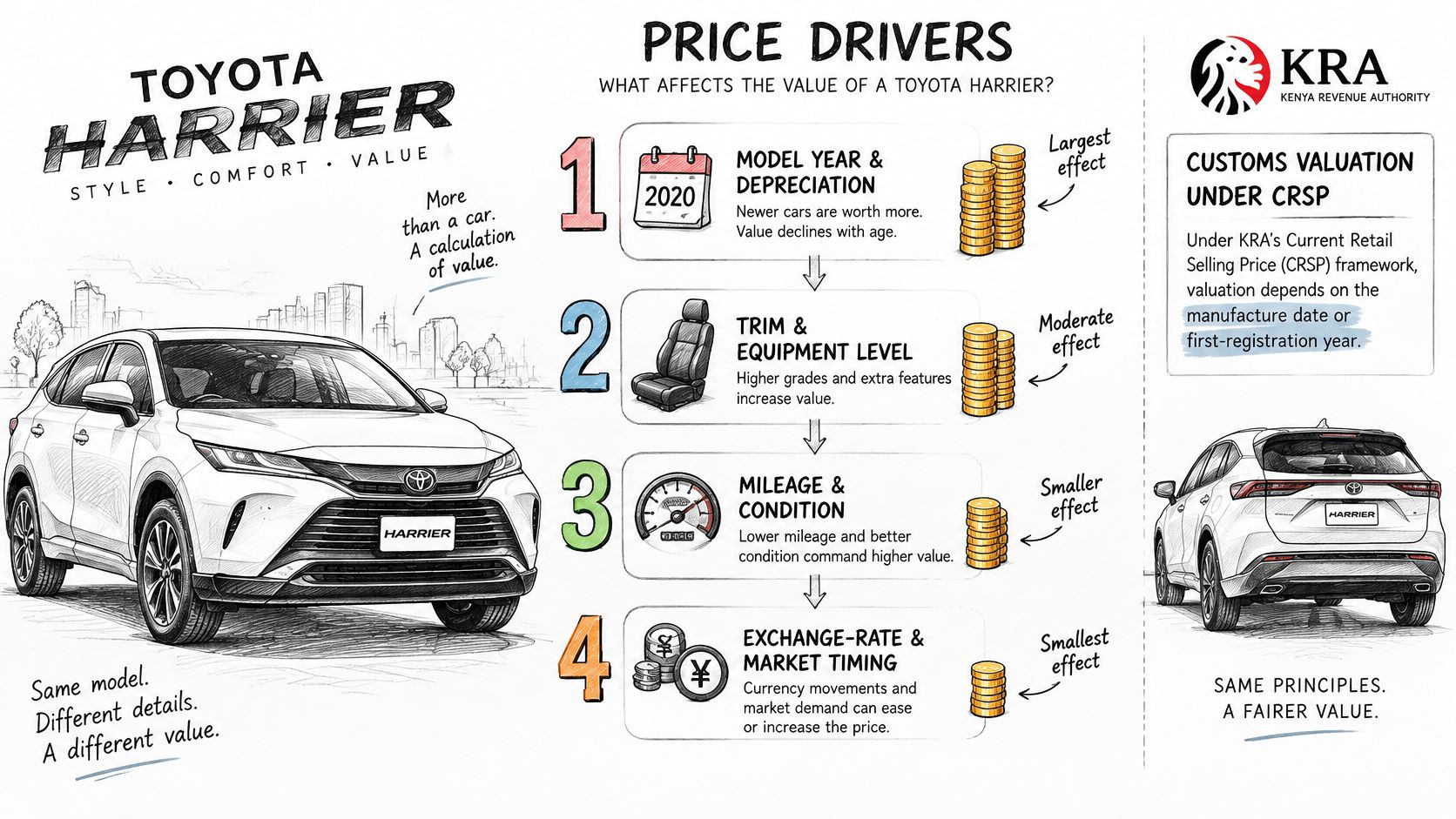
Treat the following as a practical order for reviewing a quote, not a fixed formula. A damaged newer vehicle can be worth less than an older, well-maintained example, so condition can overturn the usual ranking.
Start with valuation and classification
Model year and depreciation come first for an import. KRA's CRSP clarification records the revised schedule introduced on 1 July 2025, with depreciation linked to manufacture date or first-registration year, and a headline import-duty change from 25% in 2019 to 35% in 2025. That's why an old import calculation shouldn't be reused as a current budget.
Engine capacity needs documentary confirmation. KRA's importing guidance distinguishes excise treatment for vehicles of 1,500 cc and below from those above 1,500 cc. A trim badge or hybrid emblem doesn't establish the applicable category.
Then assess the vehicle-specific differences:
- Drivetrain: Compare petrol and hybrid examples on both acquisition cost and expected use. Don't assume the hybrid premium will repay itself.
- Mileage and condition: A supported mileage record is more useful than an attractive dashboard reading. Price any overdue work before accepting a condition premium.
- Trim and equipment: Verify leather upholstery, roof operation and driver-assistance equipment physically. A feature named in an advert isn't proof that it works.
- Market timing: Request the exchange-rate basis and quotation validity for an import. Keep pump-price movements in the ownership calculation, not the customs calculation.
Two same-year Harriers can justify different prices, but the explanation should survive a document check and a mechanical inspection.
Running Costs of a Harrier in Nairobi Traffic
Fuel use and monthly petrol cost in Nairobi
Using the KSh 226.96 per litre Nairobi reference in EPRA's petroleum statistics report, these are calculated fuel budgets for 1,500 km per month, not guaranteed consumption figures or a promise of today's pump price.
| Consumption (km/L) | Litres per 1,500 km | Monthly fuel cost (KSh) |
|---|---|---|
| 8 | 187.5 | 42,555 |
| 10 | 150 | 34,044 |
| 12 | 125 | 28,370 |
| 14 | Approximately 107 | Approximately 24,317 |
Costs use unrounded fuel volumes, which explains the rounded litres in the final row. The table isolates consumption so you can see how much your budget changes without changing the distance driven.
A Kenyan Harrier ownership account published by Money254 describes approximately 10 km/L in Nairobi traffic and 14 km/L on highways, alongside indicative minor servicing of KSh 6,000 to KSh 9,000 every 5,000 km and major repairs of KSh 25,000 to KSh 45,000. These are an owner's reported costs, not fixed workshop charges or figures that apply to every Harrier.
Budget for your route, not the best result
Stop-start journeys, air-conditioning use, tyre specification and driving style can change your result. If most of your driving involves congested commutes, don't build your monthly budget around a highway consumption figure.
A hybrid may offset part of a higher purchase price through reduced petrol spending. But battery condition, servicing needs and the actual purchase-price difference determine whether you save overall. Obtain a battery-health assessment rather than treating the hybrid badge as a financial guarantee.
Ownership test: Choose the car you can afford to maintain after paying for it, not merely the car whose deposit you can raise.
Run a three-year ownership comparison using your expected annual kilometres and the current pump price. Include insurance, parking, servicing, repair provision and any finance repayments. Keep routine maintenance separate from a repair reserve, because an oil service and a worn suspension component aren't interchangeable budget items.
Checks and Paperwork Before You Pay
A clean interior and fresh polish don't establish mechanical condition or ownership. Before paying a deposit, make sure the vehicle, its documents and the proposed transaction all describe the same car.
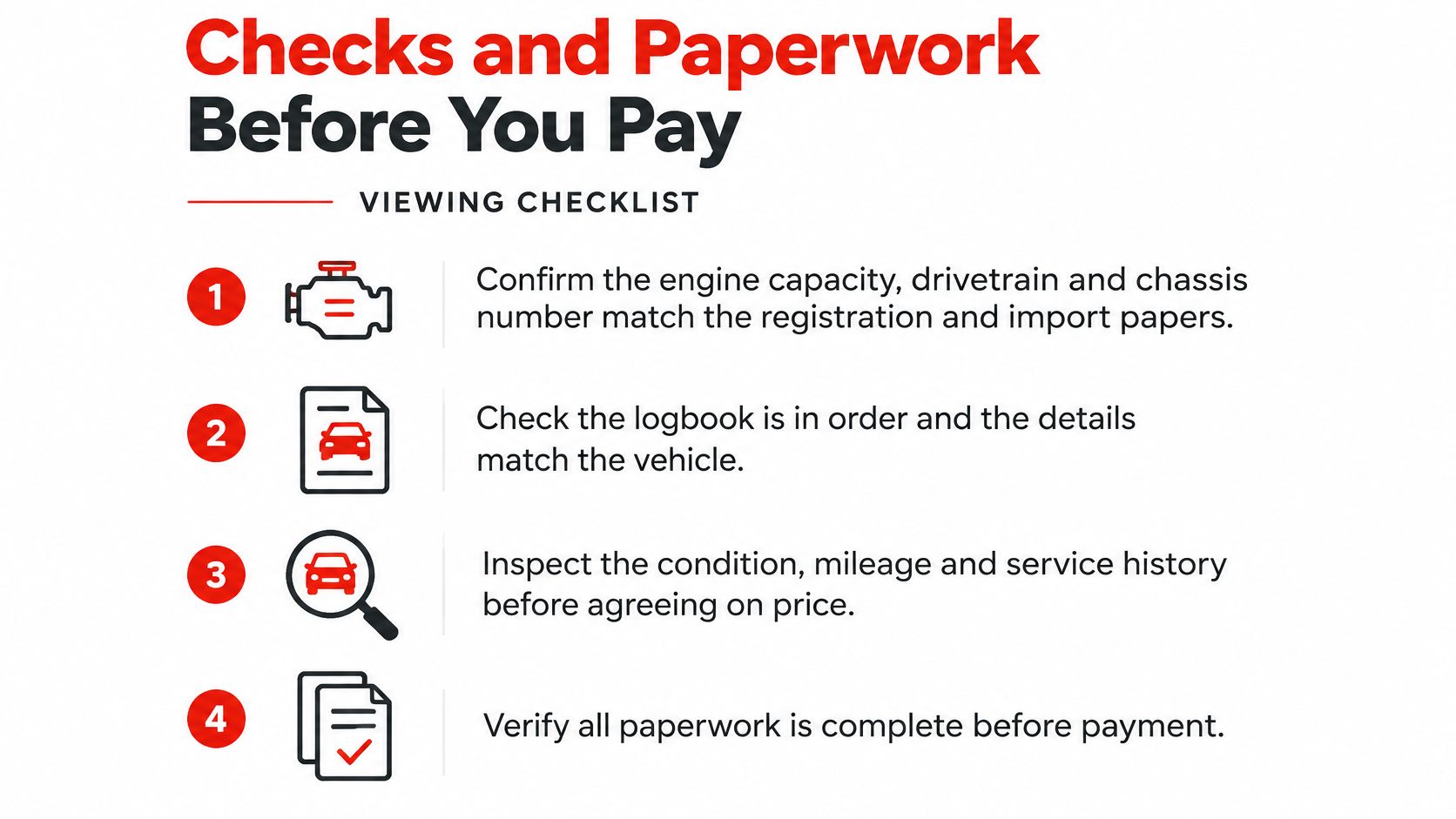
Viewing checklist
- Match the identity. Confirm engine capacity, drivetrain and chassis number against the registration and import papers.
- Verify the seller's authority. Check the logbook is in the seller's name, or establish documented authority to sell, and confirm transfer is possible.
- Read the maintenance record. Look for consistent oil and filter changes, supported by invoices rather than stamps alone.
- Scan the electronics. Have an independent mechanic read diagnostic fault codes and investigate warning lights.
- Inspect structural and cooling condition. Check for leaks, corrosion, uneven panel repairs and signs of overheating.
- Test the transmission. Start from cold, select drive and reverse, then assess engagement and acceleration during a road test.
- Assess wear components. Inspect suspension, uneven tyre wear and brakes, and obtain costs for work identified.
- Confirm certification status. Establish which inspection or roadworthiness documents apply and whether anything remains outstanding.
Separate paperwork costs from the car price
Buyers are responsible for the relevant transaction costs. Ask for a written allocation covering:
- Registration and number plates: Confirm the applicable charges through NTSA and eCitizen.
- Logbook transfer: Establish who initiates the process and who pays.
- Insurance: Obtain a vehicle-specific premium and confirm the cover start date.
- Inspection or roadworthiness certification: Identify outstanding requirements and the responsible payer.
For an imported unit, reconcile duty and port obligations against the itemised landed quotation rather than adding an unexplained allowance. Insurance premiums, government charges and third-party fees aren't automatically refundable by Brill Motors, so understand payment terms before authorising them.
Arrange an independent mechanical inspection before paying a deposit, and keep any agreed repairs or conditions in writing.
Getting Fair Value When You Sell or Trade In
Ask for the offer's reasoning in writing. A valuer should separate the car's underlying condition from presentation issues and list any repair deductions clearly enough that you can check them against your own records.
A complete file keeps that discussion honest. Bring the logbook, service history and records of previous repairs to the valuation so the offer starts from documented facts instead of a quick walk-around. Where a figure seems low, ask which specific item in your records produced the deduction.
Make the offer easy to evaluate
Our sell-your-car service includes a free valuation, secure payment and transfer assistance. You can request a valuation, receive an offer, and decide whether a direct sale or a trade-in suits your next purchase.
Keep the process practical:
- Prepare your documents: Gather the logbook, service records and insurance papers.
- Request a valuation: Disclose known faults and previous repairs so the offer reflects the car accurately.
- Ask for the reasoning: Have the valuer explain how model year, mileage and condition shaped the figure.
- Record the trade-in agreement: Put the replacement price, allowance and balance in writing.
- Complete the handover: Agree payment and transfer arrangements before releasing the vehicle.
We buy trade-in vehicles from customers. If the replacement costs more, you pay the difference; if it costs less, we refund or credit the difference as agreed.
Evaluate the replacement price and trade-in allowance separately. A generous allowance on its own says little about whether the whole transaction represents fair value.
Before accepting, ask three questions: how was the valuation set, do any deductions remain unresolved, and on what date will payment and transfer be completed. Get each answer in writing, and release the vehicle only once the payment and transfer timing is confirmed.
Confirm Your Landed Budget Before You Shop
Set your budget at the total cost of ownership: the price paid, the paperwork, and the fuel and servicing that follow. That figure gives you a firm stopping point when a tempting specification exceeds your practical allowance.
Choose your route first. For a locally used Harrier, work from the agreed purchase price plus any preparation the inspection identifies. For a foreign-used vehicle, insist on a complete arrival quotation, because the buyer carries every import-related cost: duty, taxes, shipping, inspection, port charges and handling fees. Our guide to imported cars in Kenya explains that route in more detail.
Worked example: build the budget line by line
Start with the agreed price. Add the setup costs you pay before the car is legally yours: registration fees, logbook transfer charges, number plates, insurance and any inspection or roadworthiness certification. Then add the monthly figure, meaning fuel calculated from your expected distance and realistic consumption, plus parking and any loan repayment. Finally, hold back a reserve for servicing and the repairs the inspection flagged. The sum of those four lines is the number you test every quote against; the asking price is only the first line.
We offer financing assistance and personal guidance on the available vehicle-financing options. Compare the repayment commitment against that complete monthly figure rather than judging the instalment on its own.
A Harrier that leaves room for proper maintenance is often the better buy than a newer or more highly equipped example that consumes the whole budget. Confirm the full quotation before you commit, and choose on documented condition rather than appearance.
Brill Motors offers locally used and foreign-used vehicles, valuation, trade-ins and financing guidance to help you plan your Harrier purchase. Visit Brill Motors to check current Toyota stock and live Harrier prices, then visit our Garden City Mall showroom in Nairobi to view vehicles in person.