

 SIGN UP
You are standing in traffic on Thika Road, scrolling through Touareg listings on your phone, and two cars look identical in the photos. One is cheaper, one is newer, and both sellers promise a clean premium SUV. That price gap is where most buyers make the mistake. A Touareg is not bought on asking price alone, it is bought on generation, engine, records and the monthly bill you will carry in Nairobi traffic. If you cannot explain why one car costs less than the other, do not buy either yet.
Reading a Volkswagen Touareg Listing in Kenya
Two buyers can look at the same budget and reach opposite conclusions. One sees a well equipped Touareg under his ceiling and books a viewing immediately. The other asks whether the car is locally used or imported, what engine it has, and whether the service file supports the mileage. The second buyer is usually the one who avoids an expensive first month.
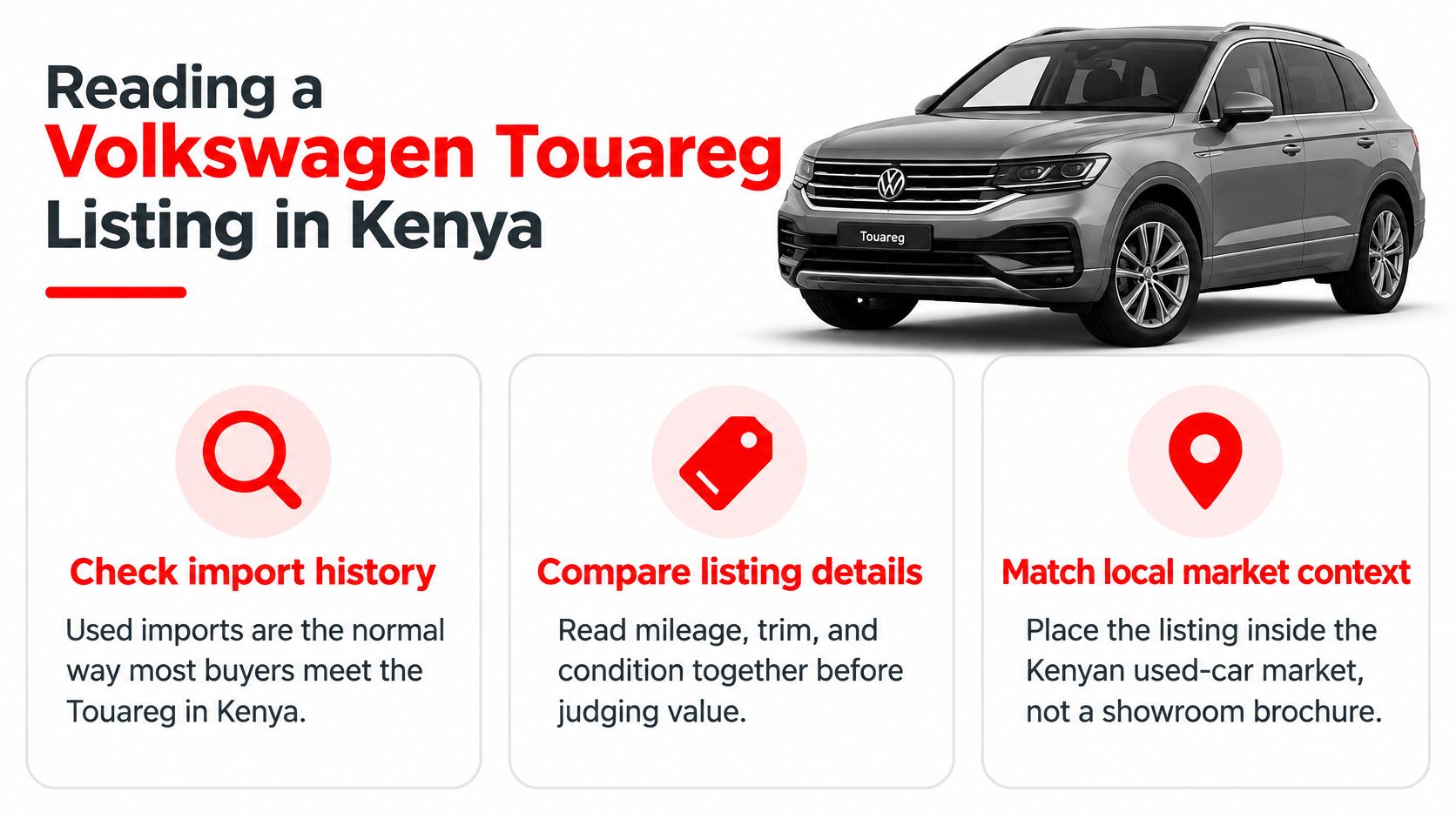
That caution is justified by how Kenya gets its cars. The Kenya Revenue Authority states that the country imports approximately 70,000 to 80,000 motor vehicles annually, including new and used vehicles, and that about 80% are used vehicles, which implies an estimated 56,000 to 64,000 used vehicles entering Kenya each year, according to Kenya Revenue Authority facts on vehicle imports. Used imports are not a niche route, they are the normal way most buyers meet a premium SUV here.
What the asking price does not tell you
A budget of under KSh 1 million, KSh 1.5 million or KSh 2 million is only a filter. It does not tell you whether the gearbox shifts cleanly when cold, whether the suspension holds its height overnight, or whether the mileage matches the service history. On a Volkswagen Touareg for sale in Kenya, those details decide value more than leather colour or wheel size.
Read every advert in the same order. Start with year, mileage, fuel type and transmission, then ask whether the unit is locally used or imported, then look for inspection and service notes. If any of those lines is missing, treat the listing as incomplete rather than as a bargain.
Do not judge a Touareg by the lowest asking price in your search results. Judge it by the cost of the work the previous owner may have left for you.
An older diesel with a complete service file can be a better purchase than a newer petrol car with gaps in its records. The reverse is also true. A locally used car that has been serviced on schedule and scanned properly can beat a foreign used car with no credible history. Origin alone proves nothing.
A practical way to shortlist
Build your shortlist around questions, not photos. Ask for the year of manufacture, not only the year of registration. Confirm the engine size in the documents, not only in the advert headline. Ask what inspection has already been done and what faults, if any, were found.
- Import status: Is this unit locally used, or was it imported for sale?
- Service evidence: Who serviced it, when was the last service, and are invoices available?
- Known faults: Are there warning lights, leaks, suspension noises or gearbox issues to declare?
- Use pattern: Has it mainly done Nairobi commuting, long distance travel, or rougher roads?
When you are ready to compare live units, check current stock directly on brillmotors.com and view the car in person rather than relying on a forwarded listing. A Touareg rewards a careful buyer, but it punishes a buyer who shops on price first and asks questions later. Set your ceiling, then let generation, engine and evidence narrow the list.
Touareg Generations Sold in the Kenyan Market
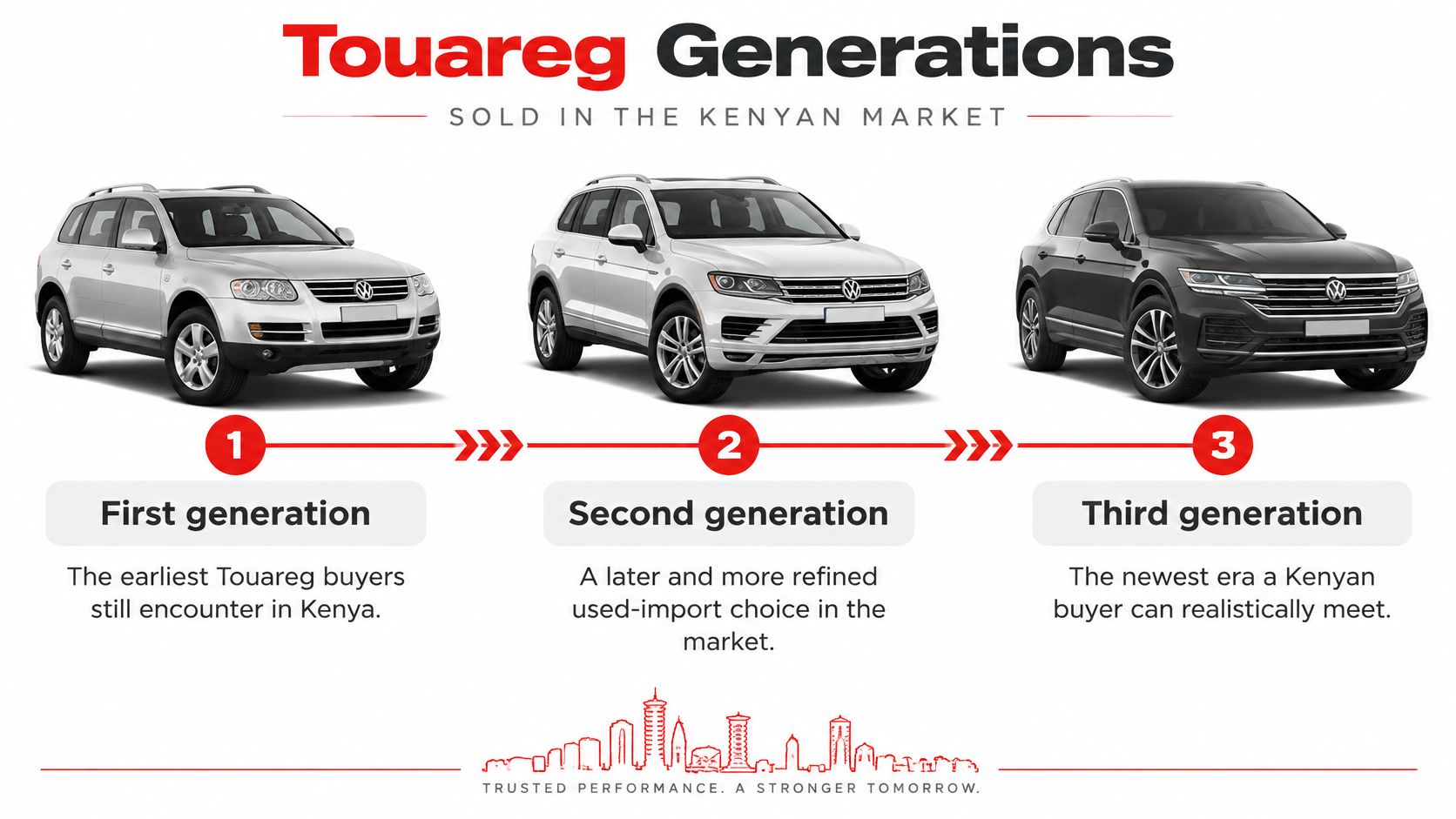
Model year is the fastest way to separate one Touareg from another, but generation is more useful. Cars from different generations share a badge, they do not share the same age risks, technology or repair exposure. When you are comparing a Volkswagen Touareg for sale in Kenya, classify the car by generation before you compare mileage or price.
Volkswagen introduced the first generation Touareg in 2002, the first generation ran from 2002 to 2010, the second generation from 2010 to 2018, and the third generation began in 2018, and the model is a five door, five seat SUV with four wheel drive identified as a core feature across earlier generations, according to Topcar Kenya Touareg model information. That timeline explains why two cars with similar mileage can feel like completely different purchases.
First generation cars and age related risk
First generation cars are the oldest Touaregs you will meet in Kenya. They can cost less to buy, and that is their main appeal. The trade off is age. Rubber, wiring, cooling components, suspension parts and electronic modules have all had more years to wear, even when the odometer looks reasonable.
Do not buy a first generation car on a smooth ten minute drive. You need evidence that the automatic gearbox, 4MOTION hardware, suspension and electronics have been maintained, not merely cleaned for a viewing. A tidy interior does not prove a healthy drivetrain.
Second generation breadth
The second generation is where many buyers focus because the spread is wide. You will find diesel, petrol and hybrid variants within the same era, so generation alone still does not make two cars equivalent. One second generation Touareg may suit long distance work, another may suit a buyer who drives less but wants petrol simplicity in some versions.
- Diesel versions: Often chosen for torque and longer trips, but condition of the fuel system and turbo matters.
- Petrol versions: Can suit lower monthly mileage, but fuel use in congestion needs honest budgeting.
- Hybrid versions: Add complexity, so battery and system health need specific checks.
If you are still deciding whether a large premium SUV fits your household at all, the wider context in our guide to choosing an SUV for sale in Kenya helps you compare size and use before you commit to the Touareg specifically.
Third generation expectations
Third generation cars bring newer technology and a more modern cabin, and they usually need a higher acquisition budget. Newer does not mean fault proof. It means faults, when they appear, may involve more integrated electronics and more expensive components.
Practical rule: Match the generation to the job and to your repair reserve, not to the newest shape you can stretch to buy.
For daily Nairobi commuting, a well maintained second generation car can be the sensible middle ground. For regular long trips or rougher roads, drivetrain condition matters more than screen size in any generation. Buy the era you can inspect properly and maintain properly, not the era that photographs best.
Engines, Gearboxes and Real Fuel Use
Engine choice changes a Touareg more than trim does. Two cars from the same year can have very different fuel bills, service needs and resale appeal because one is diesel and the other is petrol or hybrid. Read the engine entry for the specific car you are viewing, not a generic Touareg description.
Second generation versions were offered with 3.0 litre V6 diesel engines, a 4.2 litre V8 diesel, and petrol or hybrid variants, generally paired with an eight speed automatic transmission and four wheel drive, as set out in the Topcar Kenya model information cited earlier. That breadth is useful, but it also means a buyer must confirm exactly which powertrain is in the car in front of him.
Specification benchmarks worth comparing
| Example | Engine | Gearbox and drive | Published economy |
|---|---|---|---|
| Second generation diesel range | 3.0 litre V6 diesel and 4.2 litre V8 diesel | Eight speed automatic, four wheel drive | Varies by version, confirm on the specific unit |
| Second generation petrol and hybrid range | Petrol or hybrid variants | Eight speed automatic, four wheel drive | Varies by version, confirm on the specific unit |
| 2008 3.0 V6 TDI example | 2,967 cc turbo diesel, about 221 hp and 500 Nm | Six speed Tiptronic automatic, 4MOTION | Approximately 9.3 L/100 km combined |
| 2017 3.6 litre petrol example | 3.6 litre petrol | Automatic, four wheel drive pattern for the model | Approximately 11.4 km/l average consumption |
The 2008 example gives a useful worked benchmark. A commonly advertised 2008 Volkswagen Touareg 3.0 V6 TDI uses a 2,967 cc turbo diesel engine rated at about 221 hp and 500 Nm, paired with a six speed Tiptronic automatic transmission and 4MOTION all wheel drive, with approximately 9.3 L/100 km combined consumption and a 100 litre fuel tank, and the related import age context is covered in KRA procedures for importing a motor vehicle. At that stated rate, a full tank theoretically covers roughly 1,075 km before real conditions reduce the range.
Do not expect that theoretical range in Nairobi. Traffic, idling, short trips, air conditioning, tyre condition, terrain and drivetrain losses all cut it. Brochure economy is a starting point for calculation, not a promise for Waiyaki Way at rush hour.
Petrol benchmark and import age
The petrol side needs its own figure. A 2017 3.6 litre petrol example is reported at approximately 11.4 km/l average consumption, with 0 to 100 km/h acceleration in 7.5 seconds, according to the Topcar Kenya model information cited earlier. That performance is strong, but a large petrol engine used mainly in congestion will test your monthly budget quickly.
Age also affects how you should interpret an older listing. Because the cited 2008 example would be outside the current eight year import age criterion for a newly imported vehicle, its relevance in Kenya is mainly as locally registered stock, not as a compliant fresh import. If a seller describes a car of that age as a fresh import, stop and ask for documents before you discuss price.
Choose diesel for the right reason, which is suitable use and verified condition, not an assumption that diesel automatically saves money. Choose petrol with your eyes open about consumption. Choose hybrid only when the system has been checked by someone who understands it.
Budgets and Live Touareg Prices at Brill Motors
Set your ceiling before you view a single car. Buyers who start by falling in love with a Touareg and then try to stretch the budget usually cut corners on inspection, insurance or the first service. That is the wrong order for a premium German SUV.
Use budget bands as a navigation tool, not as a price promise. Whether your ceiling is under KSh 1 million, KSh 1.5 million or KSh 2 million, the question is the same. What generation, engine and condition can that ceiling buy without leaving you exposed in the first months of ownership?
Match the ceiling to the generation
A lower ceiling usually points you towards an older first generation car or a higher mileage diesel. That can work, but only if the car passes on gearbox, suspension and turbo condition. A cheap Touareg with a tired automatic gearbox is not cheap. It is a down payment on a repair.
A higher ceiling opens later second generation cars and, for some buyers, third generation stock. You are paying for newer technology and usually fewer age related faults, not for immunity from maintenance. Keep a separate reserve either way.
- Lower budget discipline: Prioritise service records and a clean diagnostic scan over cosmetic upgrades.
- Middle budget discipline: Compare second generation diesel and petrol cars on your actual monthly kilometres.
- Higher budget discipline: Check that newer technology works fully, because electronic faults reduce the value you paid extra to get.
Use live listings for live prices
Do not build your decision around a price screenshot from months ago. Stock changes, and a Touareg advert is only useful when you can open it and confirm year, mileage, fuel type, transmission and whether the unit is locally used or imported. If those details are not on the listing, ask before you travel to view.
A general price guide helps you filter. Only a live listing for a specific car helps you decide.
At Brill Motors, check current Touareg stock on brillmotors.com for the live asking price of the actual unit you want to view. Then bring that listing to the viewing and test every claim in it against the car and the paperwork. If the car in person does not match the advert on year, engine or mileage, pause the negotiation.
Financing can help a qualified buyer spread the acquisition cost, but it does not reduce running costs. Do not use financing to buy a more expensive Touareg if the monthly fuel and maintenance sums already stretch you. The right car is the one you can buy, insure, fuel and service without hoping nothing goes wrong.
Monthly Running Costs on Nairobi Roads
Ask a different question from the one most adverts invite. Not, can I buy this Touareg, but can I run this specific Touareg every month in Nairobi? For many buyers, especially below KSh 2 million, the purchase price hides the larger commitment.
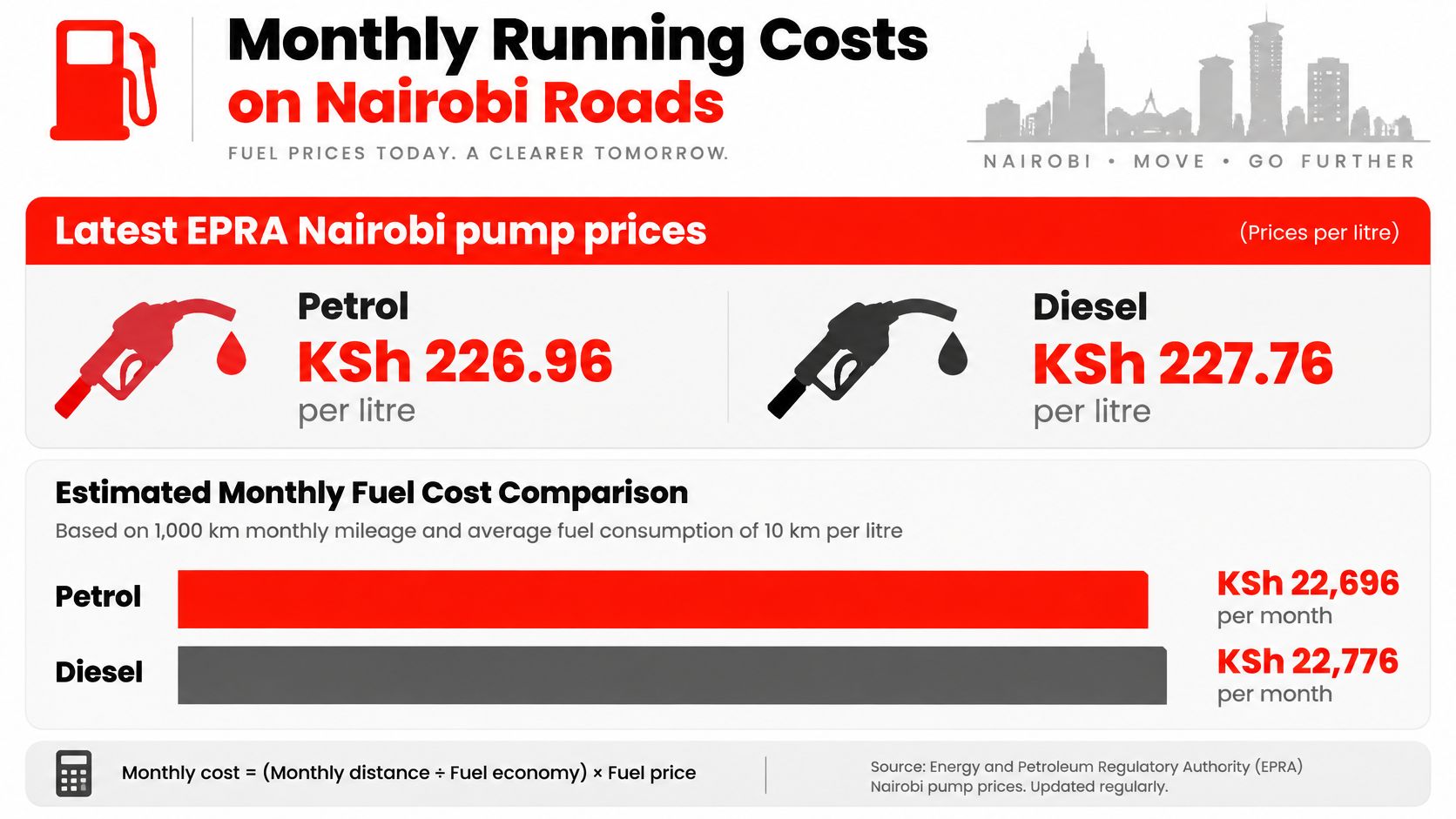
Fuel is the place to start because you will pay it every week. EPRA Nairobi prices in the latest available result were KSh 226.96 per litre for petrol and KSh 227.76 per litre for diesel, showing that diesel is not currently meaningfully cheaper at the pump, according to EPRA current pump prices. That small gap destroys the lazy assumption that a diesel Touareg is automatically the cheap option.
One worked Nairobi fuel example
Take a simple case. At an assumed 1,000 km per month and 10 km/L, fuel alone would cost roughly KSh 22,700 before maintenance, insurance, parking and repairs, using those EPRA Nairobi prices. That is about 100 litres for the month, and it is a guide tied to those prices, not a permanent bill.
Your own figure may be higher. Nairobi traffic, short school runs, air conditioning and low tyre pressures all increase consumption compared with a laboratory figure. Measure your real use over several weeks by dividing kilometres driven by litres bought, then repeat the calculation after servicing or tyre changes.
EPRA prices also move. Kenya fuel prices are reviewed monthly by EPRA, with retail and wholesale prices published on the 15th of each month, so affordability calculations should be date stamped, as explained in EPRA pump price formulae information. Recalculate before you buy, not after.
Maintenance you should budget for separately
Fuel is not the whole bill. For the 2008 3.0 TDI pattern cited earlier, annual maintenance is estimated at KSh 80,000 to 110,000, with engine oil and filter service around KSh 12,000 to 18,000 and brake pad replacement around KSh 15,000 to 25,000, as provided alongside the KRA import procedures reference cited earlier. Treat those figures as planning benchmarks for an older premium SUV, then confirm current parts and labour costs for the exact car.
A cheaper diesel can cost more overall if its turbo, injectors, emissions equipment, air suspension, automatic gearbox or electronics need work. A petrol car may avoid some diesel specific repairs, but a large engine in daily congestion can drink heavily. There is no free Touareg, there is only a Touareg whose costs you have understood in advance.
Write your monthly sum on paper before you view. Fuel, a service provision, insurance, parking and a repair reserve should all fit without strain. If the sum only works when nothing breaks, you are looking at the wrong car for your budget.
Documents That Support a Fair Touareg Price
Paperwork is not administration after the deal. It is part of the price. A Touareg with matching identity, clear registration and a credible service file is worth more than the same looking car with gaps, because you are buying certainty as well as metal.
EPRA publishes regulated maximum retail prices for petroleum products for defined monthly periods under section 101(y) of Kenya Petroleum Act 2019 and Legal Notice No. 192 of 2022, and an available EPRA result identifies a pricing period running from 15 October 2026 to 14 November 2026, showing that official figures are period specific, according to EPRA maximum retail petroleum prices for that period. Apply the same discipline to duty and registration claims. Ask for the current official position, not a remembered percentage from an old advert.
The document pass or fail test
Confirm these items before money changes hands. If the seller cannot produce them, or the details do not match, do not proceed to negotiate on cosmetic points.
- Year of manufacture: Confirm it from the vehicle documents, not only from the listing headline.
- Import documentation and customs status: Confirm how the car entered Kenya and whether its status is clear.
- Chassis and VIN consistency: The numbers on the car must match the documents exactly.
- NTSA registration details: Registration information should agree with the identity of the vehicle being sold.
- Service history: Invoices and service records should support the mileage and the asking price.
For current duty and levy rules, confirm with KRA or a licensed clearing agent and use official channels such as kra.go.ke, ntsa.go.ke and ecitizen.go.ke. Do not accept a tax explanation that cannot be traced to an official source. If you want broader context on how imported stock reaches buyers here, read our overview of imported cars for sale in Kenya before you commit a deposit.
Origin is not evidence
Foreign used does not automatically mean better maintained. Locally used does not automatically mean inferior. Condition, records and inspection evidence matter more than origin, every time.
If year, identity and registration do not match, the viewing is not worth starting.
A missing service file weakens everything else you have calculated. It undermines your confidence in the engine, it makes the monthly budget less reliable, and it gives you less protection on resale. A car outside the eight year import age window can still be legitimate local stock, but it should be presented and priced as local stock, not dressed up as a fresh import.
Pass the car on documents first. Only then spend time and money on a full mechanical viewing.
One Viewing Checklist for a Used Touareg
A short test drive is not enough for a Touareg. This is a complex German SUV with an automatic gearbox, four wheel drive, dense electronics and, on some cars, air suspension. You need one ordered mechanical check and the discipline to walk away if it fails.
Bring this checklist to the viewing and work through it in order. Do not let a polished exterior rush you past the expensive systems.
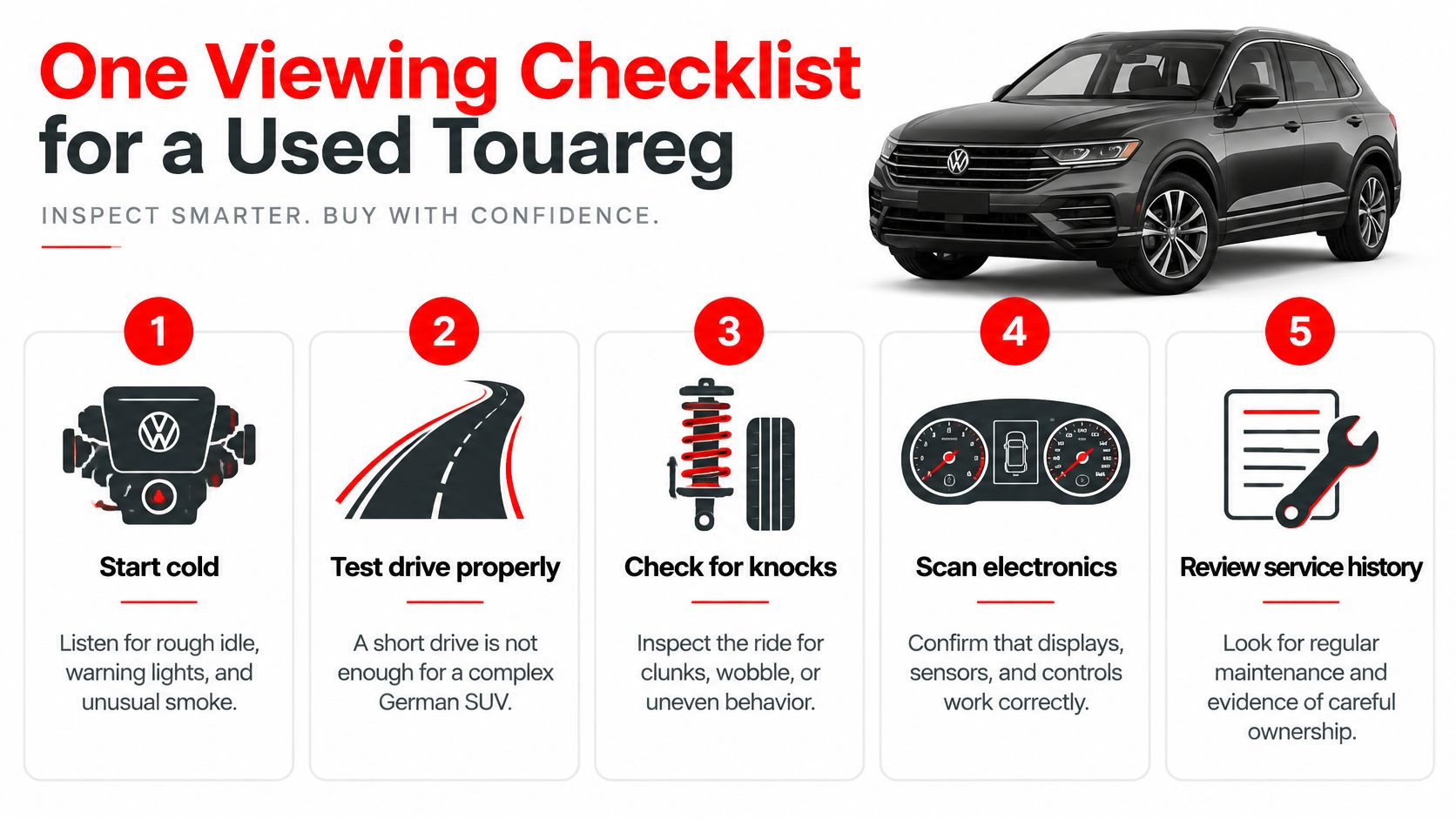
Mechanical checks in order
- Diagnostic scan: Scan the transmission and 4MOTION systems and record every stored fault, not only faults with a warning light showing.
- Diesel injection and turbo behaviour: On diesel cars, test for rough running, smoke, hesitation and signs of injection or turbo faults under load.
- Cooling system and leaks: Check cooling system pressure, coolant condition, hoses and the engine bay for oil or coolant leaks.
- Suspension operation: Test ride height and listen for knocks. Where air suspension is fitted, confirm the car rises, lowers and holds height evenly.
- Electronics and four wheel drive: Confirm displays, sensors, controls and four wheel drive engagement work, then look for evidence of accident or flood repair in panel fit, paint and hidden areas.
A pass looks specific. Shifts are stable from cold, there are no warning lights, ride height is even, the engine bay is dry, and the scan results are consistent with the service book. Vague reassurance is not a pass.
What to do with the result
Tie every fault back to money. Worn brake pads sit inside normal maintenance planning. A gearbox fault, a leaking air suspension corner or a turbo problem changes the value of the car entirely and should change the price or end the deal.
Older cars deserve extra attention on electronics and drivetrain wear because age affects those systems even at moderate mileage. Newer cars need the same checks plus a full test of their extra equipment, because you are paying more for that equipment to work.
Do not renegotiate around a serious fault unless you have a written repair estimate and you still want that specific car. In most cases, the correct response to a failed scan on a Volkswagen Touareg for sale in Kenya is simple. Walk away and find a cleaner example.
View Touareg Stock or Arrange a Trade-In
You now have a method, not just a search term. Pick the generation, read the engine entry, test the monthly fuel sum against your own kilometres, clear the documents, then use the single viewing checklist. A Touareg bought in that order is a deliberate purchase. A Touareg bought in reverse order is a gamble.
Start with current Volkswagen stock and narrow it to Touareg units that match your generation and fuel choice. Browse used Volkswagen cars at Brill Motors for live listings, then confirm year, mileage, fuel type, transmission and inspection notes on the specific car before you travel.
Viewing at Garden City Mall
View the car in person at the Garden City Mall Rooftop Car Yard, Thika Road, Nairobi. Bring the document questions with you, not as an afterthought. Ask to see the service history, confirm the chassis number against the paperwork, and arrange a proper diagnostic check before you finalise.
- Showroom viewing: Inspect the actual unit, start it cold and test the electronics and suspension on site.
- Financing: Discuss financing for the acquisition, while keeping fuel and maintenance in your own monthly budget.
- Vehicle valuation: Request a valuation if you already own a car and want to understand its value first.
- Trade ins: Apply the value of your current car towards a Touareg where a trade in is agreed.
- Selling your car: If you decide a Touareg is not right for you, you can still sell your current car through the dealership.
Do not invent certainty where it does not exist. We will not promise you a specific Touareg is in stock until you check the live listing, and you should not promise yourself a monthly cost until you have run your own kilometres through the current pump price. That honesty protects your budget.
My recommendation is direct. If you want a Touareg, buy the best documented example your ceiling allows, not the cheapest advert you can find. If the monthly sum does not work, change the car, not the arithmetic. A well chosen Touareg is a capable, comfortable SUV for Nairobi and for longer Kenyan journeys, but only when records, inspection and running costs all support the price.
Visit Brill Motors to check live Volkswagen Touareg stock, then come to the Garden City Mall Rooftop Car Yard on Thika Road to view the specific car, review its documents and run through the checklist in person. If you already own a vehicle, ask about valuation, trade in or selling your car, and discuss financing before you commit to the Touareg that fits your monthly budget.