


 SIGN UP

The Kenya National Bureau of Statistics recorded 64,204 station wagons among 93,646 new motor vehicles registered in Kenya in 2024, about 68.5 per cent of the total. That puts a practical question ahead of badge appeal when comparing cars for sale in Kenya: does the body style suit your everyday journeys, and does the full cost make sense once eligibility, taxes and ownership paperwork are counted?
A low overseas asking price isn't the same as a car you can legally register or afford to drive away in Nairobi. Compare the right alternatives in order: body style and budget, import eligibility if relevant, landed cost, mechanical condition and the route to having the vehicle recorded in your name.
Price Bands for Cars on Sale in Kenya
Station wagons are the most common body style in Kenya's new-vehicle registration figures. The Kenya National Bureau of Statistics recorded 93,646 new motor vehicles in 2024, down 21.4 per cent from 119,205 in 2023. The same data shows 64,204 station wagons registered, up from 61,711 in 2023, while 5,367 saloon cars were registered, down from 6,378, and panel vans and pick-ups fell to 5,879 from 12,957. Registration data shows what Kenyan buyers choose. It does not show what your household needs.
Start with the journeys you make and the people or luggage you carry. A wagon or compact SUV can suit family trips, while a hatchback may be easier to park in town. The table below gives a starting point for comparing prices by body style.
Guide price bands by body style
These are budget screens, not live quotations. Year, mileage, condition and service history affect where a particular car sits, so check current listings before setting a firm budget.
| Body style | Typical buyer | Examples | Guide price (KSh) | Running-cost note |
|---|---|---|---|---|
| Small hatchback | City commuter | Toyota Passo, Mazda Demio, Suzuki Swift | Under 800,000 | Typically lower fuel and parking costs |
| Compact wagon or estate | Family and school run | Toyota Fielder, Toyota Wish, Subaru Levorg | 900,000 to 1,800,000 | Boot space; 1.5 to 1.8 litre engines may use less fuel |
| Saloon | Highway and executive use | Toyota Premio, Toyota Mark X, Subaru G4 | 1,000,000 to 1,700,000 | Suits open-road journeys; boot and headroom vary |
| Compact SUV | Mixed town and upcountry | Subaru XV, Subaru Forester | 1,300,000 to 2,600,000 | Higher vehicle mass can mean more fuel in traffic |
| Larger diesel SUV | Family load and long trips | Toyota Fortuner | From about 2,200,000 | Diesel may suit distance better than short queues |
| Luxury SUV | Comfort buyers | Lexus RX | Often above 2,000,000 | Allow for higher parts, tyre and fuel costs |
A wagon can provide a large boot without the height and mass of an SUV. An SUV's ground clearance may be useful on regular routes that call for it. Match the body style to your passengers, luggage and roads rather than paying for space or capability you rarely use.
Budget rule: Set a price band, then compare the car's condition, service history and ownership costs before deciding whether it fits your budget.
Once you have a likely range, use Brill Motors' guide to affordable cars for sale in Kenya to refine your shortlist. Treat the table as a first filter, then check current asking prices for specific vehicles.
Locally Used Cars and the Eight-Year Import Rule
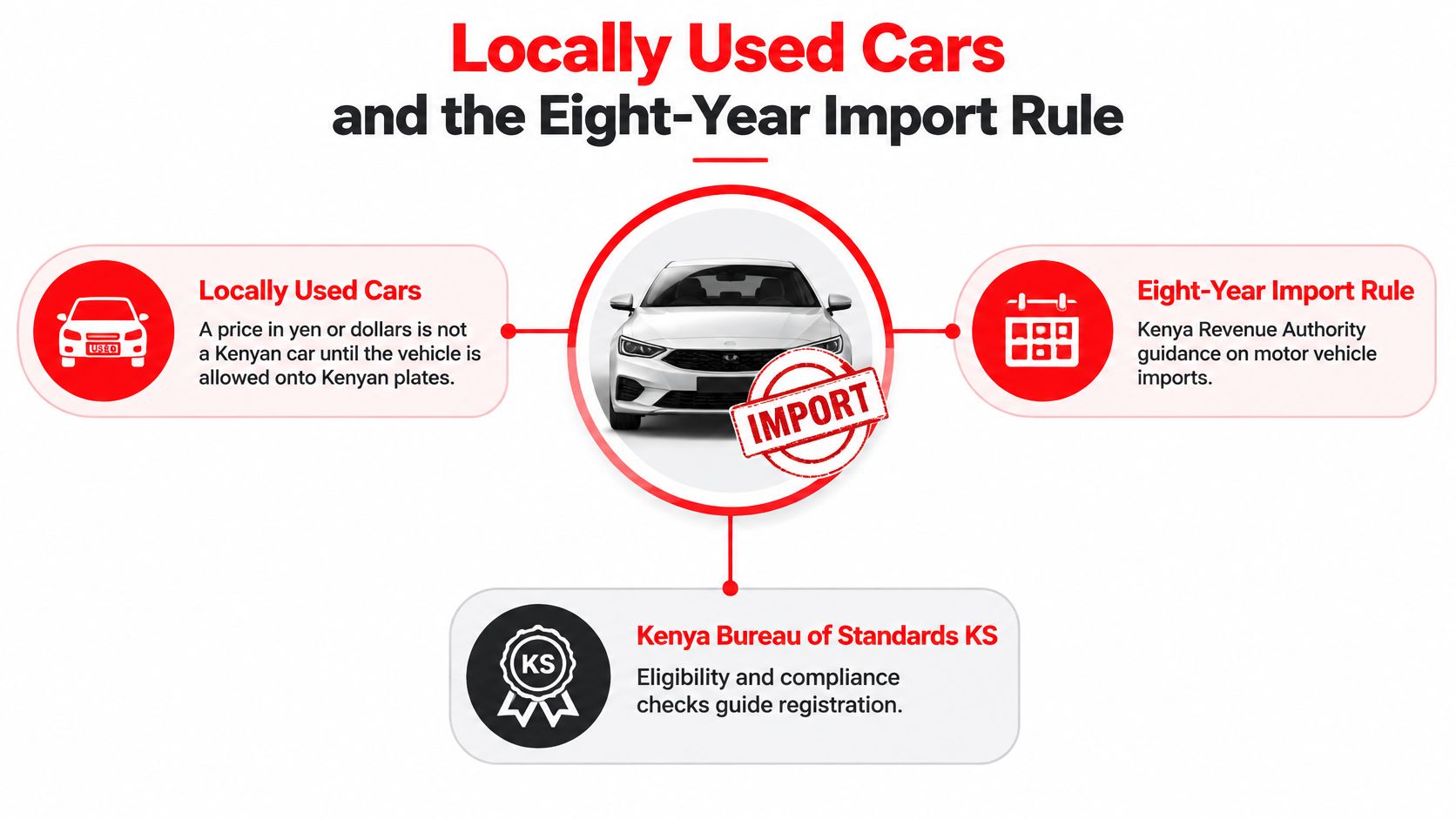
A vehicle's first-registration year can decide whether a foreign-used car is eligible for Kenyan registration. A car advertised with a recent model year may still fail the age test if its first registration was earlier than you assumed. The Kenya Revenue Authority's motor vehicle import guidance reflects the Kenya Bureau of Standards' KS 1515:2000 requirement that an imported used vehicle be less than eight years old from its year of first registration. Imported vehicles also need roadworthiness inspection through a KEBS-appointed agent in the exporting country.
That's why the price in a foreign advert isn't enough to judge whether you've found a bargain. The date that matters is the first-registration date, not just the model year or the year a seller puts in a headline. In 2026, a vehicle first registered in 2018 or earlier fails this age test, while a 2019 first registration passes it. Confirm the applicable cutoff before paying, as rules and procedures should be checked against current official guidance.
Check import eligibility before paying
Use this order when assessing a foreign-used vehicle:
- Confirm first registration. Check the first-registration year on the vehicle's record, not only the model year in an advert.
- Check the configuration. Verify that the vehicle is right-hand drive.
- Request the inspection evidence. Ask for documentation of the required pre-shipment roadworthiness inspection.
- Match the identification. Check that the chassis number on the vehicle agrees with the inspection certificate and export papers.
Don't pay a deposit while these details are uncertain. If the seller can't show the first-registration year and inspection documents, treat the vehicle as unverified and don't assume a low price will compensate for an eligibility problem.
The comparison differs for a locally used car. A vehicle already registered in Kenya doesn't have to clear the import age test as a new import, so an older Toyota or Subaru can still be considered as a local purchase. You'll still need to check its condition, records and ownership transfer, but the import gate is a separate question. When the cutoff or paperwork isn't clear, confirm the current requirements with the official authorities before you commit.
What an Imported Car Really Costs to Land
An imported vehicle has more than one meaningful price. Separate the overseas purchase price, the customs value and the Nairobi drive-away price of a vehicle that's already cleared. These figures aren't interchangeable: an overseas asking price doesn't include the full costs of importing and registering the car.
The KRA customs and border-control guidance sets out the following charges. KRA may determine customs value using the vehicle's Current Retail Selling Price, so a low invoice or auction bid doesn't necessarily set the value used to calculate charges.
KRA charges on an imported motor vehicle
| Charge | What it is calculated on | Rate in the KRA FAQ |
|---|---|---|
| Import duty | Customs value | 25 per cent |
| Excise duty | Customs value plus import duty | 20 per cent |
| VAT | Customs value plus import duty and excise duty | 16 per cent |
| Import Declaration Form | CIF (cost, insurance and freight) | 2 per cent |
| Railway Development Levy | CIF | 1.5 per cent |
The order matters. Import duty is calculated first; excise duty is charged on the customs value plus import duty; VAT applies to the customs value plus import duty and excise duty. The two CIF-based charges are calculated alongside those layers.
Port storage or delays can add expense if documents are incomplete or don't match, so leave room for uncertainty rather than treating an early estimate as a guaranteed total. Don't assume that the overseas asking price multiplied by a simple tax figure will give you a reliable KSh drive-away cost.
A locally used vehicle is the fairer comparison with a fully landed import, because its sticker price reflects taxes paid on an earlier import. Comparing that local price with a foreign purchase price alone leaves out the charges that bring the imported car into the Kenyan market. For a practical comparison, use the cleared vehicle's asking price against an estimate that includes the relevant import costs.
Before budgeting: Confirm current rates and the vehicle's customs valuation with KRA or a licensed clearing agent. Don't commit to an import based on an estimate that excludes inspection, clearance or possible delays.
For more on the comparison, see Brill Motors' guide to imported cars for sale in Kenya. Treat any estimate as provisional until the relevant costs and documents have been checked.
Engines Fuel Use and Models Kenyans Drive
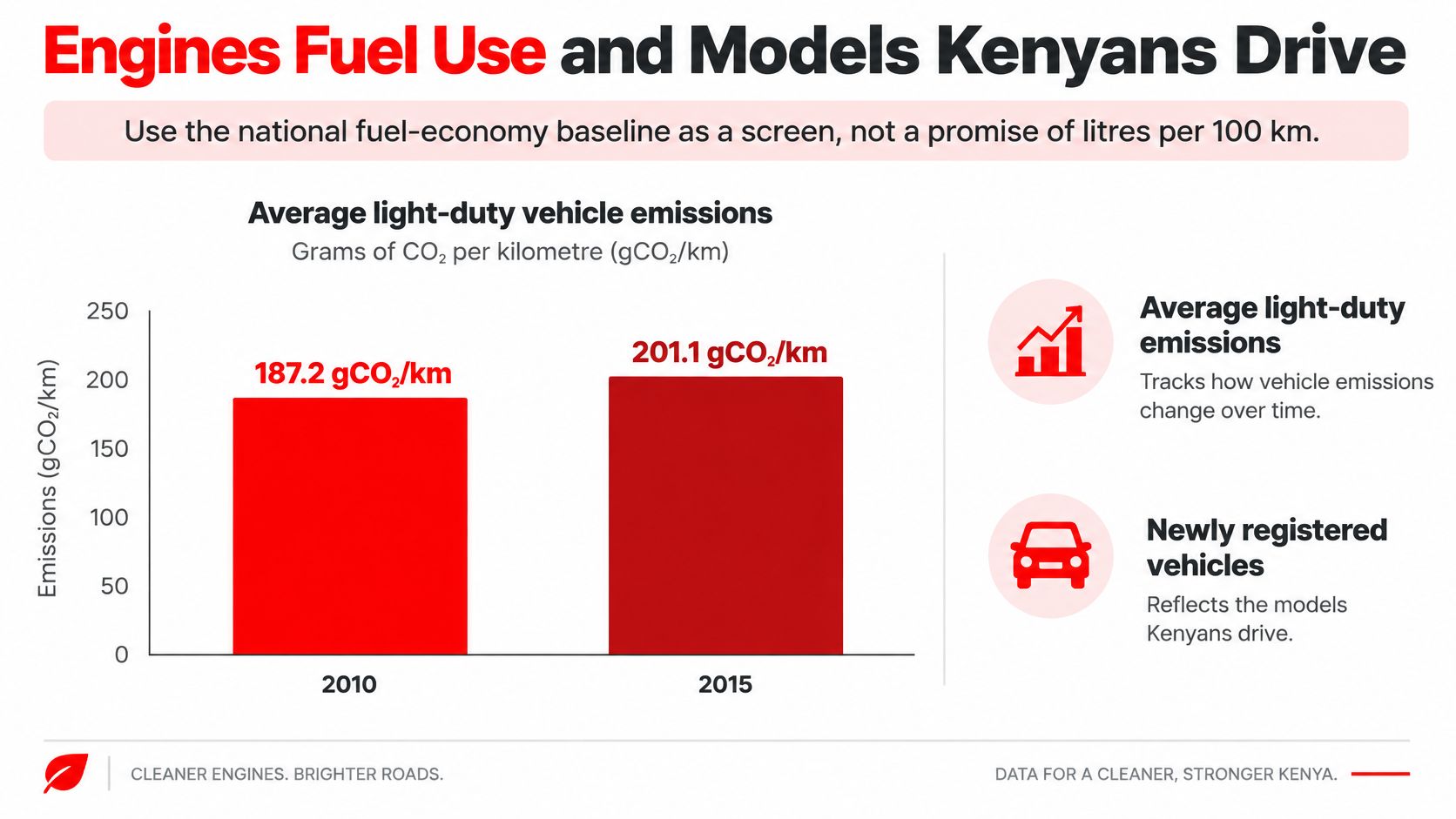
Fuel economy should be part of your ownership budget. A national baseline assessment using NTSA registration data found average light-duty vehicle emissions rose from 187.2 gCO2/km in 2010 to 201.1 gCO2/km in 2015, before falling to 161.0 gCO2/km in 2023, according to the Kenya light-duty vehicle fuel economy and emissions assessment. The 2023 level was about 20 per cent below the 2015 peak. Use this as a national benchmark. It doesn't predict the fuel use of one used car.
Match the engine to the journey
| Engine class | Typical body | Journey it suits | Running-cost note |
|---|---|---|---|
| 1,000 cc to 1,500 cc petrol | Hatchback | Short Thika Road commutes | Lowest fuel use in traffic |
| 1,500 cc hybrid | Station wagon | Short commutes in mixed traffic | Hybrid battery age matters on mid-2010s cars |
| 1,800 cc petrol | Wagon or estate | Mixed family use | Moderate fuel with good boot space |
| 2,000 cc petrol | Compact SUV | Mixed town and upcountry | Check fuel use against your usual routes |
| 2,500 cc petrol | Saloon | Highway driving | Happier on the open road than in queues |
| 3,000 cc diesel | Larger SUV | Distance and heavy load | Not suited to a short school run |
Treat the table as a shortlist by use, not a promise of performance or fuel consumption. Congestion, air-conditioning, passenger load, tyre condition and maintenance all affect the bill. Compare engine size and body type before choosing by badge or asking price. A wagon may suit family journeys, while a larger SUV is better matched to distance or heavier loads.
Estimate annual fuel from the distance you expect to drive and the car's certified consumption information. Then consider how regular traffic and a full passenger load may change that estimate. Emissions per kilometre can help narrow your options, while a test drive and inspection help you assess the individual car. If you're considering a hybrid, Brill Motors' guide to hybrid cars for sale in Kenya explains points to consider, including battery history and condition.
What to Check Before You Agree a Price
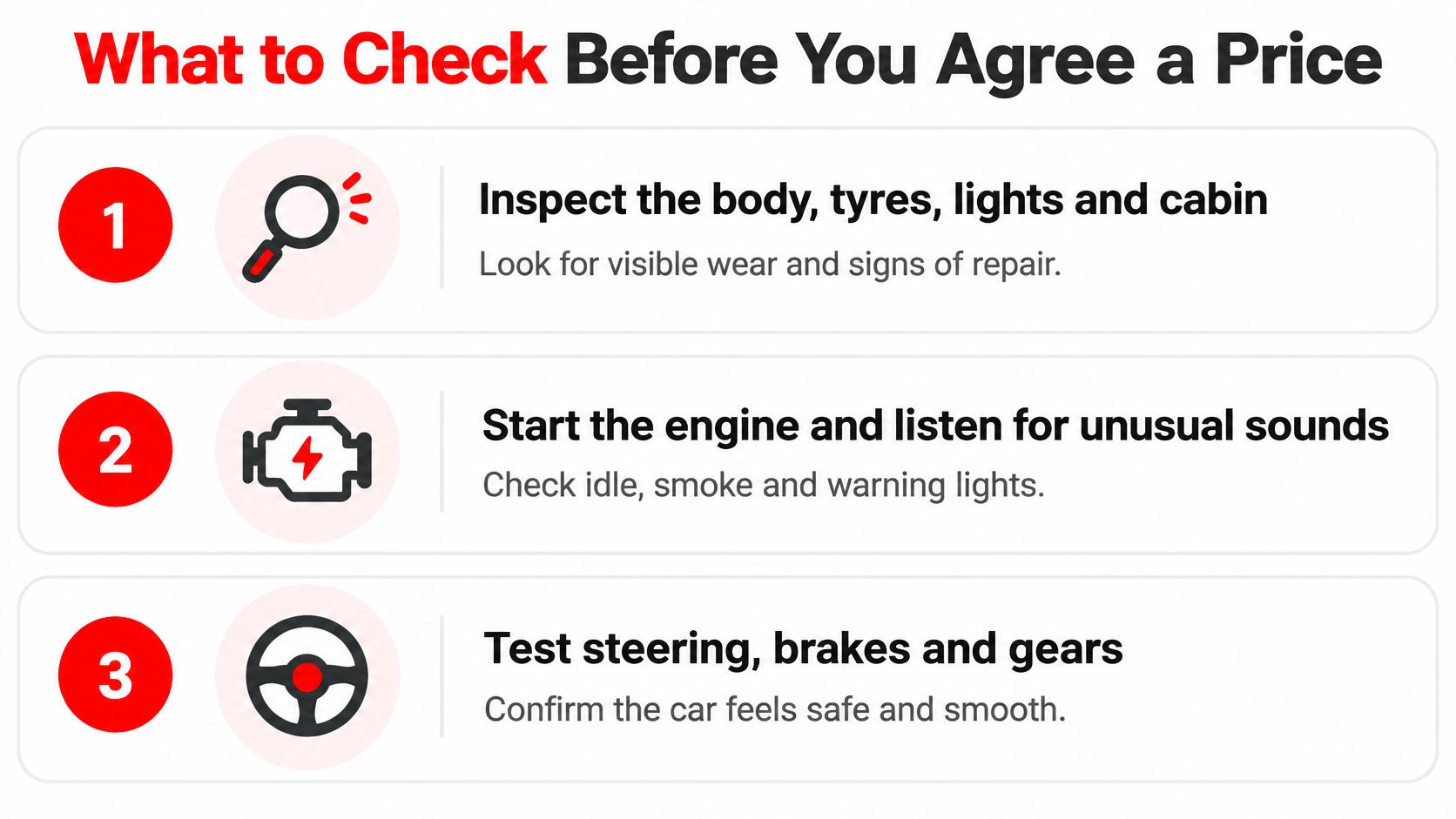
A viewing should tell you whether the vehicle behaves as well as it looks. Set aside time to see it in daylight, start it from cold and take it on a test drive. A photograph can't reveal a gearbox that jolts, a damp boot or smoke under load.
One viewing routine
- Start cold. Watch for smoke, warning lights and an unusually slow hybrid ready light. A cold start can reveal problems that may be less obvious after the engine has warmed up.
- Drive over different surfaces. Feel for CVT flare, gearbox shock, pulling under braking and suspension knocks on a rough patch. In a diesel SUV, listen and watch for smoke under load on a climb.
- Check tyres and underneath. Look for uneven wear, inspect the spare wheel and check for underbody rust, especially if the car has spent time at the coast.
- Inspect the cabin and body. Lift the carpets and check the boot for damp, then look for uneven panel gaps or paint that may point to a poorly repaired crash.
- Ask about servicing. Request the latest service record, timing-belt or timing-chain history on a high-mileage petrol engine, and battery or inverter work on a hybrid.
- Compare the odometer with records. Check service stamps and other available records rather than relying on a single displayed reading.
- Agree what stays with the car. Put included items in writing, including the second key and jack.
- Discuss the price last. First establish what the car is and what condition it's in, then negotiate with that evidence in mind.
A test drive should include normal braking, steering and gear changes, not just a slow loop around a car park. If a concern appears, ask for an explanation and supporting service information before agreeing to buy.
A viewing at Brill Motors' showroom at Garden City Mall gives you the chance to inspect the car in person and run through these checks in daylight. Decide on price after you've had the vehicle present in front of you, not from photographs alone.
How Ownership Moves to Your Name
A car can drive well and still leave you with an ownership problem. Before paying, ask the more important administrative question: can you become the recorded owner? NTSA guidance says the buyer should search the vehicle record before purchase, the seller starts the digital transfer and the buyer accepts it through the online system. The NTSA vehicle ownership-transfer guidance explains the steps and the risks of leaving a vehicle registered to a previous owner beyond the required transfer period.
Paperwork to verify before payment
Keep this check separate from the mechanical viewing:
- Search the registration record. Confirm that the vehicle record is available and doesn't show an issue that would block the transaction.
- Check the seller's identity. Match the seller's details and KRA PIN to the information provided for the sale.
- Match the vehicle identifiers. Confirm that the chassis and engine numbers agree with the vehicle's documents.
- Verify logbook status. Resolve any concern about a missing, flagged or inconsistent logbook before paying.
- Write down the agreement. Record the sale price, what's included and who'll pay transfer-related charges.
- Complete the digital acceptance. The seller initiates the transfer, and you must accept it online before treating the ownership change as complete.
A missing previous owner, an auction purchase and a forced transfer can each involve a different document route. A standard private-sale sequence may not be enough, so identify the correct process before handing over money. If you're unsure about the current transfer steps, check NTSA and eCitizen; for a KRA PIN or duty question, use KRA.
A private seller may leave you to manage the record search and digital steps directly. Buying through a dealer doesn't remove your responsibility to check the record and accept the transfer, so the same pre-payment list still applies. A cheap car whose ownership can't be transferred cleanly can become a costly problem after the sale.
Search Current Stock and Visit Garden City Mall
Brill Motors lists 116 vehicles, including locally used and foreign used cars. Search the catalogue by make, model and budget, then check the vehicle's history and specifications. A low advertised price deserves a closer look: compare the car's age, engine and ownership documents before deciding whether it is good value.
For example, a locally used 2008 Toyota Passo hatchback, with a 1,000 cc petrol engine and automatic transmission, is listed at KSh 490,000. A locally used 2015 Toyota Fortuner SUV, with a 3,000 cc diesel engine and automatic transmission, is listed at KSh 2,480,000. Check the live listing for the current price before you travel.
You can view vehicles in person at Brill Motors' showroom at Garden City, Nairobi. The dealership also buys cars directly and can help sellers find a buyer and manage the sale. Trade-ins are available for customers exchanging a vehicle.
Visit Brill Motors to browse current listings and enquire about a particular car. You can also visit the showroom to view vehicles, ask about a trade-in or request a valuation.