

 SIGN UP
A low overseas asking price can disguise a much higher cost by the time an Everest is ready for Nairobi roads. For example, the Kenya Revenue Authority's motor-vehicle import guide illustrates how a vehicle with a KSh 5,000,000 CIF value could reach approximately KSh 9,337,500 after the taxes shown, before port, clearing and registration costs.
The final bill also depends on the vehicle's age, import eligibility, condition and service history. Deferred maintenance can add further costs after purchase, so compare the full road-ready cost rather than the overseas price alone.
Ford Everest Prices in Kenya at a Glance
The advertised price is only one part of an Everest's cost. Compare vehicles at the same point of readiness: locally registered, insured, serviced and ready for your intended use.
| Condition | Indicative price (KSh) |
|---|---|
| New, ex-showroom, XLT | About 11,250,000 |
| New, ex-showroom, Limited | Up to 12,950,000 |
| Locally used, older year band | Roughly 3,000,000 to 4,200,000 |
| Locally used, newer year band | Around 4,500,000 upward |
| Low-mileage or top-spec local units | Above 7,000,000 as a broad budgeting guide |
| Foreign used, eligible import | CIF value plus confirmed taxes, clearance and road-ready costs |
A low odometer reading alone does not justify a top-band price. Service records, mechanical condition and the vehicle's actual specification matter just as much.
An unusually low asking price can reflect deferred costs. Worn tyres, neglected transmission servicing, suspension repairs or cooling-system problems may require attention soon after purchase. On an import, confirm whether the quoted amount includes freight, customs clearance and registration before comparing it with a locally registered Everest.
Equipment also affects value. Attractive wheels or leather upholstery do not confirm that a vehicle has the drivetrain or factory safety features you want. Check the specification against the vehicle's build details.
Start with the year and condition you can afford, then assess maintenance records and equipment. Keep an allowance for immediate repairs rather than spending your full budget on the purchase price. For family use, check luggage space with the rear seats occupied; for rural travel, sound tyres and functioning four-wheel drive may matter more than a higher trim level.
Use this SUV buying guide to organise your requirements. Brill Motors has a showroom at Garden City Mall where you can view available vehicles in person.
Model Years on the Kenyan Market
A model year is a starting point, not a complete description. Everest vehicles span different generations, market specifications and updates, so two cars advertised with similar registration details may have noticeably different cabins, engines and equipment.
The following bands are approximate shopping categories. They aren't a substitute for identifying the individual vehicle from its VIN and original build information.
| Year band | Generation or update | Band-specific note |
|---|---|---|
| Around 2015 to 2018 | Earlier generation | Service history and wear carry the most weight |
| Around 2019 to 2021 | Updated versions of the earlier generation | Check equipment level against the original specification |
| 2022 onward | Newer generation, subject to build and source market | Expect higher budgets and verify import eligibility separately |
Earlier cars need stronger evidence of care
An earlier car can make financial sense if the previous owner maintained the expensive mechanical systems properly. However, a tidy interior doesn't tell you whether the automatic gearbox, cooling system or drivetrain received the correct attention.
A vehicle near the beginning of an age band and one near its end can share much of their basic design while differing in equipment and accumulated wear. Don't assume that the later registration automatically makes the better purchase.
For a tighter budget, I would favour a straightforward specification with credible records over a heavily accessorised car with unanswered mechanical questions. You can replace cosmetic accessories later; neglected mechanical assemblies are a different commitment.
Updated and newer cars need specification discipline
Updated vehicles can offer a useful middle ground between purchase price and equipment. The important question is whether you're paying for features fitted by the manufacturer or for a seller's description of them.
Newer-generation vehicles generally require a larger budget, but the calendar year doesn't settle every detail. Introduction dates and registrations can overlap between source markets, and an older vehicle first registered locally later doesn't become a newer-generation car.
Shortlist neighbouring age bands, then compare individual vehicles within them. Don't let a registration year make the decision for you.
Choose your budget and intended use first. Then establish the exact build, powertrain and equipment before discussing a deposit. Where the advertised year or trim is unclear, the VIN and original build sheet should resolve the question.
Engines, 4x4 and Trims That Shape Value
The right Everest powertrain depends on how you use the vehicle. Nairobi commuting, regular upcountry trips and rough access roads place different demands on fuel, tyres and the drivetrain. Choose the larger engine only if loaded highway travel is a regular requirement.
| Engine | Usually found on | Running cost note | Price effect |
|---|---|---|---|
| 2.0-litre turbo diesel, automatic | Selected later vehicles and mid or upper specifications | Treat quoted fuel economy as a comparison guide; actual use depends on driving and condition | Value depends on the exact specification and maintenance |
| 3.2-litre five-cylinder diesel | Selected earlier-generation vehicles | Check engine-specific servicing and drivetrain condition | A well-maintained example may justify a higher price than a neglected smaller-engine model |
| 3.0-litre V6 | Selected higher specifications | Confirm fuel type and engine code before budgeting | Usually positioned towards the premium end |
Confirm the engine, not just the badge
Check the factory build information before accepting an advert that describes a 3.0-litre V6 petrol Everest. A V6 badge alone does not confirm the fuel type. The correct engine details affect your servicing and running-cost budget.
Assess performance on a proper test drive, especially if you regularly carry passengers or luggage on highway journeys. Engine capacity alone does not show how a vehicle performs under load.
Pay for equipment you'll use
Four-wheel drive can be useful where traction matters, and it adds components that require maintenance. Check that the system works and that its servicing is documented before paying extra for it.
Compare the actual seat finish, cabin equipment and safety functions across XLT, Limited and higher specifications. Trim names and equipment packages can vary between source markets, so confirm what the individual vehicle has.
Our Toyota Hilux pickup pricing and ownership guide provides context for weighing passenger comfort against load-carrying needs. For the Everest, match the engine and drivetrain to your regular journeys, then include the cost of fuel, maintenance and any deferred repairs in your budget.
How Mileage and Service History Move the Price
A higher-mileage Everest with a complete maintenance record can be a safer purchase than a low-mileage car with no supporting paperwork. The odometer records distance, not care, and neither a clean steering wheel nor a freshly detailed engine proves the reading.
Judge mileage against the vehicle's age, service invoices and physical wear. Dated records should form a believable sequence, with workshop descriptions that identify what was replaced rather than saying “service”.
The expensive maintenance matters most
Engine oil changes are only part of the ownership story. Establish whether the vehicle received the correct timing-system attention for its engine, gearbox servicing, differential oil and transfer-case maintenance where fitted.
Brake and suspension work also affects what you should pay. A heavy SUV with tired dampers, worn bushes and unevenly worn tyres may still feel acceptable during a short, slow drive, then reveal its weaknesses on rough roads or under braking.
Don't treat coolant loss, transmission hesitation, persistent warning lights or diesel-system complaints as minor bargaining points. Get a diagnosis and a written repair quotation. A seller's assurance that a fault only needs a sensor isn't evidence.
Price the work, not the explanation: An unresolved mechanical symptom should be assessed before you agree what the car is worth.
Turn condition into a fair comparison
Repainted panels and mismatched colour warrant investigation, but they don't automatically prove a serious collision. The concern is the quality and extent of repair: distorted structural sections, poor panel alignment, disturbed seams or missing safety equipment deserve much closer scrutiny.
Ownership history matters too. Several previous owners aren't an automatic rejection, but gaps in the story make maintenance harder to trace and can complicate your eventual resale.
For negotiation, start with the value of a comparable sound vehicle and subtract properly quoted deferred work. For your own cash budget, move in the opposite direction: add immediate repairs to the agreed purchase price.
That distinction prevents a common mistake. A discount doesn't make the repairs disappear, and a cheap car isn't affordable if you can't fund the work it needs. A well-documented vehicle can justify a premium because you can see what you're buying, rather than discovering the bill afterwards.
Import Age Rules That Limit Your Choice
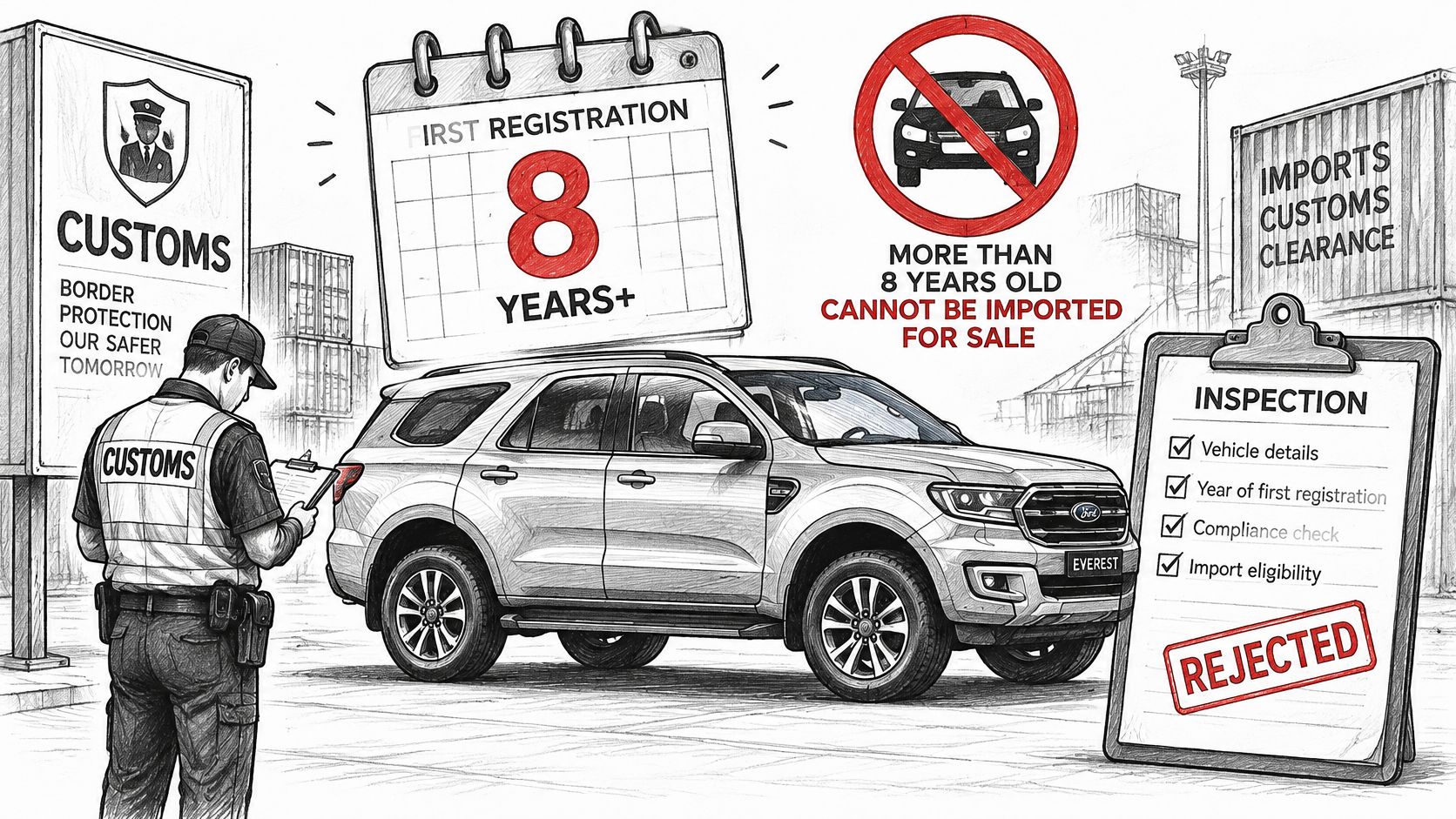
Consider a vehicle manufactured in 2017 but first registered in 2019. Under the Kenya Bureau of Standards inspection code, the manufacture and first-registration years must not differ by more than one year, while passenger vehicles more than eight years old from first registration aren't permitted for importation.
That example fails the manufacture-to-registration check even before you assess its current age. Good paintwork and low mileage can't correct an eligibility problem.
Check eligibility before paying
For arrivals from 1 January 2026, confirm the applicable annual cut-off directly with KEBS, including the treatment of vehicles first registered before 2019, compliance with KS 1515:2000, and right-hand-drive requirements with limited special-purpose exceptions. Don't authorise shipment on the strength of a seller's model-year description.
Ask for the manufacture details, original first-registration evidence and source-market export papers before paying a deposit. The steering configuration, inspection certificate and validated import documentation should support the same vehicle identity.
A local registration changes the risk
An older vehicle already registered in Kenya is a different proposition from an older vehicle awaiting importation. It can remain a candidate for purchase even when an equivalent overseas vehicle wouldn't qualify for normal importation.
That doesn't remove the need to verify ownership and condition. It removes a particular exposure to shipment, inspection and rejection problems.
Confirm inspection codes and the current annual notice with the Kenya Bureau of Standards, and current duty treatment with the Kenya Revenue Authority. The useful price is the price of a vehicle you can legally receive and register, not merely a low overseas offer.
Landed Cost of an Imported Everest
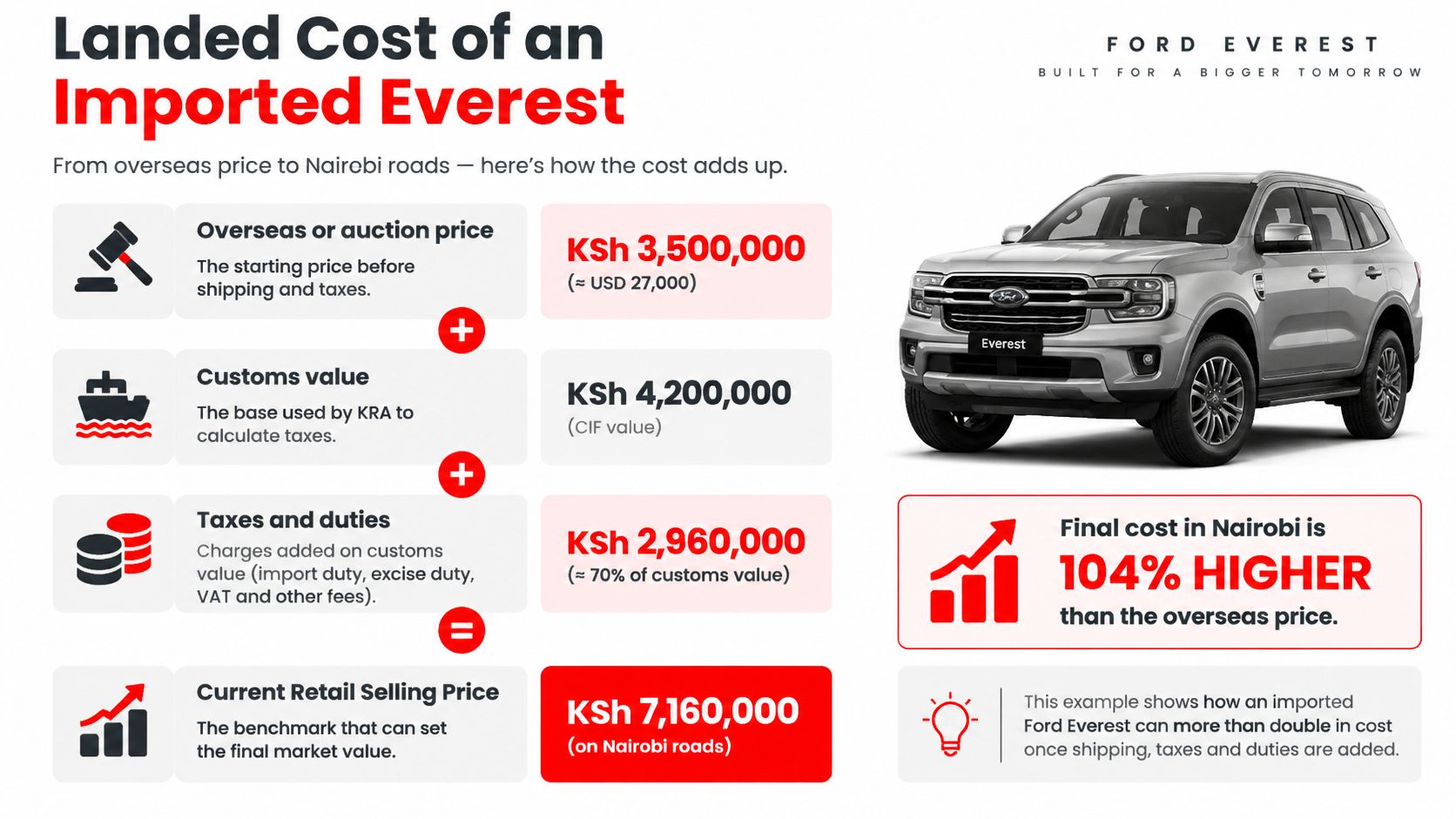
An overseas invoice is only the starting point for an Everest's Nairobi cost. Customs valuation may use the Current Retail Selling Price, so a low invoice does not necessarily mean a proportionately lower tax assessment. The Kenya Revenue Authority's customs guidance explains this valuation basis.
CIF means cost, insurance and freight. Confirm the CIF value and customs valuation basis before relying on an import quotation.
A worked illustration, not a current tax quotation
The KRA's published import example shows the calculation structure below. Its example uses 25% excise, while KRA's motor-vehicle import procedure schedule lists 20% excise, 2% IDF and 1.5% RDL, alongside 25% import duty and 16% VAT. Confirm the rates and classification for the specific Everest and import date before committing funds.
| Item | Rate basis | Example amount (KSh) |
|---|---|---|
| Import duty | 25% of CIF | 1,250,000 |
| Excise duty | 25% of CIF plus import duty | 1,562,500 |
| VAT | 16% of CIF plus duty and excise | 1,250,000 |
| Import Declaration Fee | 3.5% of CIF | 175,000 |
| Railway Development Levy | 2% of CIF | 100,000 |
| Total taxes and levies | Before port, clearing and registration | 4,337,500 |
The calculation is cumulative: excise is charged on CIF plus import duty, and VAT is applied after duty and excise. Adding the rates together and multiplying by the overseas purchase price will not produce the same total.
These figures exclude port and clearing charges, inland transport, inspection, registration and number plates, agent fees, storage and accessories. Allow separately for insurance and any servicing needed on arrival. For a wider overview of imported cars for sale in Kenya, see our import guide.
Before purchase, get one written estimate showing the valuation basis, each charge, exclusions and responsibility for unexpected costs. Use that estimate, rather than the overseas invoice alone, to judge the Everest's likely landed cost.
Confirm the Final Price Before You Buy
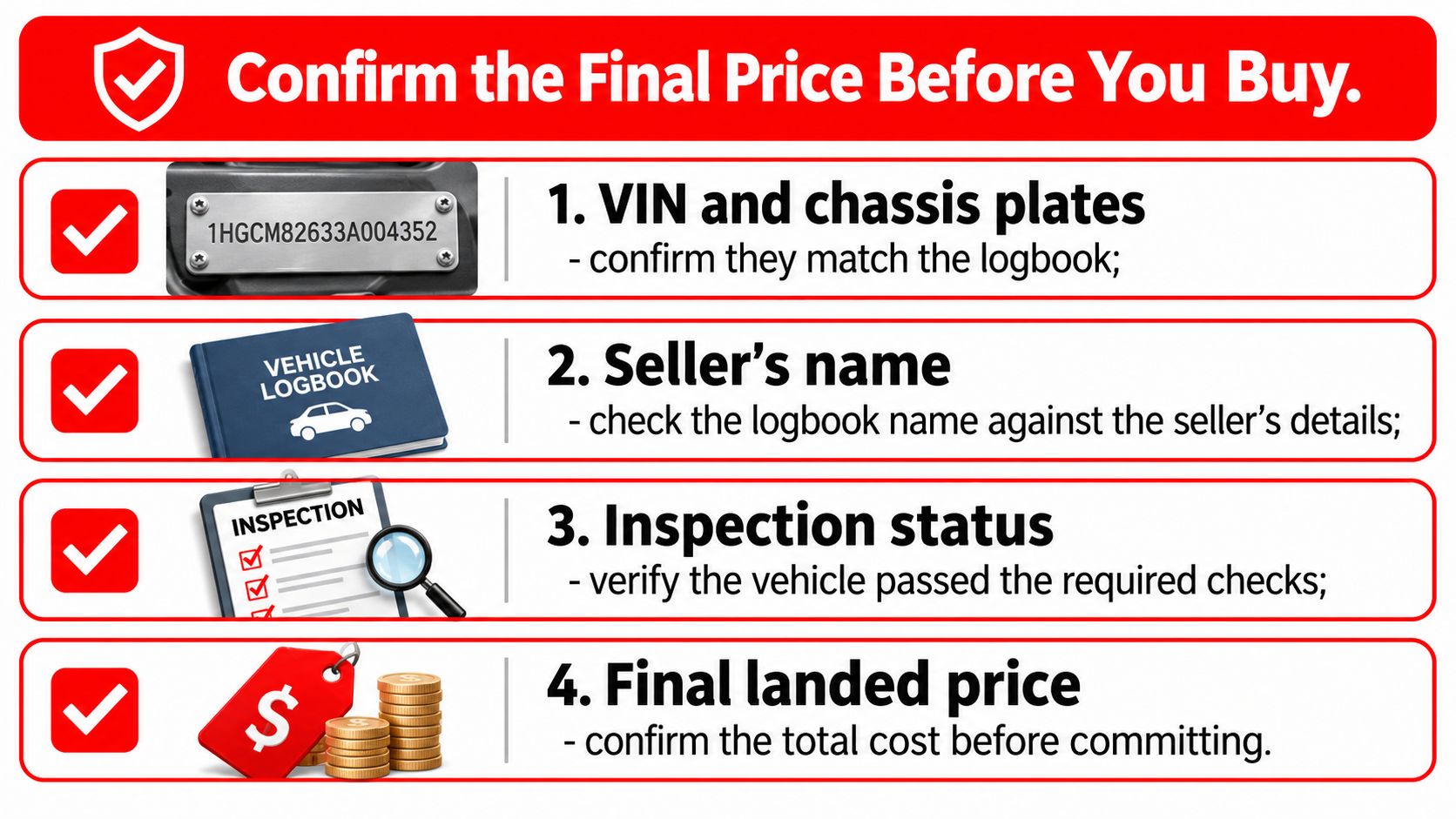
The asking price is only one part of an Everest's cost. Before paying a deposit, confirm the vehicle's identity, condition, agreed price and any work or charges still outstanding.
Your purchase decision checklist
- Match the vehicle identity. Compare the VIN and chassis plates with the logbook. Investigate altered markings or inconsistent details before proceeding.
- Confirm the seller's authority. Check the logbook name against the seller's identity, and establish the documented authority of anyone selling on the owner's behalf.
- Verify the engine and build. Match the engine number and obtain build information confirming the fuel type, drivetrain and factory specification.
- Take a proper test drive. Assess gearbox shifts, steering behaviour and the four-wheel-drive selector. Use drivetrain modes only under the conditions specified in the owner's manual.
- Assess tyres and brakes. Check tyre age, matching specifications, tread condition and braking behaviour. Include likely replacement work in your cash budget.
- Investigate body repairs. Examine repainting, panel alignment and structural repair quality. Cosmetic work and serious collision repairs require different judgements.
- Record the agreed final price. State what is included, what remains payable and which repairs or accessories form part of the agreement.
Make the showroom visit useful
Bring your budget, intended use and details of any vehicle you plan to trade in. At Brill Motors, you can view vehicles at the showroom at Garden City Mall, Nairobi, and discuss financing assistance through partner banks, subject to approval.
Vehicle valuation and trade-ins can help clarify how much you need to add when replacing your current car. Settle that figure alongside the purchase budget before agreeing on the final price.
Call or WhatsApp +254 758 243 058 to discuss your requirements and confirm current vehicle availability. Confirm that the specific Everest is available before making plans to view or buy it.
View current stock and contact details at Brill Motors, or visit the showroom at Garden City Mall, Nairobi, to compare available vehicles in person. Financing assistance, valuations and trade-ins can help you assess the amount you need to budget before committing to your next SUV.