

 SIGN UP
Japan supplied 94.3% of used vehicles exported to Kenya in the twelve months ending June 2023, according to official trade figures reported by Business Daily. That concentration explains why Japanese cars for sale offer Kenyan buyers so much choice. It doesn't mean the cheapest advertised car is the cheapest to own.
A useful comparison starts with eligibility, total acquisition cost and the money needed after purchase. An attractive overseas price can become expensive after clearance, while a locally registered bargain can need substantial repairs before it's dependable.
Why Japanese Cars Dominate Kenya's Used Market
Japanese imports give Kenyan buyers a broad starting point, from compact commuter cars to family wagons and larger SUVs. Because so many vehicles follow this route, buyers can compare familiar body styles, engines and equipment rather than choosing from an unfamiliar selection.
That familiarity helps when maintaining a car, too. A mechanic who regularly services similar Japanese vehicles has a useful starting point for diagnosis, and a parts supplier can identify components from the chassis and engine details. However, a familiar badge doesn't guarantee that every component is readily available.
Familiar models still need careful matching
A domestic-market trim can have different lights, electronics, suspension or transmission parts from another version bearing the same name. Before buying, ask a mechanic or parts supplier to identify the exact variant, particularly if the car has unusual equipment or modifications.
Japan also produces large volumes of right-hand-drive vehicles, which suit the steering configuration Kenyan buyers normally need. For the legal clearance decision, though, use the vehicle's documents and the applicable official requirements rather than assuming that Japanese origin settles everything.
The opening trade figure measures used exports to Kenya, not every vehicle registered or sold locally. It's evidence of a substantial supply base, not a complete census of Kenyan car ownership.
Understand the route behind the advert
Buyers generally encounter these routes:
- Locally used vehicles: Cars already registered and driven in Kenya, with local ownership and maintenance questions to investigate.
- Foreign used vehicles: Cars previously used abroad, whose clearance and Kenyan registration status must be established before comparing prices.
A foreign used car may already be in Kenya and cleared, or it may still be overseas. Those are different transactions, even when an advert uses the same description.
Practical rule: Ask where the car physically is and what its quoted price includes before discussing a deposit.
A deep supply base makes Japanese cars easy to find. Choosing a good individual vehicle still requires matching its specification, condition and transaction status to your needs.
Popular Japanese Makes and Models Kenyans Buy
| Model | Body type | Typical engine | Best suited to |
|---|---|---|---|
| Toyota Vitz | Hatchback | 1,000 to 1,300 cc petrol | City driving and first cars |
| Toyota Fielder | Wagon | 1,500 cc petrol or hybrid | Families needing boot space |
| Toyota Premio | Sedan | 1,800 cc petrol | Comfort on a budget |
| Toyota Fortuner | SUV | 3,000 cc diesel | Rough roads and long trips |
| Subaru Forester | SUV | 2,000 cc petrol | Mixed road and gravel driving |
| Mazda Demio | Hatchback | 1,300 to 1,500 cc petrol | Economical commuting |
| Nissan X-Trail | SUV | 2,000 cc petrol | Family SUV needs |
Treat these as starting specifications, not a promise about every generation or trim. Confirm the engine, fuel type, transmission and drivetrain on the actual vehicle.
Choose the body before the badge
Start with what you carry. A hatchback can suit Nairobi commuting and tight parking, but check whether your usual passengers and luggage fit together rather than testing them separately.
A wagon offers a useful compromise when you want load space without moving to a taller vehicle. Check the luggage opening, rear-seat folding arrangement and space beneath the boot floor. A comfortable sedan may suit passengers better, but its separate boot opening can make bulky items awkward.
An SUV makes sense when access roads, seating position or carrying requirements justify it. Height alone doesn't establish off-road capability. Check the drivetrain, tyres and underside clearance against the roads you use.
Compare the exact engine and trim
Engine capacity affects the cost comparison, including the import excise treatment that KRA sets out in its vehicle-import guidance. However, it isn't a reliable fuel-economy figure by itself: congestion, load, maintenance, gearing and driving style also matter.
For stop-start commuting, compare a petrol car with a hybrid only after allowing for battery condition and diagnostic checks. For a diesel SUV, ask whether your journeys and maintenance budget justify that powertrain rather than choosing diesel because it sounds economical.
Trim differences deserve attention:
- Useful equipment: Check airbags, parking assistance, air conditioning and seat adjustment on the actual car.
- Costly extras: Price replacement tyres before choosing large wheels, and test powered accessories before valuing them.
- Mechanical differences: Confirm whether a trim changes the drivetrain or suspension, not just the upholstery.
Browse the Toyota selection, Subaru selection, Mazda selection and Nissan selection by the specification you need. The Toyota price-list guide can also help organise a make-specific comparison.
Shortlist a small group of suitable models before comparing individual cars. Otherwise, an attractive price can pull you towards a vehicle that doesn't suit your household.
Locally Used or Foreign Used Cars and Which Fits Your Budget
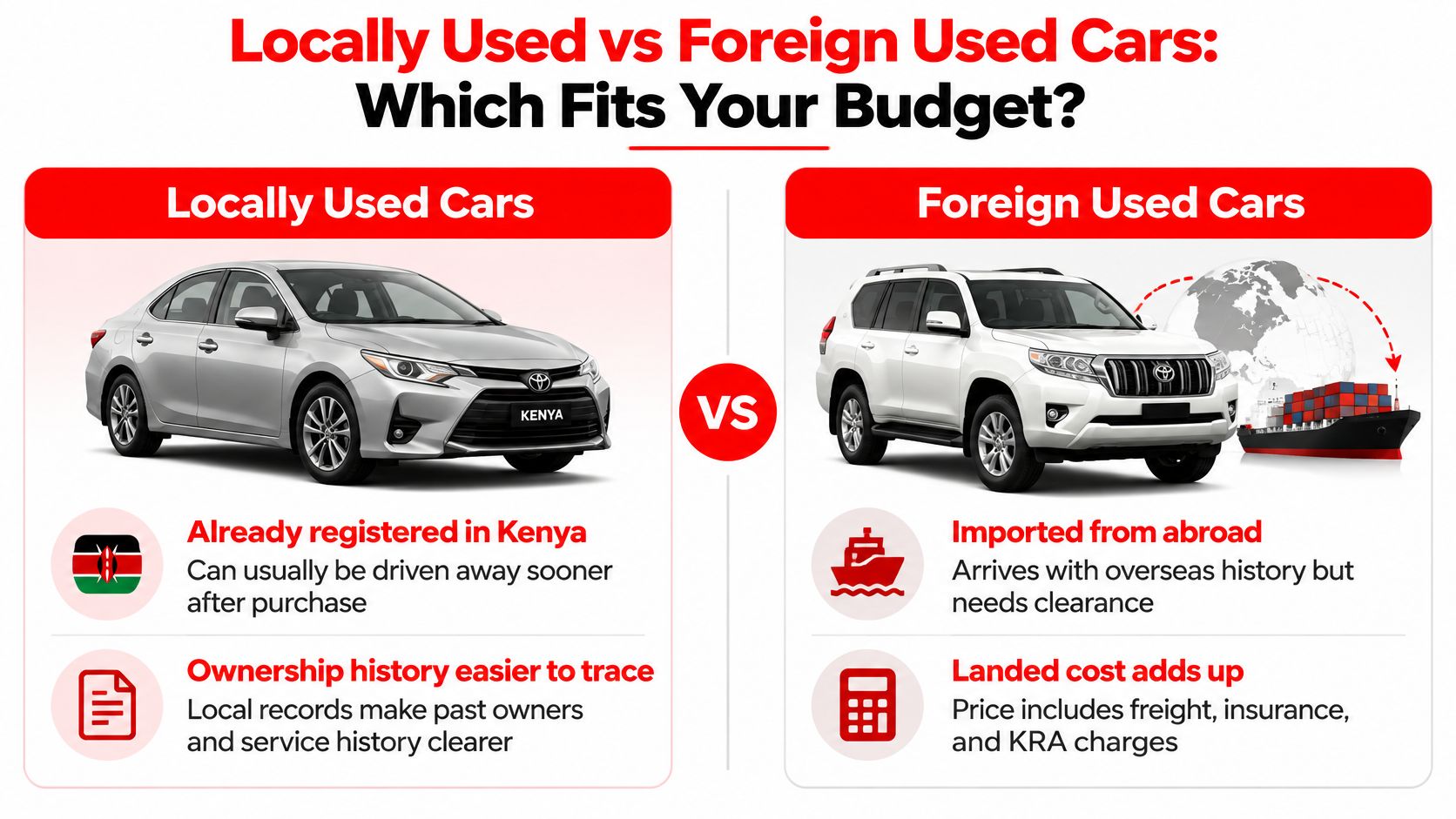
The choice is a trade-off between availability, condition, price certainty and administrative work. Neither route automatically gives you a better car.
Compare equivalent prices
A locally used car's asking price reflects a vehicle that's already entered the Kenyan market. You can examine it in person, investigate its maintenance and check ownership records, although registration records won't establish how well previous owners serviced it.
An overseas asking price describes a different stage of the purchase. It may exclude transport, taxes, clearance and registration. Foreign used stock that's already cleared should therefore be compared differently from a car still awaiting shipment.
Don't assume locally used cars always cost more. Age, mileage, condition and specification can reverse the apparent advantage.
Indicative asking-price guides, drawn from our listed vehicles rather than market-wide averages, are:
- Hatchbacks: A locally used example is listed at KSh 490,000.
- Wagons: Listed examples span KSh 950,000 to KSh 1,750,000.
- Sedans: Listed examples span KSh 1,000,000 to KSh 1,530,000.
- SUVs: Listed examples span KSh 1,280,000 to KSh 2,550,000.
- Diesel SUVs: A listed example is KSh 2,480,000, not a separate body-type price band.
These are guides to specific stock, not valuations for every car in each category. Check current vehicle listings for live prices and use the affordable-car buying guide to keep the comparison focused on your available budget.
Let your deadline influence the choice
If you need transport promptly and can't absorb uncertain extra charges, a car available for inspection with its registration position established may fit better. Agree the handover requirements before paying.
If you can wait and want a particular trim, an overseas vehicle may warrant consideration. You'll need a written specification, delivery assumptions and clear responsibility for additional costs.
Decide which route fits your timetable before you become attached to an individual advert.
Eligibility and Paperwork to Confirm Before You Pay
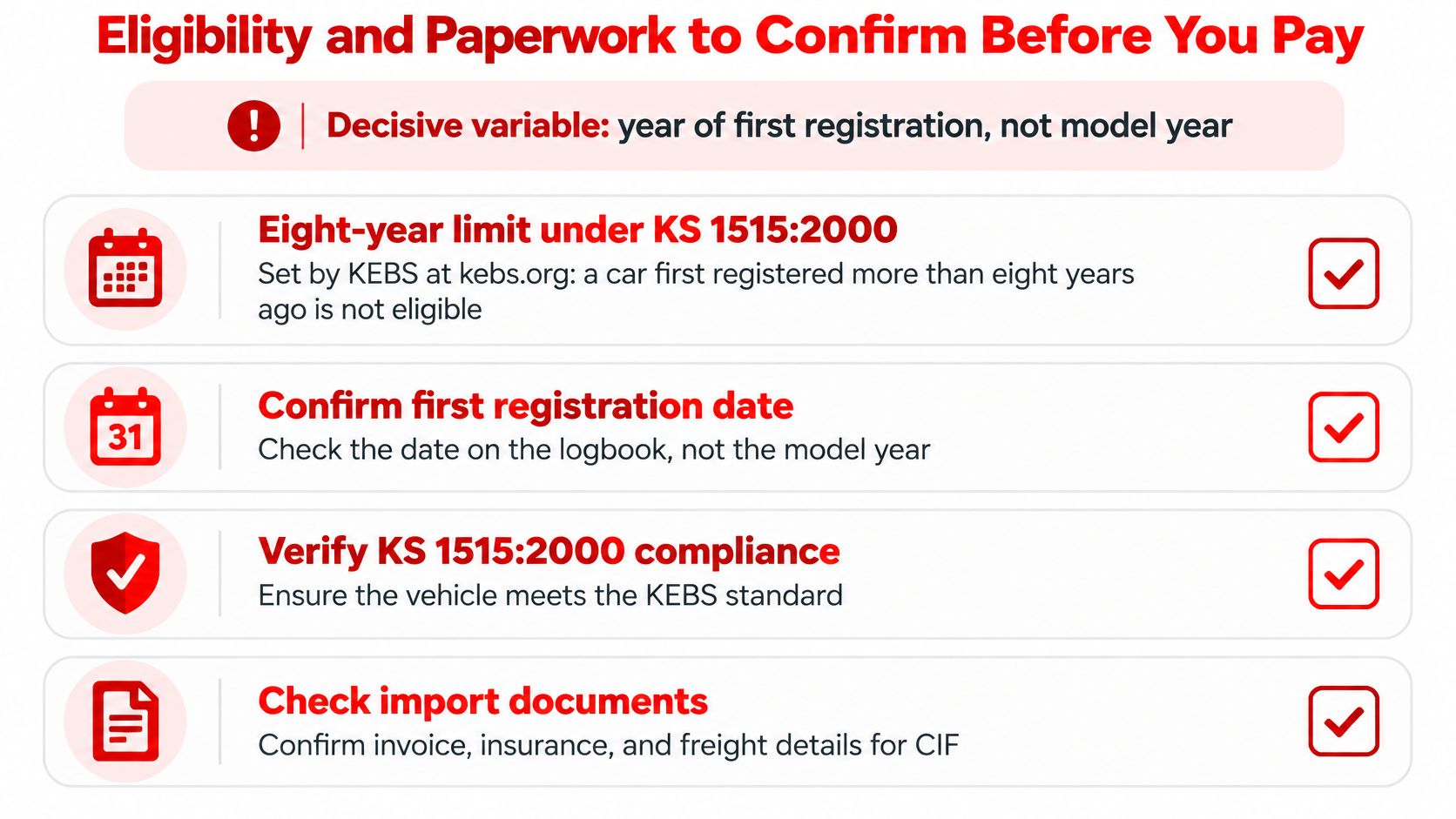
The year of first registration matters more than the advertised model year. A model designation describes the vehicle; it doesn't, by itself, prove import eligibility.
Under KS 1515:2000, KEBS guidance applies a maximum import age of eight years from first registration and specified right-hand-drive vehicles first registered from 1 January 2017 for the 2024 import cycle, while vehicles registered in 2016 or earlier arriving after 31 December 2023 could be rejected at the importer's expense.
That is a historical illustration, not today's clearance permission. The qualifying threshold moves with the import cycle, so obtain the current KEBS position before paying for an overseas vehicle.
Read the documents in transaction order
Start with the Certificate of Roadworthiness issued through the KEBS-contracted inspection arrangement. Check that it belongs to the vehicle being sold and verify its authenticity through the relevant inspection process. A photograph of a certificate isn't enough if its identifying details are unclear.
Next, examine the export or deregistration document. Use it to establish the first-registration date and compare the vehicle identity with the seller's description. Ask for a translation where necessary rather than guessing at unfamiliar fields.
Then match the chassis number across the documents and the physical vehicle. A missing character or unexplained discrepancy needs resolution before money changes hands.
The KEBS inspection manual describes the inspection and documentation chain, including the roadworthiness certificate, while KRA's import process leads to an application to NTSA for the Kenyan registration certificate or logbook after customs clearance. Don't treat clearance and registration as interchangeable milestones.
Deposit checklist
- Eligibility: Confirm the first-registration date and current import-cycle threshold.
- Inspection: Verify the Certificate of Roadworthiness against the actual vehicle.
- Export identity: Examine the deregistration document and any necessary translation.
- Chassis match: Reconcile the number on the car with export and Kenyan records.
- Registration status: Establish whether the Kenyan logbook exists or remains pending.
- Written responsibility: Record who pays if clearance fails or the vehicle is rejected.
The imported-car buying guide can help you organise the purchase around these transaction stages.
Ask the seller directly: Who bears the cost if this vehicle is rejected at the port? An answer that isn't written into the agreement leaves an important financial risk unresolved.
Landed Cost and the Price Beyond the Overseas Listing
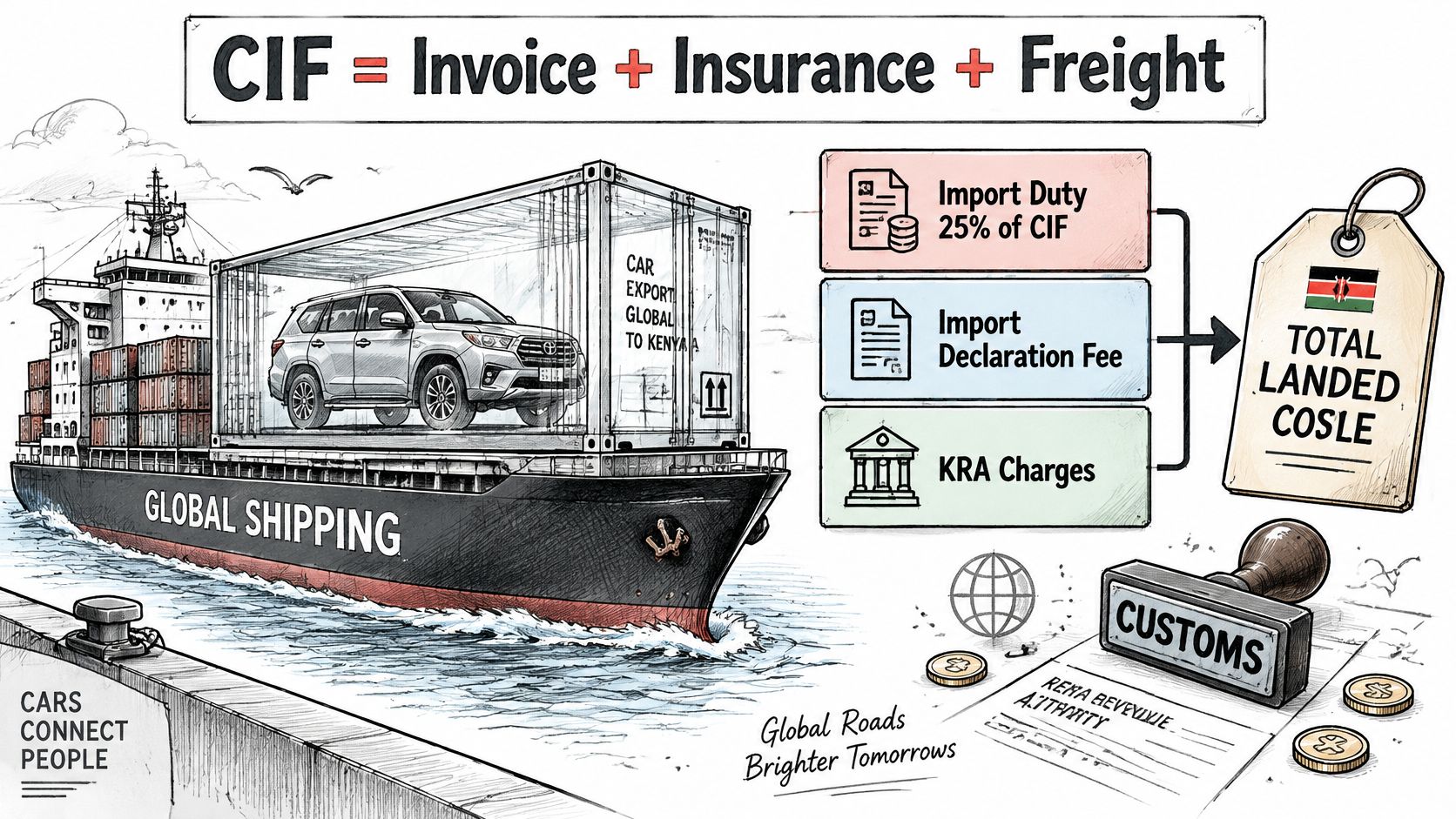
CIF means cost, insurance and freight: the vehicle value together with insurance and freight used in the import-cost calculation. Don't assume the overseas invoice alone will determine the customs assessment.
The KRA vehicle-import explainer lists import duty at 25% of CIF, Import Declaration Fee at 3.5% of CIF and Railway Development Levy at 2% of CIF; it also lists excise at 20% of customs value plus import duty for vehicles of 1,500 cc or below, or 25% on that base above 1,500 cc, and VAT at 16% of customs value plus import duty and excise duty.
These are the rates stated in that explainer, not a substitute for a current assessment. Confirm the applicable rates and classification with KRA or a licensed clearing agent before committing.
Why simple addition gives the wrong answer
The charges don't all use the same base. Excise includes import duty in its calculation, and VAT includes both import duty and excise. Adding the percentages together and applying that total to the overseas price can therefore misstate the cost.
Engine capacity can also change the excise treatment. Ask the clearing agent to calculate each shortlisted vehicle separately rather than reusing an estimate for a different engine.
How depreciation affects valuation
KRA's used-vehicle depreciation notice sets out the following age bands and rates, effective 1 September 2023, using first registration as the reference point.
| Age since first registration | Depreciation rate |
|---|---|
| More than 1 and up to 2 years | 20% |
| More than 2 and up to 3 years | 30% |
| More than 3 and up to 4 years | 40% |
| More than 4 and up to 5 years | 50% |
| More than 5 and up to 6 years | 55% |
| More than 6 and up to 7 years | 60% |
| More than 7 and up to 8 years | 65% |
Depreciation is part of customs valuation, not a discount the seller must give you. Have the agent explain the assessed value and applicable age band.
Request a written landed-cost estimate in KSh, separating taxes from freight, inspection, clearing, port handling, registration and delivery. Ask which amounts are fixed, which are estimates and which could change if the vehicle arrives late.
Compare the amount needed to take possession of a usable, registered car, not simply the amount needed to buy it overseas.
What to Inspect at a Viewing Before You Buy
Start outside while the engine is still cold. Look along the panels for mismatched paint, uneven gaps and signs that doors or the tailgate don't sit correctly. Use a torch to examine visible seams, but arrange a proper underside inspection rather than crawling beneath an unsupported vehicle.
Bodywork and mechanical condition
Inspect the sills, subframes and wheel arches for rust. Surface corrosion and structural deterioration aren't the same thing; fresh underseal can also conceal areas that need closer examination. Ask a mechanic to assess corrosion near suspension mounting points before treating it as cosmetic.
Request a cold start and listen for persistent knocking or rattling. Watch the exhaust during start-up and once the engine warms, and look for oil or coolant leakage around joints, hoses and gaskets. Don't open a hot cooling system or accept an unexplained warning light as harmless.
During the drive, check gearbox engagement and acceleration under a steady load. Hesitation, slipping, shuddering or harsh shifts need diagnosis, not an assurance that a fluid change will fix everything.
Use the manual selection mode if fitted, without forcing the transmission beyond normal operation. A diagnostic scan can help identify stored faults, but a clean scan doesn't replace a mechanical inspection.
Cabin equipment and road behaviour
Test the air conditioning, windows, locks, mirrors and infotainment functions you'll use. Check that warning lamps illuminate during the initial dashboard check and then behave normally after starting.
For a hybrid, ask for a battery health report that identifies the vehicle and explains the test findings. Warning messages, uneven battery behaviour or missing diagnostic information warrant specialist assessment.
Keep the viewing checks focused:
- Tyres: Look for uneven wear, damaged sidewalls and mismatched specifications.
- Suspension: Listen for knocks over bumps and check whether the car pulls under braking.
- Service records: Match entries to the vehicle and investigate unexplained gaps.
- Repairs: Ask for invoices supporting major work rather than relying on verbal descriptions.
Walk-away signal: A seller who won't allow an independent inspection leaves you unable to judge the risk properly.
Choose a test-drive route with bumps, an incline and safe opportunities to assess braking. If the car appears suitable but you're unsure, take an independent mechanic before agreeing the price. Keep physical-condition checks separate from the eligibility and ownership checks required before a deposit.
Annual Inspection and Running Costs in Your First Year
The parliamentary vehicle-inspection regulatory text states that vehicles older than four years from their recorded manufacture date are to undergo an inspection annually. Confirm the current implementation, vehicle category and booking requirements with NTSA rather than assuming the text alone establishes what applies to your purchase today.
For vehicles below 3,000 cc, the inspection-cost reporting accompanying that regulatory material describes an expected KSh 1,000 NTSA booking fee plus an inspection fee of up to KSh 1,000, with a fault report following failure before retesting. Treat those as reported budgeting figures, not a confirmed current tariff; obtain the applicable fee from NTSA before booking.
Build a first-year ownership worksheet
Put these items into a budget in KSh, using quotations for the particular car:
- Inspection: Allow for the applicable booking, test and possible retest charges.
- Remedial repairs: Separate urgent safety work from cosmetic improvements.
- Insurance: Obtain a quote for the cover you intend to buy before committing.
- Transfer costs: Establish the charges and who will pay them.
- Tyres: Price the correct size and specification, including fitting and alignment.
- Battery: Budget for the appropriate replacement, including specialist requirements where relevant.
- Routine servicing: Include the correct fluids, filters and any maintenance without reliable supporting records.
- Fuel: Base your estimate on your intended journeys and realistic driving conditions.
The purchase price is only the starting entry. A car that uses little fuel can still strain your budget if it immediately needs tyres, suspension repairs and overdue servicing.
Compare repair exposure rather than age alone
Say you're choosing between an older locally used car with an attractive asking price and a newer import. The local car may still be the better purchase if its condition is sound and its maintenance is documented.
Conversely, the newer car may cost less overall if it avoids substantial immediate work. Don't assume that outcome from its age or overseas history; establish it through inspection and quotations.
Keep a repair reserve separate from the money needed to complete the purchase. If buying the car leaves nothing for essential maintenance, choose a less expensive vehicle or postpone the purchase.
Check Stock and Book a Viewing at Garden City Mall
A useful shortlist includes more than a make and a maximum price. Record the body type, fuel type, transmission, intended use and condition requirements you won't compromise on. That makes a viewing a decision-making visit rather than an open-ended browse.
Confirm the vehicle before travelling
Use the details on the vehicle listing to check whether it matches your shortlist. If the engine description, registration status or other important information isn't clear, ask for clarification before arranging the visit.
To arrange a viewing, contact the vehicle sales contact on the listing and confirm availability before travelling. Ask whether you'll be able to inspect the vehicle and what arrangements are needed for a test drive.
Our showroom is at Garden City Mall Rooftop Car Yard, Thika Road, Nairobi, where you can view vehicles in person and discuss the purchase.
Arrive ready to make a measured decision
Bring your budget worksheet, driving licence and the questions specific to that vehicle. If you plan to bring a mechanic, agree the viewing arrangements beforehand so there's time for a useful assessment.
Use the visit to resolve uncertainties rather than overlooking them because the car looks clean. An unexplained fault, missing document or unclear charge should remain an open issue until you receive a satisfactory answer.
Once you've inspected the car, compare the proposed purchase terms with your original budget. You should understand what you're paying, what remains to be completed and which immediate ownership costs you'll need to cover.
Brill Motors offers showroom viewing, financing assistance, vehicle valuation, trade-ins and help selling your current car. To compare Japanese cars against your needs and total budget, browse current stock at Brill Motors, then contact the listing's sales contact to confirm availability. Visit us at Garden City Mall Rooftop Car Yard, Thika Road, Nairobi, to inspect your shortlist in person.