

 SIGN UP
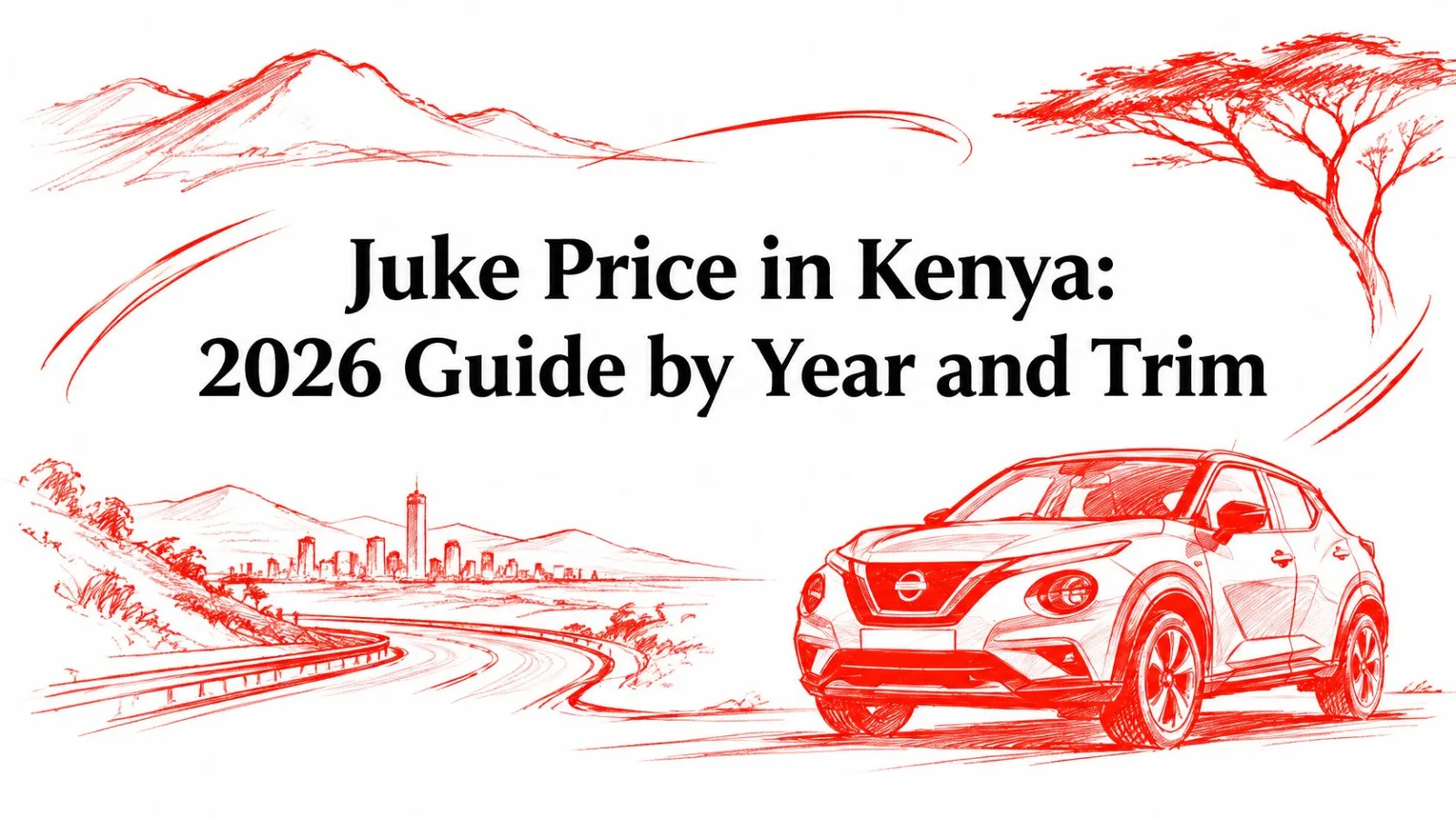
Many buyers shop Juke adverts by sticker price. That habit burns money in Kenya.
Our budgeting estimate puts older locally used Jukes at about KSh 850,000 to KSh 1,150,000, with newer direct-import cost estimates reaching KSh 2,250,000 to KSh 2,800,000. See the Section 1 table for the full bands by model year and supply route. Model year, import status and mileage move the figure within those bands.
The cheapest advertised car often costs more once eligibility is settled. Start with supply route, not appearance. A locally registered car, an already-cleared foreign-used car and a car still overseas carry different taxes, documents and risks.
Juke Price Ranges by Model Year and Supply Route
The cheapest advert often becomes the most expensive mistake. A low overseas price means nothing if the car cannot clear and transfer in Kenya, while a higher locally registered price can include the duties, documents and repairs you would otherwise pay separately. Use the bands below as this publisher's observed budgeting ranges for asking prices, not as confirmed sales data or a promise of what you will pay.
| Model year band | Supply route | Indicative price (KSh) | Main price driver |
|---|---|---|---|
| 2010 to 2012 | Locally used | 850,000 to 1,150,000 | Mileage and accident history |
| 2013 to 2015 | Locally used | 1,100,000 to 1,650,000 | Trim, engine size and service record |
| 2015 to 2016 | Foreign used, already cleared | 1,500,000 to 1,900,000 | Import documents and landed cost |
| 2017 to 2019 | Foreign used, already cleared | 1,800,000 to 2,300,000 | Age, mileage and engine specification |
| 2020 to 2023 | Direct import | 1,800,000 to 2,800,000 | Full landed cost, confirm per unit |
| 2024 to 2026 | Direct import | 2,250,000 to 2,800,000 | Full landed cost including taxes, port and clearing |
Treat the direct import figures as starting points for a vehicle specific landed quote. Confirm model year, specification, freight, duty, port charges and clearing before you compare an unshipped car with registered stock.
What moves a car within its band
For the oldest locally used cars, condition sets the value. Ask for maintenance invoices before accepting high mileage. Walk away from accident repairs, skipped servicing and unexplained gearbox behaviour that erase the apparent saving. Paint can hide neglect.
The next locally used band needs closer checks on specification. Record the engine, transmission and trim before comparing two adverts. Price wheels, screens and fresh upholstery separately from mechanical health, and pay a premium only when the engine, gearbox and suspension test well.
Already cleared foreign used cars need document checks first. The seller has paid freight and duty, so request the clearance papers, registration details and mileage record. Foreign used status gives no guarantee of accident free history or original mileage.
Compare equivalent specifications
Trim names alone mislead. Test air conditioning, cameras, electric accessories and driver assistance features, then decide if you want to maintain them. Petrol, turbocharged and hybrid versions carry different parts costs and fuel use, so price them as separate cars.
Some engines and trims appear only in certain years. Identify the exact unit first, then judge whether its asking price fits its supply route.
Budgeting rule: Compare cars with the same supply status first, then adjust for condition, mileage and specification.
Brill Motors sells both foreign-used and locally used cars. Use current Nissan listings for live prices, and use the bands to frame questions rather than settle the valuation. For help deciding if a compact crossover suits your use, read our SUV buying guide alongside these Juke bands.
Import Eligibility and Landed Cost
Eligibility comes before price. A cheap Juke overseas has no useful purchase value to a Kenyan buyer if it cannot legally enter the country.
The KRA motor vehicle import procedures require right-hand-drive vehicles that meet Kenya's inspection standards and are less than eight years old under the applicable registration or manufacture reference; for 2026, the general eligibility guide is first registration from 2019 onward. Confirm the exact cut-off and treatment of the particular vehicle with KRA before paying a deposit.
An older Juke already registered in Kenya can be bought and driven here. That says nothing about whether you can ship in another Juke of the same age.
Clear the eligibility gate
Use this short import check before discussing shipping:
- First registration: Read the export papers rather than relying on the advert's model-year description.
- Steering position: Confirm right-hand drive on the actual vehicle, using clear photographs and the inspection record.
- Pre-shipment inspection: Obtain the relevant conformity and inspection documents before authorising shipment.
- Engine capacity: Match the stated capacity to the vehicle documents and proposed customs assessment.
A rejected car can leave you with shipping, handling and return costs without a usable vehicle in Kenya. An assurance that clearance will be sorted out later is not an acceptable substitute for eligibility evidence. Ask for the chassis number early so the eligibility discussion concerns a specific car. A generic quotation for a Juke does not establish whether the vehicle eventually allocated to you meets the requirements.
Understand the customs calculation
Customs value is set by KRA's assessment, which can differ from the seller's invoice. A low purchase invoice does not automatically produce a proportionately low tax bill.
The KRA guide to importing a motor vehicle states import duty of 25%, excise duty of 20% for engines of 1,500 cc and below or 25% above 1,500 cc, and VAT of 16% on customs value plus import duty and excise duty. Using those stated rates, the illustration below starts with a customs value of KSh 1,000,000 and reaches KSh 1,740,000 before other charges.
| Cost item | Rate or basis | Amount (KSh) |
|---|---|---|
| Customs value (CIF) | Illustration base | 1,000,000 |
| Import duty | 25% of customs value | 250,000 |
| Excise duty | 20% for 1,500 cc and below, applied to customs value plus import duty | 250,000 |
| VAT | 16% of customs value plus duty and excise | 240,000 |
| Subtotal before other charges | Sum of the above | 1,740,000 |
| Port, clearing, storage, transport and registration | Itemised vehicle-specific quotations | Obtain written amounts before payment |
The excise calculation deserves attention. It is not just the stated rate multiplied by the original customs value. Its assessment base includes import duty, which is why adding the headline percentages together gives a misleading result.
This is an illustration using the rates stated in that KRA guide, not a current customs quotation. Confirm current rates, valuation and applicable rules with KRA or a licensed clearing agent. Budget separately for the Railway Development Levy, Import Declaration Fee and any other applicable charges.
Compare the final payable amount
Request a written landed-cost breakdown that distinguishes the vehicle payment, freight, taxes, clearing, port costs, registration and delivery. Establish which charges are fixed, which remain estimates and who pays if storage accrues.
A supplier price and a Nairobi handover price are not comparable until both include the costs needed to put the car legally in your name.
A locally used car avoids a fresh import process, although its condition may require more attention. A cleared foreign-used car has already absorbed import costs, so its price does not represent dealer margin alone. Keep a contingency outside the purchase payment rather than committing your entire budget to shipment. Exchange-rate changes, assessment differences and delays can alter the final amount. I recommend buyers weigh the full landed figure first, because that determines the cost, and our guide to imported cars in Kenya helps frame the choice between importing and buying already-cleared stock.
Engines, Fuel Economy and Running Costs
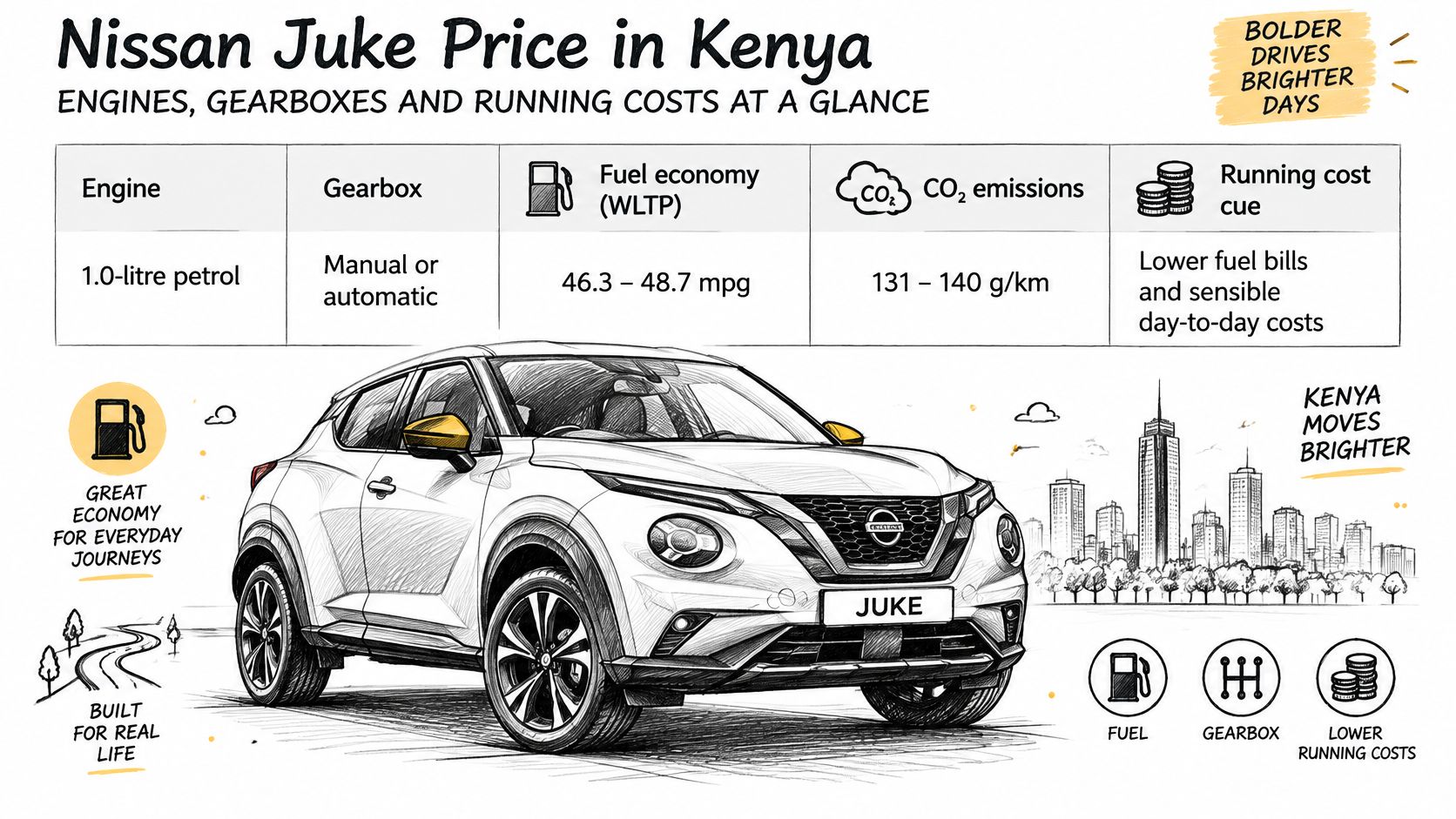
| Engine and transmission | Fuel economy (WLTP) | CO2 emissions |
|---|---|---|
| 1.0-litre petrol, manual or automatic | 46.3 to 48.7 mpg | 131 to 140 g/km |
| Hybrid | Up to 19% more efficient than petrol automatic | Confirm exact specification |
| 1.5-litre petrol (1,498 cc), older models | No verified figure stated here | No verified figure stated here |
Nissan's current Juke specifications give the petrol figures of 46.3 to 48.7 mpg WLTP and approximately 131 to 140 g/km CO2, and describe the hybrid as up to 19% more efficient than the petrol automatic. Those are manufacturer test figures for the relevant specifications, not a promise for an older Kenyan-market car.
Translate test figures into your commute
Say your drive involves queuing along Thika Road, repeated acceleration between junctions and air-conditioning throughout. The engine can consume fuel while you're barely covering distance, so you shouldn't budget around achieving laboratory economy in that journey.
There isn't an honest numerical commuting calculation without knowing your route, distance, actual consumption and fuel price. Record distance travelled and fuel added over repeated full-tank refills instead of relying entirely on the dashboard display. That gives you a useful ownership baseline.
Tyre pressure, dragging brakes, neglected servicing and aggressive acceleration can all increase consumption. Correct those issues before concluding that the engine itself is unsuitable.
Look beyond fuel consumption
Identify the engine and gearbox before comparing running costs. An advert that says automatic doesn't tell you whether the car uses a CVT, dual-clutch transmission or another arrangement. Confirm the specification from the vehicle records and have the actual installation checked if anything is unclear.
Ask a mechanic to price routine filters, plugs, fluids and brake components against the exact chassis and engine. Parts availability should be checked locally, not assumed from the model badge. Follow the maintenance schedule for that powertrain, especially its specified transmission fluid and replacement requirements.
Engine capacity also affects the customs treatment described by KRA, while additional powertrain complexity changes what a proper inspection must cover. For a hybrid, include battery-condition diagnostics rather than judging it only by how it moves.
Our hybrid car buying guide offers further context if you're weighing fuel savings against purchase price and maintenance needs.
Common Faults That Move the Price
The faults below are inspection targets where the relevant equipment is fitted. Treat them as pricing signals for that specific car, because a cheap older example that cannot clear or cannot be repaired economically is the worst buy regardless of the asking price band.
| Fault | Symptom to notice | Effect on price |
|---|---|---|
| CVT judder or whine | Shudder when pulling away, humming under load | Lower offer based on repair quote |
| Turbo oil leak or smoke | Oil smell, blue smoke on acceleration | Lower offer, potentially substantial |
| Dual-clutch jerking | Jerky gear changes at low speed | Lower offer based on gearbox assessment |
| Clutch wear on manual | Slipping under load, high biting point | Lower offer based on replacement cost |
| Worn suspension bushes | Knocks over bumps, uneven tyre wear | Modest discount if isolated and confirmed |
| Accident repair | Uneven panel gaps, paint mismatch | Repair-quality adjustment, reject unsafe structural work |
Gearbox behaviour with no clear cause should pause the deal. Mountings, poor running and transmission faults share symptoms, so a shudder needs a quoted cause before it gets a price adjustment. I recommend walking away when the seller cannot explain it in writing.
Smoke needs the same discipline. A mechanic should separate an external oil leak from oil burning internally, plus other causes. Pricing the car as if it only needs a seal leaves you exposed to an open-ended engine or turbo bill.
Price a diagnosed repair. Do not price a guess.
Worn bushes or a confirmed clutch replacement can sit inside the offer when the rest of the car is sound. Ask for a written quotation covering parts, labour, fluids and related work, rather than working from the cheapest component price alone. Missing invoices and patchy maintenance records add uncertainty that a cleaner file of receipts avoids, especially around gearboxes and turbos.
A discount cannot make an unsafe structural repair acceptable. Cosmetic panel work, distorted mounting points, compromised restraints and poor welding carry very different consequences, and structural faults should end the negotiation outright.
Use the viewing checklist in the next section to turn these concerns into evidence before you name a figure.
Viewing Checklist and Paperwork to Confirm
Print this checklist and take it to the viewing. Arrange to see the car before it's warmed up, and leave enough time for a meaningful road test rather than a short movement around the yard.
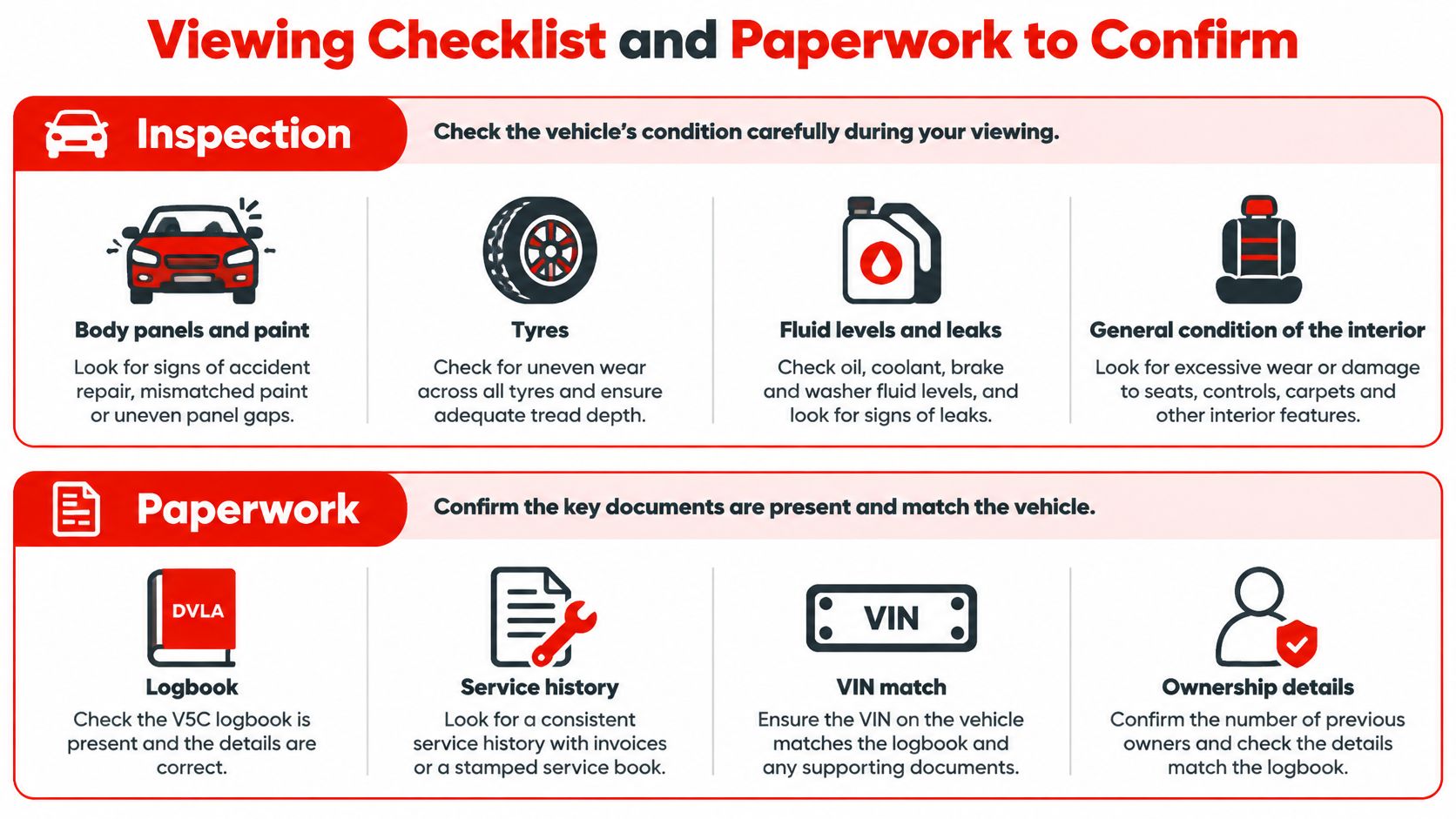
Inspection
- Body and cabin: Examine panel gaps, paint finish, overspray, interior wear and signs of accident repair.
- Tyres: Check uneven wear, sidewall damage and whether the wear pattern suggests alignment or suspension trouble.
- Fluids and leaks: Inspect levels safely, look beneath the engine and gearbox, and ask about evidence of recently cleaned leaks.
- Cold road test: Assess starting, gear engagement, steering pull and braking, then repeat relevant observations once warm.
- Transmission behaviour: Check CVT or dual-clutch response under gentle acceleration and load, where fitted.
- Dashboard warnings: Confirm warning lamps illuminate during the initial check and extinguish appropriately after starting.
- Maintenance consistency: Compare service stamps and invoices with odometer readings, dates and the vehicle's visible wear.
Paperwork
- Original logbook: Match chassis and engine numbers to the car itself, not just to a photocopy or advert.
- Seller identity: The seller's name must match the logbook; where someone acts for the owner or a business, verify their authority and the ownership chain.
- Transfer details: Confirm the relevant KRA PIN, transfer forms and requirements for the applicable transfer process.
- Inspection certificate: Obtain and verify it where applicable.
- Foreign-used clearance: Check customs clearance receipts and supporting import documents against the vehicle identity.
- Ownership history: Ask for records explaining previous ownership and any gaps in the paperwork.
The logbook establishes the recorded vehicle identity and owner. Transfer details help establish whether the transaction can proceed, while customs records support the claimed import status. Service records serve a different purpose: they help you judge whether the mileage and maintenance story are credible.
Confirm registration and transfer details with NTSA, and tax or clearance documents with KRA, where relevant. Don't treat a seller's screenshot as independent verification.
A complete document set is part of the value you're buying. Missing supporting records can justify a lower offer, but unresolved ownership or clearance isn't merely a bargaining point. Don't pay until the seller resolves it.
Negotiate Your Price and Visit Brill Motors
Start from a total ownership budget, not from the asking price on the screen. Set the maximum you can commit and hold back a clear reserve for immediate servicing, insurance and normal running expenses. That reserve decides whether a Juke is affordable for you.
An opening offer below asking needs a reason tied to the car. Documented faults, mileage without supporting records and overdue service carry weight. A claim that another car looked cheaper online does not, unless condition, specification and supply status match.
Put the decision in the right order
- Choose the car category. Fix your preferred model-year band and supply route before you compare individual cars.
- Establish the payable total. Confirm what is already settled in a cleared-car price and what is still payable on an import route.
- Set your walk-away figure. Price the immediate work the car needs, plus your ownership reserve, then stop there.
- Compare current asking prices. Match like for like on condition and specification, rather than using a single headline Juke price in Kenya.
- Agree the transaction conditions. Settle logbook, ownership and eligibility questions before any deposit changes hands.
Pressure to commit quickly is a signal to slow down. Ask for time to check the numbers, and measure any repair allowance against a written scope of work. Where the seller disputes your figure, narrow the gap by comparing parts and labour lines, not by trading opinions.
Use your current car sensibly
Brill Motors has a showroom at Garden City Mall in Nairobi where you can view vehicles in person. If you already own a car, ask about a valuation, selling it or using it as a trade-in towards your next purchase. We buy trade-in vehicles from customers.
Price the trade-in and the replacement separately so the balance is clear. A strong allowance on your old car means little if the replacement is overpriced or needs major work.
You can contact us by phone or WhatsApp on +254 758 243 058 to discuss a viewing. Confirm availability before travelling, and bring the vehicle details and questions that matter to your budget.
Brill Motors offers locally used and foreign-used cars, showroom viewing, vehicle valuations and trade-ins to help you assess your next purchase. View current stock at Brill Motors, or visit our showroom at Garden City Mall in Nairobi to discuss a Juke that fits your budget.