


 SIGN UP
A workable car under KSh 500,000 in 2026 is usually a locally used 1.0 to 1.3 litre hatchback from the late 2000s or early 2010s, not a newly imported car or an SUV. That's the opposite of the popular advice to chase the biggest body or the shiniest import advert for the money, and following that advice is how buyers end up with a tired 2.0 litre car, bald tyres and no cash left for transfer, insurance or the first repair. Buy small, buy locally registered, and protect a repair reserve. That's how second hand cars in Kenya under 500k make sense.
Second Hand Cars That Fit Under KSh 500000
Start with six names and ignore the rest until you've seen these in person. The honest field is Toyota Passo, Toyota Vitz, Nissan March, Mazda Demio, Suzuki Alto and Honda Fit, all locally used, all old enough that condition matters more than trim. If you're browsing broadly first, our guide to affordable cars for sale in Kenya puts this budget in context, but for KSh 500,000 you should narrow fast.
These guide bands aren't live prices. They're the range where a plausible car, not a wreck and not a fantasy, usually sits. Check current stock at Brill Motors for what's available this week.
| Model | Fuel use |
|---|---|
| Toyota Passo | 16 to 18 km/L |
| Toyota Vitz | 15 to 17 km/L |
| Nissan March | 14 to 16 km/L |
| Mazda Demio | 14 to 16 km/L |
| Suzuki Alto | 18 to 22 km/L |
| Honda Fit | 14 to 16 km/L |
The six cars worth viewing
- Toyota Passo, about 2006 to 2012, 1,000 cc petrol automatic: Expect roughly 140,000 to 250,000 km and a guide asking range pressed against the ceiling, often KSh 420,000 to 500,000. Watch for CVT shudder on take off. Browse Toyota cars at Brill Motors for current examples.
- Toyota Vitz, about 2005 to 2011, 1.0 or 1.3 petrol: Similar kilometres, similar money, often KSh 430,000 to 500,000 for a tidy one. Check worn suspension and, on the 1.3, oil use between services.
- Nissan March, about 2005 to 2012, 1.2 petrol: Usually KSh 320,000 to 460,000, which leaves useful reserve cash. The same CVT shudder warning applies. See Nissan cars at Brill Motors.
- Mazda Demio, about 2007 to 2013, 1.3 petrol: Often KSh 380,000 to 500,000, drives better than most here, but check engine mounts and weak air conditioning. See Mazda cars at Brill Motors.
- Suzuki Alto, about 2009 to 2015, 660 cc or 1.0: More often below the cap, roughly KSh 320,000 to 450,000. Accept highway noise, light bodywork and slow overtaking. See Suzuki cars at Brill Motors.
- Honda Fit, about 2004 to 2009, 1.3: The oldest metal here, roughly KSh 340,000 to 480,000, with the best boot trick. Check ignition coils and rust around arches and sills. See Honda cars at Brill Motors.
That spread exists because Kenya's market is built on used imports that later become locally used stock. According to Kenya Revenue Authority information, imported used vehicles make up approximately 80% of the country's annual vehicle imports, and Kenya imports about 70,000 to 80,000 vehicles each year, including both new and used units. That flow explains why older Japanese hatchbacks are everywhere, but it doesn't mean they're all under KSh 500,000. Year, mileage, duty already paid, condition and engine size separate a KSh 380,000 Alto from a KSh 490,000 Vitz.
Treat any 2.0 litre SUV advertised well under this cap as a condition or paperwork risk until you've proved otherwise on a ramp and in the logbook.
Prados, Foresters and late model saloons don't fall out of this search because they're bad cars. They fall out because a sound one costs more, and a cheap one usually needs the difference spent on a gearbox, suspension or accident repair. If the advert promises big car comfort at hatchback money, ask what the seller isn't showing you. Then go back to the six above and buy the best kept example, not the largest badge.
Why Fresh Imports Rarely Fit This Budget
The age rule decides this before price does. Kenya applies an eight year limit to imported used vehicles, and in 2026 that pushes a normally cleared used import to about 2019 first registration onward. A Passo, Vitz, Demio or Fit of that age, once duty, freight and margin are added, sits well above KSh 500,000. The cars under the cap are therefore already registered in Kenya.
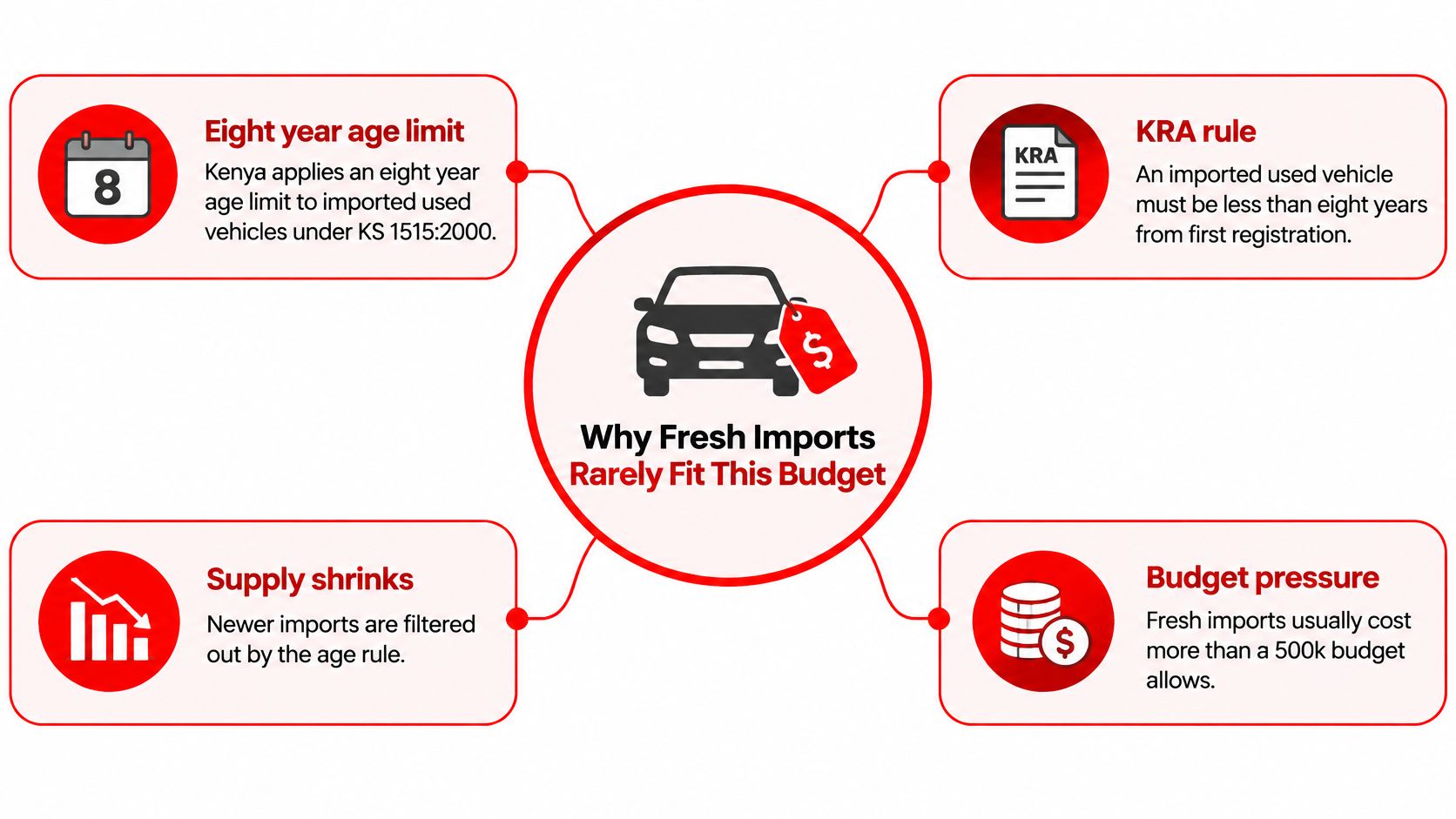
The KRA import procedures for motor vehicles state that imported vehicles must be less than eight years old from the year of first registration and must undergo roadworthiness inspection by a KEBS appointed agent before clearance, under KS 1515:2000. Older, cheaper cars can't legally enter through the normal process because a buyer wants one. That's a supply constraint, not a dealer excuse.
Three labels you must separate
Locally used means a Kenyan logbook and a Kenyan service life. That's your market. Paint may be faded and the service book may be a folder of receipts, but the car exists here, can be test driven cold, and can be transferred if the paperwork is clean.
Foreign used means the car was imported as a used vehicle and may present with cleaner paint and a shorter local history. Don't treat a foreign used advert under KSh 500,000 as a bargain until the first registration year and clearance status are confirmed. Clean paint doesn't pay duty.
In transit means not yet cleared. The headline price isn't the cost to drive away, and you shouldn't fund somebody else's clearance risk with a deposit. If you want the wider picture, read our notes on imported cars for sale in Kenya, then come back to the domestic logbook market for this budget.
Engine size also changes the tax bill on an import, so don't accept a verbal landed figure. Confirm the current assessment with KRA or a licensed clearing agent before you treat any import price as final. Rates and assessments change, and a seller's estimate isn't an assessment.
Practical rule: In 2026, if it's genuinely fresh through the normal import route, it almost certainly isn't a KSh 500,000 car. If it's under KSh 500,000, expect a Kenyan logbook.
Shop accordingly. Spend your viewing time on registered cars you can start cold, put on a lift and transfer. Treat KSh 500,000 as an all in ceiling, not a sticker price, because the import route won't rescue a budget that has already spent every shilling on the advert.
Fuel Economy Reliability and Repair Bills
The winning car is the one whose first year you can fund. If your ceiling is KSh 500,000, aim to leave about KSh 70,000 to 120,000 after the negotiated price for transfer, insurance, tyres if tread is marginal, fluids, a battery and one immediate repair. That sounds cautious until you price four tyres and a set of front shocks in the same month.
A KSh 490,000 car with bald tyres and a slipping gearbox will cost more in year one than a KSh 430,000 Alto that only needs a service. Buyers who spend the whole budget on the sticker then borrow for repairs at the worst possible moment, when the car is already off the road. Don't do that. Keep the reserve in cash and separate from the purchase money.
Match the car to the job
For city fuel use and light duty, choose an Alto or Passo 1.0. You'll accept weak overtaking, a busy engine at speed and a noisy cabin on Thika Road. In return you get the lowest fuel and tyre bills here, which is what matters for a school run, station run or short commute.
For parts and workshops, choose a Vitz or Passo. Toyota consumables, filters, pads, mounts and second hand trim are easy to find in Nairobi, and almost any competent workshop knows these engines. Sellers know that too, which is why tidy examples sit near the cap. Pay for condition, not for the badge alone.
For people and boot space, choose an older Honda Fit, or a Nissan Note only if one sits inside the cap after reserve. You'll accept older metal and more rust checking. If you regularly carry adults in the back or fold seats for boxes, that space is worth more than a slightly newer dashboard.
Worked fuel and service planning
Use planning figures, not promises. Say you cover about 1,000 km a month. A 1.0 litre car returning 16 to 18 km/L in mixed town use burns far less fuel than a tired 1.5 returning 11 to 13 km/L, month after month. That difference pays for servicing over a year, while the larger car gives you little extra if most trips are short and loaded lightly.
Budget a normal service at roughly KSh 5,000 to 15,000 if nothing is worn, covering oil, filters and checks. Third party insurance on these old cars is often a few thousand shillings a year, while full cover may not be offered or may cost more than the car justifies. Confirm transfer with NTSA and insurance options with a licensed insurer regulated through the Insurance Regulatory Authority before you commit, because quotes depend on the car and driver.
Don't stretch into a tired 1.8 or 2.0 litre saloon for image. A head gasket, automatic gearbox repair or full suspension refresh can pass KSh 80,000 and wipe out the reserve in one invoice.
Pick the smallest reliable car that does the weekly trip well. If it can't overtake quickly, leave earlier. If it uses little fuel, starts every morning and leaves KSh 80,000 untouched after purchase, it's the cheaper car to own even if the advert price looked higher than a rough alternative.
Mileage and Condition You Should Expect
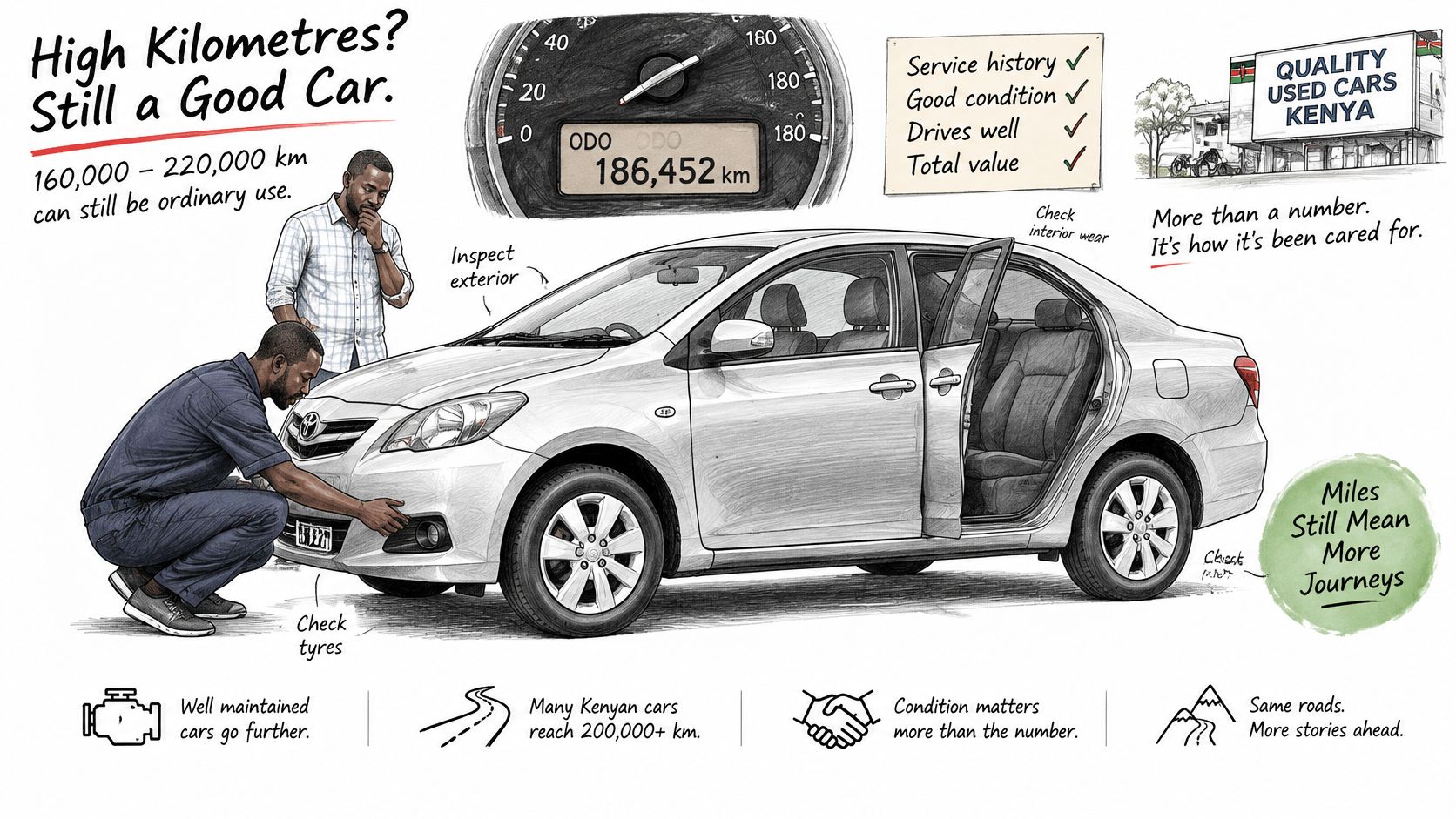
For these model years, 160,000 to 220,000 km is ordinary Kenyan use, not a scandal. A 2009 hatchback that has done a normal commute for years should show that sort of figure. Judge the number with the body, gearbox and receipts, because mileage alone tells you very little about whether the car was serviced or abused.
Under about 120,000 km on a 2008 car deserves a harder look. Check whether the cluster looks disturbed, whether service stickers and receipts follow a believable sequence, and whether pedal rubbers, seat bolsters and the steering wheel match the claim. Clocking is a known risk at this price, and a low number is easy to sell. Over about 250,000 km can still be fine on a Vitz or Passo if history is continuous and the test drive is quiet, but budget for a clutch on a manual or proper CVT attention on an automatic. For Vitz specific pricing context, see Vitz price in Kenya.
Paint and interior tell the truth
Nairobi sun fade, stone chips from Thika Road and small car park marks are normal. Bubbling arches, a wavy boot floor, overspray on window rubbers, mismatched panel bolts and uneven gaps point to crash repair. On a cheap car, poor crash repair often hides bent mounts, water leaks and alignment problems that cost more than the discount saves.
Inside, a sagging driver seat bolster and a shiny steering wheel match high kilometres. A showroom fresh cabin in a tired, high mileage shell doesn't, unless seats and trim have been swapped. Neither proves the car is good or bad by itself, but mismatch means you slow down and ask for evidence instead of compliments.
Mechanically, expect tired shocks, a brief noisy cold start that settles, and air conditioning that may be weak. Don't accept a CVT that hesitates, flares between ratios or shudders as you pull away in a Passo, March or similar automatic. That's a walk away fault, or it needs a price cut large enough to fund specialist work running to tens of thousands of shillings. A manual car, if you can drive one happily in traffic, is simpler to judge and usually cheaper to put right.
Two cars, two decisions
Say you view a Passo at KSh 460,000 showing 190,000 km. Panel gaps are even, four matching tyres sit above the wear bars, the cold start is clean, the CVT pulls without shudder and the logbook is in the seller's name. That's a fair car. Negotiate on small jobs, keep your reserve, and buy it if the numbers match.
Contrast a car at KSh 390,000 claiming 98,000 km, with fresh paint down one side, a replacement looking seat, two different front tyres and a gearbox flare on the first hill. That's not a bargain waiting for polish. It's an unsafe or at least expensive project wearing a low price. Leave it, even if the seller drops another KSh 20,000 while you walk.
Score every viewing as fair, tired or unsafe before you talk money. Fair cars can be negotiated. Tired cars need a priced list of jobs. Unsafe cars, clocked cars and cars with structural repair you can't measure should end the visit, whatever the sticker says.
Checks Before You Pay Any Deposit
Do the viewing in this order and don't pay a deposit halfway through because the seller says another buyer is coming. There are plenty of old hatchbacks in Nairobi. There aren't plenty of clean ones, which is exactly why the routine matters.
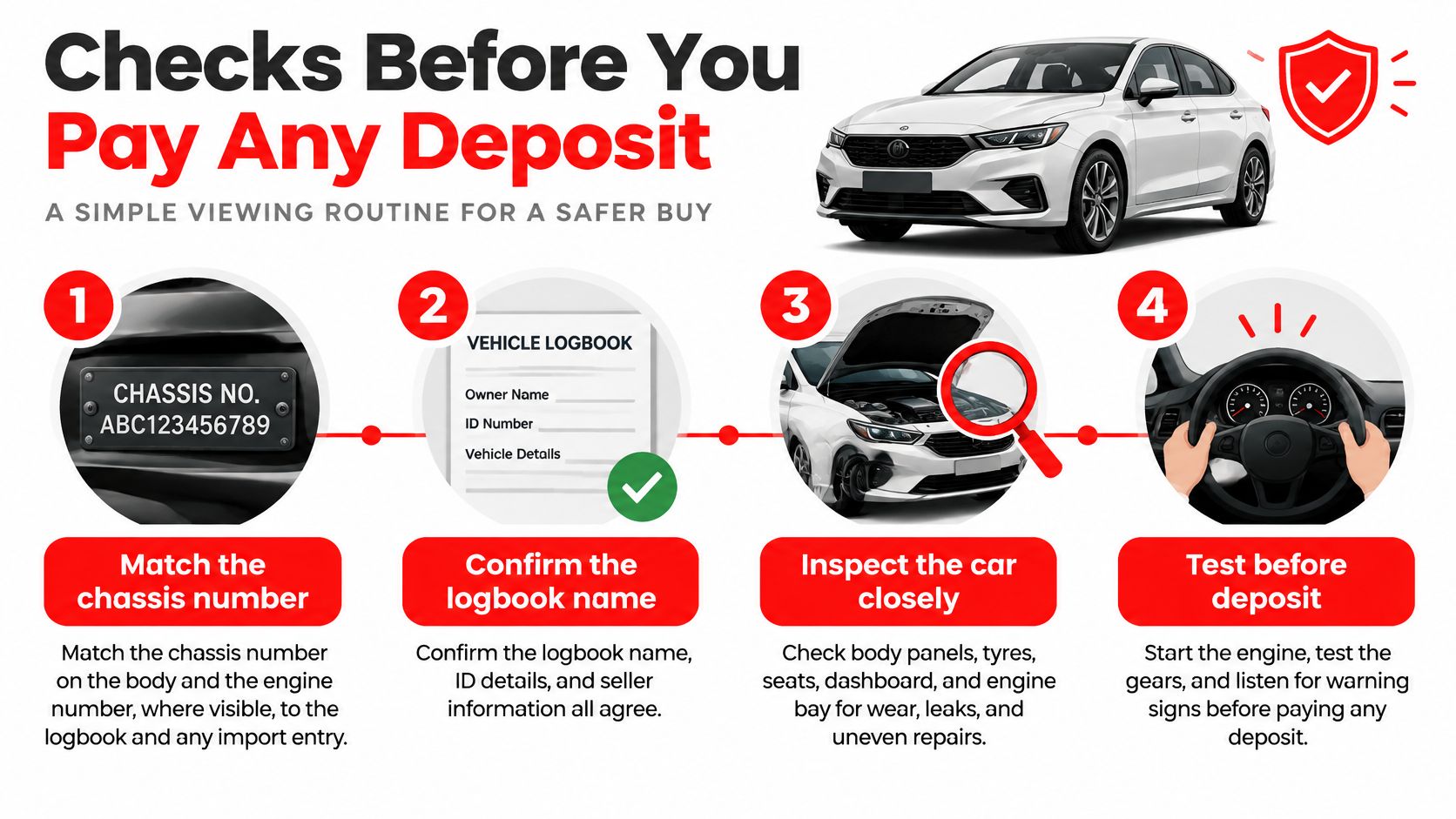
The one viewing routine
- Match the chassis number: Compare the number on the body, and the engine number where visible, with the logbook and any import entry. One digit wrong stops payment until it's explained in documents, not conversation.
- Confirm the logbook name: Check the seller's name, ID and KRA PIN path for transfer, and ask directly whether any loan flag sits on the car that the seller can't clear before transfer.
- Ask for first registration year: If the seller calls it a fresh import, the age and inspection rules still apply and the papers should be ones that can be validated. Vague answers here are a stop sign.
- Cold start, then drive for 15 minutes: Include a bump, a hill and slow creep in drive. Listen for CVT shudder, clutch slip, knocking suspension and steering that pulls or has play.
- Check brakes, handbrake, lights and tyres: Include the spare. Uneven tyre wear points to alignment or suspension wear you're about to buy.
- Look underneath: A wet sump, leaking radiator, rusted sills or a rotten subframe change the price completely, and structural rust can end the deal.
- Run air conditioning and watch temperature: Weak cooling may be a negotiable job. A temperature gauge that keeps climbing in traffic isn't.
- Price visible faults before discussing the sticker: Write figures next to tyres, battery, shocks, brakes and leaks while you're still standing by the car.
These aren't cosmetic preferences. KEBS road vehicle code DKS 1515 says all imported road vehicles must be inspected in inspection centres approved by the relevant government authority, and passenger vehicles more than eight years old from their year of first registration are not allowed for importation. Ask for evidence of the applicable inspection history where it applies, and use NTSA for transfer questions, KEBS for inspection rules and KRA for tax identity questions.
Missing papers aren't a small admin issue. They can block inspection, registration, transfer or a later resale, and you'll own the problem once you've paid.
Pay a deposit only after the numbers match, the logbook route is clear and the test drive is done. View in person rather than paying on photos alone, because photos hide overspray, tyre dates, warning lights and the smell of hot coolant. If a seller refuses a cold start, won't show the logbook or pressures you to pay before a drive, walk away that day. A clean seller expects these checks.
How to Negotiate With a Repair Reserve
Start from a walk away number, not the advert. If your all in ceiling is KSh 500,000, set aside transfer, insurance and the first likely jobs first. What's left is the most the car itself can cost before you price any mechanical fault. Write that figure down before you arrive, because it's easy to forget arithmetic beside a freshly washed car.
Build the offer from faults you can see
- List each job: Worn front tyres, weak battery, front shocks, a weeping radiator, brake pads, a CVT service. Keep paint wishes off the list.
- Get rough workshop prices: Call a Nairobi workshop you trust and price parts and labour. Rough is fine, guessed while smiling at the seller isn't.
- Add the jobs up: Ask for that total off the price, or ask the seller to fix the jobs properly before payment. Choose one route, not both.
- Refuse repair promises after full payment: Once the balance has moved, your negotiating power has moved with it. Fixes happen before, or money stays with you.
- Put any deposit in writing: Record the chassis number, agreed figure, what's included, the balance and when transfer happens. Complete the balance at transfer, not on trust.
Say a Demio is advertised at KSh 470,000 and needs two front tyres, a battery and front shocks you price at KSh 55,000 in total. Your sensible offer is around KSh 415,000, or KSh 470,000 only if the seller completes those jobs with receipts before transfer. If the seller offers KSh 10,000 off and a polish, thank him and leave. Polish doesn't stop a car bouncing through a pothole.
If you want finance, Brill Motors can explain its financing options, but don't assume approval on an older, low value car or build a negotiation around money you haven't secured. Cash discipline matters more at this end of the market. A loan on a car that still needs KSh 70,000 of work leaves you paying monthly for a car parked at a workshop.
Be ready to leave. At this price there are many tired examples and sellers test whether you'll fund their deferred maintenance. A seller who refuses a cold start, a look underneath or a logbook check ends the talk without an argument. The discount is only real if the repair reserve is still in your pocket after transfer, insurance and the first service are paid.
View Current Stock at Garden City Mall
Use the shortlist to view cars, not to fall in love with photographs. Browse current used stock at Brill Motors, confirm the live price on the car's own page, and remember the guide ranges here aren't offers. Stock changes, and a car that fits on Monday may be sold by Friday. One relevant example from our listings is a 2008 Toyota Passo Hatchback, locally used, 1,000 cc petrol automatic, listed at KSh 490,000, which shows exactly why you must still ask whether transfer and first jobs fit your own ceiling.
Brill Motors has a showroom at Garden City Mall in Nairobi where you can view vehicles in person, at the rooftop car yard on Thika Road. That's where you check paint in daylight, read tyre sidewalls, feel seat bolsters and insist on a cold start. You can't judge CVT creep, a hot restart or a pulling steering wheel from a phone screen.
We also offer financing, vehicle valuation, trade ins and a service for selling your car. If you're replacing a current vehicle, a valuation helps you set a real budget instead of hoping a private sale completes on time. If you're a first time buyer, bring your reserve calculation and your fault list, and ask us to walk the car with you against it.
You can reach us by phone or WhatsApp at +254 758 243 058 before you travel, so you don't waste a trip on a car that has just sold. Ask whether the logbook is available to inspect, whether the car can be started cold on arrival, and what the live price is that day.
The useful question on arrival isn't which sticker is lowest. It's whether the logbook, the test drive and your repair reserve still fit inside KSh 500,000 together. If they do, you've found your car. If they don't, keep the cash and view the next one.
Check current stock now at Brill Motors, shortlist a locally used Passo, Vitz, March, Demio, Alto or Fit that leaves you a real repair reserve, then visit our Garden City Mall rooftop yard on Thika Road to inspect the logbook, start it cold and test drive it before paying any deposit.